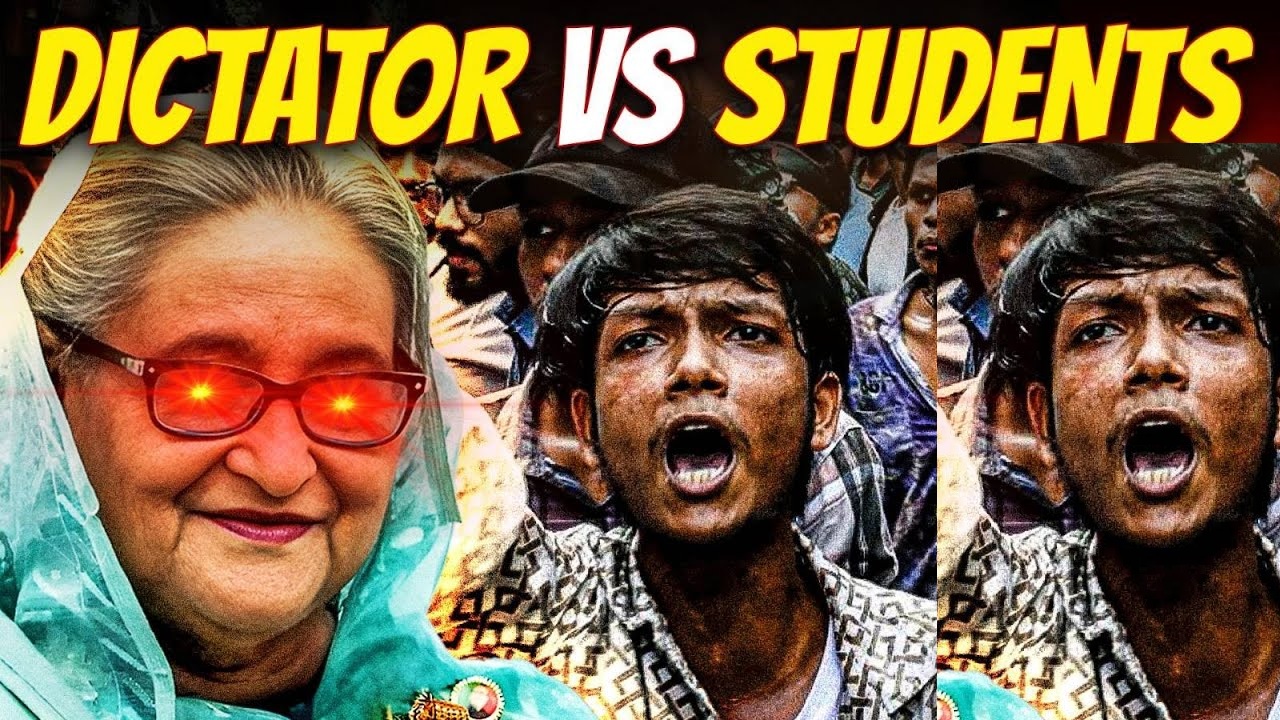
In recent weeks, the student protests in Bangladesh have drawn international attention due to the government’s brutal crackdown on demonstrators. The situation escalated when police forces, supported by special forces and even the army, were deployed to suppress the protests. The government, led by Sheikh Hasina, has taken drastic measures, including lethal force, to quell the unrest. This article examines the root causes of the protests, the controversial quota system, and why Sheikh Hasina’s regime is being labeled as dictatorial.
The Catalyst: Student Protests and Violent Suppression
Over the past two weeks, the Bangladesh police force has brutally suppressed student protesters, using extreme measures like shooting them on the streets and running them over with vehicles. Special forces and the army have been deployed to quash the protests. These scenes resemble an anti-terror operation, but they are instead targeted at the country’s youth. Reports of this brutality are numerous and appalling, yet the full extent remains unknown due to a media blackout.
This period is being labeled as one of the darkest episodes in Bangladesh’s history. Officially, over 160 lives have been lost, with thousands injured, although these numbers are likely incomplete due to restricted information. A nationwide curfew and complete internet blackout have prevented many stories of violence from reaching the public.
A Historical Perspective: Understanding the Context
To understand the recent violence, it’s important to grasp the historical context. Bangladesh gained independence from Pakistan in 1971 following a brutal genocide against Bengalis, supported by the United States. This struggle for independence involved significant contributions from various segments of society, culminating in Bangladesh’s victory and Pakistan’s eventual withdrawal.
The Awami League, led by Sheikh Mujibur Rahman, played a pivotal role in this liberation movement. After independence, a Freedom Fighter Quota was introduced in 1972 to honor those who fought. However, subsequent governments expanded this reservation system, often for political gain rather than genuine social justice.
The Controversial Quota System
In 2018, students began protesting against the Freedom Fighter Quota, arguing that it no longer served its original purpose. They claimed the system was used by Sheikh Hasina’s government to favor loyalists, offering them government jobs under the guise of social justice. The students demanded the immediate removal of this quota, as it lacked a logical basis and did not address economic or social backwardness.
The Freedom Fighter Quota accounted for a significant 30% of government job reservations, benefiting only 0.13% of the population. Students pointed out that this quota was being misused to create a cadre of civil servants loyal to Sheikh Hasina, undermining meritocracy and fairness.
The Battle for Reforms
The Bangladesh High Court challenged the legality of the quota system in March 2018 but rejected a petition questioning its validity. This sparked widespread protests as students felt their voices were not being heard. They called for reforms that aligned with population and social justice principles, specifically targeting the Freedom Fighter Quota.
The Tragic Unfolding of Violence
In the past fortnight, Bangladesh has witnessed some of its worst violence in recent history. Reports indicate that more than 160 people have died, and thousands have been injured, although these numbers are likely incomplete due to a nationwide curfew and an internet blackout. Videos and firsthand accounts of the brutality have not yet fully emerged. This tragic chapter in Bangladesh’s history has been marked by Sheikh Hasina’s brutal attempts to stifle student demands.
Despite the oppressive response, the students’ legitimate demands have started gaining recognition. The government could not completely ignore the widespread protests, demonstrating the power of unified student voices.
Understanding the Roots of the Unrest
To comprehend the current unrest, we must explore the historical context that has led to this point. Bangladesh gained independence from Pakistan in 1971, following a horrific genocide perpetrated by the Pakistani army with American support. Over 3 million Bengalis lost their lives during this struggle. The Awami League, led by Sheikh Mujibur Rahman, played a pivotal role in this freedom struggle, introducing the Freedom Fighter Quota in 1972.
This quota system, originally designed to honor freedom fighters, expanded over time, incorporating social justice aspects. However, by 2018, many students began protesting against the 30% Freedom Fighter Quota. They argued that the quota was outdated and misused, serving as a tool for political patronage rather than genuine social justice.
The Quota System Controversy
The student protests primarily target the 30% Freedom Fighter Quota, not the entire reservation system. Students argue that the quota has been extended unnecessarily to the children and grandchildren of freedom fighters, lacking a constitutional basis and serving political interests instead. Currently, only 0.13% of the population holds the status of official freedom fighter descendants, yet they enjoy 30% of the reserved positions in government jobs. This discrepancy has fueled anger and calls for reform.
In 2018, the Bangladesh High Court rejected a petition challenging the quota system’s legality. The students took to the streets, demanding reform and the abolition of the Freedom Fighter Quota. In response, Sheikh Hasina issued an executive order canceling the entire quota system, which led to protests and discussions. By 2020, the order was implemented, removing the quota system altogether. However, political maneuvering soon followed, resulting in the reintroduction of the quota.
Political Dynamics and Dictatorial Rule
Sheikh Hasina’s regime has faced widespread criticism for its authoritarian rule. In the January 2024 elections, her party, the Awami League, secured a historic victory, with opposition parties boycotting the election. International watchdogs, such as Transparency International, labeled the elections as fraudulent and one-sided, with opposition leaders facing arrests and media outlets silenced.
The Awami League’s control over various institutions, including the judiciary and law enforcement, has fueled accusations of dictatorial governance. The High Court’s decision to reintroduce the quota system was seen as a move aligned with Sheikh Hasina’s interests, further eroding public trust.
Student Protests Intensify
The student protests gained momentum as the High Court’s decision to reinstate the quota system was perceived as orchestrated by Sheikh Hasina. Students believe the judiciary is acting on her orders to reinforce political patronage. By July 1, student protests intensified, with calls for systemic reform and accountability.
Sheikh Hasina’s government responded with force, labeling the protesters as anti-national and deploying police and pro-government student wings to suppress dissent. Reports indicate that violent clashes occurred, resulting in numerous casualties. Despite the violence, the students remained resilient, organizing large-scale rallies and demonstrations.
The Role of the Internet Blackout and Censorship
On July 18, the government imposed a nationwide internet blackout and curfews to suppress the protests. The deployment of army troops further escalated the situation. The information blackout has hindered accurate reporting on the ground, making it challenging to ascertain the exact number of casualties and injuries.
Amidst the chaos, Sheikh Hasina’s government eventually bowed to some of the student demands. The Supreme Court’s decision on July 21 reduced the quota to 7%, with 5% allocated for freedom fighter descendants, 1% for ethnic minorities, and 1% for disabled and transgender individuals. However, protests continue as students demand the release of arrested protesters and accountability for those responsible for the violence.
A Call for Democratic Reform
The student protests have evolved into a broader movement advocating for democratic reform in Bangladesh. Students and civil society groups are calling for an independent election commission and caretaker government to ensure free and fair elections. Sheikh Hasina’s government has been accused of stalling reforms and using state machinery to suppress dissent.
While the immediate crisis may have subsided, the protests have highlighted the need for democratic change in Bangladesh. The students’ struggle for justice and accountability continues, and their demands for a representative quota system and democratic governance remain unresolved.
In conclusion, the Bangladesh student protests represent a pivotal moment in the country’s history. The students’ resilience and determination have challenged the status quo, demanding a more just and democratic society. As the situation unfolds, it remains to be seen whether Sheikh Hasina’s government will heed the calls for reform or continue to employ authoritarian tactics to maintain control.