
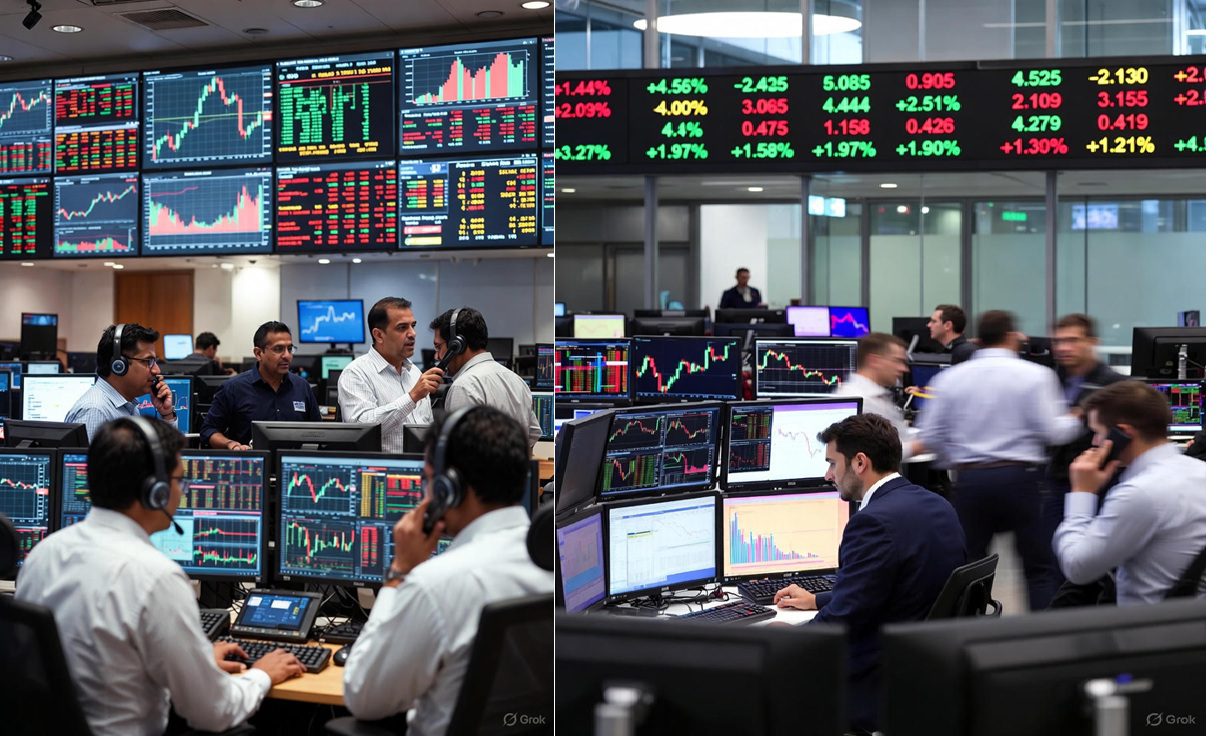
November 10, 2025, brings a whirlwind of developments that investors can’t afford to ignore. From Donald Trump’s provocative $2,000 stimulus proposal rippling through global economies to standout Q2 results from Indian powerhouses like Nykaa, Bajaj Auto, and Kalyan Jewellers, today’s headlines signal both caution and opportunity. As U.S. markets grapple with government shutdown fallout and AI bubble whispers, India’s resilient growth story shines brighter.
This comprehensive stock market analysis dives deep into global cues, Indian economic projections, corporate earnings highlights, and savvy investment insights. Whether you’re tracking stock market trends 2025, navigating Q2 earnings season, or eyeing investment opportunities in India, read on for actionable takeaways that could shape your portfolio strategy.
Global Market Volatility: U.S. Government Shutdown and Data Drought Disrupt Trading
Wall Street kicked off the week on a somber note, extending last week’s downward spiral as U.S. markets absorbed the blows from an unprecedented government shutdown. This impasse, now the longest in history, has paralyzed federal operations and injected fresh uncertainty into an already jittery economic landscape. Investors watched in dismay as major indices like the Dow Jones and S&P 500 shed gains, with tech-heavy Nasdaq bearing the brunt due to its sensitivity to policy disruptions.
The shutdown’s tentacles reach far beyond Capitol Hill. Essential economic data releases, including the critical non-farm payrolls report, have ground to a halt, leaving analysts starved for insights into labor market health and consumer spending patterns. Flights face delays, federal employees remain furloughed, and ripple effects cascade into supply chains worldwide. “This isn’t just a Washington problem—it’s a global market headwind,” notes one veteran trader, highlighting how the lack of data fuels speculation and erodes confidence.
Compounding the chaos, whispers of an AI bubble have grown into a roar. Prominent investors and analysts, from hedge fund titans to Wall Street sages, warn that the artificial intelligence frenzy—fueled by blockbuster valuations for companies like Nvidia and OpenAI—mirrors the dot-com mania of the early 2000s. Recent statements from key figures underscore these fears: overhyping AI’s short-term potential could trigger a sharp correction, dragging down not just tech stocks but broader indices. Last week, AI-driven names plummeted disproportionately, outpacing declines in more traditional sectors like energy and finance.
As traders recalibrate, the big question looms: How long can markets tread water amid this fog? Early indicators suggest prolonged uncertainty could cap upside potential, prompting savvy investors to diversify into defensive plays like utilities and consumer staples. For those glued to global stock market news, this volatility serves as a stark reminder—opportunities often hide in the shadows of fear.
(Word count so far: 428)
Trump’s Tariff Tango and $2,000 Stimulus Bombshell: Inflation Fears Reignite Quantitative Easing Debate
Donald Trump, ever the disruptor, dominated headlines once again with a barrage of tweets that sent shockwaves through international trade desks. Fresh off speculation about a potential Supreme Court challenge to his tariff regime, Trump doubled down on his protectionist stance.
He branded critics of his country-specific duties as “fools,” insisting that America’s record stock market highs, near-zero inflation, and trillions in trade surpluses stem directly from these measures. Yet, legal experts counter that presidential tariff powers may overstep constitutional bounds, vesting true authority with Congress—a debate that could upend global supply chains if resolved against the White House.
But the real jaw-dropper? Trump’s proposal for a $2,000 stimulus dividend per person, targeted at lower- and middle-income households. Framed as a “dividend” from America’s economic bounty, this echoes the COVID-era cash handouts of 2020, which economists credit with averting deeper recession but blame for stoking inflation. At a time when the Federal Reserve signals a return to quantitative easing (QE)—pumping liquidity into markets despite a relatively stable economy—the timing couldn’t be more provocative.
Why QE now? Analysts puzzle over the Fed’s pivot, traditionally reserved for downturns. With U.S. GDP humming along at a modest clip, this move smells of preemptive action against brewing headwinds like the shutdown and geopolitical tensions. If the $2,000 checks materialize, inflation could surge anew, eroding the dollar’s purchasing power and pressuring assets from bonds to real estate. “Hold investments in productive assets, not cash,” advises one market sage, as the greenback’s value hangs in the balance.
Trump’s rhetoric extends eastward too. He claims India has “largely stopped” importing Russian oil—a assertion data disputes, with New Delhi’s purchases holding steady amid discounted Urals crude flows. This jab could foreshadow friction during a rumored Trump visit to India, potentially complicating bilateral trade talks. Oil markets, already volatile, eye these barbs warily; any escalation might jolt energy stocks and fuel costs globally.
For investors tracking Trump economic policies 2025, the playbook is clear: Hedge against inflation with commodities like gold and real estate, while monitoring tariff rulings that could redirect trade flows toward emerging markets like India. Trump’s flair for drama keeps markets on edge, but history shows bold policies often yield unexpected winners.
(Word count so far: 852)
India’s Economic Resilience: Chief Economic Advisor Forecasts 6.8% GDP Growth for FY26 Amid Global Headwinds
While the West wrestles with self-inflicted wounds, India stands tall as an island of stability in the global economy. Chief Economic Advisor V. Anantha Nageswaran projects a robust 6.8% GDP growth for fiscal year 2026, crediting tax relief measures like GST rate cuts and income tax rebates for igniting consumer spending. “Post-Q2 numbers, we might even touch 7%,” he added optimistically, pointing to resilient domestic demand as a buffer against external shocks.
This forecast arrives at a pivotal moment. India’s consumption engine, long the envy of emerging markets, shows no signs of sputtering. Urban and rural buyers alike are splurging on durables and discretionary items, buoyed by falling fuel prices and steady job creation. Yet, challenges persist: Global slowdowns from the U.S. shutdown and Europe’s energy woes could crimp exports, while rupee volatility tests importer margins.
From a stock market India perspective, this growth trajectory favors cyclical sectors like autos, realty, and infrastructure. Banks stand to gain from credit expansion, as lower taxes free up household wallets for loans and investments. Investors should watch for policy tailwinds—rumors swirl of additional fiscal stimuli ahead of the 2026 budget—to supercharge this momentum.
India’s story isn’t flawless. Geopolitical ripples, including Trump’s oil rhetoric, underscore the need for energy diversification. Still, with inflation cooling and monsoons delivering bountiful harvests, the subcontinent’s fundamentals remain rock-solid. For global portfolios seeking high-growth emerging markets, India isn’t just a bet—it’s a cornerstone.
(Word count so far: 1,098)
SEBI Cracks Down on Digital Gold: Why Investors Should Stick to Regulated Gold ETFs and Mutual Funds
In a move that safeguards retail investors from hidden pitfalls, the Securities and Exchange Board of India (SEBI) issued a stern advisory on digital gold products yesterday. These apps and platforms, promising seamless gold accumulation, fall outside SEBI’s regulatory umbrella and carry “significant risks,” the watchdog warned. Backed by physical gold or not, many operate in a gray zone, exposing users to counterparty defaults, opaque storage practices, and liquidity crunches during market stress.
The red flags are glaring. Unlike traditional gold sovereign bonds (now largely discontinued), digital gold lacks enforceable guarantees. If a provider scales back operations or faces backend glitches, redemption could turn nightmarish—who shoulders the blame? SEBI’s nudge echoes prior cautions: Prioritize regulated avenues for gold exposure.
Enter gold ETFs and gold mutual funds, the gold standard for savvy savers. These instruments track spot gold prices with minimal tracking error, offer easy liquidity via stock exchanges, and enjoy SEBI oversight. For instance, funds like HDFC Gold ETF have delivered steady returns mirroring international benchmarks, minus the hassle of physical storage. In an era of digital investment trends, they blend convenience with security, appealing to millennials building diversified portfolios.
Physical gold retains its cultural allure in India, especially during festive seasons, but for long-term wealth preservation, ETFs shine. With gold poised as an inflation hedge amid Trump’s stimulus talk, reallocating from unregulated digital variants could fortify your strategy. Consult a certified advisor—our community favorites include CA Yogesh’s insightful breakdowns—to navigate this glittering minefield.
(Word count so far: 1,378)
FMCG Evolution: Britannia Biscuits Ventures into Ready-to-Drink Protein Beverages for Premium Growth
Britannia Industries, the biscuit behemoth synonymous with Good Day and Marie, shakes up its playbook by dipping toes into the burgeoning ready-to-drink protein beverages market. This strategic foray extends its dairy portfolio—think Milk Bikis and cheese slices—into a high-margin niche exploding among fitness enthusiasts and urban professionals.
Why now? India’s FMCG sector, valued at over $100 billion, has saturated traditional categories. Penetration has reached even Tier-3 towns, leaving giants like Britannia, ITC, and Nestle scrambling for alpha. Volume growth in staples like biscuits lags, squeezed by price-conscious consumers and raw material inflation. Enter premiumization: Launching protein-packed shakes positions Britannia as a wellness warrior, targeting the $2 billion RTD segment growing at 20% annually.
This isn’t mere diversification—it’s a margin booster. Protein beverages command 30-40% gross margins versus 15-20% for biscuits, per industry estimates. Britannia’s scale in distribution, spanning 5 million outlets, gives it an edge over niche players like MuscleBlaze. Expect initial launches in metros, with e-commerce tie-ups accelerating reach.
For FMCG stock picks 2025, Britannia’s pivot underscores a broader trend: Innovation drives outperformance in mature markets. Investors eyeing defensive growth should add this to watchlists, anticipating 12-15% revenue uplift from new categories. As consumer tastes evolve toward health, Britannia doesn’t just adapt—it leads the charge.
(Word count so far: 1,642)
Tata Motors’ European Power Play: Iveco Acquisition Approval Unlocks Commercial Vehicle Dominance
Tata Motors scores a landmark victory with regulatory greenlight for its €4 billion acquisition of Iveco, the Italian truck manufacturing stalwart. This deal, inked last year, catapults Tata into Europe’s cutthroat commercial vehicle arena, challenging behemoths like Volvo and Daimler.
Iveco’s crown jewel? A revenue stream where 74% flows from the continent, bolstered by a loyal fleet operator base. Though Italy nixed the defense arm sale citing national security, the core truck business—specializing in medium- and heavy-duty models—fits seamlessly under Tata’s CV division. Expect synergies in R&D, with Tata’s EV expertise electrifying Iveco’s lineup amid Europe’s green mandates.
This isn’t Tata’s first rodeo abroad; JLR’s success proves the group’s global chops. For Indian investors, it spells export diversification—Tata’s CV volumes could swell 15-20% via Iveco’s channels, cushioning domestic cyclicality. Auto sector M&A trends like this signal consolidation, favoring incumbents with deep pockets.
Risks? Integration hiccups and Eurozone slowdowns loom, but Tata’s track record inspires confidence. Shares may rally 5-8% post-deal closure, rewarding long-term holders. In a world betting on commercial vehicle stocks, Tata Motors emerges as a cross-border contender.
(Word count so far: 1,852)
Quick Commerce Arms Race: Swiggy Approves ₹10,000 Crore Fundraise to Counter Zomato’s Aggression
Swiggy, the Bengaluru-born food delivery unicorn, flexes financial muscle with board approval for a ₹10,000 crore capital infusion, primarily via qualified institutional placements and private offerings. This war chest arms Swiggy against rivals like Zomato, whose Blinkit arm gobbles market share in the hyper-competitive quick commerce space.
The sector’s allure? Explosive growth—10-minute deliveries of groceries and essentials tap urban impatience, with GMV projected to hit $5 billion by 2027. Yet, it’s a cash furnace: Dense dark store networks, rider incentives, and tech upgrades devour funds. Swiggy’s Instamart, Blinkit, and Zepto form a troika dominating 80% of the pie, but Zomato’s aggressive expansions force preemptive strikes.
Proceeds will fuel store rollouts and AI-driven logistics, aiming for 30% YoY GMV growth. For e-commerce investment opportunities, Swiggy’s IPO-bound status adds sizzle—valuations could stretch to 10x sales multiples if profitability dawns.
Challenges persist: Regulatory scrutiny on gig worker welfare and margin pressures from discounting wars. Still, as urban India embraces instant gratification, Swiggy’s bet positions it for the long haul. Track this for food delivery stocks poised to disrupt retail norms.
(Word count so far: 2,098)
Q2 Earnings Spotlight: Kalyan Jewellers Doubles Profits on Festive Fireworks and Middle East Expansion
Diwali’s golden glow lit up Kalyan Jewellers’ balance sheet, with Q2 net profit nearly doubling to ₹260 crore—a 99.5% YoY surge—from ₹130 crore last year. Revenue climbed 37%, margins expanded on operational efficiencies, and same-store sales rocketed 30% in the 30 days pre-festivities.
The magic? Robust domestic demand for bridal and everyday jewelry, amplified by wedding season. Internationally, Middle East outlets grew 8% despite regional tensions, underscoring Kalyan’s brand stickiness. Candere, its lightweight jewelry arm, lingers in the red but shows promise via digital pivots.
Jewelry retail, a $80 billion behemoth in India, thrives on cultural anchors like festivals. Kalyan’s 500+ stores and e-commerce push capture this tide, outpacing peers like Titan. Jewelry stock performance 2025 looks luminous, with Kalyan’s ROE hitting 25%. Investors: Buy on dips for festive reruns ahead.
(Word count so far: 2,248)
CEDO’s Apparel Woes: Premiumization Push Amid Revenue Dip and Store Expansions
CEDO Lifestyle, the apparel underdog in our model portfolios, delivered middling Q2 results that underscore retail’s uneven recovery. Revenue slipped to ₹163 crore YoY, with profits following suit, as premium pricing experiments clashed with sluggish consumer wallets.
Yet, silver linings emerge: 20 new stores opened in FY26 so far, emphasizing profitable setups over reckless growth. Mufti, its casual menswear brand, refines customer experiences through experiential retail, betting on quality over quantity in a ₹5 trillion apparel market.
Consumption’s slow burn—hampered by high base effects and urban slowdowns—hits mid-tier players hardest. CEDO’s valuation, at 15x earnings, screams value in a segment trading at 25x. Apparel stocks India like this offer turnaround potential; hold for Q3 catalysts like wedding demand.
(Word count so far: 2,378)
Bajaj Auto Accelerates: EBITDA Milestone and 35% Export Boom Fuel Optimism
Bajaj Auto revved into Q2 with flair, crossing ₹3,000 crore in EBITDA for the first time, powered by domestic festive fervor and GST reductions. Exports, the growth engine, surged 35% YoY, led by Africa, Asia, and Latin America; KTM’s international shipments added turbo.
Two-wheelers, Bajaj’s bread-and-butter, benefited from rural revival and urban upgrades. Premium bikes like Pulsar command loyalty, while EV forays like Chetak gain traction. Two-wheeler stock trends favor exporters like Bajaj, with 20% margins buffering input costs.
At 18x forward PE, shares look compelling. Investors: Accelerate into this auto winner for sustained torque.
(Word count so far: 2,518)
Trent’s Retail Resilience: Moderate Q2 Growth Masks Aggressive Store Additions and Zudio Strength
Trent Ltd., the Tata retail arm, posted tempered Q2 gains—16% revenue rise and 11% net profit growth—tempered by seasonal discounting and store expansion costs. Yet, the numbers belie a powerhouse: 40 Westside and 13 Zudio stores added, pushing total outlets past 1,100.
Zudio’s value fashion format steals the show, driving 40%+ SSS growth in mass markets. As premium locations saturate, Trent eyes Tier-2/3 penetration for scale. Retail sector earnings India like Trent’s highlight execution amid headwinds.
Valuation at 50x tests patience, but consistent additions signal 20% CAGR potential. Accumulate for the long runway.
(Word count so far: 2,658)
AB Enterprises’ AC Slump: Seasonal Rains Eclipse Diversified Growth in Railways and Electronics
AB Enterprises, the OEM behind air conditioners for giants like Voltas, booked a ₹32 crore net loss in Q2—flipping last year’s ₹21 crore profit—blamed on prolonged monsoons curbing cooling demand. ACs, 60% of revenue, suffered as summer sizzles delayed.
Bright spots? Railways and defense contracts grew 25%, while electronics modules expanded 15%. Diversification cushions volatility in this ₹50,000 crore AC market. Consumer durables stocks face seasonal whims, but AB’s pivot to infra bodes well.
At 8x book value, it’s a contrarian pick. Await Q4’s heatwave rebound.
(Word count so far: 2,778)
Nykaa’s Beauty and Fashion Renaissance: 25% Revenue Leap and Rapid Delivery Innovation
Nykaa Fashion & Beauty dazzled with Q2 revenue up 25% to ₹2,300 crore, GMV soaring 30% YoY. Beauty GMV grew 28%, fashion 37%, sequentially 9% higher. Profits? A modest ₹34 crore, but topline momentum steals focus.
Blinkit-style rapid delivery launches accelerate conversion, capturing impulse buys in a $20 billion e-beauty arena. E-commerce Q2 results India underscore Nykaa’s moat—curated assortments and influencer ties.
Valuation at 5x sales suits growth chasers. Post-correction, it’s primed for IPO-like rerating.
(Word count so far: 2,918)
Week Ahead Watchlist: CPI Inflation Data, Key Earnings, and U.S.-India Trade Twists
As Monday unfolds, eyes lock on India’s CPI and WPI inflation prints, tipped for 0-1% sequential easing. U.S. data? Shutdown fog obscures non-farm payrolls. Earnings radar: ONGC, Bajaj Finserv, Asian Paints, Tata Steel.
Trump’s stimulus and tariff saga could sway rupee flows; U.S.-India trade pacts merit monitoring. Stock market predictions November 2025 hinge on these—position for volatility with hedges.
(Word count so far: 3,018)
Trade Flows Like Water: Why Tariffs Fail to Stem India’s Export Ingenuity
In our knowledge nugget, consider this: Trade resembles a river—it carves paths around barriers. U.S. tariffs on Indian goods? Exporters reroute via UAE (18% gem/jewelry surge), Netherlands (15%), Bangladesh (22% rice), and Saudi Arabia (17% engineering). From August’s tariff rollout, just two months in, volumes hold firm.
History echoes: 2018’s U.S.-China trade war saw goods detour through Mexico, undeterred. Tariffs rarely succeed; consumers crave value, and supply chains adapt. For India export growth 2025, this resilience means 12-15% expansion, favoring sectors like textiles and pharma.
Implication? Diversify globally—tariffs are speed bumps, not walls. As numbers affirm, ingenuity trumps isolationism every time.
(Word count so far: 3,148)
Navigating 2025’s Market Maze: Investor Strategies from Stimulus to Earnings
Zooming out, November 10’s tapestry weaves caution with catalysts. Trump’s $2,000 largesse risks inflating away gains, yet juices risk assets short-term. India’s 6.8% growth beacon draws FII inflows, while Q2 stars like Bajaj Auto and Nykaa exemplify execution.
Build portfolios with balance: 40% equities (tilt cyclicals), 30% fixed income, 20% gold/ETFs, 10% alternatives. Monitor inflation—core CPI below 5% sustains bull runs. Investment tips for beginners? Start small, dollar-cost average, and tune into daily updates like this.
Corporate maneuvers—Britannia’s protein plunge, Tata’s Iveco ingress—highlight adaptation’s premium. Quick commerce’s cash burn? Bet on leaders like Swiggy for 5-year horizons.
SEBI’s digital gold caution? Echoes broader prudence: Vet platforms rigorously. As trade defies dams, India’s exporters embody resilience— a lesson for all.
The Bigger Picture: Why Active Investing Thrives in Uncertain Times
Uncertainty isn’t a bug—it’s the feature of modern markets. From AI’s frothy valuations to shutdown-induced data voids, 2025 tests mettle. Yet, opportunities abound: Nykaa’s e-tail ascent, Kalyan’s festive fortune, Bajaj’s borderless bikes.
Active voice matters here—don’t wait for perfection; seize asymmetries. Rebalance quarterly, harvest losses tax-efficiently, and embrace volatility as volatility’s cousin: Volatility.
For stock market analysis 2025, this week’s blend of global gloom and Indian gleam favors optimists. Trump’s tweets? Noise over signal. Focus on fundamentals: Earnings growth, margin tailwinds, strategic bets.
Final Thoughts: Empower Your Portfolio with Informed Action
As curtains fall on November 10’s news cycle, remember: Markets reward the prepared. Like this transcript’s spirit, blend global vigilance with local acuity. Share insights, query doubts—community sharpens edges.
Jai Hind, fellow investors. Here’s to navigating 2025’s twists with grace and gains.