
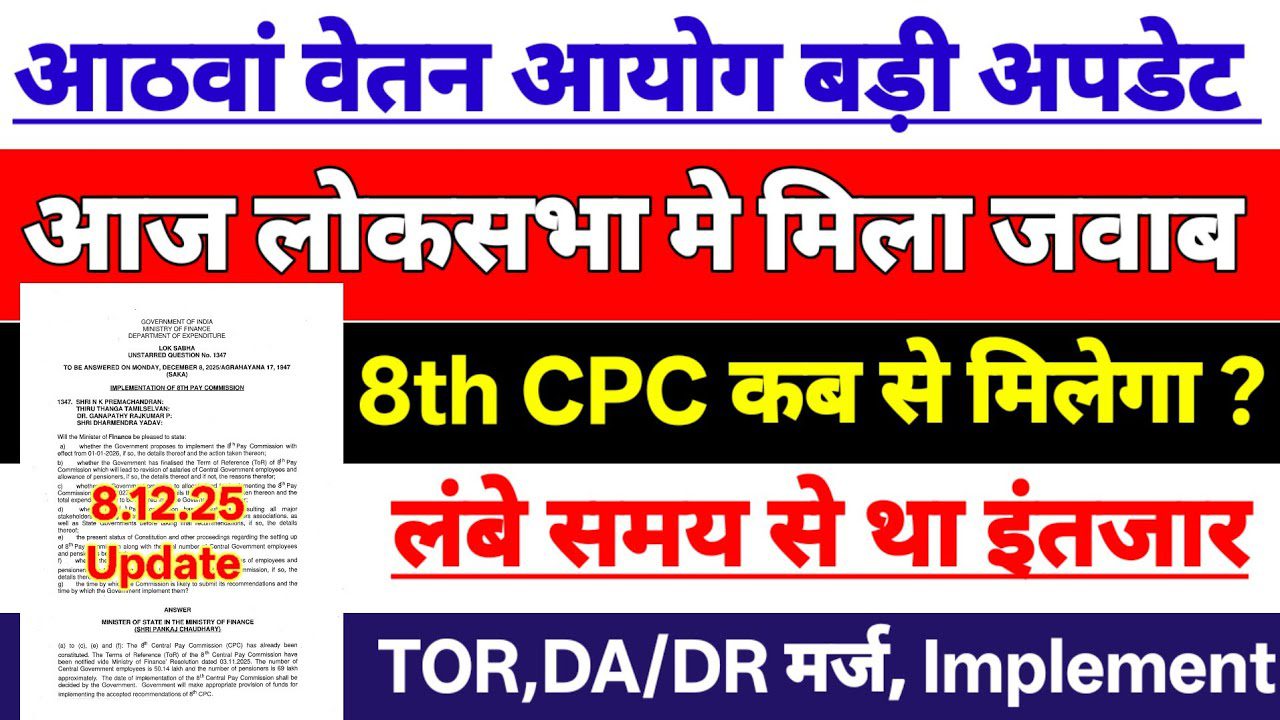
The 8th Central Pay Commission (8th CPC) has been one of the most talked-about topics among more than 50 lakh central government employees and 69 lakh pensioners in India. On 8 December 2025, the Ministry of Finance finally broke its silence in the Lok Sabha and provided detailed written replies to a series of crucial questions raised by several Members of Parliament. This official parliamentary response has cleared many doubts while confirming some hard realities about the timeline, DA/DR merger, Terms of Reference (ToR), budget provisions, and benefits for pensioners.
Here is a complete, updated, and easy-to-understand breakdown of what the Government of India has officially stated about the 8th Pay Commission in 2025–2026.
When Will the 8th Pay Commission Be Implemented? Official Lok Sabha Answer
The million-dollar question that every central government employee and pensioner has been asking — “Will the 8th CPC be implemented from 1 January 2026?” — has now received a clear answer.
According to the written reply tabled by Minister of State for Finance Shri Pankaj Chaudhary:
“The date of effect of the recommendations of the 8th Central Pay Commission will be decided by the Government.”
In simple words: There is no fixed implementation date yet, and the final decision rests entirely with the Government of India.
The earlier speculation that the 8th CPC would automatically apply from 1 January 2026 (because the 7th CPC completed its 10-year cycle) has been put to rest. The government has made it clear that even though the commission was notified, the actual implementation date will be decided later — most likely only after the commission submits its final report.
8th CPC Terms of Reference (ToR) Already Finalized and Notified
Good news on the administrative front: The Terms of Reference (ToR) of the 8th Central Pay Commission were finalized and officially notified through a Finance Ministry Resolution dated 3 November 2025.
This means:
- The scope of salary revision, allowances, pension restructuring, and other benefits has already been defined.
- The commission knows exactly which departments, categories of employees, and types of allowances fall under its purview.
- No further delay is expected on account of ToR finalization.
The ToR notification is a major milestone and signals that the commission can now begin its core work without procedural hurdles.
Expected Timeline: When Will Employees Actually Get Revised Salaries?
The official resolution states that the 8th CPC has been given 18 months from the date of its constitution (i.e., from November 2025) to submit its report.
Let us break it down month by month:
- Commission constituted: November 2025
- Deadline to submit report: May 2027 (18 months)
- Government scrutiny & cabinet approval: Additional 3–6 months
- Most probable implementation window: Early to mid-2028
This effectively means a delay of nearly 2–2.5 years from the originally expected date of 1 January 2026.
However, once implemented, employees and pensioners will receive full arrears from 1 January 2026 (or whichever date the government finally notifies as the effective date). Note: Just like the 7th CPC, HRA and Transport Allowance arrears may not be paid retrospectively.
DA and DR Merger: Will Dearness Allowance Be Merged Before 8th CPC?
A major demand from employee unions was the immediate merger of Dearness Allowance (DA) and Dearness Relief (DR) into basic pay as interim relief.
The government has categorically ruled out any such merger before the 8th CPC implementation.
Key points confirmed:
- Current DA rate (as of July 2025): 58% (expected to cross 60% from January 2026)
- DA/DR will continue to be calculated and increased every six months as usual
- Only at the time of actual 8th CPC implementation will the accumulated DA (likely around 60–65%) be merged into the new basic pay
- No interim relief or early merger will be granted
This stand aligns with previous statements made in both Lok Sabha and Rajya Sabha.
Fitment Factor Expectations for 8th Pay Commission
Though the government has not revealed any figure, employee unions and experts widely expect the fitment factor to be in the range of 2.0 to 2.86.
What this means in practice:
- Current minimum basic pay (Level-1): ₹18,000
- With a 2.0 fitment factor → New basic pay ≈ ₹36,000
- With a 2.57–2.86 factor (as demanded by unions) → ₹46,000–₹51,000 range
A fitment factor of 2.0 or slightly higher appears most realistic at this stage, which will still double the basic salary for most employees in the lower levels — a significant long-term gain.
Will Pensioners Get Full Benefits of 8th CPC?
Yes — 100% confirmed.
The Lok Sabha reply explicitly states that all 69 lakh central government pensioners (including defence and railway pensioners covered under CPC) will receive complete benefits of the 8th Pay Commission, including:
- Revised pension based on new pay matrix
- Full arrears from the effective date
- Revised family pension, gratuity ceiling, and commutation values
- Updated Dearness Relief calculation on the new pension
Any earlier ambiguity regarding pensioners being excluded has been completely removed.
Budget Allocation for 8th Pay Commission in 2026–27 or 2027–28?
The government has assured that “adequate financial provisions” will be made in the Union Budget of the year in which the recommendations are implemented.
Given the expected implementation in 2028, major provisioning is likely to appear in the 2027–28 or 2028–29 budgets.
Consultation with Stakeholders and Employee Unions
The 8th CPC is following the standard process:
- Initial memoranda and suggestions were already invited from staff associations, NC-JCM (Staff Side), and state governments
- The commission will continue consultations throughout its 18-month tenure
- Final recommendations will factor in inputs from all major stakeholders
This ensures the report reflects ground realities and genuine grievances of serving employees as well as pensioners.
Total Beneficiaries of 8th Central Pay Commission
As per official data tabled in Parliament:
- Serving central government employees: 50.14 lakh
- Pensioners (civil + defence + railways under CPC): 69 lakh
- Total beneficiaries: Over 1.19 crore individuals and families
This massive scale makes the 8th CPC one of the largest salary and pension revision exercises in the world.
Why the Delay in 8th CPC Implementation?
While the government has not explicitly cited reasons for the delay, analysts point toward:
- Fiscal prudence and budget constraints
- Ongoing economic recovery priorities
- Desire to first study inflation trends up to 2027
- Avoiding mid-tenure financial burden
Employee unions have expressed disappointment over the two-year delay and continue to press for early implementation and interim relief.
What Should Central Government Employees and Pensioners Do Now?
- Continue receiving regular DA hikes (next likely in January 2026 → 60–61%)
- Plan finances assuming implementation only in 2028
- Stay updated through official channels and authentic sources
- Participate in union representations for a higher fitment factor and better allowances
Final Verdict: December 2025 Lok Sabha Update in One Line
The 8th Central Pay Commission is officially constituted, ToR finalized, and will submit its report by May 2027, but the actual implementation date and arrears will be decided solely by the Government — most likely in 2028.
While the wait is longer than expected, the eventual revision is expected to bring substantial and permanent financial benefits to over 1.19 crore central government employees and pensioners across India.
Stay tuned for more authentic 8th CPC updates, fitment factor calculations, expected pay matrix previews, and allowance revisions as soon as official notifications are released.