
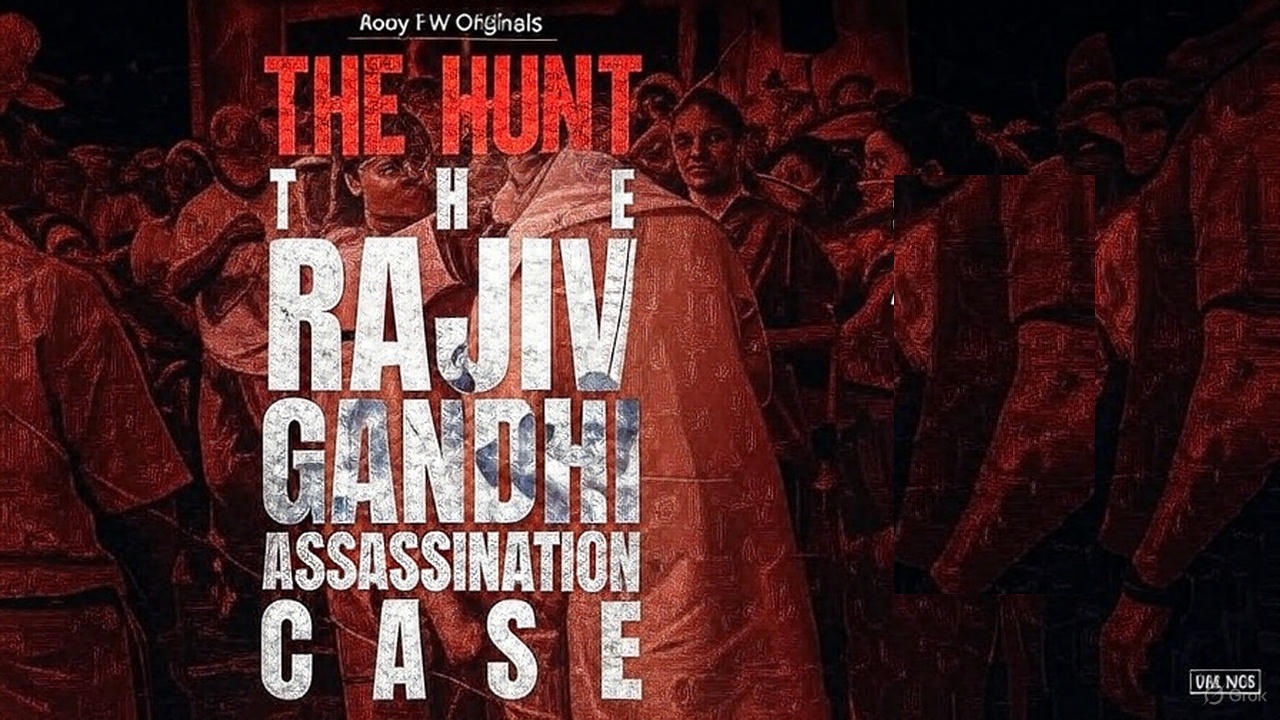
The Rajiv Gandhi assassination in 1991 stands as a pivotal moment in India’s political history, a tragedy that reverberated across the nation and altered its trajectory. In 2025, acclaimed filmmaker Nagesh Kukunoor brings this seismic event to life in his gripping short series, The Hunt. Based on Anerudya Mitra’s 2022 book 90 Days, the series dives into the chaotic 90 days following the assassination, unraveling a true-crime thriller that captures the intensity of a nation in turmoil. Directed with precision and sensitivity, The Hunt transforms a historical event into a compelling police procedural, set against the backdrop of pre-cellphone India. This article explores the brilliance of Kukunoor’s storytelling, the challenges of recreating a bygone era, the intricacies of portraying real-life figures, and the cultural significance of this bold narrative.
The Rajiv Gandhi Assassination: A Turning Point in Indian History
On May 21, 1991, former Prime Minister Rajiv Gandhi was assassinated by a woman suicide bomber during an election campaign in Sriperumbudur, Tamil Nadu. The attack, orchestrated by the Liberation Tigers of Tamil Eelam (LTTE), sent shockwaves through India, reshaping its political landscape. The event’s complexity—rooted in geopolitical tensions, ethnic conflicts, and India’s evolving identity—makes it a subject ripe for exploration.
Nagesh Kukunoor’s The Hunt doesn’t merely recount the assassination; it dissects the meticulous investigation that followed, led by the Special Investigation Team (SIT). The series captures the urgency and stakes of what Kukunoor describes as “the largest manhunt in Indian history.” By focusing on the 90 days post-assassination, The Hunt offers a fresh perspective, blending historical accuracy with the pulse-pounding pace of a thriller.
Why Revisit 1991 in 2025?
The choice to revisit the Rajiv Gandhi assassination in 2025 might seem unconventional, given the passage of time. However, Kukunoor’s decision stems from his passion for tackling uncharted genres. “The excitement for me is always diving into something new,” Kukunoor explains. “When I read Anerudya Mitra’s 90 Days, it felt like a blockbuster thriller—twists and turns that were almost unbelievable, yet they actually happened.”
This narrative choice underscores the series’ appeal. By framing the assassination as a true-crime story, The Hunt transcends its historical roots, offering a universal tale of suspense and human drama. The series resonates with modern audiences by highlighting timeless themes: justice, resilience, and the human cost of political violence.
Crafting a Pre-Cellphone India: The Aesthetic Challenge
One of the most striking aspects of The Hunt is its vivid recreation of 1991 India—a world without smartphones, internet, or high-tech forensics. This pre-cellphone setting poses unique challenges for a police procedural, a genre often reliant on modern investigative tools. Kukunoor and his team masterfully navigate these constraints, turning limitations into strengths that enhance the series’ authenticity.
Stripping Down the Visual Palette
To evoke the era, Kukunoor opts for a muted aesthetic. “I wanted nothing to pop,” he says. “The colors, the clothes, the settings—everything had to feel understated, like the photographs from that period.” The series’ cinematography, led by Sangram Giri, avoids flashy techniques, grounding the viewer in a gritty, unembellished world. Conference rooms, nondescript walls, and muted gray-and-white attire dominate the visuals, reflecting the simplicity of the time.
This minimalist approach serves a dual purpose. It not only ensures historical accuracy but also keeps the focus on the story’s emotional and intellectual core. By stripping away distractions, Kukunoor immerses viewers in the painstaking process of the SIT’s investigation, where every clue and conversation carries weight.
The Logistics of Recreating 1991
Recreating a pre-digital India required meticulous attention to detail. From the boxy Ambassador cars to the absence of mobile phones, every element had to reflect the era’s limitations. Production design became a cornerstone of The Hunt’s authenticity. Kukunoor recalls poring over archival photographs to capture the essence of 1991, from clothing styles to office setups. “The challenge was to make it feel lived-in, not like a costume drama,” he notes.
The absence of modern technology also shaped the storytelling. Without GPS, surveillance cameras, or instant communication, the SIT relied on intuition, legwork, and human intelligence. This dynamic infuses The Hunt with a raw, almost tactile quality, as investigators navigate a labyrinth of leads with limited resources.
Balancing Sensitivity and Drama in a True-Crime Narrative
Portraying real-life events, especially those involving living individuals, demands a delicate balance. The Hunt features historical figures like SIT members Kartikeyan and Amod Kant, requiring Kukunoor to tread carefully to avoid sensationalism or misrepresentation.
The Writing Process: A Labor of Sensitivity
The writing phase was the most challenging aspect of The Hunt. Kukunoor, along with co-writers Rohit and Sriram, spent months ensuring the script honored the real people involved. “Every line was scrutinized,” Kukunoor reveals. “Would the real person have said this? Are we being respectful? You’re constantly questioning yourself.”
This sensitivity extended to the depiction of the LTTE, the perpetrators of the assassination. Rather than portraying them as one-dimensional villains, Kukunoor humanizes their motivations. “I view the world in shades of gray,” he says. “People do things for reasons they believe in. As a writer, I wanted to observe their process, not judge it.” This nuanced approach allows viewers to understand the LTTE’s perspective without endorsing their actions, fostering a deeper engagement with the narrative.
Directing Real-Life Figures
Directing a story with living figures like Kartikeyan posed unique challenges, especially in India’s sensitive socio-political climate. Kukunoor relied heavily on Mitra’s 90 Days as a guiding light, cross-referencing it with other accounts to ensure accuracy. “We didn’t get every line perfect, but we did our best to do right by them,” he admits.
The decision to avoid casting actors as prominent figures like Sonia, Rahul, or Priyanka Gandhi further reflects this sensitivity. “The show isn’t about the Gandhi family,” Kukunoor explains. “It’s about the investigation. Putting the camera on them would’ve diluted the focus.” This restraint keeps The Hunt tightly focused, amplifying its impact as a police procedural.
The Role of Media: A Stark Contrast to Modern Narratives
In The Hunt, the media’s presence is notably subdued compared to Kukunoor’s other works, like City of Dreams, where media is a disruptive force driving the narrative. In 1991, media operated differently—print dominated, and television news was limited to nightly broadcasts like Doordarshan’s. This contrast shapes the storytelling in profound ways.
A Liberating Absence
Kukunoor describes the absence of constant media as “liberating.” Unlike modern narratives, where media cuts are almost mandatory, The Hunt focuses on pure storytelling. “We didn’t need to insert breaking news alerts or social media buzz,” Kukunoor says. “We could just tell the story.” Occasional archival footage, like reports on Rajiv Gandhi, adds a chilling authenticity without overwhelming the narrative.
This restraint highlights the era’s slower pace of information dissemination. In 1991, news wasn’t instantaneous; it required patience, a quality mirrored in the SIT’s methodical investigation. By minimizing media’s role, The Hunt underscores the human element of the story, letting characters’ actions and emotions take center stage.
India’s Linguistic Diversity: A Directorial Challenge
The Hunt reflects India’s rich linguistic tapestry, with characters speaking Tamil, Sri Lankan Tamil, Malayalam, Hindi, and English. Directing such a multilingual cast posed significant challenges, particularly for Kukunoor, a Hyderabadi filmmaker navigating Tamil and Sri Lankan Tamil dialogues.
Directing Across Languages
Kukunoor describes directing in multiple languages as “like holding a loaded gun to your head every day.” Actors like Jotish (playing LTTE leader Prabhakaran) and Shafi Mustafa (playing Sivarasan) spoke Sri Lankan Tamil, despite being Malayali. Kukunoor, fluent in Hindi and English but less so in Tamil, relied on his associate director, Raja, to ensure linguistic accuracy.
The process was exhausting. Kukunoor would issue directions in English or Hindi, then verify Tamil dialogues with Raja while cross-referencing an English script. “I’d explain the scene in Hindi to Shafi, then in English to Jotish, and they’d rehearse in Malayalam,” he recalls. “It was chaos, but it mirrored the real investigation’s challenges.” The SIT, too, grappled with linguistic barriers, with Tamil-speaking officers like Amit Vema holding an edge in Tamil Nadu.
A Reflection of India’s Diversity
This linguistic complexity underscores India’s diversity, a theme woven into The Hunt’s fabric. The series showcases how language shapes identity and communication, both in the investigation and on set. Kukunoor’s ability to navigate this diversity highlights his skill as a director and India’s unique cultural landscape.
The Evolution of Storytelling: From Cinema to OTT
Kukunoor’s transition from cinema to OTT platforms marks a significant shift in his career. Known for films like Hyderabad Blues and Dhanak, he has embraced the long-format storytelling of series like City of Dreams and The Hunt. This evolution reflects broader trends in the entertainment industry.
The OTT Boom in India
When streaming platforms arrived in India, Kukunoor was ready. “I’d been wanting to do long-format storytelling for years,” he says. His first OTT venture, City of Dreams, was among Applause Entertainment’s initial projects, followed by The Hunt. The early days of OTT in India were a “wild west,” with abundant work and creative freedom. However, as the industry consolidated, opportunities narrowed, pushing content into more formulaic spaces.
Despite these challenges, Kukunoor finds OTT exhilarating. “The format allows you to dive deeper into characters and stories,” he notes. Unlike films, which demand concise narratives, series offer room to explore complex arcs, making The Hunt a perfect fit for the medium.
Comparing The Hunt and City of Dreams
The Hunt and City of Dreams showcase Kukunoor’s versatility. While City of Dreams is vibrant and media-driven, The Hunt is restrained and introspective. “City of Dreams reflects today’s hyper-connected world,” Kukunoor explains. “The Hunt takes you back to a time when storytelling was unencumbered by technology.” This contrast highlights his ability to adapt to different narrative demands.
The Art of Humanizing Complex Characters
Kukunoor’s storytelling philosophy centers on humanizing characters, even those involved in heinous acts. In The Hunt, the LTTE’s motivations are explored with nuance, inviting viewers to understand their perspective without condoning their actions.
A Gray Worldview
“I don’t believe in black-and-white characters,” Kukunoor says. “Everyone has reasons for what they do.” This approach shapes The Hunt’s portrayal of the LTTE, presenting them as individuals driven by a cause they believed in. By avoiding judgment, Kukunoor encourages viewers to form their own opinions, creating a thought-provoking narrative.
The Power of Observation
As a director, Kukunoor sees himself as an observer, not an advocate. “I want the audience to watch the process unfold,” he explains. This observational style makes The Hunt a compelling study of human behavior, from the SIT’s determination to the LTTE’s conviction.
Why The Hunt Resonates Today
The Hunt is more than a historical drama; it’s a testament to the power of storytelling to bridge past and present. By revisiting the Rajiv Gandhi assassination, Kukunoor sheds light on a transformative moment in India’s history while delivering a gripping thriller. The series’ focus on human resilience, linguistic diversity, and the challenges of justice in a pre-digital world makes it universally relatable.
A Universal Thriller
The assassination’s twists and turns, as depicted in The Hunt, rival any fictional thriller. “The real events were so dramatic, I couldn’t believe they happened,” Kukunoor says. This inherent drama, combined with the series’ authentic portrayal of 1991 India, ensures its appeal to global audiences.
A Reflection of India’s Complexity
The Hunt also celebrates India’s complexity—its languages, cultures, and histories. By showcasing the SIT’s multilingual investigation and the LTTE’s motivations, the series reflects the nation’s diversity and the challenges of unity in the face of division.
Conclusion: A Masterpiece of Sensitivity and Suspense
Nagesh Kukunoor’s The Hunt is a triumph of storytelling, blending historical accuracy with the intensity of a true-crime thriller. By recreating pre-cellphone India, humanizing complex characters, and navigating linguistic diversity, Kukunoor crafts a series that is both gripping and thought-provoking. As India continues to grapple with its past and present, The Hunt serves as a powerful reminder of the resilience and determination that define its people. For fans of history, thrillers, or masterful storytelling, The Hunt is a must-watch, cementing Kukunoor’s legacy as one of India’s finest storytellers.


