
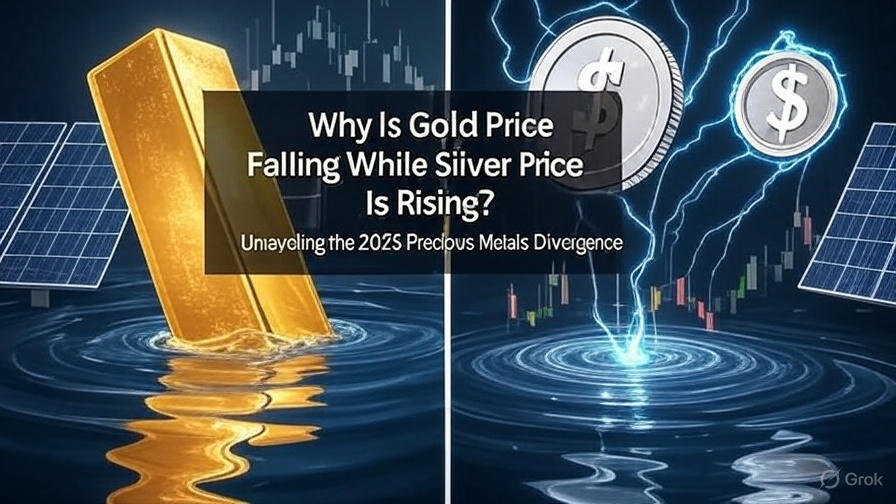
The precious metals market is a fascinating arena where gold and silver often take center stage, each reacting differently to economic shifts, market trends, and global events. Recently, a curious divergence has emerged: gold prices are declining, while silver prices are on an upward trajectory. This article delves into the reasons behind this phenomenon, explores the gold-to-silver ratio, and provides actionable insights for investors considering these metals in 2025. By understanding the forces at play, you can make informed decisions to optimize your investment portfolio.
Understanding the Current Market Trends for Gold and Silver
The precious metals market has been a rollercoaster in recent times, with gold and silver exhibiting contrasting behaviors. While gold has been consolidating or declining, silver has surged, capturing the attention of investors. This divergence prompts the question: why are these two metals, often considered close cousins, moving in opposite directions?
Gold’s Decline: A Closer Look
Gold, traditionally viewed as a safe-haven asset, has experienced a downward trend recently. Several factors contribute to this:
- Strengthening Dollar Index: A stronger U.S. dollar typically exerts downward pressure on gold prices. As of June 2025, the dollar index hovers around 97, signaling relative strength. Since gold is priced in dollars, a robust dollar makes gold more expensive for foreign investors, reducing demand and pushing prices lower.
- Cooling Bond Yields: U.S. Treasury yields have moderated to around 3.3%, down from higher levels. Lower yields generally support gold prices, but the current cooling hasn’t been sufficient to offset other bearish factors, leading to gold’s stagnation.
- Market Consolidation: After a significant rally in prior years, gold is in a consolidation phase. Technical analysis shows gold trading within a defined range, with recent price action indicating a lack of strong bullish momentum. This consolidation often precedes a breakout, but for now, gold remains subdued.
- Geopolitical Stability: Recent de-escalation in geopolitical tensions, such as the cooling of Israel-Iran conflicts, has reduced the risk premium typically associated with gold. Investors are less inclined to flock to safe-haven assets when global stability appears more assured.
Silver’s Surge: What’s Driving the Rally?
Silver, often dubbed the “poor man’s gold,” has outperformed gold in recent months, with prices rising approximately 10% in the last month alone. Here’s why silver is shining:
- Industrial Demand: Unlike gold, which is primarily an investment and jewelry asset, silver has significant industrial applications. It’s used in electronics, solar panels, and medical devices, among others. The global push for renewable energy, particularly solar power, has boosted silver demand, as it’s a critical component in photovoltaic cells.
- Undervaluation Relative to Gold: The gold-to-silver ratio, a key metric comparing the price of gold to silver, recently hit 100, well above its historical range of 50–70. This suggests silver is undervalued compared to gold, prompting investors to shift focus to silver, driving its price higher.
- Market Momentum: Silver’s recent breakout above key resistance levels has attracted technical traders. The strong price action, coupled with positive market sentiment, has fueled a self-reinforcing rally.
- Investment Vehicles: Exchange-traded funds (ETFs) like the ICICI Prudential Silver ETF have seen increased interest. The ETF, which traded around 97–98 a month ago, now hovers near 108, reflecting robust investor demand.
The Gold-to-Silver Ratio: A Key Indicator for Investors
The gold-to-silver ratio is a critical tool for understanding the relative valuation of these metals. Historically, the ratio fluctuates between 50 and 70, indicating how many ounces of silver are needed to buy one ounce of gold. When the ratio exceeds this range, as it did recently at 100, it suggests silver is undervalued or gold is overvalued, creating opportunities for investors.
Current Ratio Dynamics
As of June 2025, the gold-to-silver ratio has pulled back to around 91, driven by silver’s 10% price increase while gold remains flat. This correction aligns with expectations that the ratio should revert to its historical mean of 50–70. For investors, this signals:
- Silver’s Upside Potential: Silver’s rally may continue as the ratio normalizes, potentially offering higher returns than gold in the near term.
- Gold’s Correction Phase: Gold’s high valuation relative to silver suggests it may face further downward pressure or remain stagnant until the ratio adjusts.
Strategic Implications
Investors can leverage the gold-to-silver ratio to optimize their portfolios:
- Silver Investments: Given silver’s undervaluation, allocating funds to silver ETFs or physical silver could yield significant returns. For instance, the ICICI Prudential Silver ETF offers a convenient way to gain exposure.
- Timing Gold Purchases: Those eyeing gold investments might consider waiting for the ratio to drop closer to 50–70, signaling a more favorable entry point.
Global Economic Factors Influencing Gold and Silver Prices
The divergence in gold and silver prices isn’t occurring in a vacuum. Several macroeconomic and geopolitical factors are shaping the precious metals market in 2025.
U.S. Federal Reserve Policies
The Federal Reserve’s stance on interest rates significantly impacts precious metals. Recent statements from the Fed indicate a cautious approach to rate cuts, awaiting clearer signs of inflation stabilization. This uncertainty has kept gold prices in check, as higher interest rates typically reduce the appeal of non-yielding assets like gold. Conversely, silver’s industrial demand cushions it from some of these pressures.
Geopolitical Developments
Geopolitical events, such as U.S. warnings to Iran regarding nuclear activities and NATO’s decision to increase defense spending from 2% to 5% of GDP, have ripple effects. While reduced geopolitical risk dampens gold’s appeal, the increased defense spending in Europe has boosted related stocks, indirectly supporting industrial metals like silver.
Crude Oil and Dollar Dynamics
Crude oil prices have fallen from a risk premium of around $80 per barrel to $68–67, reflecting reduced geopolitical tensions. A weaker crude oil market supports equity markets, including those tied to silver’s industrial applications. Additionally, the dollar index’s stability at 97 is more favorable for silver than gold, as silver’s industrial demand outweighs currency-related pressures.
Investment Opportunities in Silver: Why Now?
Silver’s recent performance and undervaluation make it an attractive investment. Here’s how you can capitalize on this trend:
Silver ETFs
Silver ETFs offer a convenient and liquid way to invest in silver without the complexities of physical storage. The ICICI Prudential Silver ETF, for example, has risen from 97–98 to 108 in a month, reflecting strong investor interest. Other options include global ETFs like the iShares Silver Trust (SLV).
Physical Silver
For those preferring tangible assets, physical silver in the form of coins or bars is a viable option. Ensure purchases from reputable dealers to avoid counterfeits, and consider storage costs when investing.
Silver Mining Stocks
Investing in silver mining companies can amplify returns due to leverage. Companies like First Majestic Silver or Pan American Silver benefit from rising silver prices, though they carry higher risks due to operational factors.
Risks to Consider in Precious Metals Investing
While silver presents compelling opportunities, investors must weigh the risks:
- Market Volatility: Precious metals are subject to sharp price swings driven by macroeconomic shifts or speculative trading.
- Geopolitical Uncertainty: Overnight developments, such as U.S. policy changes under President Trump or renewed Middle East tensions, could disrupt markets.
- Short-Term Speculation: Avoid investing short-term funds in volatile assets like silver. Reserve such investments for long-term horizons (7–10 years) to weather market fluctuations.
Broader Market Context: Indian Equities and Global Trends
The Indian equity market provides context for precious metals’ performance. The Sensex recently gained 1,000 points to close at 83,756, while the Nifty rose 304 points to 25,549. The Bank Nifty hit an all-time high, closing at 57,207. However, mid-cap and small-cap stocks have lagged, remaining 4–5% below their peaks.
Technical Breakout in Indian Markets
The Indian market has broken out of a consolidation phase, with the Nifty sustaining above key resistance levels at 25,300. Technical indicators suggest potential for further gains, with the next resistance at 25,800. However, foreign institutional investors (FIIs) have been net sellers, and high short positions (77% as of recent data) indicate possible short covering, which could propel markets higher.
Sectoral Shifts
The market’s cyclical nature means large-cap, mid-cap, and small-cap stocks often take turns leading rallies. Currently, large-cap stocks, particularly in banking, are driving gains, while mid and small caps await their moment. Investors should diversify across sectors to capture these shifts.
Practical Investment Strategies for 2025
Given the current market dynamics, here are actionable strategies for investors:
Long-Term Precious Metals Investments
- Silver Focus: Allocate a portion of your portfolio to silver via ETFs or physical assets, given its undervaluation and industrial demand.
- Gold Timing: Monitor the gold-to-silver ratio and consider gold investments when it approaches 50–70 for better value.
Equity Market Approach
- Diversify Across Caps: Balance investments between large-cap, mid-cap, and small-cap stocks to capture cyclical gains.
- Sector Focus: Explore sectors like banking (given Bank Nifty’s strength) and defense, which may benefit from NATO’s increased spending.
Fixed-Income Alternatives
For short-term needs, avoid volatile assets like stocks or precious metals. Instead, consider fixed deposits (FDs) with small finance banks offering high interest rates (up to 8.6% for general investors and 9.1% for seniors). Use apps like Stable Money to compare FD rates and invest securely with RBI-regulated banks.
Case Study: Jio’s Impact on Indian Markets
An interesting parallel to the precious metals discussion is the transformative impact of Reliance Jio on India’s digital landscape. Launched in 2016 with a $25 billion investment, Jio disrupted the telecom sector by offering free data and calls, growing its valuation to $100 billion by 2025. Mukesh Ambani, in an interview with McKinsey, highlighted Jio’s risk as a calculated move to digitize India, even if it meant potential losses. This case underscores the value of long-term vision in investments, whether in equities or precious metals like silver.
Health Insurance and Regulatory Updates
In a related development, the Insurance Regulatory and Development Authority (IRDA) has cracked down on health insurance companies like Star Health, ManipalCigna, and Tata AIG for delays in claim settlements and regulatory non-compliance. Investors in these companies should monitor developments, as penalties and stricter norms could impact profitability. Conversely, policyholders may benefit from improved claim processing and transparency.
Conclusion: Navigating the Gold and Silver Markets in 2025
The divergence between gold and silver prices in 2025 reflects a complex interplay of economic, industrial, and geopolitical factors. Silver’s rally, driven by industrial demand and undervaluation, positions it as a compelling investment, while gold’s consolidation suggests a wait-and-watch approach for value seekers. By leveraging tools like the gold-to-silver ratio and staying informed on global trends, investors can make strategic decisions to enhance returns.
For those diversifying into equities, the Indian market’s breakout offers opportunities, particularly in large-cap and banking sectors. However, caution is warranted for short-term funds, which are better suited to fixed-income options like FDs. As global uncertainties persist, a balanced portfolio combining precious metals, equities, and fixed-income assets will help navigate the dynamic financial landscape of 2025.
Call to Action: Share your thoughts on gold and silver investments in the comments below. Have you invested in silver ETFs or experienced challenges with health insurance claims? Your insights can help others make informed decisions. For more market analysis and investment tips, subscribe to our newsletter and follow our updates on social media.