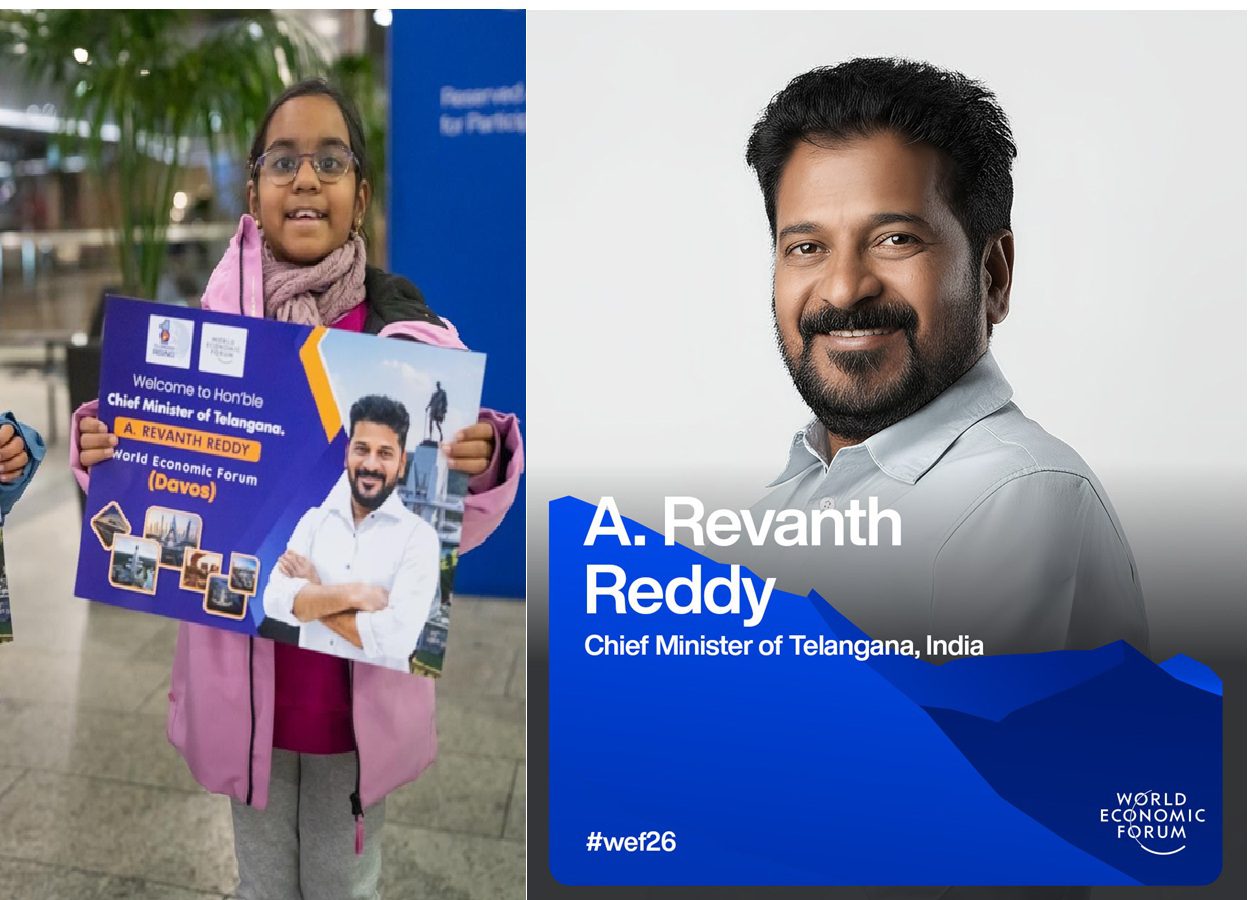
The global economic spotlight shifts to the snow-capped peaks of Switzerland this week as the World Economic Forum (WEF) Annual Meeting 2026 commences. In a significant move to position the Indian state of Telangana as a premier global investment destination, Chief Minister Sri A. Revanth Reddy has touched down in Zurich, spearheading the “Telangana Rising” delegation.
This visit marks a pivotal moment in the state’s economic history. With the freshly minted “Telangana Rising 2047” Vision Document—launched just last month in December 2025—the administration is ready to present a robust, future-ready roadmap to the world’s most influential business leaders.
A Rousing Reception in Zurich: The Diaspora Connection
The atmosphere at Zurich Airport was electric as the delegation landed. Members of the Telangana diaspora, who have established a strong footprint in Europe, gathered in large numbers to extend a warm, traditional welcome to their leader.
“Telangana is not just a geographical location; it is a global community,” one diaspora representative remarked. The Chief Minister, visibly moved by the reception, engaged briefly with the crowd, signaling that the state’s growth story is a collective effort involving both residents and Non-Resident Indians (NRIs).
This reception underscores a critical component of the state’s strategy: leveraging “Soft Power.” The diaspora serves as cultural ambassadors and economic bridges, often facilitating introductions and fostering trust with European enterprises. By acknowledging their support immediately upon arrival, CM Revanth Reddy has set a tone of inclusivity and unity for the trip.
The Strategic Delegation: Who is Representing Telangana?
The composition of a delegation often speaks louder than the agenda itself. For WEF 2026, the Telangana government has curated a team that balances political weight with administrative expertise.
- Sri A. Revanth Reddy (Chief Minister): Leading from the front, the CM is the face of the state’s progressive governance. His presence signals to global CEOs that decision-making in Telangana is decisive and supported at the highest level.
- Sri Ponguleti Srinivasa Reddy (Minister for Revenue, Housing, and I&PR): His inclusion suggests a focus on infrastructure and land allocation—critical factors for any heavy industry or manufacturing plant looking to set up shop in the state.
- Sri D. Sridhar Babu (Minister for IT, E&C, Industries & Commerce): Having arrived in Davos ahead of the main party, Minister Sridhar Babu has likely already laid the groundwork. As the custodian of Hyderabad’s booming tech ecosystem, his role is to translate policy into actionable business deals.
- Senior Bureaucrats: A team of top-tier officials accompanies the ministers to ensure that Memorandums of Understanding (MoUs) and regulatory queries are handled in real-time.
The Core Mission: Selling “Telangana Rising 2047”
The centerpiece of this visit is the “Telangana Rising 2047” Vision Document. But what does this roadmap entail, and why is it the focal point of the Davos 2026 pitch?
Launched in December 2025, this document aligns with the broader national goal of a developed India by 2047 (the centenary of independence). However, Telangana has crafted a specific niche. The roadmap moves beyond generic promises of growth and outlines specific, measurable milestones in:
- Sustainable Urbanization: Transforming Hyderabad and Tier-2 cities into smart, carbon-neutral hubs.
- Next-Gen Industrialization: Moving from basic manufacturing to high-value sectors like semiconductors, advanced robotics, and aerospace defense.
- Social Infrastructure: Ensuring that economic gains translate into world-class healthcare and education for the state’s workforce.
At Davos, the delegation will use this document not just as a brochure, but as a guarantee of stability. In a volatile global economy, investors seek certainty. A 20-year roadmap provides the policy continuity that multinational corporations crave.
The Agenda: High-Impact Engagements
The schedule for the opening day of WEF 2026 reflects an aggressive pursuit of foreign direct investment (FDI). The delegation is not merely attending sessions; they are hosting them.
Exclusive Roundtables: The CM is scheduled to host an exclusive interaction with top executives. These are not open-door events but curated meetings with decision-makers from Fortune 500 companies. The focus will be on answering the hard questions: What are the tax incentives? How fast is the clearance process? Is the energy infrastructure reliable?
Bilateral Meetings: Beyond the corporate world, the delegation will meet with representatives from other sovereign regions and nations. These government-to-government (G2G) interactions often pave the way for trade agreements and knowledge-sharing partnerships, particularly in areas like vocational training and environmental technology, where Switzerland is a global leader.
Why Davos? The Significance of WEF 2026
Critics often question the ROI of such expensive trips. However, for a state like Telangana, the World Economic Forum is the ultimate marketplace of ideas and capital.
In 2026, the global conversation is dominated by Artificial Intelligence regulation, climate financing, and supply chain resilience. By being physically present, Telangana inserts itself into these conversations.
- Supply Chain Diversification: As companies look for “China Plus One” options, Telangana positions itself as the premier alternative with its “Look East” logistics connectivity and stable political climate.
- The AI Revolution: With Hyderabad already known as “Cyberabad,” the delegation aims to attract the next wave of AI labs and data centers. Minister Sridhar Babu’s early arrival suggests that tech partnerships are a top priority.
The Hyderabad Advantage: A Pitch to the World
While the delegation represents the whole state, Hyderabad remains the jewel in the crown. The pitch at Davos will heavily feature the capital’s unique ecosystem.
The Life Sciences Capital: Telangana is already the “Vaccine Capital of the World.” The delegation will look to expand this into high-end genomics and medical devices. The “Genome Valley” cluster is a proven success story that the CM will use to attract further R&D centers.
Aerospace and Defense: With majors like Boeing and Lockheed Martin already collaborating with Tata in Hyderabad, the state has a track record. The goal for 2047 is to become a full-scale distinct manufacturing hub for civil and military aviation.
Navigating the Competitive Landscape
Telangana is not the only Indian state courting investors at Davos. Maharashtra, Karnataka, and Tamil Nadu often have strong representations. To outrank domestic competitors, the “Telangana Rising” delegation is focusing on Speed of Execution.
The narrative being crafted by Revanth Reddy’s team is one of agility. “In Telangana, we don’t just sign MoUs; we break ground,” is the sentiment. The presence of the Revenue Minister is crucial here, as land acquisition is often the bottleneck in India. His presence assures investors that land allotment will be streamlined.
Conclusion: A Vision in Motion
As the snow falls in Davos, the heat is on in the boardrooms. The next few days will determine the trajectory of capital flow into Telangana for the coming fiscal year.
The “Telangana Rising 2047” roadmap is ambitious. It demands massive capital infusion and technological transfer. By taking this vision directly to the global elite in Zurich and Davos, Chief Minister Revanth Reddy is making a bold statement: Telangana is open for business, ready for partnership, and prepared for the future.
The rousing reception in Zurich was just the beginning. The real work happens now, behind closed doors, where the future of Telangana’s economy is being written, one handshake at a time.
Deep Dive: The Economic Pillars of “Telangana Rising 2047”
To truly understand the weight of the document CM Revanth Reddy is carrying, we must analyze the specific economic pillars that the delegation is selling to the world. The “Telangana Rising 2047” vision is not a vague aspiration; it is built on four sturdy pillars designed to support a trillion-dollar economy.
Pillar 1: The Digital and AI Frontier
Hyderabad has long been a backend office for the world’s tech giants. Google, Microsoft, Amazon, and Facebook all have massive footprints here. However, the 2047 vision seeks to move up the value chain.
From Services to Product Innovation: The delegation is specifically targeting companies involved in Deep Tech and Product Development. The message to Davos is clear: “Come to Hyderabad not just for cost arbitrage, but for innovation.”
Minister Sridhar Babu is expected to highlight the state’s T-Hub, the world’s largest innovation campus, as a sandbox for global startups. The pitch involves integrating global AI startups with Telangana’s vast dataset in healthcare and agriculture to create scalable solutions.
Pillar 2: Life Sciences 2.0
While Genome Valley is a success, the 2047 vision looks toward “Biology 2.0.” This involves the intersection of technology and biology—Bioinformatics and personalized medicine.
The delegation is meeting with Swiss pharmaceutical giants (Switzerland being the HQ for companies like Roche and Novartis). The argument is compelling: Telangana offers the fastest regulatory pathways for clinical trials in India, combined with a vast pool of genetic diversity and data analytics talent.
Pillar 3: Sustainable Manufacturing & Green Energy
The global investor community at WEF is obsessed with ESG (Environmental, Social, and Governance) criteria. Revanth Reddy’s administration is keenly aware that dirty manufacturing is no longer welcome.
The Green Pitch: The “Telangana Rising” document commits to significant renewable energy targets. The delegation is showcasing vast tracts of land dedicated to solar parks and green hydrogen plants. For automotive manufacturers, particularly in the EV sector, the promise of “Green Manufacturing” (using renewable energy to power factories) is a massive incentive.
Pillar 4: The Skill Ecosystem
Infrastructure can be built, but talent must be nurtured. A recurring theme in the delegation’s talks will be the “Skilling Telangana” initiative.
Investors often worry about the “employability gap.” The delegation is carrying proposals for public-private partnerships (PPPs) in education. They are inviting global universities and technical institutes to set up campuses in Telangana, promising autonomy and infrastructure support. This ensures a pipeline of industry-ready workforce for the companies investing in the state.
The Geopolitical Context: Why India? Why Now?
To understand why the reception in Zurich was so warm, one must look at the broader geopolitical chessboard. The 2026 economic climate is defined by a search for stability.
Europe is grappling with aging demographics. The US is navigating internal economic shifts. China is transitioning from a manufacturing hub to a consumption economy. In this matrix, India stands out as the engine of growth.
Within India, Telangana offers a unique proposition:
- Political Stability: The government has a clear mandate.
- Cosmopolitan Culture: Hyderabad is culturally diverse and welcoming to expatriates, a crucial factor for foreign executives.
- Climate and Geography: Located on the Deccan Plateau, the region is seismically stable and less prone to the devastating floods or cyclones that affect coastal industrial hubs.
The delegation is expertly using these geographical and political facts to differentiate Telangana from other competing regions in Southeast Asia.
The Role of the Revenue Minister: Unlocking Land Value
The presence of Sri Ponguleti Srinivasa Reddy, the Minister for Revenue, cannot be overstated. In the complex landscape of Indian investment, land is the most critical asset.
Historically, projects in India have stalled due to litigation or unclear land titles. By bringing the Revenue Minister to the negotiation table in Davos, the CM is cutting through the red tape. They can offer “Plug and Play” infrastructure—land that is already acquired, zoned, and cleared for industrial use.
This immediacy is a “Killer App” in the world of FDI. When a CEO asks, “When can we start building?” the Revenue Minister can point to a map and say, “Tomorrow.”
Anticipated Outcomes from WEF 2026
What does success look like for the “Telangana Rising” delegation? It is not just about the dollar figure of MoUs signed, although that is important.
1. Brand Recalibration: Success means shifting the global perception of Telangana from “an IT hub” to “an Integrated Industrial Powerhouse.”
2. Strategic Alliances: Beyond money, the delegation seeks technology transfers. Partnerships that bring Swiss precision engineering or German automotive technology to local Telangana MSMEs (Micro, Small, and Medium Enterprises) are highly improved.
3. The Diaspora Dividend: The rousing reception in Zurich suggests a renewed engagement with the NRI community. Success involves channeling their wealth and expertise back into the state—not just as charity, but as venture capital for local startups.
Summary: The Road to 2047 Starts in Davos
The journey that began with a flight to Zurich is actually the first step of a two-decade marathon. The “Telangana Rising 2047” document is the map, Chief Minister Revanth Reddy is the navigator, and the global investors at Davos are the fuel.
By combining the charm of soft power (the diaspora reception) with the hard logic of economics (the Vision Document), the Telangana delegation has crafted a compelling narrative. As they navigate the icy avenues of Davos, they carry the warm aspirations of 40 million people back home, hoping to turn global promises into local prosperity.