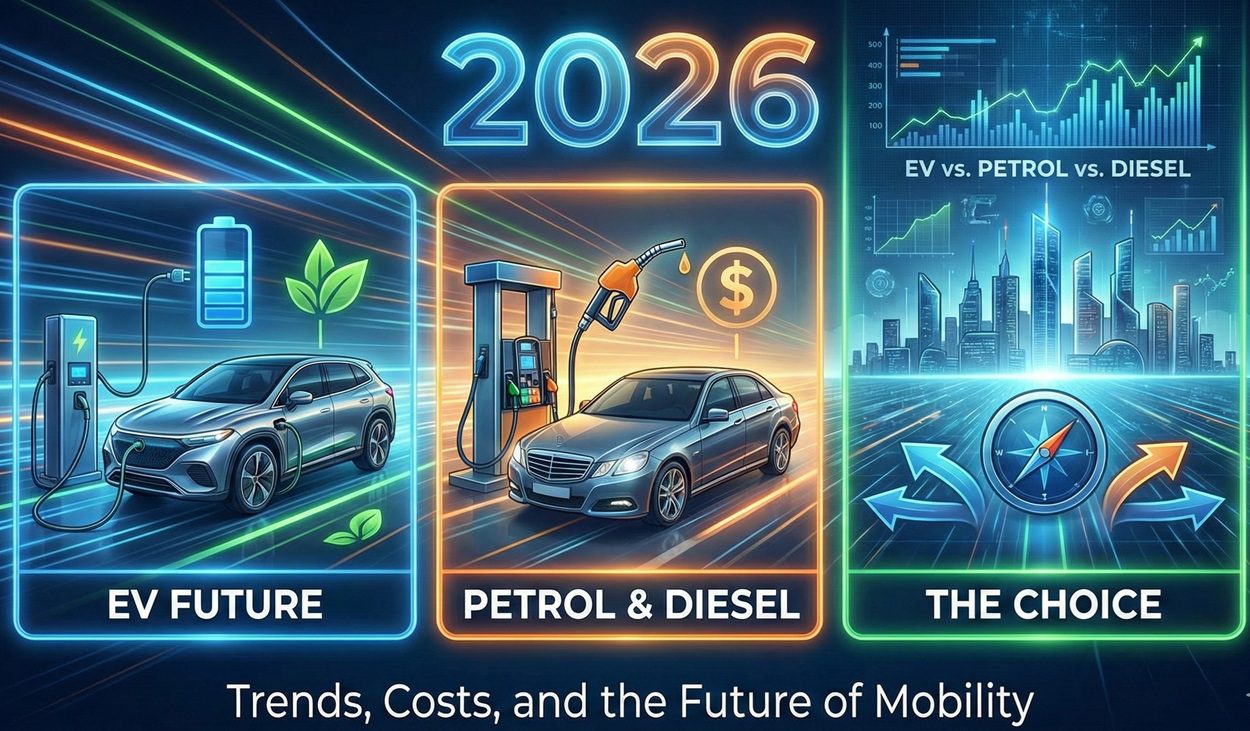
The automotive landscape is shifting beneath our feet. As we approach 2026, the question on every prospective car buyer’s mind is no longer just about brand or color—it is a fundamental choice of propulsion. Should you stick with the time-tested reliability of Petrol, opt for the raw power of Diesel, or embrace the futuristic efficiency of an Electric Vehicle (EV)?
Tesla CEO Elon Musk once famously remarked, “Buying a gas car today is like buying a horse when cars were invented.” It sounds dramatic, perhaps even like a marketing ploy designed to inflate stock prices. But is there truth to it? Is purchasing an Internal Combustion Engine (ICE) vehicle today truly a step backward into obsolescence?
This comprehensive guide breaks down the technical, financial, and practical realities of buying a car in 2026. We will analyze the engineering behind the engines, the Total Cost of Ownership (TCO), and the environmental impact to help you make the smartest investment for your future.
The Great Dilemma: Understanding the Market Shift
Imagine it is 2026. You are ready to sign the check for your dream SUV. Suddenly, a wave of confusion hits. A friend recently called me with this exact predicament. “I want to buy a car in 2026,” he said, “but I am paralyzed by choice. The future looks electric, but is it ready?”
His concerns mirror the anxieties of millions:
- Range Anxiety: “Will I get stranded?”
- Infrastructure: “Are there enough chargers?”
- Resale Value: “Will my battery die and render the car worthless?”
The reality, however, has evolved significantly. Early EVs struggled with 200 km ranges, but modern electric SUVs now deliver a real-world range of 500 km. The infrastructure in India has exploded to over 26,000 charging stations, with fast chargers now a staple at petrol pumps. The fear of battery degradation is mitigated by lifetime warranties and the fact that EVs, having fewer moving parts, suffer less mechanical wear and tear.
Furthermore, the driving experience has transformed. We are seeing luxury cabins that rival first-class lounges, featuring 16-speaker Harman Kardon audio systems with Dolby Atmos, ambient lighting, and triple-screen layouts that offer personalized entertainment for both drivers and passengers. With 5-Star BNCAP safety ratings, the modern EV is not just a gadget; it is the safest room on the road.
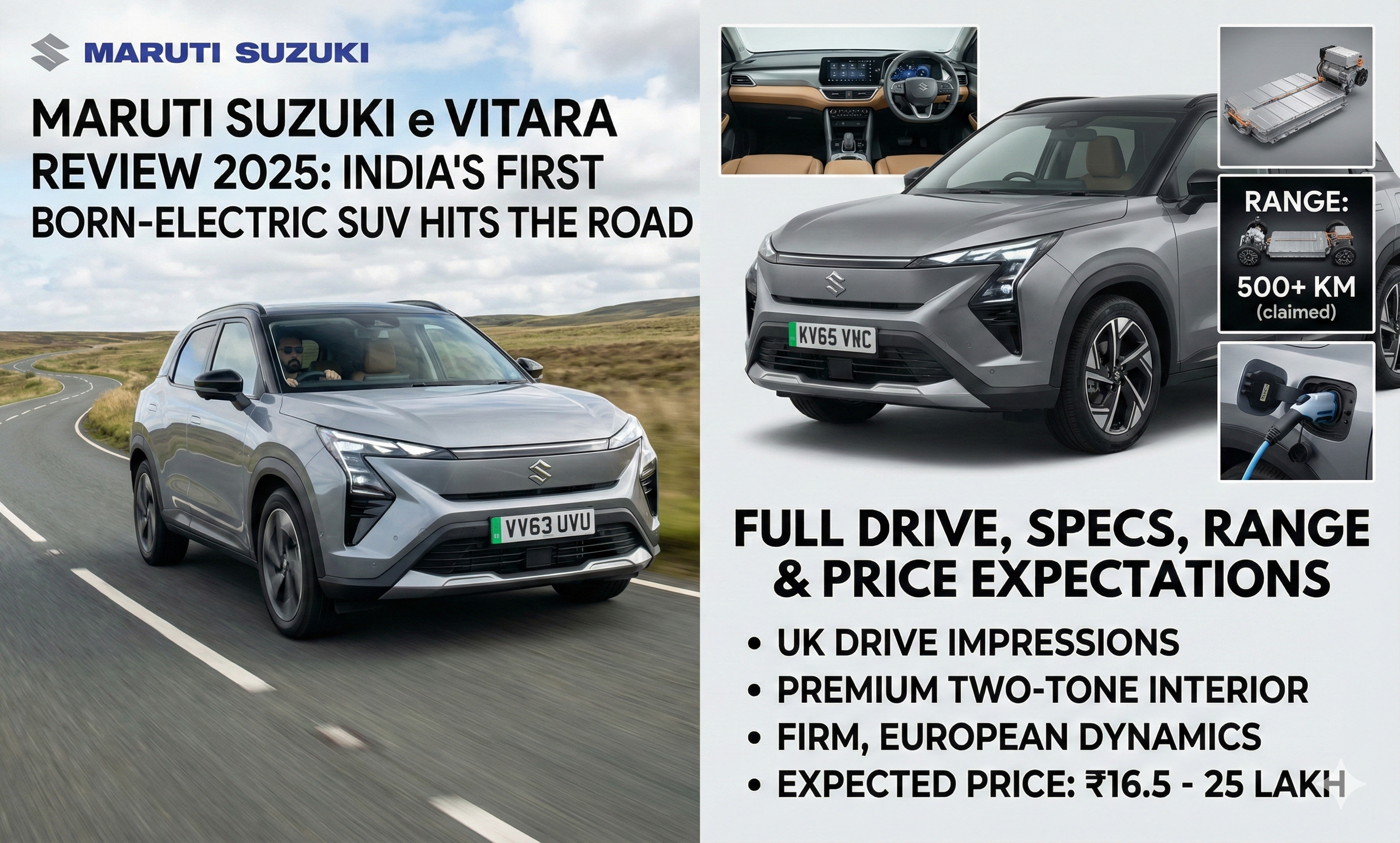
Yet, the sticker price remains a hurdle for many. Or does it? With entrants like Mahindra’s BE 6e and XUV 9e pricing themselves between ₹18.9 Lakh and ₹30.5 Lakh, and government subsidies slashing road taxes, the math is changing.
Let us dive deep into the three contenders to see which one deserves your hard-earned money.
The Petrol Engine: The Reliable Veteran
Petrol engines have been the heartbeat of personal transport for over a century. They are like that reliable friend who shows up regardless of the weather—rain, heat, or snow.
The Engineering: The Otto Cycle
The petrol engine operates on the Otto Cycle, a four-stroke process invented by Nicolaus Otto in 1876.
- Intake: Air and fuel are drawn into the cylinder.
- Compression: The piston squeezes the mixture.
- Power: A spark plug ignites the compressed gas, causing a mini-explosion that drives the piston down.
- Exhaust: Burnt gases are expelled.
This controlled chaos happens thousands of times a minute. However, the efficiency of this process relies heavily on the Compression Ratio. The higher the ratio, the better the efficiency. Unfortunately, Indian fuel generally has an Octane rating of 87-91, which limits the potential of high-performance imported engines. While modern injection technology has boosted efficiency to 85-90% (compared to 65-70% in old carburetors), petrol engines still grapple with inherent energy losses.
Real-World Economics of Petrol
- Mileage: In city traffic (like Mumbai), expect 8–14 km/l. On highways, this can improve to 20–22 km/l.
- Running Costs: If you drive 50 km daily, your monthly fuel bill will hover between ₹12,000 and ₹18,000. Annually, that is ₹1.5 Lakh to ₹2.2 Lakh.
- Inflation Risk: Factoring in a 12% fuel inflation rate, you could spend ₹8 Lakh to ₹12 Lakh on petrol alone over five years—essentially the cost of a new compact car.
The Verdict on Petrol
Pros: Unbeatable infrastructure (85,000+ pumps), low initial purchase price, and cheap maintenance (service costs ~₹3,000–₹5,000).
Cons: Rising fuel prices (projected to hit ₹150–₹180/liter by 2030), high carbon emissions (2.3kg CO2 per liter burned), and a bleak future resale value as regulations tighten.
The Diesel Engine: Power and Torque
“Diesel means Power.” This sentiment holds true. Invented by Rudolf Diesel in 1893, the diesel engine is a marvel of thermal efficiency.
Why Diesel is Different
Unlike petrol, diesel engines do not use spark plugs. They rely on Compression Ignition—squeezing air until it is hot enough to auto-ignite the fuel. This results in a higher thermal efficiency of 35–45% (compared to petrol’s 25–35%). Furthermore, diesel fuel is denser, carrying 15–20% more energy per liter.
Modern diesel technology, such as Common Rail Direct Injection (CRDi) and Variable Geometry Turbochargers (VGT), allows engines to deliver massive torque. A 1.5-liter diesel engine today offers performance comparable to a 2.5-liter petrol engine.
The Cost-Benefit Analysis
- Running Costs: With diesel prices around ₹90/liter, a 50 km daily commute costs roughly ₹12,500/month or ₹1.08 Lakh to ₹1.5 Lakh annually.
- Savings: Over five years, a diesel car saves you ₹2 Lakh to ₹4 Lakh compared to a petrol variant.
- The Premium: You pay upfront for these savings. Diesel cars cost ₹1.2 Lakh to ₹2.8 Lakh more than their petrol counterparts due to complex internals and emission control systems.
The Looming Threat: Regulations
The biggest enemy of the diesel engine is not physics; it is policy.
- Regulatory Bans: In Delhi-NCR, 10-year-old diesel cars are banned.
- BS-7 Norms: Upcoming emission standards (expected 2027-28) will add ₹50,000–₹80,000 to the cost of diesel vehicles.
- Maintenance: Diesel Particulate Filters (DPF) require cleaning (costing ₹8k–₹15k), and general maintenance is more complex.
The Electric Vehicle (EV): The Sunrise Sector
If petrol is the past and diesel is the fading present, EVs are the undeniable future. The concept is elegant in its simplicity: Battery ➔ Motor ➔ Wheels. No explosions, no exhaust fumes, just silence and torque.
Instant Torque and Performance
The defining characteristic of an electric motor is Instant Torque. Unlike Internal Combustion Engines (ICE) that need to “rev up” to reach their power band, an EV delivers 100% of its torque from zero RPM.
- Performance: The Mahindra BE 6e hits 0-100 km/h in just 6.7 seconds, making it the fastest in its segment.
- Global Adoption: In Norway, 88% of new cars are electric. Global sales grew by 68% in 2022. The shift is not a trend; it is a transition.
The Economics of Electricity
The financial argument for EVs is devastatingly strong.
- Running Cost: While petrol costs ₹8–10/km, an EV runs on ₹1–₹2/km. That is a savings of 80–90%.
- Case Study: Consider “Priya” from Mumbai, who commutes 80 km daily.
- Petrol Cost: ₹22,000/month.
- EV Charging Cost: ₹3,500/month.
- Net Savings: ₹18,500/month or ₹2.2 Lakh/year.
- Payback Period: Although EVs command a premium of ₹5–7 Lakh upfront, the savings recoup this extra cost in just 3 to 4 years. After that, it is pure profit.
Technology and Convenience
Modern EVs are essentially smartphones on wheels. Features like Over-the-Air (OTA) updates, pre-cooling via mobile apps, and real-time tracking are standard. Furthermore, “home charging” eliminates the need to visit a fuel station ever again. You start every morning with a “full tank.”
Comparative Financial Modeling: 5-Year Ownership
To make a truly informed decision, we must look at the Total Cost of Ownership (TCO) over a 5-year period.
| Cost Component | Petrol SUV | Diesel SUV | Electric SUV |
| Initial Cost | Lower | Moderate | Higher (offset by subsidies) |
| Fuel/Energy Cost (5 Years) | ₹8 – 12 Lakh | ₹6 – 8 Lakh | ₹1 – 1.5 Lakh |
| Maintenance | Low (Simple) | High (Complex) | Very Low (Few moving parts) |
| Resale Value Trend | Declining | Risk of Crash (Bans) | Improving |
| Total Cost (Approx) | ₹28 Lakh | ₹26.5 Lakh | ₹20.5 Lakh |
The Result: Buying an EV today could save you approximately ₹7.5 Lakh over five years compared to a petrol car.
Decision Matrix: Which Car Fits Your Life?
Still confused? Use this simple profiler to decide based on your driving habits.
1. The City Commuter
- Profile: You drive 30–50 km daily in heavy traffic.
- Recommendation: BUY EV.
- Why: You maximize savings on fuel. EVs are efficient in stop-and-go traffic (thanks to regenerative braking), and the silence reduces driver fatigue. Diesel is a waste here due to DPF clogging issues in low-speed traffic.
2. The Highway Warrior
- Profile: You drive 80+ km daily and take frequent long road trips.
- Recommendation: Diesel or Hybrid (for now).
- Why: While EV fast-charging corridors are growing, diesel still offers the ultimate “fill it and forget it” convenience for cross-country runs. However, high-range EVs are quickly closing this gap.
3. The Weekend Driver
- Profile: You drive only 10–20 km occasionally.
- Recommendation: Petrol.
- Why: The high upfront cost of a Diesel or EV is not justified if the car sits idle. Petrol offers the lowest entry price.
4. The Budget Conscious
- Profile: Low budget, high running.
- Recommendation: CNG.
- Why: It is the only fuel that competes with EV running costs, albeit with a compromise on boot space and performance.
Future Outlook: The Road to 2030
The automotive industry is in a “Sunset Phase” for ICE engines and a “Sunrise Phase” for EVs.
- Battery Tech: By 2026-27, battery prices are expected to drop by another 30–40%. Solid-state batteries are on the horizon, promising ranges of 600–800 km and 10-year lifespans.
- Infrastructure: India plans to expand to 50,000+ charging stations.
- Resale Dynamics: As carbon taxes are introduced and fuel prices rise, the resale value of petrol/diesel cars will plummet. Conversely, as EV trust grows, their resale value is stabilizing.
Conclusion: Don’t Buy the Horse
Returning to Elon Musk’s analogy: The shift from horses to cars took decades, but the shift from combustion to electric is happening at digital speeds. Climate change, government policy, and consumer economics are all aligning in one direction.
Smart buyers do not just follow trends; they follow the math. If you have high daily usage and can charge at home, an EV is the only sensible financial choice for 2026. You get superior performance, luxury tech, and massive savings.
For those ready to make the leap, vehicles like the Mahindra BE 6e and XUV 9e represent the new standard—combining the legacy assurance of a trusted brand with cutting-edge electric performance.
The revolution has already started. The question is, will you be driving the future, or will you be left holding the reins of the past?