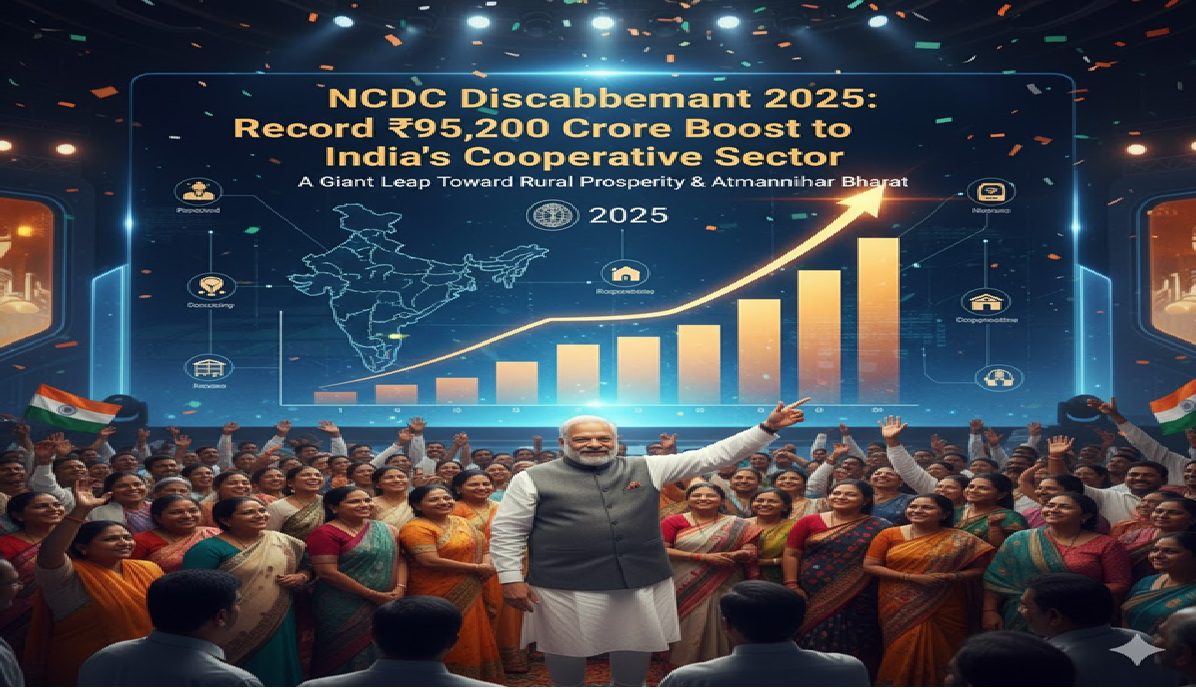
India’s cooperative movement is experiencing a historic transformation, and the National Cooperative Development Corporation (NCDC) stands at the forefront of this revolution. On November 19, 2025, Union Minister for Cooperation Amit Shah revealed that NCDC disbursed an astonishing ₹95,200 crore in financial assistance during FY 2024-25 – a nearly fourfold jump from ₹24,700 crore in FY 2020-21. This massive surge underscores the government’s unwavering commitment to empowering farmers, rural entrepreneurs, fishers, and women-led cooperatives through accessible, low-cost funding.
Speaking at the 92nd General Council Meeting of NCDC in New Delhi, Minister Shah emphasized how the creation of a dedicated Ministry of Cooperation in 2021 has supercharged the sector. “NCDC has become the bedrock of cooperative transformation in India,” he declared, highlighting zero net NPAs, a compounded annual growth rate (CAGR) exceeding 40% over the past four years, and a record net profit of ₹807 crore.
Why the Cooperative Model is India’s Fastest Path to Viksit Bharat
Cooperatives embody the principle of “by the people, for the people.” Unlike corporate-driven models that concentrate wealth, cooperatives distribute prosperity directly to members – especially in rural India where 65% of the population resides. Minister Shah rightly pointed out that cooperatives guarantee participation, create sustainable livelihoods, and drive inclusive growth, making them the ideal vehicle for achieving a $5 trillion economy.
The numbers speak volumes: from a modest ₹5,735 crore in disbursements in 2014-15, NCDC has scaled up nearly 17 times to ₹95,182.88 crore by the end of FY 2024-25 (with minor rounding variations across reports). In the current FY 2025-26, NCDC has already released over ₹49,799 crore in the first seven months alone, signaling continued aggressive expansion.
Explosive Growth in Key Rural Sectors: Dairy, Fisheries, Sugar, and Beyond
NCDC’s funding reaches every corner of rural economy:
- Dairy Cooperatives: Through District Central Cooperative Banks (DCCBs) and State Cooperative Banks, NCDC has fueled the white revolution 2.0. Giants like Amul and thousands of village-level societies now access working capital and infrastructure loans at concessional rates.
- Fisheries Sector Transformation: NCDC exceeded its target by forming and strengthening 1,070 Fishery Farmer Producer Organizations (FFPOs). Under the Pradhan Mantri Matsya Kisan Samriddhi Sub-Yojana (PM-MKSSY), another 2,348 FFPOs are being bolstered. Special assistance for deep-sea trawlers in Maharashtra and Gujarat has empowered coastal communities, particularly women, while contributing to India’s Blue Economy goals.
- Cooperative Sugar Mills Modernization: Leveraging a ₹1,000 crore central grant, NCDC sanctioned ₹10,005 crore to 56 sugar mills for ethanol production plants, co-generation units, and zero-liquid discharge systems. This shift toward a circular economy reduces import dependence on crude oil and increases farmers’ income through by-products.
- Food Processing, Textiles, Storage, and Cold Chains: From handloom weavers’ societies to FPOs aggregating fruits and vegetables, NCDC funding is building end-to-end value chains that minimize wastage and maximize farmer returns.
Empowering Women and Marginalized Communities
Inclusive growth remains a cornerstone of NCDC’s mission. Between FY 2021-22 and FY 2024-25, the corporation disbursed ₹4,823.68 crore exclusively to women-led cooperatives, funding everything from self-help group enterprises to large dairy units. Special focus on Scheduled Caste and Scheduled Tribe cooperatives has ensured that no community is left behind.
New Frontiers: Bharat Taxi – India’s First Cooperative Ride-Hailing Platform
In a groundbreaking move, NCDC is spearheading the launch of Bharat Taxi, a multi-state cooperative ride-hailing service designed to challenge private aggregators. The society has already been registered, driver onboarding is underway, and app development is progressing rapidly. Backed by leading cooperatives like IFFCO, Amul, KRIBHCO, and NAFED, Bharat Taxi will put drivers in control – ensuring fair commissions, profit-sharing, and democratic decision-making.
This initiative aligns perfectly with the government’s vision of “Sahkar se Samriddhi” (Prosperity through Cooperation) in urban and semi-urban mobility.
Massive ₹2,000 Crore Government Grant to Unlock ₹20,000 Crore in Concessional Loans
Approved on July 31, 2025, a ₹2,000 crore grant-in-aid (released at ₹500 crore annually) empowers NCDC to mobilize ₹20,000 crore in long-term and working capital loans at highly subsidized interest rates. Priority sectors include:
- Dairy and livestock development
- Fisheries and aquaculture
- Cooperative sugar mills and ethanol production
- Textile and handloom societies
- Food processing units
- Cold storage and warehousing
- General agriculture and allied activities
- Women-led and grassroots cooperatives
This 10:1 leverage model dramatically amplifies government support, delivering maximum impact with minimal fiscal burden.
Expanding Footprint: New Offices in Underserved Regions
To bring services closer to the people, NCDC recently inaugurated a regional office in Vijayawada and sub-offices across Jammu & Kashmir, Ladakh, Sikkim, Manipur, Mizoram, Tripura, Arunachal Pradesh, Meghalaya, and Nagaland. These steps ensure that even the remotest northeastern and hilly states benefit from timely financial assistance.
Zero NPA, Record Profits: A Model of Financial Discipline
In an era when many financial institutions struggle with bad loans, NCDC maintains zero net non-performing assets (NPAs) while posting its highest-ever profit of ₹807 crore. This pristine balance sheet reflects rigorous due diligence, strong recovery mechanisms, and the inherent trustworthiness of the cooperative ethos.
The Bigger Picture: How NCDC Drives Atmanirbhar Bharat and Sahkarita
Prime Minister Narendra Modi’s vision of an Atmanirbhar Bharat finds its strongest expression in the cooperative sector. By linking primary societies with national multi-state entities like:
- National Cooperative Organics Limited (NCOL)
- Bharatiya Beej Sahakari Samiti Limited (BBSSL)
- National Cooperative Export Limited (NCEL)
NCDC is pushing India toward leadership in organic farming, seed sovereignty, and global agri-exports.
The corporation also promotes next-generation initiatives such as the “Cooperative Intern” program to groom young professionals and schemes like Yuva Sahakar and Swayamshakti Sahkar that nurture startups and women entrepreneurs.
What the Record ₹95,200 Crore Disbursement Means for Rural India in 2025 and Beyond
For millions of small farmers and rural artisans, this funding translates into:
- Higher incomes through value addition
- Reduced dependence on moneylenders
- Modern infrastructure (cold chains, processing units, trawlers)
- Climate-resilient practices (ethanol, circular economy)
- Women’s financial independence
- Job creation in villages, curbing urban migration
As Minister Amit Shah aptly summarized, “The government is fully committed to transforming the lives of farmers, rural families, fishers, and small producers through the cooperative movement.”
Conclusion: Cooperatives Are India’s Economic Superpower in the Making
The NCDC’s stellar performance in FY 2024-25 – with ₹95,200 crore disbursed, zero NPAs, and groundbreaking projects like Bharat Taxi – proves that India’s cooperative sector is no longer a relic of the past but a dynamic engine of future growth.
With continued government backing, expanded outreach, and innovative schemes, NCDC is poised to cross the ₹1 lakh crore disbursement milestone very soon. For anyone searching for real stories of rural empowerment, financial inclusion, or sustainable development in 2025, the National Cooperative Development Corporation offers the most inspiring blueprint.
India’s journey from “Sahkar se Samriddhi” to “Sahkar se Viksit Bharat” is well and truly underway – and NCDC is driving it at full speed.