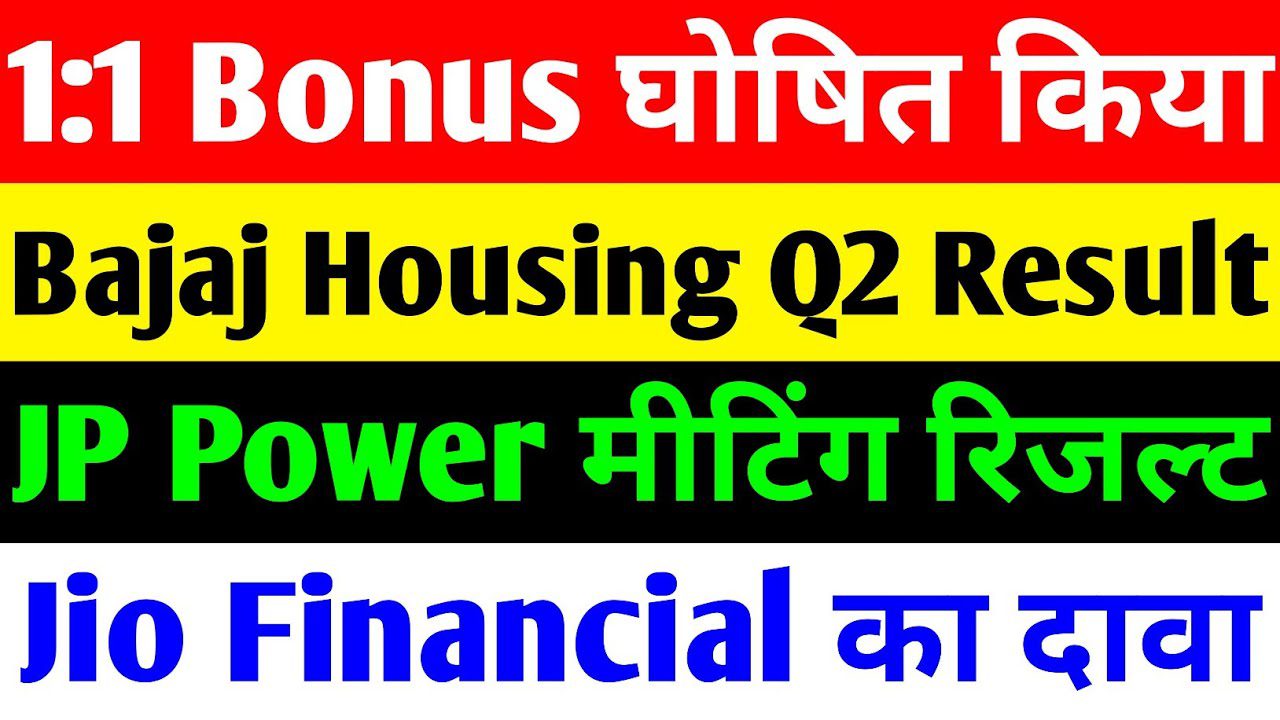
In the dynamic world of Indian stock markets, investors constantly seek the latest updates on high-potential stocks to refine their portfolios. November 2025 brings a flurry of exciting developments across key sectors: housing finance, power generation, digital financial services, and diagnostics. Bajaj Housing Finance dazzles with robust Q2 results, signaling sustained momentum in the affordable housing boom.
Meanwhile, JP Power Ventures teeters on the edge of a transformative auction, Jio Financial Services outlines ambitious expansion plans amid India’s economic renaissance, and Dr. Lal PathLabs rewards shareholders with a generous bonus issue and dividend payout. This comprehensive analysis dives deep into these stories, offering actionable insights for savvy investors. Whether you’re tracking Bajaj Housing Finance share news today or eyeing JP Power latest news, we’ve got you covered with data-driven breakdowns, expert opinions, and forward-looking projections.
Bajaj Housing Finance Q2 2025: Revenue Rockets and Profit Milestones Mark Strong Recovery
Bajaj Housing Finance Limited continues to solidify its position as a frontrunner in India’s burgeoning housing finance sector. The company, a subsidiary of the powerhouse Bajaj Finance Group, recently unveiled its Q2 FY2026 results, painting a picture of resilience and growth amid fluctuating market conditions. Closing at ₹119 on a recent trading session, the stock edged up by a modest 0.037% despite broader market downturns—a testament to its underlying strength.
For long-term holders, this translates to impressive returns since its IPO priced around ₹70, though it lingers below its all-time high of ₹188. Investors optimistic about Bajaj Housing Finance latest updates will find plenty to cheer as the company navigates economic headwinds with strategic finesse.
Delving into the numbers, Bajaj Housing Finance reported total revenue of approximately ₹755 crore for the quarter, a significant leap from ₹66 crore in the prior quarter. This quarter-on-quarter (QoQ) surge underscores the company’s ability to scale operations efficiently. Year-on-year (YoY), revenue climbed to ₹2,410 crore from ₹1,910 crore in September 2023, reflecting a consistent upward trajectory that has defined the firm’s performance over the past few years. Such growth stems from expanded loan disbursements in the affordable and mid-income housing segments, where demand remains insatiable due to government initiatives like PMAY (Pradhan Mantri Awas Yojana).
Expenses, too, rose in tandem with business expansion, reaching ₹253 crore QoQ from ₹244 crore and ₹1,790 crore YoY from ₹1,760 crore in the corresponding period last year. This uptick is no red flag; rather, it signals proactive investments in technology, branch networks, and customer acquisition to fuel future revenues. On the profitability front, financing profit hit ₹844 crore, up from ₹765 crore QoQ and a staggering jump from ₹780 crore YoY. The financing margin stabilized at an impressive 31%, aligning with levels from September 2023 and edging past the previous quarter’s 29%. This margin resilience highlights Bajaj’s adept pricing strategies and cost controls in a low-interest-rate environment.
Other income remained negligible, keeping the focus squarely on core operations. Profit before tax (PBT) soared to ₹833 crore, a QoQ increase from ₹757 crore and a YoY rise from ₹780 crore. Net profit followed suit at ₹643 crore, surpassing ₹583 crore QoQ and ₹546 crore YoY, with earnings per share (EPS) climbing to ₹7.7 from ₹7.0 in the last quarter and ₹6.66 YoY. Compared to FY2023-24’s ₹6.7 EPS, this marks a clear acceleration. The company’s net non-performing assets (NPA) ratio stays enviably low at 0.113%, underscoring robust asset quality and risk management practices that shield it from sector volatilities.
What makes these results particularly compelling is the broader context of India’s housing market revival. Urbanization, rising disposable incomes, and favorable RBI policies have created a fertile ground for non-banking financial companies (NBFCs) like Bajaj Housing Finance. The firm’s asset under management (AUM) has ballooned, driven by a diversified product portfolio that includes home loans, loans against property, and developer financing. Analysts point to the company’s digital onboarding processes, which have reduced turnaround times to under 24 hours, as a key differentiator in a competitive landscape dominated by players like HDFC and LIC Housing Finance.
Motilal Oswal’s Bullish Bet on Bajaj Housing Finance: Projections for Explosive CAGR
Post-results, the investment community buzzes with optimism, led by none other than Motilal Oswal Financial Services. In their latest report, the brokerage firm expresses unbridled enthusiasm for Bajaj Housing Finance, citing its “stellar” Q2 performance as a harbinger of sustained excellence. They highlight the company’s deployment of gross product and its investor presentation as blueprints for a scalable business model. “Bajaj Housing Finance has consistently outperformed peers by leveraging interest rate declines and maintaining impeccable asset quality,” the report states, emphasizing how these factors have bolstered margins and profitability.
Motilal Oswal forecasts a compound annual growth rate (CAGR) of 22% for Bajaj Housing Finance from FY2025 to FY2028, a projection rooted in conservative assumptions around loan book expansion and market penetration. Return on assets (ROA) is expected to hover at 2.3%, while return on equity (ROE) could reach 14.2% by FY2028—metrics that outpace industry averages and signal efficient capital utilization. This bullish stance isn’t mere hype; it’s backed by the company’s track record of year-over-year revenue and profit escalations, even as macroeconomic challenges like inflation and liquidity crunches loomed large.
For investors pondering Bajaj Housing Finance share price target 2025, this report screams opportunity. The stock’s current valuation, trading at a price-to-earnings (P/E) multiple below historical norms, suggests undervaluation relative to growth prospects. Motilal Oswal recommends accumulating on dips, envisioning a re-rating as AUM crosses ₹1 lakh crore milestones. However, they caution about short-term pressures from rising funding costs if RBI maintains a hawkish stance on rates.
A glance at the shareholding pattern reveals intriguing shifts. Promoters, primarily Bajaj Finance Ltd., hold a commanding 88.70%, but regulatory mandates from SEBI require dilution to 75% over time, potentially unlocking value through stake sales. Foreign institutional investors (FIIs) trimmed their stake slightly to 0.91% from 1.04% in June 2025, while domestic institutional investors (DIIs) reduced from 5.59% to 0.54%—likely profit-booking post-IPO lock-in expiry. Retail participation, however, surged to 9.81% from 9.61%, indicating grassroots confidence. Others’ holding dipped to 0.05% from 4%, consolidating ownership among core stakeholders.
In essence, Bajaj Housing Finance embodies the NBFC sector’s resilience. As India aims for 100% housing coverage by 2030, this stock stands poised for multi-fold gains. Long-term investors should view current consolidations as entry points, while traders eye resistance at ₹130-140 for breakout trades.
JP Power Ventures Latest News: Auction Heats Up with Vedanta’s ₹17,000 Crore Bid and Promoter Counter
Shifting gears to the power sector, Jaiprakash Power Ventures Limited (JP Power) captures headlines with its high-stakes insolvency saga. The stock closed at ₹17.65, down 0.223% in line with market sentiment, but its narrative transcends daily fluctuations. Over the past year, it has shed 5.93%, underperforming amid promoter woes, yet longer horizons reveal a multibagger gem: 24% returns in two years, 130% in three, 266% in four, and a whopping 640% in five. For those searching JP Power share latest news, this duality—short-term pain, long-term gain—defines the opportunity.
The epicenter of attention is the resolution process for promoter Jaiprakash Associates Limited (JP Associates), mired in insolvency since 2017. On November 7, 2025, the Committee of Creditors (COC)—in its 23rd meeting—greenlit the resolution plan’s progression, with a final decision imminent. JP Power, as the operational arm, disclosed these developments to the stock exchanges, signaling closure on a protracted drama that has tied up assets worth billions.
Enter Vedanta Limited, the metals-to-energy conglomerate, with the highest bid clocking in at ₹17,000 crore—a figure that could reshape JP Power’s fortunes by injecting fresh capital and expertise. Vedanta’s interest aligns with its aggressive foray into renewables and hydro projects, where JP Power’s 400 MW Baspa-II and 300 MW Karcham Wangtoo plants in Himachal Pradesh offer strategic synergy. However, the plot thickens: JP Associates, the original promoters, have thrown their hat back in the ring with a counter-bid of ₹18,000 crore, aiming to reclaim control and steer the company away from external suitors.
This bidding war isn’t isolated. JP Associates recently defaulted on ₹55,371 crore in dues to a consortium of lenders, including Axis Bank, Bank of Maharashtra, State Bank of India, ICICI Bank, and Indian Overseas Bank. The insolvency proceedings ensure creditor recovery, but payouts hinge on the winning bid—likely settling at a fraction for banks after haircuts. JP Power itself remains a profit engine, insulated from parent liabilities, with steady cash flows from power purchase agreements (PPAs) and low-cost hydro generation.
Analysts tracking JP Power auction update 2025 anticipate resolution by Q4 FY2026, potentially catapulting the stock toward ₹25-30 if Vedanta prevails, leveraging its balance sheet for deleveraging and capex. A promoter win might stabilize operations but delay growth. Risks abound: regulatory delays or bid withdrawals could prolong uncertainty. Yet, JP Power’s debt-free status (post-2020 restructuring) and EBITDA-positive books make it a turnaround play. Investors should monitor COC announcements closely, positioning for volatility with stop-losses at ₹16.
Historically, JP Power has thrived on India’s power demand surge, projected to hit 1,900 billion units by 2030. Its focus on clean hydro energy positions it favorably against thermal peers facing ESG scrutiny. As the auction unfolds, this stock could evolve from a speculative bet to a core holding in diversified portfolios.
Jio Financial Services Management Vision: KV Kamat’s Bold Call on India’s Banking Boom
Jio Financial Services Limited (JFSL), the financial arm of Reliance Industries, emerges as a digital disruptor in India’s fintech landscape. Closing at ₹299 with a 0.52% uptick—yet breaching the psychological ₹300 mark—the stock reflects cautious optimism. It has retreated from a peak of ₹390 earlier in 2025, but underlying business momentum suggests a rebound. For enthusiasts of Jio Financial Services latest news, Chairman KV Kamat’s recent pronouncements offer a roadmap to exponential value creation.
Kamat, a veteran banker with stints at leading institutions, likened India’s current phase to China’s transformative 2005 era, where banking reforms supercharged economic expansion. “India stands at the cusp of a similar inflection point,” he declared, emphasizing how banks and NBFCs will anchor 7-8% sustainable GDP growth, with aspirations for 10%. This aligns with the government’s Viksit Bharat @2047 vision, targeting a $5-10 trillion economy in the first phase, scaling to $28 trillion thereafter. JFSL, with its tech-first ethos, is primed to capture this wave.
Kamat highlighted ongoing reforms: enhanced investment capacities, influx of foreign direct investments (FDIs), and direct equity infusions into banks. A prime example is Japan’s Sumitomo Mitsui Banking Corporation (SMBC) acquiring a major stake in Yes Bank, underscoring global confidence in Indian lenders. For JFSL, these tailwinds amplify its pivot from a demerged entity (post-Reliance Jio split) to a full-spectrum financial powerhouse, encompassing lending, insurance, and wealth management.
Central to JFSL’s strategy is the adoption of BlackRock’s Aladdin platform—a sophisticated AI-driven tool for portfolio analytics, data insights, and machine learning-based decision-making. Aladdin empowers investors to optimize allocations, time exits, and mitigate risks in real-time, democratizing access to institutional-grade tools. This integration promises to swell JFSL’s customer base from millions to tens of millions, leveraging Reliance’s 1.4 billion-strong ecosystem via JioMart, JioCinema, and telecom synergies.
Projections for Jio Financial Services future plans 2025 are tantalizing: AUM growth at 30-40% CAGR, driven by micro-lending to underserved segments and embedded finance in e-commerce. Margins could expand to 8-10% as digital efficiencies curb costs. Risks include regulatory tightening on data privacy and competition from Paytm or PhonePe, but JFSL’s parent backing provides a moat. Kamat envisions JFSL as a “growth multiplier” for India’s $5 trillion economy dream, urging investors to bet on its 5-7x potential over the decade.
Shareholding remains dominated by promoters at 46.32%, with FIIs at 13.5% and DIIs at 7.2%, ensuring stability. As JFSL rolls out UPI-linked credit and insurance products, watch for catalysts like quarterly user additions to propel the stock past ₹350.
Dr. Lal PathLabs Q2 Triumph: 1:1 Bonus Shares, ₹7 Dividend, and Robust Revenue Growth
Rounding out our coverage, Dr. Lal PathLabs Limited delights shareholders with a shareholder-friendly bonanza amid solid Q2 results. The stock closed at ₹3,990, dipping 0.29%, but the announcement of a 1:1 bonus issue—rewarding one free share per held share—alongside a ₹7 per share dividend (post-bonus) has ignited fervor. For those querying Dr. Lal PathLabs bonus shares news, this move, approved under the 2025 Employee Stock Option Scheme, reaffirms the company’s commitment to wealth creation.
Q2 revenue clocked in at ₹731 crore, posting a healthy 10.70% YoY growth, fueled by volume expansions in tier-2/3 cities and premium testing segments like genomics and wellness. EBITDA rose 10.80% to ₹224 crore, reflecting operational leverage from a 500+ lab network and automated processing. Profit after tax (PAT) jumped 16.40% to ₹152 crore, with EPS at ₹11.0—up 16.80% YoY. These figures beat consensus estimates, driven by a 12% test volume increase and pricing discipline.
Dr. Lal PathLabs’ edge lies in its integrated model: from sample collection to report delivery via a robust app ecosystem. The diagnostics sector, valued at ₹80,000 crore and growing at 15% annually, benefits from post-pandemic health awareness and chronic disease prevalence. The bonus issue, funded from reserves exceeding ₹1,200 crore, enhances liquidity without diluting value, while the dividend yields ~0.18% pre-bonus.
Looking ahead, Dr. Lal PathLabs share price target 2026 analysts peg at ₹4,500-5,000, citing 20% revenue CAGR through acquisitions and international forays (e.g., Nepal and Sri Lanka labs). Challenges like raw material inflation loom, but a 25% EBITDA margin trajectory mitigates them. Promoter holding stands at 30%, with institutions at 50%, ensuring governance strength.
Strategic Investment Takeaways: Navigating Volatility in India’s Top Stocks
As 2025 unfolds, these stocks—Bajaj Housing Finance’s steady climb, JP Power’s auction intrigue, Jio Financial’s digital leap, and Dr. Lal PathLabs’ rewards—epitomize India’s growth narrative. Diversify across sectors, consult advisors, and conduct due diligence. The market rewards patience; in this bull cycle, positioning now could yield generational wealth.