Chief Minister A. Revanth Reddy of Telangana conducted a comprehensive emergency review meeting on Wednesday, October 29, 2025, to assess the severe impact of Cyclone Montha across multiple districts of the state. The cyclonic storm, which made landfall on the Andhra Pradesh coast near Kakinada around 8 PM on Tuesday, October 28, brought extremely heavy rainfall and gusty winds to Telangana, particularly affecting the erstwhile Khammam, Warangal, and Nalgonda districts. As intense downpours continued to lash the state, the Chief Minister directed all district officials to remain on high alert and coordinate disaster response efforts with precision and urgency.
Emergency Preparedness and Coordination Across Multiple Departments
During the high-level review meeting, CM Revanth Reddy emphasized the critical importance of inter-departmental coordination in managing the cyclone’s aftermath. The Chief Minister instructed all department officials and staff to maintain round-the-clock vigilance, particularly as the cyclone coincided with the crucial paddy harvesting season when farmers were drying grains in fields across several districts. He stressed that no loss of life, property, or livestock should occur under any circumstances, making this directive the cornerstone of the state’s emergency response strategy.
The coordination mechanism established by the Chief Minister involved multiple state agencies working in tandem. The State Disaster Response Force (SDRF) and National Disaster Response Force (NDRF) teams were deployed strategically under the guidance of respective district collectors in the most affected areas. According to official sources, three NDRF teams were stationed in Telangana as part of the broader national response, with 45 teams deployed across affected states including Andhra Pradesh, Odisha, and neighboring regions. These specialized rescue teams were equipped with high-capacity inflatable boats, rescue equipment, and medical supplies to respond swiftly to emergency situations.
Protecting Agricultural Produce: Critical Measures for Paddy and Cotton Procurement
The timing of Cyclone Montha proved particularly challenging for Telangana’s agricultural sector, as the storm struck during the peak paddy harvesting and cotton procurement season. CM Revanth Reddy issued specific directives to ensure that harvested crops, especially paddy grains being dried at procurement centers, were protected from rain damage. Civil Supplies Minister N. Uttam Kumar Reddy and Agriculture Minister Tummala Nageswara Rao held urgent coordination meetings with district collectors to implement protective measures at all procurement facilities.
Officials were instructed to use tarpaulins extensively at all procurement centers and ensure rapid transportation of paddy stocks to rice mills to prevent moisture-related damage. As of October 27, 2025, Telangana had procured 180,452 metric tonnes of paddy from 22,433 farmers, valued at ₹431.09 crore, including 73,628 metric tonnes of coarse grain and 106,824 metric tonnes of fine grain. The state government had approved 8,342 procurement centers, of which 4,428 were operational at the time of the cyclone’s impact.
Agriculture Minister Tummala Nageswara Rao specifically advised farmers in eastern Telangana and cyclone-affected areas to temporarily halt paddy harvesting to prevent crop damage from the heavy rainfall. For crops already harvested, officials were directed to ensure immediate weighing and purchase, provided they met quality standards. The minister emphasized that the government was committed to ensuring farmers did not incur losses, with strict checks in place to prevent traders from neighboring states from selling their produce in Telangana.
Cotton procurement centers faced similar challenges, with the Cotton Corporation of India (CCI) establishing purchase centers across the state. The “Kapas Kisan” mobile app-based slot booking system was being utilized for cotton procurement, with agricultural extension officers instructed to collect updated mobile numbers of farmers in each village to facilitate timely scheduling. The cyclone’s impact threatened cotton crops still in fields, with moisture-related issues causing procurement delays in several districts.
Railway Disruptions and Alternative Transportation Arrangements
The heavy rainfall caused significant disruptions to rail traffic across Telangana and neighboring states. Railway tracks were flooded at Dornakal Junction in Mahabubabad district, halting the Golconda Express at the station. The Mumbai-Bhubaneswar Konark Express was stopped at Gundratimadugu station, while the Adilabad-Tirupati Krishna Express came to a halt at Mahabubabad Railway Station. The Sainagar Shirdi Express was stopped at Kondapalli in the Krishna district of Andhra Pradesh, along with at least 12 goods trains at various stations.theshillongtimes+2
The South Central Railway (SCR) responded by canceling 127 trains and diverting 14 trains due to Cyclone Montha’s impact. On October 29, the SCR announced cancellation of the Secunderabad-Visakhapatnam Express and the Howrah-Secunderabad Falaknuma Express scheduled for October 30. Canceled trains for October 29 included Nanded-Visakhapatnam, Visakhapatnam-Lingampalli, Visakhapatnam-Kadapa, and Narasapur-Guntur services.
CM Revanth Reddy directed railway authorities to make alternative arrangements to ensure passengers did not face inconvenience due to these disruptions. SCR General Manager Sanjay Kumar Srivastava conducted emergency review meetings on train operation safety and preparedness to tackle the cyclone situation. The railway established helpline numbers (040-27786170, 040-27786140, and 040-27781765) for passenger assistance, with officials informing reserved ticket holders via SMS alerts about cancellations, diversions, or rescheduling. Online ticket holders received automatic refunds, while passengers with physical tickets could claim refunds at reservation counters within three days or approach the Chief Commercial Manager’s office.
Monitoring Water Bodies and Preventing Flooding in Low-Lying Areas
The Chief Minister issued comprehensive instructions regarding the monitoring of water levels in reservoirs, tanks, and ponds across the state. Irrigation department officials were directed to continuously monitor water levels and alert collectors and field staff in advance regarding water releases from fully filled reservoirs. As a precautionary measure, sandbags were to be kept ready at reservoirs and tanks operating at full capacity.
The cyclone’s impact was particularly severe in districts along the Godavari River basin, stretching from Bhadrachalam in the east to Karimnagar in the northwest. These areas faced the added risk of flash flooding, with heavy rainfall exceeding 100 mm in isolated pockets. The Paleru reservoir in Khammam district reached 22.5 feet, nearing its full capacity of 23 feet, as continuous moderate rain persisted since the previous night. Officials in districts along the Godavari and Krishna basins closely monitored conditions as the cyclone’s influence spread, conducting evacuation drills and preparing relief measures to mitigate potential flooding risks.
The Chief Minister specifically instructed officials to remain vigilant as streams and rivulets might overflow due to the heavy rainfall. Families residing in low-lying areas were to be relocated to relief camps immediately to ensure their safety. The Roads and Buildings Minister Komatireddy Venkat Reddy placed his department on high alert, directing officials to install danger warning boards at causeways and culverts and maintain close coordination with police, revenue, electricity, irrigation, and panchayat raj departments to alert the public in vulnerable areas.
Traffic Restrictions and Public Safety Measures on Flooded Roads
CM Revanth Reddy ordered complete traffic restrictions on roads, low-level bridges, and causeways where water had accumulated. Police and revenue officials were instructed to set up barricades and monitor the situation continuously. The Andhra Pradesh government, facing similar challenges, announced a complete suspension of vehicle movement in seven cyclone-affected districts from 8:30 PM until 6:00 AM, with only emergency medical services exempted from the night curfew.
Roads and Buildings Minister Komatireddy Venkat Reddy established an R&B control center operational at the department’s headquarters, connected to all district offices for real-time monitoring. The minister advised arranging alternative routes for emergency public transport where needed and urged the public to venture out only if necessary while following safety precautions issued by authorities.
The Greater Hyderabad Municipal Corporation (GHMC), the Hyderabad Disaster Response and Asset Protection Agency (HYDRAA), SDRF, and Fire Services personnel in Hyderabad city were directed to respond promptly to complaints and requests from the public. HYDRAA, established in July 2024 under the leadership of Commissioner AV Ranganath, oversees disaster management and asset protection in Hyderabad. The agency deployed 130 monsoon emergency teams, each comprising 12 personnel, along with 51 Disaster Response Force (DRF) teams of 15 members each to manage waterlogging and flood response.
Health Department Preparedness and Disease Prevention Strategies
The Chief Minister directed the Health Department to keep medical camps and adequate stocks of medicines ready to prevent the spread of diseases following the cyclone. Director of Public Health Dr. B. Ravindra Nayak had issued a general advisory urging citizens to take precautions against seasonal illnesses, noting that prevailing weather conditions could lead to lower temperatures, higher humidity, and an increase in vector-borne, water-borne, and air-borne diseases such as malaria, dengue, chikungunya, jaundice, typhoid, and viral fevers.
CM Revanth Reddy cautioned that stagnant rainwater could lead to mosquito breeding and the spread of infectious diseases. Municipal, urban, and rural sanitation workers were therefore directed to carry out cleaning operations regularly to prevent water accumulation and eliminate mosquito breeding sites. The Health Department made special arrangements, including the provision of adequate hospital beds, IV fluids, essential medicines, and ORS sachets at all public health facilities. ANMs, ASHA workers, and Anganwadi workers were instructed to keep emergency supplies ready for immediate deployment.
Citizens were advised to take preventive measures against mosquito bites by installing mosquito nets and screens, using repellents regularly, maintaining drains, and preventing water stagnation around homes. To prevent water-borne diseases, people were urged to drink boiled or filtered water, wash hands before meals, and avoid consuming outside or stale food. For air-borne infections such as influenza, the department recommended frequent hand sanitization, avoiding handshakes when unwell, and using handkerchiefs while sneezing or coughing
Rainfall Data and Weather Warnings Across Telangana Districts
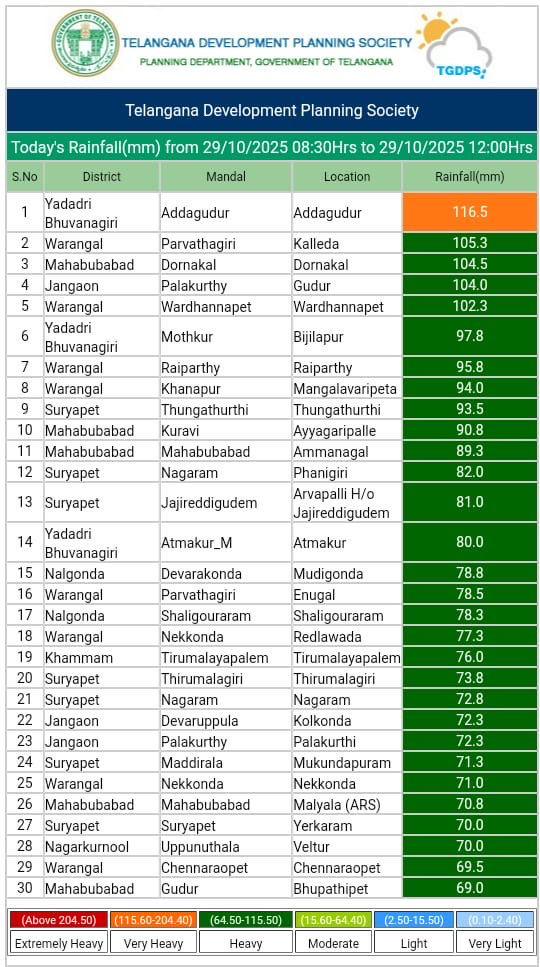
According to data from the Telangana Development Planning Society (TGDPS), significant rainfall was recorded across multiple districts on October 29, 2025. Kalleda in Warangal district and Addagudur in Yadadri Bhuvanagiri received 91 mm of rainfall during the 8:30 AM to 11:00 AM period alone. By the 8:30 AM to 12:00 PM timeframe on October 29, Addagudur recorded the highest rainfall at 116.5 mm, followed by Kalleda with 105.3 mm, Dornakal with 104.5 mm, Gudur in Jangaon with 104.0 mm, and Wardhannapet with 102.3 mm[attached image data
The India Meteorological Department (IMD) issued a red alert for very heavy to extremely heavy rainfall accompanied by thunderstorms, lightning, and gusty winds (40-50 kmph) in Mahabubabad, Warangal, and Hanumakonda districts from 10:00 AM on October 29 to 8:30 AM on October 30. A red alert indicates extremely heavy rain exceeding 20 cm in 24 hours. An orange alert was issued for heavy to very heavy rainfall in Adilabad, Mancherial, Nirmal, Jagtial, Rajanna Sircilla, Karimnagar, Peddapalli, Jayashankar Bhupalpally, Suryapet, Jangaon, Siddipet, and Yadadri Bhuvanagiri districts during the same period
Hyderabad experienced moderate rainfall with intermittent showers throughout October 29, with areas such as Qutubullapur, Gajularamaram, Kukatpally, Miyapur, Nizampet, Alwal, Amberpet, Jubilee Hills, Banjara Hills, Gachibowli, Lingampalli, Madhapur, and Hitech City reporting notable precipitation. The downpour led to water accumulation on roads, causing serious difficulties for motorists and resulting in substantial traffic disruption.
Nagarkurnool district recorded the highest cumulative rainfall of 167.3 mm until 5:00 AM on October 29, while Nalgonda recorded 131.3 mm. Wanaparthy, Rangareddy, and Suryapet also recorded heavy rainfall during the same period. The IMD warned that northern and eastern districts could receive 100-150 mm of rain, while central Telangana was expected to witness moderate to heavy rainfall, and southern parts of the state would see light to moderate showers.
Impact on Paddy and Cotton Crops in Eastern Districts
The cyclone’s effects caused considerable damage to paddy and cotton crops, particularly in eastern Telangana districts. In Yadadri Bhongir district, paddy stocks at Choutuppal market yard suffered major damage due to heavy rains. Farmers expressed concerns over delayed paddy purchases amid the impending cyclone threat, with arrivals of stocks at purchase centers increasing but procurement yet to pick up significantly.
Suryapet District Collector Tejas Nandlal Pawar and his team reached out to farmers in Arvapalli, Timmapur, and Velpucherla areas, advising paddy and cotton growers to stay vigilant and take immediate precautions to safeguard their produce from the cyclone’s impact over the next 48 hours. The collector also enquired about the availability of tarpaulins and officials’ preparedness for paddy procurement.
In the Khammam region, persistent rains caused considerable damage to agricultural operations. In areas like Manuguru, Illandu, and Sattupalli, rainwater inundated open-cast coal mines, significantly impacting coal production in addition to agricultural losses. Cotton crops were likely to bear the brunt of the cyclone’s effects, with moisture-related issues causing procurement to remain subdued despite arrivals of produce continuing to gain momentum.
GHMC and HYDRAA Emergency Response in Hyderabad
The Greater Hyderabad Municipal Corporation (GHMC) and the Hyderabad Disaster Response and Asset Protection Agency (HYDRAA) coordinated extensive emergency response efforts in the state capital. HYDRAA, which assumed responsibility for all monsoon emergency operations following concerns over GHMC’s tender allocation processes, deployed specialized teams across flood-prone zones.
The 130 monsoon emergency teams deployed by GHMC, each comprising 12 personnel, worked in coordination with 51 Disaster Response Force (DRF) teams from HYDRAA, each consisting of 15 members. These teams operated under the direct supervision of HYDRAA officials to ensure swift response during waterlogging incidents. Their coordinated efforts aimed to ensure smooth vehicular movement and eliminate flooding threats in residential areas.
HYDRAA’s responsibilities extended beyond immediate emergency response to include clearing catchpits during rainfall, dewatering operations, management of traffic diversions, safety inspections of nalas (storm drains) to prevent accidents, and post-rainfall desilting work. The agency was also responsible for removing obstructions caused by fallen trees or poles and coordinating with the Hyderabad Metropolitan Water Supply and Sewerage Board (HMWSSB), Telangana State Power Distribution Company Limited (TGSPDCL), and other agencies for monsoon-related response and relief efforts.
Residents facing water and sewerage issues were encouraged to contact HMWSSB via customer service numbers 155313 or 040-23300114, or through social media platforms. For concerns related to waterlogging, GHMC could be reached through its official handle on X (formerly Twitter) at @GHMCOnline. The Fire Services department, working in coordination with GHMC and HYDRAA, maintained readiness to respond to emergency calls throughout the cyclone period.
Chief Minister’s Emphasis on Zero Casualty and Coordinated Response
CM Revanth Reddy’s overarching directive emphasized that every measure must be taken to prevent loss of life, property, or livestock. He called for coordinated efforts from all departments, including Revenue, Electricity, Panchayat Raj, Roads and Buildings (R&B), Health, Police (Telangana DGP), Fire Services, and SDRF, to effectively manage the cyclone situation.
The Chief Minister’s governance approach during the cyclone reflected his broader leadership style since assuming office as Telangana’s second Chief Minister on December 7, 2023. Known as “The Lion of Telangana,” Revanth Reddy has built a reputation for strong connections with the people and decisive action during crises. His administration’s response to Cyclone Montha demonstrated the coordinated disaster management framework established under his leadership, with clear lines of authority and communication across multiple departments and agencies.
Civil Supplies Commissioner Stephen Ravindra was directed to remain available round-the-clock to coordinate response efforts, with the Chief Minister himself accessible for direct contact in case of emergencies. This hands-on approach ensured that decision-making remained swift and responsive to evolving ground conditions across the affected districts.
Regional Impact and Meteorological Context
Cyclone Montha developed from a well-marked low-pressure area that formed over the southeast Bay of Bengal around October 24, 2025. The system gradually intensified into a deep depression by October 26 and further strengthened into a cyclonic storm under favorable conditions, including warm sea surface temperatures above 28°C, low vertical wind shear, and sufficient moisture inflow. The cyclone reached severe cyclonic storm status before making landfall near Kakinada on the Andhra Pradesh coast around 8:00 PM on October 28, 2025.
The name “Montha” was contributed by Thailand to the World Meteorological Organization’s regional committee list of cyclones, meaning “a fragrant flower” or “beautiful flower” in Thai. This naming practice, followed by member countries in the region, helps facilitate public identification, improves communication during warnings, and avoids confusion among multiple active storms in the same season
After landfall, Cyclone Montha maintained its form for three additional hours until 2:30 AM on October 29, when the rear section completely crossed the coastline. The cyclone weakened to a deep depression by 8:30 AM on October 29, with satellite imagery at 9:30 AM depicting a rain band centered over Warangal in Telangana, stretching southwest toward Hyderabad and southeast toward coastal Andhra Pradesh. The IMD projected that the remnants would retain cyclone status for an additional three hours before weakening further into a depression.
The cyclone’s path took an unexpected northward turn toward North Telangana and South Bastar regions rather than dissipating over the east coast as initially expected. The system intensified slightly as it interacted with local moisture, particularly affecting districts along the Godavari River basin. Sweeping winds clocking between 28 and 33 kilometers per hour posed risks of uprooting trees, disrupting power lines, and complicating travel on waterlogged roads.
Comparative Context: Telangana’s Rainfall Patterns in 2025
The impact of Cyclone Montha must be understood within the broader context of Telangana’s rainfall patterns during 2025. The state recorded 31% excess rainfall during the southwest monsoon season (June 1 to October 4, 2025), receiving 991.5 mm compared to an average of 756.7 mm. Out of 33 districts, seven reported ‘large excess’ rainfall, 16 were in the ‘excess’ category, and 10 registered ‘normal’ rainfall, with none falling under ‘large deficient’ or ‘no rain’ categories.
Hyderabad recorded 939 mm of rainfall during the southwest monsoon against an average of 697.6 mm, equating to a 35% surplus. Neighboring districts also saw higher-than-usual precipitation, with Rangareddy reporting 42% excess and Medchal-Malkajgiri registering 47% excess. August and September contributed significantly to this surplus, with multiple intense spells boosting seasonal totals.
However, scientists warned that while total annual rainfall may not have changed drastically, the number of rainy days had plummeted, concentrating water into fewer, more violent spells. For semi-arid states like Telangana, where natural drainage and civic infrastructure are not designed to absorb such shocks, this trend proved especially dangerous. In 2023, Jayashankar Bhupalpally witnessed 65 cm of rainfall in just one day, while in 2024, Mulugu received 44 cm in a single day, revealing a worrying escalation in the scale and intensity of extreme weather events.
Lessons from Previous Cyclones and Disaster Management Evolution
Telangana’s disaster management infrastructure has evolved significantly based on lessons learned from previous flooding events and cyclones. The October 2020 floods in Hyderabad provided critical insights that shaped current preparedness measures. During those floods, GHMC’s Disaster Response Force (DRF) responded to approximately 11,000 requests in its first five years of operation, demonstrating the importance of dedicated emergency response teams.
The establishment of HYDRAA in July 2024 represented a major evolution in Telangana’s disaster management approach. The agency’s three wings—Asset Protection, Disaster Management, and Logistics Support—provided a comprehensive framework for coordinating emergency response while protecting public assets. The Disaster Management Wing operated the Disaster Response Force in cooperation with national and regional agencies like the National Disaster Response Force and the Telangana Disaster Response and Fire Service
The state had deployed twelve State Disaster Response Force (SDRF) teams, each with 100 trained personnel, across Telangana, with three NDRF teams stationed specifically in Hyderabad. Fire personnel in all district headquarters had undergone disaster response training, and rapid-response HYDRAA teams had been established in Hyderabad and its suburbs. This multi-layered approach ensured that specialized resources could be deployed quickly to areas experiencing severe impacts.
Public Communication and Information Dissemination
Effective public communication proved crucial during Cyclone Montha’s impact on Telangana. The IMD-Hyderabad maintained constant updates through official bulletins, issuing weather warnings for seven days ahead and adjusting alert levels as conditions evolved. Weather alerts had been sent to 1.92 crore mobile users in affected districts through automated systems, ensuring widespread awareness of impending dangers.
The South Central Railway established multiple communication channels, including helpline numbers and SMS alerts to passengers about train cancellations, diversions, and rescheduling. Airline operators, including IndiGo and Air India Express, informed passengers in advance about flight cancellations at Visakhapatnam, Vijayawada, and Rajahmundry airports, with over 35 flights canceled as the cyclone approached
Social media platforms played a significant role in real-time information sharing, with government agencies maintaining active presence on platforms like X (formerly Twitter). The Chief Minister’s office, district administration offices, and various departments provided regular updates on emergency measures, evacuation procedures, and safety advisories. Independent weather forecasters, such as Telangana-based meteorologist Balaji Tarini, supplemented official communications with localized predictions and analysis.
Economic Impact and Recovery Measures
The economic impact of Cyclone Montha extended beyond immediate agricultural losses to affect multiple sectors. The disruption of rail and air transport created cascading effects on supply chains, with goods trains halted at various stations and passenger services severely curtailed. The cancellation of over 127 trains and diversion of 14 additional trains disrupted not only passenger travel but also freight movement critical to regional commerce.
The state government’s commitment to procuring agricultural produce at Minimum Support Price (MSP) provided crucial economic security to farmers during this challenging period. For paddy, procurement continued at MSP rates, with the government releasing funds worth ₹431.09 crore for purchases completed before the cyclone. Cotton procurement was set at ₹8,110 per quintal for long-staple varieties and ₹7,710 per quintal for medium-staple cotton, ensuring farmers could at least recover their cost of cultivation despite weather-related quality concerns.
Chief Secretary K. Ramakrishna Rao noted that the government would procure large quantities of paddy, cotton, and maize at MSP directly from farmers, with the bulk of procurement expected to take place over 45 to 60 days following the cyclone. Civil Supplies Minister Uttam Kumar Reddy issued strong warnings against corruption or irregularities in the procurement process, emphasizing that strict action would be taken on any complaints and that officials must carry out regular inspections to ensure transparency.
Infrastructure Resilience and Long-Term Planning
The cyclone’s impact on Telangana’s infrastructure highlighted both strengths and vulnerabilities in the state’s disaster resilience. While immediate response mechanisms functioned effectively, the flooding of railway tracks, disruption of road connectivity, and power outages in some areas revealed ongoing infrastructure challenges.
CM Revanth Reddy had recently directed irrigation department officials to prepare comprehensive project-wise analysis of all dams in the state, with complete status reports to be submitted before a follow-up review meeting scheduled for the second week of November. This initiative, focused on the Kaleshwaram project’s barrages and other irrigation structures, aimed to ensure long-term water management capacity and structural integrity.
The Chief Minister’s emphasis on preparing plans for the Tummidihatti project to draw 80 TMC water, along with repairs to the Sundilla barrage to bring water to the Sripada Yellampalli project, demonstrated attention to long-term water security alongside immediate disaster response. These dual priorities—emergency management and infrastructure development—reflected an integrated approach to building resilience against future extreme weather events.
Regional Cooperation and Interstate Coordination
Cyclone Montha’s impact extended beyond Telangana to affect multiple states, necessitating coordinated regional response. Andhra Pradesh bore the brunt of the cyclone’s landfall, with one death reported in Makanagudem village of Konaseema district when a tree was uprooted in strong gales. Over 76,000 people were evacuated in Andhra Pradesh, with 219 medical camps established and essential supplies distributed among displaced families.
Odisha prepared over 2,000 disaster relief centers across eight southern districts, with 11,396 people taking shelter in these facilities as Chief Minister Mohan Charan Majhi announced deployment of 30 ODRF teams, 123 fire brigades, and five NDRF teams. The state’s emphasis on a “zero casualty” policy mirrored Telangana’s approach, demonstrating shared priorities across state boundaries.
The National Disaster Response Force coordinated deployment of 45 teams across affected states, with 25 teams pre-deployed and remaining units on standby for emergency deployment. This interstate coordination extended to railway operations, with the South Central Railway and East Coast Railway working together to manage train diversions and cancellations across state boundaries.
Looking Ahead: Post-Cyclone Recovery and Assessment
As Cyclone Montha weakened and moved inland, attention shifted to damage assessment and recovery operations. The IMD indicated that weather activity would gradually extend to northeastern India by October 31, with Telangana expected to see continued but diminishing rainfall. By October 30, the state received a yellow alert for heavy rainfall in select districts, with conditions expected to improve thereafter.
The Chief Minister’s directive that the government’s performance during this critical period—particularly in handling paddy, maize, and cotton procurement—would be closely monitored established clear accountability standards. Civil Supplies Commissioner Stephen Ravindra and Agriculture Minister Tummala Nageswara Rao committed to remaining available round-the-clock to coordinate ongoing response efforts.
Health officials continued surveillance for disease outbreaks in the cyclone’s aftermath, with surveillance officers deployed at a ratio of one per 50,000 population to ensure prompt medical response. Special rapid response teams stood ready to contain outbreaks of diarrheal and vector-borne diseases, while chlorine tablets and bleaching powder were distributed in potentially affected areas to prevent water contamination.
The cyclone experience will likely inform future disaster preparedness strategies, with lessons learned about infrastructure vulnerabilities, communication protocols, and inter-agency coordination incorporated into updated contingency plans. CM Revanth Reddy’s emphasis on zero casualties and comprehensive protection of both lives and livelihoods established a benchmark for the state’s evolving disaster management framework, positioning Telangana to better withstand future extreme weather events in an era of increasing climate variability.