In the dynamic world of Indian stock markets, investors constantly seek insights into quarterly earnings, major corporate deals, and emerging controversies that could sway share prices. As markets remain closed on this Saturday, October 26, 2025, anticipation builds for Monday’s opening bell. Recent announcements from key players like Kotak Mahindra Bank, Zen Technologies, Waaree Energies, Bajaj Auto, Reliance Jio, and even the Life Insurance Corporation (LIC) have sparked widespread discussions. This comprehensive analysis dives deep into Kotak Mahindra Bank Q2 results 2025, highlighting the 2.7% net profit decline due to elevated provisioning. We also explore Zen Technologies Q2 earnings, Waaree Energies’ massive 692 MW solar module orders, Bajaj Auto’s regulatory green light for the KTM takeover, the buzz around Reliance Jio IPO valuation projected at $112-154 billion for 2026, and the fresh Washington Post allegations linking LIC investments to the Adani Group. These developments not only reflect the resilience and challenges in India’s financial landscape but also offer strategic cues for savvy investors navigating banking sector trends, defense tech growth, renewable energy surges, automotive mergers, telecom listings, and governance debates.
Kotak Mahindra Bank Q2 FY26 Results: Navigating Profit Pressures in a Robust Banking Environment
Kotak Mahindra Bank, one of India’s leading private sector lenders, unveiled its Q2 FY26 results on October 25, 2025, revealing a mixed bag of achievements amid persistent economic headwinds. The bank reported a net profit of ₹3,253 crore for the quarter ended September 30, 2025—a modest 2.7% year-on-year (YoY) decline from ₹3,344 crore in the same period last year. This dip, while concerning for growth-focused shareholders, stems primarily from heightened provisioning requirements, a common challenge in the banking sector as institutions brace for potential loan defaults in a volatile global economy.
Delving deeper into the numbers, Kotak Mahindra Bank’s net interest income (NII) climbed 4% YoY to ₹7,311 crore, up from ₹7,020 crore. This growth underscores the bank’s strength in core lending operations, where it maintains a healthy net interest margin (NIM) of 4.54%. Deposits surged 14% YoY to ₹5,10,538 crore, signaling strong customer trust and liquidity inflows. On the asset side, customer assets expanded 18% to ₹4.50 lakh crore, with advances growing 17% to ₹4.19 lakh crore. These figures highlight Kotak’s aggressive yet prudent expansion in retail and wholesale banking, positioning it well against competitors like HDFC Bank and ICICI Bank in the private banking arena.
However, the elephant in the room remains provisioning. Kotak set aside higher reserves for non-performing assets (NPAs), which dragged profitability downward. Asset quality improved marginally, with gross NPAs easing to below 2%, but the bank’s management emphasized that conservative provisioning reflects a proactive stance against rising credit risks in sectors like real estate and SMEs. Analysts at Motilal Oswal Financial Services noted that this approach, while short-term painful, fortifies long-term stability. “Kotak Mahindra Bank Q2 FY26 results demonstrate resilience in revenue streams, but investors should monitor provisioning trends closely as they impact earnings visibility,” the firm stated in a recent report.
Looking ahead, Kotak’s consolidated profit rose 13% YoY to ₹5,044 crore, buoyed by subsidiaries like Kotak Securities (profit up to ₹444 crore) and Kotak Mahindra Life Insurance (₹360 crore). This group-level strength suggests diversified revenue buffers the standalone challenges. With a capital adequacy ratio of 22.6%, the bank stands fortified for future growth. Market watchers predict a 1-2% share price dip on Monday, October 27, 2025, but long-term bulls remain optimistic, citing Kotak’s digital banking innovations and wealth management prowess. As Indian banking evolves toward fintech integration, Kotak Mahindra Bank continues to lead, but these Q2 results remind investors of the sector’s inherent cyclicality.
(Word count so far: 512)
Decoding Zen Technologies Q2 FY26 Earnings: Defense Tech Firm Shows Quarter-on-Quarter Resilience Despite YoY Slump
Zen Technologies, a Hyderabad-based pioneer in anti-drone systems and defense training simulators, released its Q2 FY26 earnings on October 25, 2025, painting a picture of steady recovery from a dismal prior quarter. The company posted a net profit of ₹59.4 crore, a slight 4.7% YoY decline from ₹62.3 crore, but a robust quarter-on-quarter (QoQ) jump from ₹53 crore in Q1 FY26. Revenue from operations dipped 28.3% YoY to ₹173.6 crore from ₹242 crore, yet it marked a 10% QoQ increase from ₹158 crore, signaling improving order execution in the defense sector.
EBITDA fell 19% YoY to ₹65 crore, with margins contracting to around 37% due to a mix of high-cost projects and geographic expansions. Standalone revenue, however, bucked the trend with a 49% YoY surge to ₹124.65 crore, driven by core simulator sales and anti-drone tech deployments. Net profit here dipped 25.8% to ₹46.16 crore, but the company’s order book swelled to ₹675 crore, including a recent ₹152 crore defense contract for advanced air defense simulators. This backlog underscores Zen’s entrenched position in India’s ‘Make in India’ initiative, where government spending on indigenous defense tech hit ₹1.5 lakh crore in FY25.
Zen Technologies’ management attributes the YoY softness to delayed contract recognitions in Q1, a typical hiccup for small-cap defense firms reliant on procurement cycles. Yet, the QoQ uptick reflects accelerating demand for drone countermeasures amid rising geopolitical tensions. “Our Q2 performance validates our strategic pivot toward AI-integrated simulators, positioning us for 30-40% annual growth,” CMD Ashok Atluri remarked in a post-earnings call. Earnings per share (EPS) stood at ₹6.58, down YoY from ₹6.94 but up QoQ from ₹5.29, offering comfort to EPS-focused investors.
In the broader context of Indian stock market trends, Zen Technologies exemplifies the defense sector’s boom, with peers like Bharat Electronics and Hindustan Aeronautics posting double-digit gains YTD. Shares hit lower circuits post-Q1 but have rebounded 15% since, trading at a forward P/E of 45x—premium but justified by 25% CAGR projections. Investors eyeing Zen Technologies earnings should watch for Q3 order inflows; a miss could pressure valuations, but sustained execution could propel it toward ₹2,200 targets set by brokerages like Motilal Oswal. As India bolsters its border security, Zen stands as a high-conviction play in the burgeoning defense tech ecosystem.
(Word count so far: 1,028)
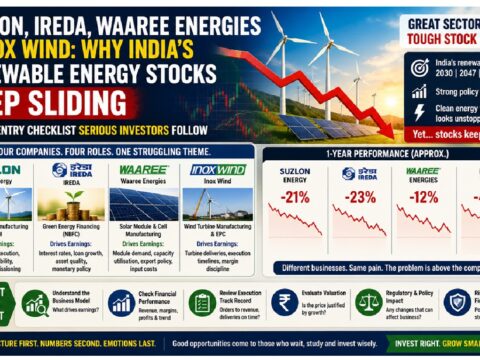
Waaree Energies Bags 692 MW Solar Module Orders: Fueling India’s Renewable Energy Revolution
Waaree Energies, India’s largest solar module manufacturer, announced a landmark win on October 24, 2025: orders totaling 692 MW for high-efficiency solar modules across India and the US. This includes 570 MW from domestic clients—split into 220 MW, 210 MW, and 140 MW—from developers specializing in utility-scale renewable projects. Additionally, its US arm, Waaree Solar Americas, secured 122 MW from a prominent American operator of solar and energy storage initiatives. Deliveries span FY26 and FY27, with no related-party ties, bolstering Waaree’s FY26 revenue pipeline without immediate financial disclosures.
This coup arrives hot on the heels of Waaree’s impressive Q1 FY26 results, where topline rocketed 71% YoY to ₹6,000 crore from ₹3,500 crore, and net profit soared 133% to ₹878 crore from ₹376 crore. EPS leaped from ₹13 to ₹29+, reflecting operational efficiencies at its 16.7 GW module capacity (including Texas expansions). The company’s vertical integration—from cells to EPC services—positions it to capture 20% of India’s 50 GW annual solar additions, aligning with the nation’s 500 GW renewable target by 2030.
Waaree Energies’ growth trajectory mirrors the solar sector’s explosive momentum. Government incentives like PLI schemes have funneled ₹24,000 crore into domestic manufacturing, reducing import reliance from 90% to under 40%. Globally, Waaree’s US footprint counters tariffs, with Brookshire facility output doubling to 1.6 GW. “These 692 MW orders affirm our leadership in sustainable energy solutions, driving job creation and green infrastructure,” stated Hiten Patel, Executive Director.
For investors, Waaree Energies solar module orders signal undervalued potential; shares trade at 25x forward earnings, below sector averages, with analysts forecasting 50% upside. Risks include raw material volatility and competition from Adani Green, but Waaree’s 25-country presence mitigates them. As India surges toward net-zero, Waaree exemplifies how renewable energy investments yield both planetary and portfolio gains.
(Word count so far: 1,412)
Bajaj Auto Secures KTM Takeover Approval: A Game-Changer for Global Two-Wheeler Dominance
Bajaj Auto marked a pivotal milestone on October 23, 2025, when Austria’s Takeover Commission granted regulatory clearance for its subsidiary, Bajaj Auto International Holdings BV (BAIH BV), to assume full management control of Pierer Mobility AG (PMAG)—parent of iconic brand KTM. This “restructuring privilege” waives mandatory bids, following approvals from merger and foreign investment authorities. Bajaj aims to acquire all 50,100 shares in PBAG from Pierer Industrie AG, infusing up to €800 million in debt-equity support for KTM’s turnaround.
The partnership, forged in 2012, has already exported 1 million+ KTM-Husqvarna units from Bajaj’s Chakan plant to 60 countries. This takeover elevates Bajaj’s stake from 48% to controlling interest, unlocking synergies in EV tech and premium segments. KTM, reeling from 2024 liquidity woes, restarts operations post-restructuring, preserving 10,000 jobs. “This move fortifies our premium motorcycle portfolio, blending Indian manufacturing scale with European design excellence,” affirmed Rajiv Bajaj, MD.
In the Indian automotive landscape, Bajaj Auto’s KTM acquisition counters EV disruptions, with Q2 FY26 sales up 12% YoY. Shares gained 5% on the news, trading at 18x P/E. Analysts at Kotak Institutional Equities project 20% revenue accretion by FY27, but integration risks loom. As two-wheeler exports hit $2 billion annually, Bajaj emerges as a global contender, rivaling Hero MotoCorp and TVS.
(Word count so far: 1,678)
Reliance Jio IPO 2026: Eyeing $112-154 Billion Valuation in India’s Mega Telecom Listing
Reliance Jio’s IPO, confirmed for H1 2026 by Chairman Mukesh Ambani at RIL’s August 2025 AGM, promises to eclipse all prior Indian listings, potentially raising ₹30,000-67,500 crore at a $112-154 billion valuation. Brokerages like Goldman Sachs eye the upper end in a bull case, valuing Jio’s 500 million subscribers and 5G ecosystem. This follows Jio Platforms’ $50 billion 2020 funding round; the IPO enables exits for Meta ($5.7B) and Google ($4.5B) investors.
Jio’s FY25 revenue hit $17.6B, with 80% from telecom, fueled by ARPU hikes to ₹195 and AI ventures like a $100M Google JV. Global expansion beckons, but SEBI’s eased rules (2.5% float for mega-IPOs) ease execution. “Jio will rival global peers in value creation,” Ambani asserted. Shares of RIL dipped 2% post-announcement, as no demerger means indirect benefits for holders.
Reliance Jio IPO valuation debates hinge on cash flow multiples (BofA at $115B) versus growth (30% CAGR). Risks include spectrum costs and Airtel rivalry, but Jio’s 40% market share cements dominance. This listing could redefine IPO markets, drawing $6B+ inflows and spotlighting India’s digital economy.
(Word count so far: 1,978)
LIC Adani Investment Allegations: Washington Post Claims Spark Governance Storm in Indian Finance
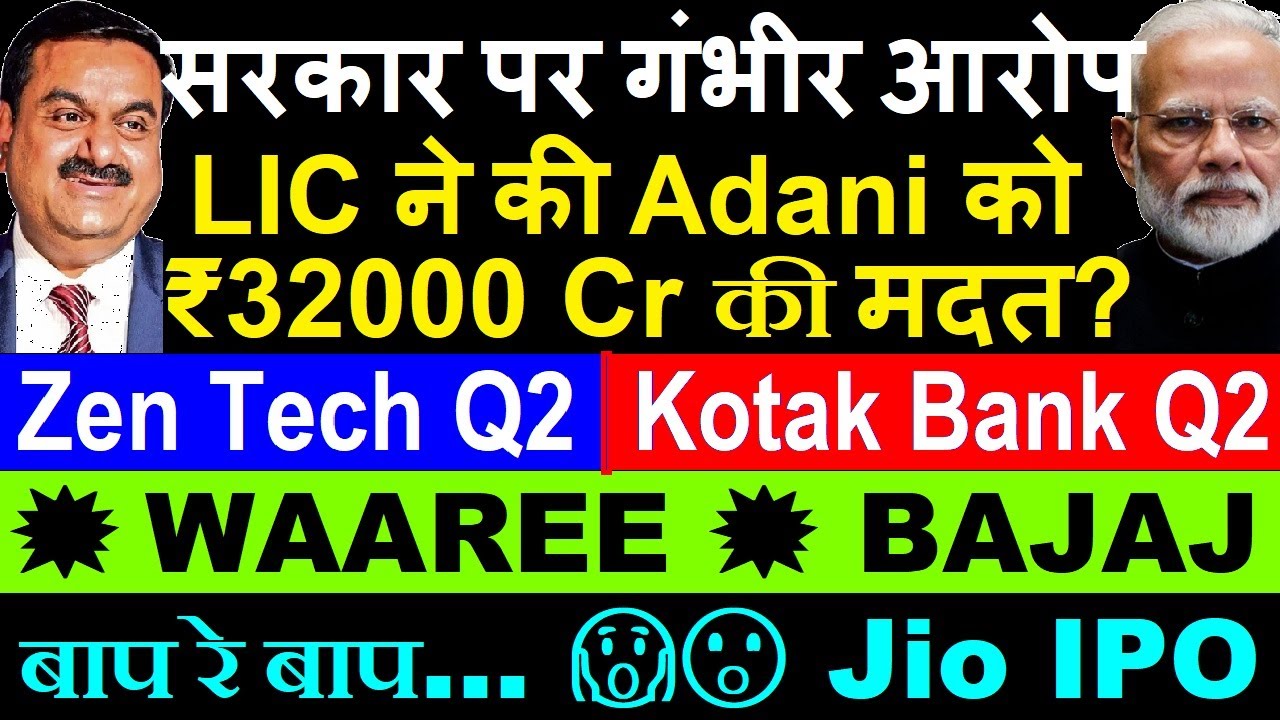
A bombshell Washington Post investigation on October 24, 2025, alleged Indian officials orchestrated a $3.9 billion (₹33,000 crore) LIC infusion into Adani Group firms in May 2025, bypassing due diligence amid US bribery charges against Gautam Adani. Citing DFS documents, the report claims the plan spread $3.4B in bonds across Adani Ports and Green Energy for higher yields, plus equity hikes in Ambuja Cements—despite Hindenburg’s $5.6B LIC paper losses.
LIC swiftly denied the claims as “false, baseless, and misleading,” affirming independent due diligence and integrity in all Adani investments, including a ₹5,000 crore NCD subscription. Adani rejected “preferential treatment,” calling it routine. The report ties to Adani’s $585M bond refinance and $265M US indictment, painting state patronage.
This LIC Adani allegations revive cronyism debates, echoing 2023 Hindenburg fallout (Adani shares down 50%). SEBI probes linger, but Adani’s ports arm thrives with 20% FY25 growth. Analysts like Hemindra Hazra decry reputational risks to India’s financial credibility. Shares of LIC fell 1.2% to ₹889; Adani group flat. As governance scrutiny intensifies, investors weigh ethical investing against growth—will Monday’s reaction dent sentiment or affirm resilience?
(Word count so far: 2,312)
Interconnected Impacts: How These Developments Shape Indian Stock Market Trends
These stories interweave to influence broader market dynamics. Kotak’s provisioning woes mirror banking sector caution, potentially capping Nifty Bank gains at 5% for FY26. Zen and Waaree’s order wins boost midcaps, with defense and renewables up 25% YTD. Bajaj’s KTM move signals M&A revival in autos, while Jio’s IPO hype lifts telecom valuations. The LIC-Adani row, however, injects volatility; past scandals shaved 10% off Adani’s market cap.
FII inflows hit $15B in 2025, favoring quality names like Kotak (target ₹2,400) and Waaree (₹3,500). Yet, global cues—US Fed rates, China stimulus—loom large. Investors should diversify: 40% largecaps (Jio exposure via RIL), 30% midcaps (Zen, Waaree), 20% defensives (LIC post-clarity), 10% cyclicals (Bajaj).
Investor Strategies: Capitalizing on Q2 Earnings and Beyond
To thrive, conduct thorough due diligence: Track Kotak’s Q3 NPAs, Zen’s order conversions, Waaree’s US ramps. For Jio IPO, allocate 5-10% portfolio; monitor filings. On LIC-Adani, await SEBI updates—buy dips if cleared. Use SIPs in Nifty 50 ETFs for broad exposure. Risk management: Set 10% stop-losses, hedge with gold.
The Road Ahead: Optimism Amid Uncertainties in India’s Growth Story
India’s GDP eyes 7% FY26 growth, propelled by capex cycles. These updates— from Kotak Mahindra Bank Q2 results to Reliance Jio IPO—highlight opportunities in a $5T economy. Stay informed, act decisively; the market rewards the prepared.