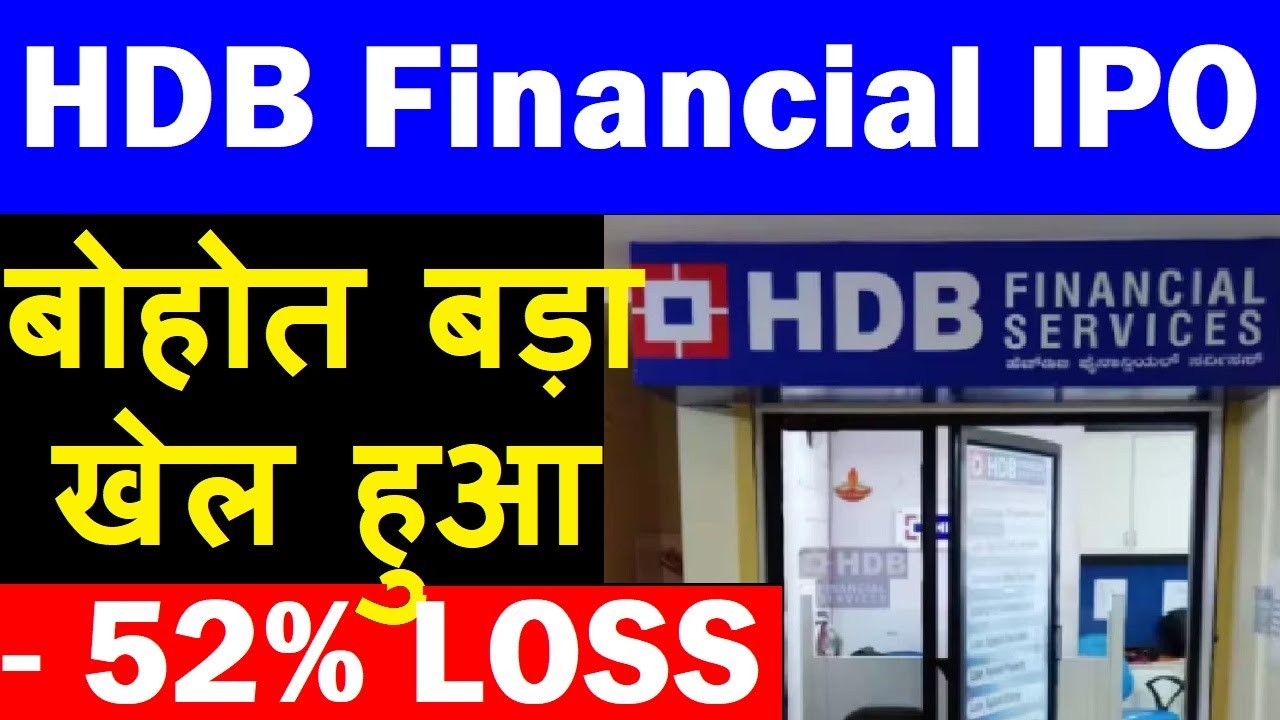
The highly anticipated HDB Financial Services IPO has sent shockwaves through the unlisted share market, leaving early investors reeling from potential losses of up to 52%. As a subsidiary of the reputable HDFC Bank, HDB Financial was expected to be a blockbuster IPO, but the reality has been far from rosy for those who invested in its unlisted shares. This article dives deep into the HDB Financial IPO debacle, exploring what went wrong, why unlisted markets are so risky, and how investors can avoid similar pitfalls in the future. Whether you’re a seasoned investor or a newbie in the stock market, this comprehensive guide will arm you with the knowledge to navigate the volatile world of unlisted shares and IPOs.
What Is the HDB Financial IPO Debacle?
The HDB Financial Services IPO, slated to open in the coming weeks, has turned heads for all the wrong reasons. Early investors in the unlisted market—those who purchased shares before the company went public—are now staring at notional losses ranging from 40% to 52%. But what exactly happened?
HDB Financial Services, a non-banking financial company (NBFC) under HDFC Bank, was a hot pick in the unlisted market due to its strong parentage and promising growth prospects. Investors poured money into its shares, expecting a massive payoff when the company listed on the stock exchange. However, the IPO’s announced price band of ₹700–₹740 per share has shattered those dreams, as unlisted shares were trading at much higher prices—peaking at ₹1,550 in September 2024 and hovering around ₹1,275 just before the IPO announcement.
This drastic price drop has left investors in disbelief, with some calling it a “game-changer” in the worst possible way. Let’s break down the key factors behind this unprecedented loss and what it means for the broader unlisted share market.
Understanding the Unlisted Share Market
Before diving into the HDB Financial IPO specifics, it’s crucial to understand the unlisted share market and why it’s a double-edged sword for investors.
What Are Unlisted Shares?
Unlisted shares are stocks of companies that are not yet listed on a stock exchange like the NSE or BSE. These shares are traded in the over-the-counter (OTC) market, often through brokers or specialized platforms. Companies like HDB Financial Services, which are preparing for an IPO, often see significant trading activity in the unlisted space as investors try to get in early.
Why Do Investors Buy Unlisted Shares?
The allure of unlisted shares lies in their potential for high returns. Investors believe that buying shares at a lower price before the IPO will allow them to sell at a premium once the company lists. However, this strategy is fraught with risks, as the HDB Financial case vividly illustrates.
Risks of Unlisted Shares
- Lack of Regulation: Unlike listed stocks, unlisted shares are not subject to stringent regulatory oversight, making them prone to manipulation and misinformation.
- High Volatility: Prices in the unlisted market are driven by speculation and hype, leading to wild swings.
- Liquidity Issues: Selling unlisted shares can be challenging, especially during adverse market conditions.
- Valuation Discrepancies: The price of unlisted shares often doesn’t reflect the company’s true valuation, as seen in the HDB Financial IPO.
The HDB Financial IPO: A Timeline of Events
To understand the scale of the HDB Financial IPO shock, let’s trace the timeline of events that led to this moment.
September 2024: Unlisted Shares Peak at ₹1,550
In September 2024, HDB Financial’s unlisted shares were trading at a staggering ₹1,550, fueled by hype around the upcoming IPO and the company’s strong fundamentals. Investors, both retail and institutional, scrambled to buy shares, expecting a blockbuster listing.
Pre-IPO Decline: Shares Drop to ₹1,275
Even before the IPO announcement, cracks began to appear. By late 2024, the unlisted share price had slipped to ₹1,275, a 17% drop from its peak. This decline was a warning sign, but many investors dismissed it as a temporary correction.
IPO Price Band Announcement: ₹700–₹740
The real bombshell dropped when HDB Financial announced its IPO price band of ₹700–₹740 per share. This was a far cry from the ₹1,275 unlisted price, let alone the ₹1,550 peak. The announcement triggered panic among unlisted shareholders, who now faced notional losses of 40–52%.
Valuation Shock: ₹59,000 Crore vs. ₹60,500 Crore Expectation
Adding to the distress, HDB Financial’s valuation came in at approximately ₹59,000 crore, lower than the anticipated ₹60,500 crore. This ₹3,500 crore shortfall further eroded investor confidence, highlighting the disconnect between unlisted market hype and actual company valuations.
Why Did Unlisted Shareholders Lose So Much?
The HDB Financial IPO debacle is a textbook case of how unlisted market speculation can backfire. Here are the key reasons behind the massive losses:
Overhyped Valuations
Unlisted share prices are often driven by hype rather than fundamentals. In HDB Financial’s case, investors assumed the IPO would list at ₹1,200–₹1,350, based on unlisted market trends. However, the company’s conservative price band of ₹700–₹740 reflected a more realistic valuation, catching investors off guard.
Lack of Due Diligence
Many investors bought HDB Financial shares without thoroughly researching the company’s financials or understanding the risks of unlisted markets. Social media influencers and YouTube channels often amplify hype, leading retail investors to make impulsive decisions.
Misaligned Expectations
Investors in unlisted shares often expect quick profits by selling at a premium post-listing. However, IPOs come with terms and conditions, such as lock-in periods, that can delay or limit selling opportunities. HDB Financial’s IPO was no exception, leaving investors stuck with depreciating shares.
Market Dynamics
The unlisted market operates on trust and large-volume deals, which can distort prices. When the IPO price band was announced, the unlisted market had no choice but to align with the lower valuation, resulting in a sharp correction.
Notional Loss vs. Actual Loss: What’s the Difference?
One term that’s been thrown around in the HDB Financial IPO saga is “notional loss.” Let’s clarify what it means and how it applies to unlisted shareholders.
What Is Notional Loss?
A notional loss occurs when the value of an investment declines on paper, but the investor hasn’t sold the asset to realize the loss. For example, if you bought HDB Financial shares at ₹1,550 and the IPO price is ₹740, your notional loss is 52%. However, if you hold onto the shares and the price recovers post-listing, the loss could shrink or disappear.
Notional Loss in HDB Financial’s Case
- At ₹1,275: Investors who bought at ₹1,275 face a notional loss of 42% based on the ₹740 IPO price.
- At ₹1,550: Those who bought at the peak of ₹1,550 are looking at a 52% notional loss.
Can Investors Recover?
The notional nature of the loss offers a glimmer of hope. If HDB Financial’s shares perform well post-listing, investors could recoup some or all of their losses. However, this depends on market sentiment, the company’s performance, and broader economic conditions.
Is This the First Time? Lessons from Past IPOs
The HDB Financial IPO shock may feel like a one-off, but history tells a different story. Several high-profile IPOs have burned unlisted shareholders in similar ways. Here are a few examples:
UTI AMC IPO
UTI Asset Management Company’s unlisted shares were trading at a premium before its IPO. However, the IPO price band was significantly lower, leading to losses for early investors.
Tata Technologies IPO
Tata Tech’s unlisted shares were hyped up, but the IPO listing price disappointed investors, resulting in notional losses of 20–30%.
PB Fintech IPO
PB Fintech (Policybazaar’s parent company) saw unlisted shares trade at ₹100, only for the IPO to price them at ₹70–₹80, leaving investors in the red.
These cases underscore a critical lesson: unlisted markets are inherently risky, and IPO price bands often reflect a company’s true valuation, not the speculative prices in the unlisted space.
Why Unlisted Markets Are a Minefield
The HDB Financial IPO debacle highlights the dangers of unlisted markets. Here’s why they’re a minefield for investors:
Lack of Transparency
Unlisted markets lack the transparency of stock exchanges. Prices are often set by brokers or large players, leaving retail investors vulnerable to manipulation.
Social Media Hype
In the age of social media, influencers and YouTubers often promote unlisted shares without disclosing risks. Retail investors, swayed by promises of quick profits, jump in without proper research.
Unrealistic Expectations
Many investors buy unlisted shares expecting to double or triple their money post-IPO. However, as HDB Financial shows, IPOs don’t always deliver blockbuster gains.
Hidden Terms and Conditions
Unlisted shares often come with lock-in periods or other restrictions that limit selling opportunities. Investors who overlook these terms can find themselves trapped in a losing position.
How to Avoid Unlisted Market Pitfalls
The HDB Financial IPO serves as a wake-up call for investors. Here are practical tips to avoid similar losses in the unlisted market:
Do Your Homework
Before investing in unlisted shares, research the company’s financials, management, and growth prospects. Don’t rely solely on social media or broker recommendations.
Understand Valuations
Learn to assess a company’s valuation based on metrics like price-to-earnings (P/E) ratio, revenue growth, and market share. If the unlisted price seems inflated, it probably is.
Stay Skeptical of Hype
Be wary of social media influencers or YouTubers promoting unlisted shares. Many have vested interests and may not disclose the risks.
Diversify Your Portfolio
Don’t put all your money into unlisted shares. Diversify across asset classes like mutual funds, listed stocks, and fixed-income securities to reduce risk.
Consult a Financial Advisor
If you’re unsure about unlisted investments, consult a certified financial advisor who can guide you based on your risk tolerance and financial goals.
What’s Next for HDB Financial Shareholders?
For unlisted shareholders of HDB Financial, the road ahead is uncertain. Here are some scenarios to consider:
Hold and Hope
If you believe in HDB Financial’s long-term growth, holding onto your shares post-listing could be a viable strategy. The company’s strong parentage and NBFC expertise make it a solid bet for patient investors.
Cut Your Losses
If you’re unwilling to wait, selling your shares post-listing might be the best option, even if it means booking a loss. This depends on your financial situation and risk appetite.
Monitor Market Sentiment
Keep an eye on market sentiment post-IPO. If HDB Financial’s shares gain traction, you might recover some of your notional losses. Conversely, if the stock underperforms, it may be time to exit.
Broader Implications for the IPO Market
The HDB Financial IPO shock has ripple effects beyond unlisted shareholders. Here’s how it could impact the broader IPO market:
Increased Scrutiny of Unlisted Markets
Regulators may tighten oversight of unlisted markets to protect retail investors from speculative bubbles.
Shift in Investor Behavior
The HDB Financial debacle could make investors more cautious about unlisted shares, leading to lower trading volumes in the OTC market.
Focus on Fundamentals
Investors may prioritize company fundamentals over hype, leading to more rational valuations in both unlisted and IPO markets.
The NSC IPO: Another Potential Shock?
As if the HDB Financial IPO wasn’t enough, another IPO is raising eyebrows: the National Stock Exchange (NSE) IPO. Early reports suggest unlisted NSE shares have dropped 50–60% in a week, sparking panic among investors. While details are scarce, the NSE IPO could follow a similar trajectory, with the price band potentially undercutting unlisted prices.
This underscores the need for caution in unlisted markets. Until the NSE announces its price band, investors should avoid speculative bets and focus on verified information.
Key Takeaways for Investors
The HDB Financial IPO debacle offers valuable lessons for investors:
- Unlisted Markets Are Risky: Anything can happen in the unlisted space, from massive gains to crippling losses.
- Hype Is Dangerous: Don’t let social media or influencers sway your investment decisions.
- Valuations Matter: Always assess a company’s true worth before investing.
- Patience Pays: Shortcuts like unlisted shares rarely deliver consistent returns.
- Learn from History: Past IPOs like UTI AMC and Tata Tech show that unlisted shocks are not uncommon.
Conclusion: Navigating the Unlisted Market Minefield
The HDB Financial Services IPO has exposed the dark side of unlisted share investments, leaving early investors with notional losses of up to 52%. While the company’s strong fundamentals and HDFC Bank’s backing offer hope for recovery, the immediate pain is undeniable. This saga serves as a stark reminder that unlisted markets are not for the faint-hearted. They demand rigorous research, skepticism of hype, and a willingness to accept high risks.
As you navigate the stock market, prioritize fundamentals over speculation and diversify your portfolio to mitigate risks. Whether you’re eyeing the upcoming NSE IPO or other unlisted opportunities, let the HDB Financial debacle guide your decisions. Stay informed, stay cautious, and invest wisely.
For more insights on IPOs, stock market strategies, and financial planning, subscribe to our newsletter and follow our YouTube channel. Don’t let the next big IPO catch you off guard—arm yourself with knowledge and take control of your financial future.