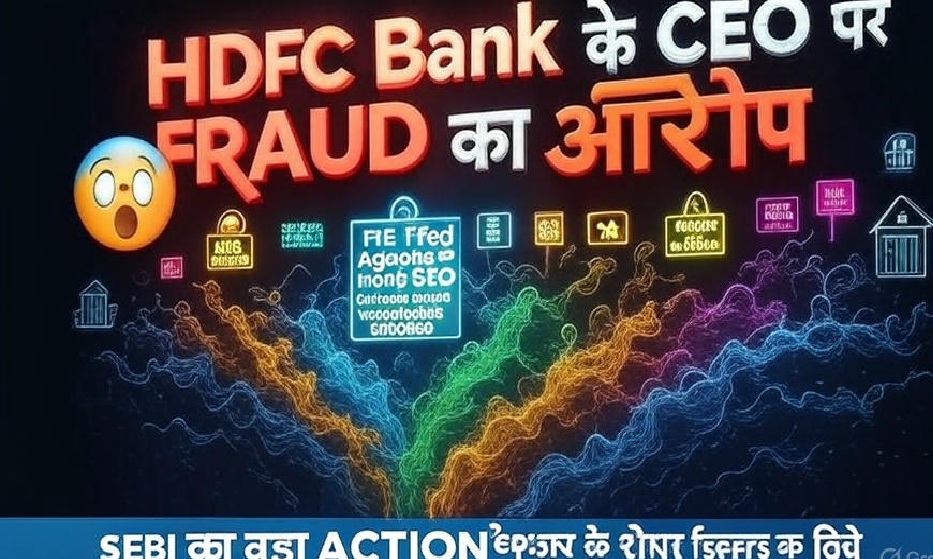
In the fast-paced world of Indian finance, few institutions command as much respect and influence as HDFC Bank. As one of India’s leading private-sector banks, it has long been a cornerstone of the nation’s financial ecosystem. However, recent developments have thrust the bank into the spotlight for all the wrong reasons. Allegations of financial fraud leveled against its CEO, Sashidhar Jagdishan, by the Lilavati Trust have sent shockwaves through the industry, raising questions about trust, governance, and the bank’s future trajectory. This article dives deep into the controversy, its implications for HDFC Bank and the broader stock market, and other key market updates that are shaping investor sentiment.
The Lilavati Trust Allegations: A Deep Dive into the Controversy
What Are the Allegations Against Sashidhar Jagdishan?
The Lilavati Trust, a prominent charitable organization linked to Mumbai’s Lilavati Hospital, has made serious accusations against HDFC Bank’s CEO, Sashidhar Jagdishan. The trust alleges that Jagdishan was involved in a financial fraud scheme, specifically claiming that he received ₹2 crore in unaccounted cash from a former hospital trustee to harass the father of a current trust member. These claims, described as “dark allegations” by market analysts, have sparked intense debate about their validity and potential impact on HDFC Bank’s reputation.
The accusations are not just a personal attack on Jagdishan but also a challenge to the governance standards of one of India’s most trusted financial institutions. The trust has gone so far as to demand Jagdishan’s suspension and the initiation of legal proceedings against him, escalating the matter into a high-stakes corporate drama.
HDFC Bank’s Response: A Strong Denial
HDFC Bank has categorically denied the allegations, labeling them as “baseless” and “malicious.” In an official statement, the bank dismissed the claims as an attempt to tarnish its reputation and announced its intent to pursue legal action against the accusers. The bank’s leadership emphasized that there is no evidence to support the trust’s claims and accused the organization of orchestrating a smear campaign.
This swift and forceful response underscores HDFC Bank’s commitment to protecting its brand and maintaining investor confidence. However, the mere existence of such allegations, regardless of their merit, can create uncertainty in the market, particularly for a bank that plays a pivotal role in India’s financial indices.
Potential Market Implications
HDFC Bank is a heavyweight in India’s stock market, with significant influence on indices like the Nifty 50 and Sensex. Any negative news surrounding its leadership could trigger volatility in its stock price and ripple across the broader market. Investors will be closely monitoring how the market reacts to this controversy when trading resumes. Will the allegations dent HDFC Bank’s stellar reputation, or will the bank’s robust denial and legal countermeasures restore confidence? The coming weeks will be critical in determining the outcome.
Broader Market Updates: Key Companies in Focus
While the HDFC Bank controversy dominates headlines, several other companies and sectors are also making waves in the Indian stock market. Below, we explore the latest developments that investors should keep on their radar.
MCX: A Boost from SEBI’s Approval
The Multi Commodity Exchange of India (MCX) is poised for growth following a significant regulatory update. The Securities and Exchange Board of India (SEBI) has granted MCX permission to launch electricity derivatives on its platform. This move is expected to diversify MCX’s offerings and drive business expansion, potentially boosting its stock performance. Investors looking for opportunities in the commodity trading space should study MCX closely, as this development could enhance its long-term growth prospects.
Ola Electric: Navigating a Challenging Landscape
Ola Electric, a prominent player in India’s electric vehicle (EV) sector, is facing turbulent times. The company recently made headlines when its head, Bhavish Aggarwal, pledged an additional ₹20 crore worth of shares to maintain loan positions. This move comes as Ola’s share price has experienced significant volatility, with a downward trend reflecting broader challenges in the EV market.
Ola Electric is grappling with intense competition and declining market share, compounded by operational difficulties. The company’s financial metrics have been underwhelming, and negative sentiment continues to weigh on its stock. Investors should approach Ola Electric with caution, as the company’s ability to navigate these challenges will determine its future trajectory.
Adani Group: Cementing Its Dominance
The Adani Group remains a focal point for investors, with its cement business drawing particular attention. The CEO of Ambuja Cements, an Adani subsidiary, recently made a bold statement, claiming that the group controls approximately 30% of India’s home and infrastructure cement market. This includes brands like ACC and Ambuja, as well as other acquisitions that have solidified Adani’s position in the sector.
The group’s aggressive expansion strategy has positioned it as a dominant player in India’s infrastructure landscape. However, the market will be watching closely to see how Adani’s cement stocks react to this claim and whether the group can sustain its growth momentum.
Tesla’s Turbulence: A Global Perspective
On the global front, Tesla continues to capture attention following a significant market cap wipeout. The electric vehicle giant’s stock plummeted, erasing value equivalent to the market capitalization of India’s TCS. The decline has been attributed to tensions between Tesla CEO Elon Musk and U.S. political figures, particularly President Donald Trump. While Tesla’s long-term growth story remains intact, its near-term volatility makes it a stock to watch for risk-tolerant investors.
Insurance Sector: A Potential Premium Hike
The Indian insurance sector is buzzing with speculation about a potential increase in third-party insurance premiums. The Insurance Regulatory and Development Authority of India (IRDAI) has requested a premium hike of 18-25%, the first in three to four years. While this could be a burden for consumers, it’s a boon for insurance companies, as higher premiums would improve their top-line revenue.
Companies like ICICI Lombard and GIC Re have already seen positive market reactions to this news. Investors should keep an eye on these stocks, as an official announcement could drive further gains in the sector.
Gold Loan Providers: A Regulatory Win
Gold loan providers like Muthoot Finance, Manappuram Finance, and IIFL Finance are celebrating a recent regulatory update from the Reserve Bank of India (RBI). The RBI has increased the loan-to-value (LTV) ratio for gold loans up to ₹2.5 lakh from 75% to 85%. This means borrowers can now access up to ₹85,000 for every ₹1 lakh of gold pledged, making gold loans more attractive.
This change is expected to boost demand for gold loans, driving revenue growth for these companies. The market responded positively to the news, with stocks in the sector rallying. Investors should consider these companies for their portfolios, as the regulatory shift could lead to sustained growth.
Chemical Companies: Benefiting from Anti-Dumping Duties
The Indian government’s decision to impose anti-dumping duties on vitamin and rubber chemical imports from China, Japan, and the European Union is a significant win for domestic chemical companies. These duties protect local players by leveling the playing field against cheaper imports. Companies in this sector are likely to see improved margins and increased competitiveness, making them attractive investment options.
Tata Group: Mixed Fortunes
The Tata Group is experiencing a mix of challenges and opportunities across its portfolio. Tata Motors is facing headwinds due to difficulties at its Jaguar Land Rover (JLR) division, which is grappling with supply chain disruptions and a tough market environment. Conversely, Tata Power is gaining traction with a major contract in Uttar Pradesh, positioning it as a key player in the power sector. Investors should weigh these contrasting dynamics when evaluating Tata Group stocks.
Asian Paints: Facing Anti-Trust Scrutiny
Asian Paints, a leader in India’s paint industry, is under scrutiny following a complaint filed by Birla Opus (Aditya Birla Group’s paint division) with the Competition Commission of India (CCI). The complaint alleges that Asian Paints engaged in anti-competitive practices to suppress competition. While the investigation is ongoing, the allegations could impact Asian Paints’ market perception and stock performance. Investors should monitor developments closely, as the outcome could have long-term implications for the company.
Strategies for Investors: Navigating a Volatile Market
Focus on Fundamentals
In a market driven by news and sentiment, investors must prioritize companies with strong fundamentals. HDFC Bank, despite the current controversy, has a robust track record and a dominant position in the banking sector. Similarly, companies like MCX, Tata Power, and gold loan providers are well-positioned to capitalize on regulatory tailwinds and market opportunities.
Stay Informed on Regulatory Changes
Regulatory updates, such as SEBI’s approval for MCX’s electricity derivatives or the RBI’s gold loan LTV hike, can significantly impact stock performance. Staying informed about these changes allows investors to make timely decisions and capitalize on emerging trends.
Monitor Global and Domestic Risks
Global factors, such as Tesla’s volatility or China’s export restrictions on rare earth minerals, can influence Indian markets. Domestically, allegations like those against HDFC Bank’s CEO highlight the importance of governance and transparency. Investors should assess both global and local risks when building their portfolios.
Diversify Across Sectors
The Indian market offers opportunities across diverse sectors, from banking and insurance to chemicals and infrastructure. Diversifying investments across these sectors can mitigate risks and enhance returns, especially in a volatile market environment.
Conclusion: A Market in Flux
The allegations against HDFC Bank’s CEO, Sashidhar Jagdishan, have cast a shadow over one of India’s most trusted institutions. While the bank’s swift denial and legal countermeasures aim to restore confidence, the market’s reaction will be a key indicator of investor sentiment. Beyond this controversy, the Indian stock market is abuzz with developments across sectors, from MCX’s regulatory win to Ola Electric’s challenges and Adani’s cement dominance.
Investors must navigate this complex landscape with a blend of caution and opportunity-seeking. By focusing on fundamentals, staying informed on regulatory changes, and diversifying across sectors, they can position themselves for success in a dynamic market. As the market reopens, all eyes will be on HDFC Bank and other key players to see how these developments shape the future.