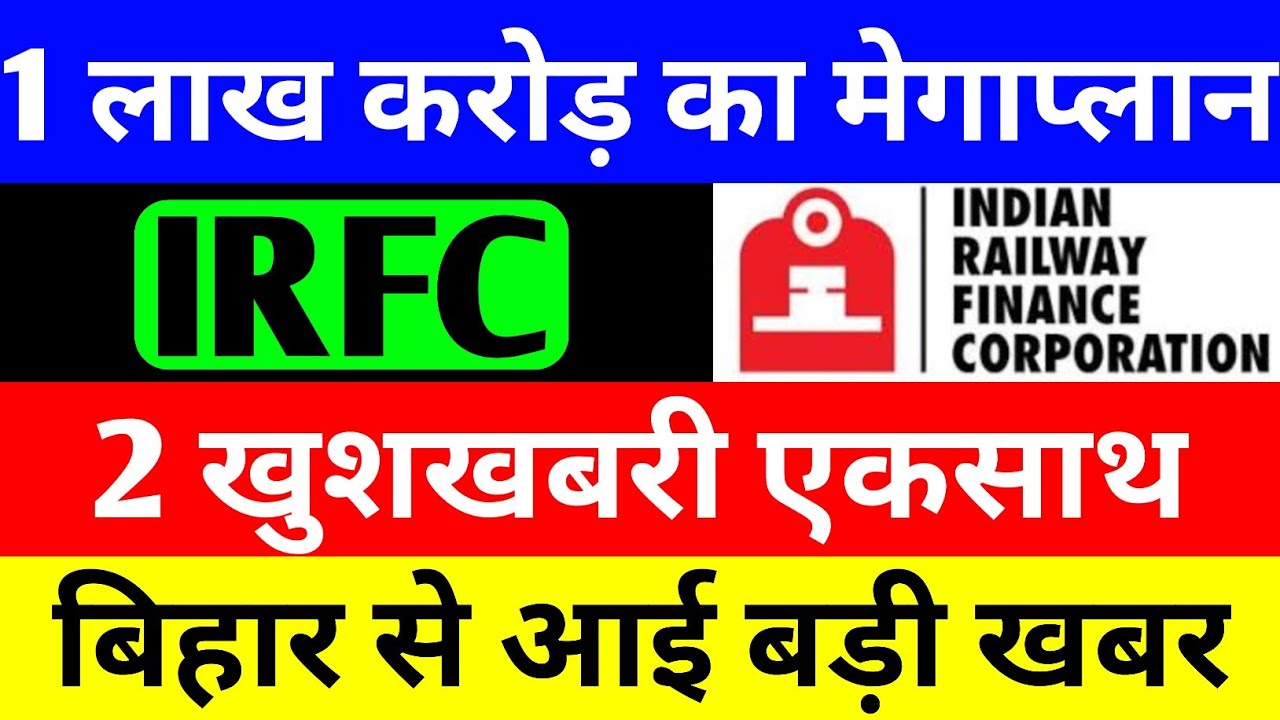
The Indian Railway Finance Corporation (IRFC) has been a focal point for investors, especially amid recent market volatility. While the stock has faced downward pressure due to Foreign Institutional Investor (FII) sell-offs, the Indian railway sector is poised for transformative growth. With a massive 1 lakh crore investment plan announced by Railway Minister Ashwini Vaishnaw, IRFC’s role in financing these ambitious projects positions it as a critical player in India’s infrastructure revolution. This article explores the latest updates, market trends, and long-term opportunities for IRFC shareholders.
Why IRFC’s Stock is Under Pressure: FII Sell-Offs and Market Sentiment
The recent dip in IRFC’s share price—closing at ₹131.77 with a 1.77% decline—reflects broader market turbulence. FIIs have been net sellers, offloading ₹24,863 crore in February 2024 alone, overshadowing Domestic Institutional Investor (DII) buying of ₹8,789 crore. This sell-off aligns with global risk aversion, but it masks the structural growth story unfolding in India’s railway sector.
Key factors driving short-term volatility:
- FII Liquidation: Persistent selling by foreign investors due to global macroeconomic uncertainties.
- Profit Booking: IRFC’s stock corrected nearly 75% from its all-time high of ₹229 (July 2023), triggering retail investor panic.
- Sector-Wide Correction: Broader market indices like Sensex and Nifty fell by 1.5% amid rising bond yields and geopolitical tensions.
However, this correction presents a potential entry point for long-term investors, given the government’s unprecedented focus on railway modernization.
1 Lakh Crore Mega Investment: Bihar’s Rail Revolution
Railway Minister Ashwini Vaishnaw’s announcement of a ₹1 lakh crore investment in Bihar underscores the government’s commitment to transforming rail infrastructure. This initiative includes:
- 12 New Vande Bharat Trains: Enhancing connectivity across 15 districts.
- 98 Amrit Bharat Stations: Modernizing stations with WiFi, lifts, and escalators.
- Track Electrification: 3,020 km of tracks electrified since 2014, achieving 100% electrification in key corridors.
- Expanded Network: Adding 1,832 km of new tracks—equivalent to Malaysia’s entire rail network.
Bihar’s Strategic Importance:
With state elections approaching in 2025, these projects aim to boost regional connectivity and economic growth. Over ₹8,645 crore has already been allocated for ongoing projects, while ₹10,66 crore is earmarked for station development in the 2024–25 budget—a ninefold increase compared to the UPA era (2009–2014).
Karnataka’s Rail Boost: ₹7,564 Crore Budget Allocation
Beyond Bihar, Karnataka has secured ₹7,564 crore for rail upgrades, despite the state’s Congress-led government. This funding will drive:
- Track Expansion: 150 km of new tracks annually, up from 113 km/year under previous administrations.
- Electrification: 294 route km electrified since 2014, a 16x jump from 2009–2014.
- Safety Upgrades: Advanced signaling systems and passenger amenities across 393 stations.
Karnataka’s rail network is now 96.5% electrified, rivaling Sri Lanka’s total infrastructure. Such investments highlight IRFC’s pivotal role in channeling funds to execute these national projects.
IRFC’s Financial Backbone: Fueling India’s Rail Ambitions
As the financing arm of Indian Railways, IRFC raises capital through bonds and loans to fund rolling stock, track upgrades, and station modernization. Key strengths include:
- Monopoly Status: Exclusive access to railway financing deals.
- Strong Asset Quality: Zero NPAs due to sovereign-backed agreements.
- Dividend Growth: Consistent payouts, with a 5.3% yield at current prices.
Post-Correction Valuation:
At ₹131, IRFC trades at a P/B ratio of 3.8—below its 5-year average of 4.2. Analysts cite a 25–30% upside potential if execution aligns with the ₹2.65 lakh crore national rail budget.
Future Catalysts: What’s Next for IRFC?
- Vande Bharat Expansion: 400 new trains by 2025, requiring ₹50,000 crore in funding.
- Freight Corridor Monetization: Dedicated routes to boost freight revenue by 15% annually.
- Global Partnerships: Collaborations with Japan and Germany for high-speed rail tech.
- Green Bonds: Raising ₹10,000 crore for solar-powered stations and eco-friendly initiatives.
Should You Invest in IRFC Now? Risks vs. Rewards
Bull Case:
- Infrastructure spending to drive 20% CAGR in loan book growth.
- Margin expansion as interest rates stabilize.
- Inclusion in MSCI indices attracting foreign inflows.
Bear Case:
- Delayed project execution due to bureaucratic hurdles.
- Rising borrowing costs impacting profitability.
- Political shifts altering funding priorities.
Expert Take:
“IRFC is a long-term play on India’s infrastructure boom. While short-term volatility persists, the stock could double by 2026 if rail capex sustains.” — Marketsmith India
Conclusion: Positioning for the Rail Renaissance
The Indian Railways’ ₹1 lakh crore investment marks a watershed moment for IRFC. While FII-driven sell-offs have dampened sentiment, the company’s monopoly in rail financing and the government’s growth focus make it a compelling bet. Investors should accumulate on dips, targeting ₹180–200 levels over 12–18 months.
Disclaimer: This analysis is for educational purposes only. Consult a financial advisor before investing.
Keywords: IRFC share price, Indian Railway Finance Corporation, 1 lakh crore rail investment, Ashwini Vaishnaw, railway stocks 2024, FII sell-off, Bihar rail projects, Karnataka rail budget, Vande Bharat trains, Amrit Bharat stations, IRFC future growth.