
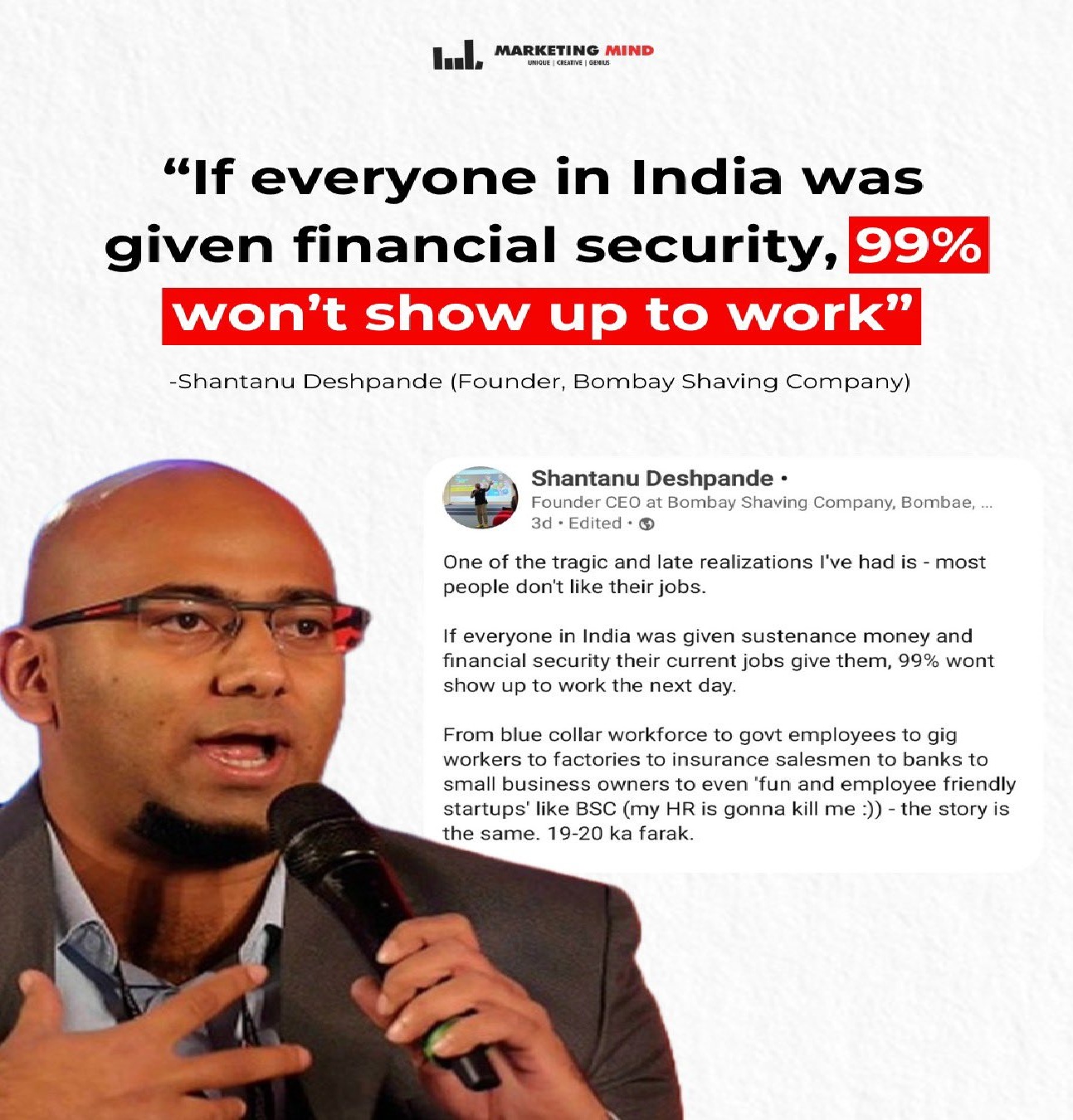
Shantanu Deshpande, the CEO of Bombay Shaving Company, has ignited widespread discussion about India’s work culture through a candid and thought-provoking LinkedIn post. In his post, Deshpande critiqued the dissatisfaction many Indians feel toward their jobs, the inequities of the country’s labor system, and the stark wealth disparity among its population.
This article delves into the key points raised by Deshpande, exploring the systemic challenges in India’s workforce and his call for a more compassionate and equitable society.
The Harsh Reality of Job Dissatisfaction in India
In his LinkedIn post, Deshpande revealed a startling observation: most Indian employees dislike their jobs and would quit working entirely if their financial needs were met. He stated, “One of the tragic and late realizations I’ve had is that most people don’t like their jobs. If everyone in India was given sustainable money and the financial security their current jobs give them, 99% wouldn’t show up to work the next day.”
This dissatisfaction isn’t confined to specific sectors. According to Deshpande, it spans across various industries, including blue-collar workers, government employees, gig workers, startups, and even organizations known for their employee-friendly environments.
India’s Work Culture: A “Dangling Carrot” System
Deshpande likened India’s work culture to a “dangling carrot” system, where employees are lured away from their families and homes for long hours, often extending into days and weeks, all for the promise of a paycheck. He remarked, “We just assume it’s alright to do that because that’s what’s been happening for 250+ years. That’s how nations have been built. So we do it.”
This system, rooted in historical practices, has perpetuated a cycle where work is seen as a necessity rather than a choice. Deshpande emphasized that for many Indians, work is a means to provide for their families, including spouses, children, elderly parents, and dependent siblings. “The starting point for most people is zero, and work is a majboori (compulsion) to survive,” he noted.
Wealth Inequality: A Stark Contrast
Another critical issue highlighted by Deshpande is the glaring wealth disparity in India. He pointed out that a mere 2,000 families control 18% of the nation’s wealth, while their contribution to taxes is less than 1.8%. He described this disparity as “insane” and underscored the challenges it poses to creating a fair and balanced society.
Deshpande also touched upon the narrative of “working hard to climb up,” which he admitted is often self-serving for those in positions of privilege. While 75% of billionaires may be self-made, he argued that the denominator is still too small to offer meaningful opportunities for the majority.
A Call for Compassion and Equity
In his concluding remarks, Deshpande urged individuals with resources and privilege to extend kindness and support to those less fortunate. “Life is very hard for most people. Very few will change that. Most people carry invisible burdens on tired shoulders and smile their way through inevitability. If you are privileged, be kind and generous and push as many people up as you can,” he wrote.
This heartfelt appeal resonated with many, highlighting the need for a collective effort to address the systemic challenges faced by India’s workforce.
Lessons from Deshpande’s Insights
The Bombay Shaving Company CEO’s post has sparked a necessary dialogue about the state of work culture in India. It sheds light on critical issues that require immediate attention:
- Job Satisfaction: Organizations must prioritize creating work environments that foster engagement and fulfillment.
- Work-Life Balance: Employers need to reassess expectations and provide employees with the flexibility to maintain a healthy balance between work and personal life.
- Wealth Distribution: Policymakers and industry leaders should address wealth disparity and work towards equitable opportunities for all.
- Compassionate Leadership: Leaders must adopt a more empathetic approach, recognizing the challenges faced by employees and supporting them in meaningful ways.
The Road Ahead: Rethinking Work Culture
Deshpande’s observations reflect a broader need to rethink and reshape India’s work culture. As the nation continues to grow and evolve, there is an urgent need to address systemic issues that hinder employee satisfaction and perpetuate inequality.
By fostering a culture of compassion, fairness, and inclusivity, India can pave the way for a workforce that is not only productive but also genuinely content and motivated. Deshpande’s call to action serves as a reminder that every individual.
India’s Workforce: Struggling with Job Dissatisfaction
Deshpande’s post laid bare a reality many silently endure: job dissatisfaction is rampant across professions in India. From blue-collar workers and government employees to gig economy participants and even those in “fun and employee-friendly startups,” the narrative remains consistent. He described this widespread discontent as a “19-20 ka farak” scenario, emphasizing the minimal difference in experience across diverse job roles.
According to Deshpande, most employees begin their professional journeys with nothing and are compelled to work to support their families. He termed this compulsion as “majboori” (helplessness), highlighting the systemic pressures that force people into roles they may not find fulfilling.
The “Dangling Carrot” Work Culture
The CEO drew a powerful analogy between India’s work culture and a “dangling carrot” system. He critiqued the long-standing societal norm of demanding employees spend extended hours away from their families, driven by the lure of financial security.
“For over 250 years, this model has shaped nations, justifying the endless hours employees dedicate to their jobs,” he wrote. However, Deshpande admitted to questioning the inequity of this structure. The psychological toll of this system, he noted, often goes unnoticed as employees bear their invisible burdens with a stoic smile.
The Stark Wealth Disparity in India
In his post, Deshpande shifted focus to another pressing issue: the wealth gap in India. According to him, 2,000 families in India control 18% of the nation’s wealth. This concentration of economic power, he argued, highlights a troubling inequity.
Deshpande also criticized the tax contributions of these wealthy families, stating that they collectively contribute less than 1.8% of the nation’s taxes. While acknowledging the role of self-made billionaires, he questioned whether the “work hard and climb up” narrative holds relevance for the masses, given the small denominator of success stories.
A Call for Compassionate Leadership
The Bombay Shaving Company CEO concluded his post with a heartfelt appeal to those in privileged positions. Acknowledging the difficulties faced by most workers, he urged leaders and resourceful individuals to adopt a compassionate approach.
“Life is very hard for most people,” Deshpande wrote. “If you are privileged, be kind, generous, and push as many people up as you can.”
The Broader Implications of Deshpande’s Reflections
Deshpande’s remarks raise crucial questions about the future of work in India. The pervasive dissatisfaction among employees underscores the need for systemic change. Workplaces must focus on creating more meaningful, equitable environments that prioritize employee well-being over relentless productivity.
The critique of wealth disparity also calls for policy interventions to address inequity and ensure a fairer distribution of resources. By fostering a culture of empathy and inclusion, leaders can contribute to a more balanced and fulfilling professional landscape.
Conclusion: A Mirror to Society
Shantanu Deshpande’s LinkedIn post has done more than just spark a debate—it has held up a mirror to India’s societal and economic structures. As conversations about work culture and wealth inequality gain momentum, his words serve as a reminder that change begins with awareness and compassion. For India to truly thrive, it must create a workforce that is not just financially secure but also mentally and emotionally fulfilled.