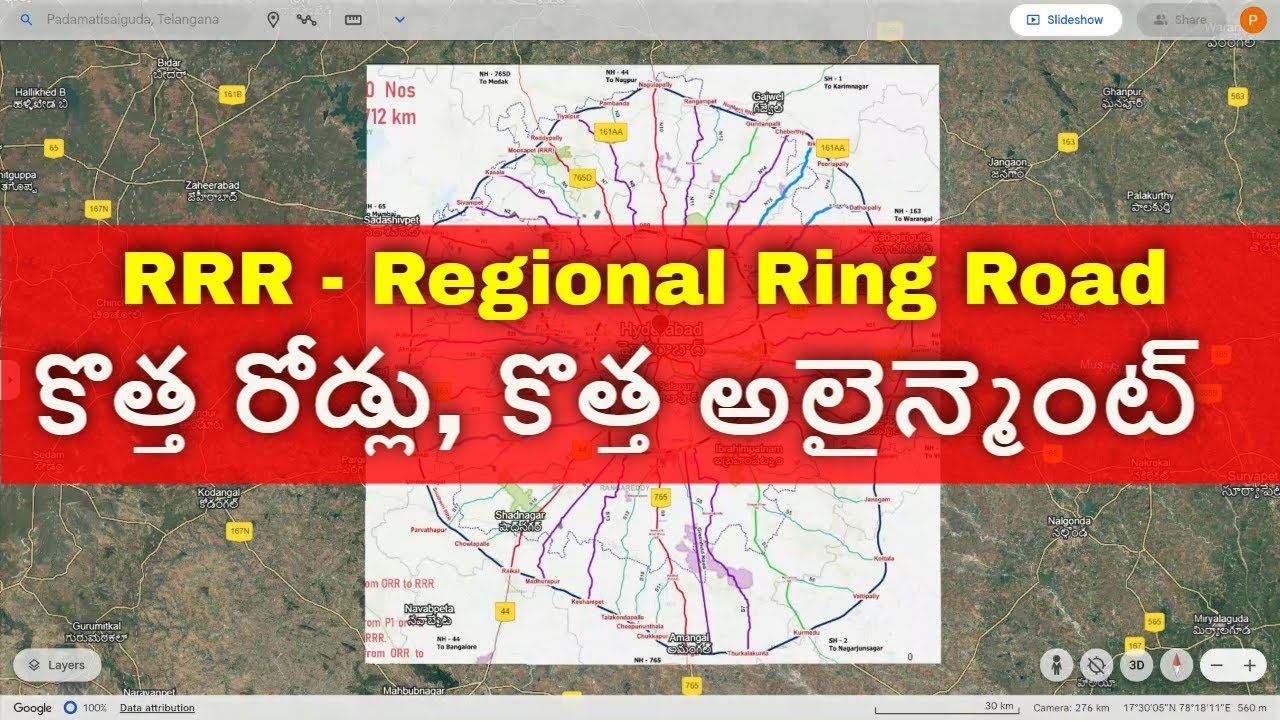
The Regional Ring Road (RRR) has taken a significant leap as the central Ministry of Environment, Forest, and Climate Change has granted forest clearance for its northern section. This pivotal approval enables the long-awaited project to progress, enhancing connectivity and boosting regional infrastructure development.
Forest Clearance: Key Approvals and Land Allocation
The Assistant Inspector General of Forests, Kailash Bhimrao Bhavar, communicated the approval via an official letter to the state authorities. The clearance falls under the Forest Conservation Act, approved by the Regional Empowered Committee (REC). This decision permits the use of forest land in various districts as follows:
- Medak District: 35.5882 hectares
- Siddipet District: 28.2544 hectares
- Yadadri District: 8.511 hectares
The forest land, allocated under Bharatmala Pariyojana Phase-1, is managed by the Project Implementation Unit (PIU) Gajwel. With this clearance, the National Highways Authority of India (NHAI) can now expedite the technical approvals, paving the way for tendering processes. The state government plans to issue tenders by December or January, marking a major milestone in the project’s timeline.
Project Details and Land Requirements
The northern alignment of the RRR spans approximately 161 kilometers, connecting regions such as Sangareddy, Toopran, Gajwel, Yadadri, and Choutuppal. The project has been divided into six packages, requiring an estimated 1,940 hectares of land, including 72.35 hectares of forest land.
To facilitate this, the state government had requested forest clearance through a letter to the central government on July 26, 2023. In return, the state has agreed to allocate compensatory land for forestation. The Detailed Project Report (DPR), submitted by NHAI, outlines critical details, including the construction of interchanges, bridges, underpasses, and culverts.
Accelerated Progress and Upcoming Tenders
State Minister for Roads and Buildings, Komatireddy Venkat Reddy, expressed gratitude to Union Minister Bhupender Yadav for granting the clearance. Highlighting the project’s progress, he confirmed that nearly 90% of land acquisition has been completed. The government aims to initiate tendering soon, underscoring its commitment to rapid infrastructure development.
Strategic Importance of the Northern Alignment
The northern section of the RRR forms a crucial part of the overall project, designed to decongest traffic in Hyderabad and improve connectivity between urban and rural areas. The alignment integrates several critical highways and proposed radial roads, ensuring seamless travel and reduced transit times for commuters and freight transport.
Innovative Road Designs and Phased Development
The RRR is being developed in multiple phases to optimize planning and execution:
- Phase 1: Focuses on connecting the Inner Ring Road (IRR), Outer Ring Road (ORR), and the RRR through 16 radial roads.
- Phase 2: Introduces an additional 16 radial roads, extending connectivity between the ORR and the RRR.
- Phase 3: Includes link roads connecting radial roads to the RRR, further enhancing the network.
The combined length of the proposed roads in these phases exceeds 1,700 kilometers, with designs emphasizing sustainability and efficient land use.
Environmental Considerations and Compensatory Measures
To mitigate the environmental impact, the state government has committed to providing alternate land for forestation. This aligns with India’s focus on sustainable development while advancing infrastructure projects of national importance.
Conclusion: A Boost to Regional Development
The Regional Ring Road’s northern alignment signifies a transformative step for Telangana’s infrastructure landscape. With forest clearance in place and technical approvals underway, the project is poised to accelerate, offering significant economic and logistical benefits to the region.
As tendering begins and construction unfolds, the RRR promises to be a game-changer, fostering growth, connectivity, and sustainability in the years to come.