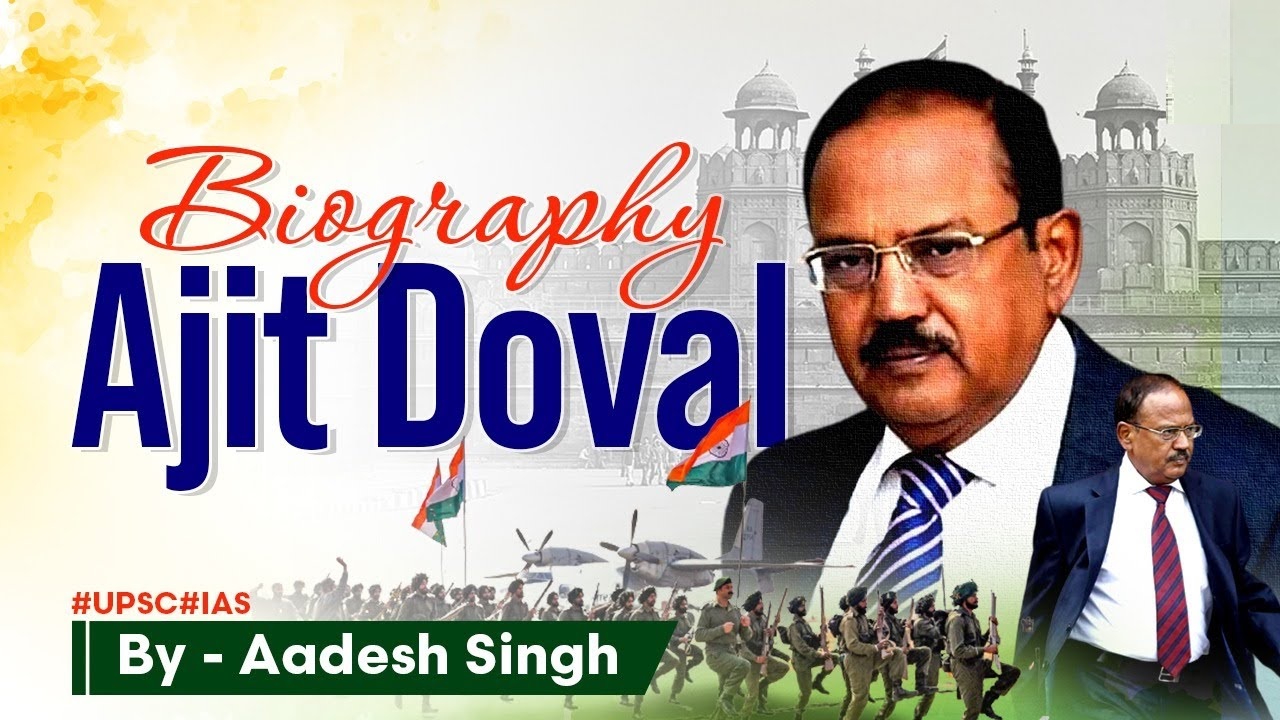
Ajit Doval has become one of India’s most influential figures in intelligence and security, known for his strategic mind and fearless approach to covert operations. From his early days in the Indian Police Service to his high-stakes missions across the nation, Doval’s life has been marked by a series of bold moves that have shaped India’s security landscape. His legacy spans counter-terrorism efforts, diplomatic intelligence gathering, and conflict resolution in some of India’s most turbulent regions.
Early Life and Education
Ajit Doval was born in Pauri Garhwal, Uttarakhand, into a family with a strong military background. His father, Major G.N. Doval, served in the Indian Army, a legacy that inspired Doval’s dedication to serving his country. Doval completed his schooling at the Indian Military Boarding School in Ajmer, Rajasthan. In 1967, he graduated with a master’s degree in economics from Agra University and subsequently cracked the Union Public Service Commission (UPSC) exam on his first attempt in 1968, joining the Indian Police Service (IPS) at the young age of 22.
First Mission in Kerala: Defusing Riots with Strategic Intelligence
In 1971, shortly after his appointment as Assistant Superintendent of Police (ASP) in Kerala’s Kottayam district, Doval faced a challenging incident in the Thalassery region, where religious tensions escalated into riots. Known for his courage and strategic insight, Doval intervened in the conflict, not with brute force but by gathering intelligence and negotiating with local leaders. His ability to understand the situation’s roots and retrieve looted properties helped end the unrest within days. His approach earned him national recognition, and by mid-1972, he was recruited into the Intelligence Bureau (IB) to support India’s covert operations.
Counter-Insurgency in Mizoram: Bringing Stability through Diplomacy
In the early 1970s, Doval was deployed to Mizoram, where he encountered the separatist movement led by Lal Denga of the Mizo National Front (MNF). The movement, fueled by local dissatisfaction and economic hardships, aimed to separate Mizoram from India. The situation grew volatile when former soldiers from the Mizo regiment joined the insurgency, strengthening MNF’s military capabilities.
Doval infiltrated the MNF ranks, gaining the trust of its key commanders. Over two years, he persuaded six of the seven top commanders to side with India, significantly weakening Lal Denga’s support and leading to peace negotiations. His covert operations played a pivotal role in stabilizing the region, and Mizoram was eventually declared a separate state. This accomplishment solidified Doval’s reputation as an exceptional intelligence officer.
Political Maneuvering in Sikkim: Countering External Influence
When the Himalayan kingdom of Sikkim was facing increasing influence from the United States, Doval was once again called to action. The US had gained leverage in Sikkim after CIA agent Hope Cooke married Sikkim’s King Palden Thondup Namgyal. To counter this, Doval worked with local political leaders, especially Kazi Dorjee of the Sikkim National Congress, providing them with resources to gain public support. Eventually, the public rallied behind Kazi, pushing for democratic governance. In 1975, after a referendum in which 97% voted in favor, Sikkim officially became a part of India.
Intelligence Work in Pakistan: Gathering Crucial Insights on Nuclear Ambitions
Following India’s nuclear tests, Pakistan intensified its own nuclear ambitions with support from China. Doval was stationed in Pakistan as part of India’s intelligence efforts to monitor these activities. Disguised in various personas, including that of a beggar, Doval gathered critical intelligence on Pakistan’s nuclear developments, particularly in the Kahuta region. Despite close calls, he relayed key insights to Indian intelligence agencies, enabling India to counter Pakistan’s nuclear advancements strategically.
Operation Blue Star and Golden Temple Incidents
In 1984, Operation Blue Star aimed to counter Sikh separatists led by Jarnail Singh Bhindranwale who had fortified themselves within the Golden Temple in Amritsar. Although successful in neutralizing the militants, the operation caused significant damage to the temple, sparking anger among the Sikh community. Four years later, in 1988, a similar crisis arose when pro-Khalistan militants occupied the Golden Temple again, expecting the government to avoid intervention. Doval played a crucial role in defusing the situation, helping bring it under control with minimal bloodshed.
Recognized for Service: Presidential Police Medal and National Recognition
Ajit Doval’s service to the nation was formally recognized with the President’s Police Medal, a prestigious honor typically awarded after 14 years of service. However, due to Doval’s exemplary contributions in Sikkim and Mizoram, he received this honor within just seven years. His strategies and courage during some of India’s most turbulent times helped elevate him to a position of critical importance in national security.
Legacy and Impact on India’s National Security Strategy
Ajit Doval’s career is marked by his steadfast dedication to India’s security, using his intelligence acumen to influence India’s policies on national and international stages. From counter-terrorism initiatives to diplomatic intelligence, Doval’s contributions have been instrumental in shaping India’s modern defense and intelligence framework. His courage and strategic foresight continue to inspire a new generation of security professionals dedicated to protecting India’s interests.
The Strategic Mind Behind India’s National Security
Ajit Doval is a highly influential figure in India’s national security, renowned for his tactical acumen and daring missions. His story is marked by covert operations, diplomatic negotiations, and a transformative approach to India’s security strategy. Let’s explore the key highlights of his impactful career.
The Role in Operation Black Thunder: Intelligence and Strategy
During the 1980s, India faced rising militant activities in Punjab, primarily centered around the Golden Temple in Amritsar. Ajit Doval, already a seasoned intelligence officer, gathered critical intelligence while undercover in Pakistan, relaying vital information to agencies in Punjab. When the decision was made to launch a counter-militant operation, Doval was called back to India, where he worked alongside KPS Gill to coordinate Operation Black Thunder.
To gather intelligence on militant positions, Doval disguised himself as a rickshaw driver and infiltrated the Golden Temple area. Recognizing the necessity of entering the Temple itself, he leveraged his proficiency in Urdu and a convincing Pakistani accent to pose as an ISI agent, gaining the militants’ trust. His infiltration allowed him to map their positions, enabling the Central Reserve Police Force (CRPF) and National Security Guard (NSG) commandos to conduct a highly successful operation.
The Kandahar Hijacking Negotiations: Ajit Doval’s Diplomacy in Action
In 1999, an Indian Airlines flight (IC-814) was hijacked and diverted to Kandahar, Afghanistan. The hijackers, associated with the terrorist group Harkat-ul-Mujahideen, demanded the release of militants from Indian prisons. Due to his extensive experience in handling hijackings, Doval was selected as part of the negotiation team. His role was instrumental in steering discussions, which eventually led to the release of hostages in exchange for a limited number of prisoners—a difficult but calculated decision under immense pressure.
Strengthening National Security: Establishing the Multi-Agency Center (MAC)
Following the Kandahar incident, Doval advocated for bolstered national security mechanisms. His efforts led to the establishment of the Multi-Agency Center (MAC) and the Joint Task Force on Intelligence (JTFI), enhancing intelligence sharing and collaboration among various security agencies. This was a crucial step in preempting and addressing potential threats more effectively.
Tactical Response to Threats: Ajit Doval and the Dawood Ibrahim Mission
In 2005, Ajit Doval devised a bold plan to target notorious underworld figure Dawood Ibrahim. He collaborated with Chhota Rajan, once an ally of Dawood, to eliminate him during a family event in Dubai. Although this operation ultimately fell through due to interference from law enforcement, it demonstrated Doval’s willingness to employ unconventional strategies to neutralize high-profile threats.
Founding Security Institutions: Raksha Shakti University and Vivekananda International Foundation
In 2008, under an invitation from then-Gujarat Chief Minister Narendra Modi, Doval helped establish the Raksha Shakti University, focusing on internal security and police science. Following this, he founded the Vivekananda International Foundation (VIF), a think tank dedicated to research on national security, diplomacy, and international relations. VIF became instrumental in providing policy recommendations and fostering discussions on critical security issues.
Combatting Corruption and Black Money: VIF’s Role
The Vivekananda Foundation took an active stance against corruption, publishing a report on Indian black money held abroad, which attracted significant attention. This report sparked discussions and protests, eventually leading to widespread anti-corruption movements. The foundation’s activism, along with its involvement in seminars featuring influential leaders like Baba Ramdev, Anna Hazare, and Arvind Kejriwal, positioned it as a key player in the fight against corruption.
Ajit Doval as National Security Advisor: A New Security Paradigm
In 2014, Doval was appointed National Security Advisor (NSA), marking a shift in India’s security strategy. He championed a “defensive-offensive” approach, moving India away from a traditionally defensive posture to a more proactive stance. His strategic planning was evident in significant operations, including the Myanmar strike, the Balakot airstrike, and the 2019 revocation of Article 370 in Jammu and Kashmir. Doval’s tenure has emphasized preemptive actions and a focus on deterrence, shaping India’s security landscape.
Facing Controversies: Allegations and Political Tensions
Doval’s close association with BJP leaders, especially Home Minister L.K. Advani, sparked controversy, with some accusing him of political bias. His proposed appointment as the chief of the Research and Analysis Wing (R&AW) was blocked due to political opposition, resulting in tension with the Congress-led government. Additionally, his son Shaurya Doval’s involvement with India Foundation and partnerships with international defense firms raised security concerns, further fueling opposition.
The Modi-Doval Alliance and the Rise of a Security-Driven Government
Doval’s influence continued to grow under the leadership of Prime Minister Narendra Modi, who valued Doval’s expertise in security matters. Their partnership led to several high-stakes operations, including the return of Indian nurses trapped in Iraq and the surgical strikes across the Line of Control in response to terror attacks. Doval’s strategic mindset has become central to India’s security framework, with his influence reaching across military, diplomatic, and intelligence domains.
Legacy and Ongoing Influence
Ajit Doval’s career exemplifies a commitment to India’s security, driven by bold actions and relentless pursuit of national interests. His innovative approach has redefined how India approaches security threats, positioning the country as a resilient force in the region.