Supreme Court Clarifies, Private Property as Community Resources under Article 39 b
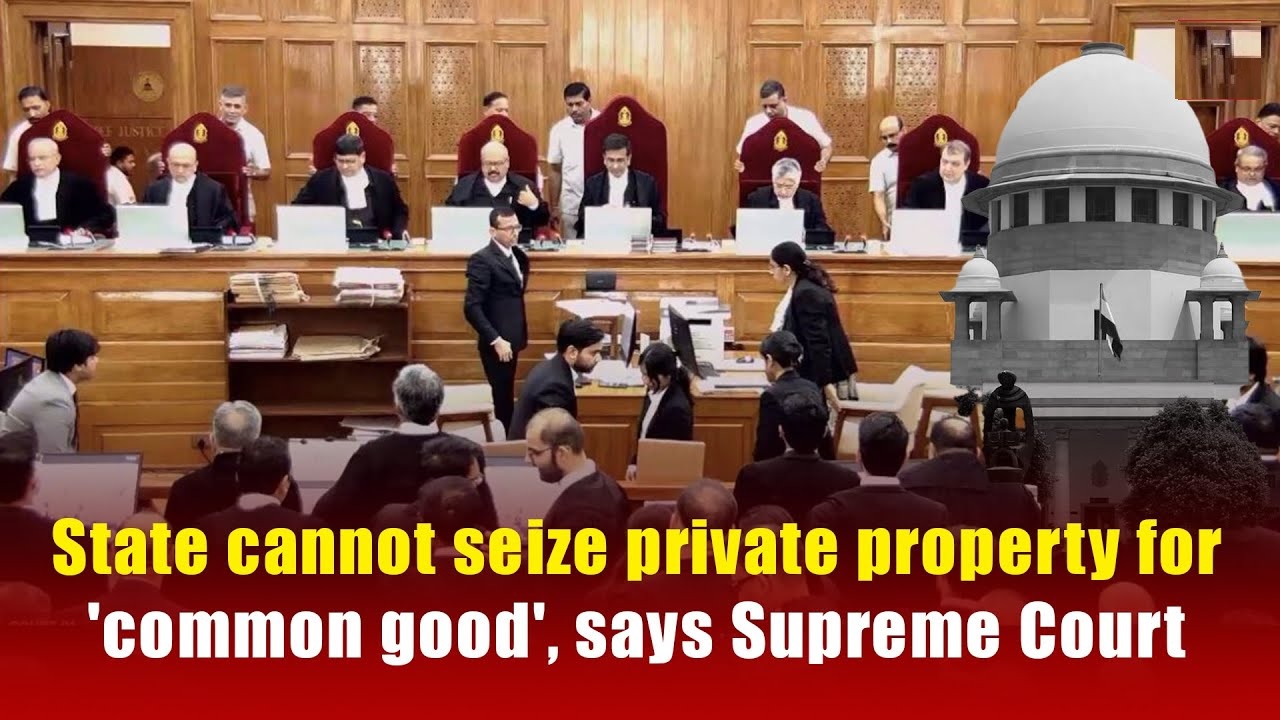
In a significant ruling on November 5, the Supreme Court of India determined that not all private property falls under the “material resources of the community” as outlined in Article 39(b) of the Constitution, which directs the State to ensure an equitable distribution of community resources. The majority decision, delivered by a 7:2 ratio in a nine-judge bench led by Chief Justice DY Chandrachud, ruled that while some privately-owned resources could be deemed community resources, this depends on their role and impact on society.
Key Aspects of the Judgment
The Supreme Court bench, comprising Justices DY Chandrachud, Hrishikesh Roy, B.V. Nagarathna, Sudhanshu Dhulia, J.B. Pardiwala, Manoj Misra, Rajesh Bindal, Satish Chandra Sharma, and Augustine George Masih, offered various perspectives on Article 39(b). Although the majority opinion authored by CJI Chandrachud gained the most consensus, Justice B.V. Nagarathna partly concurred, and Justice Dhulia issued a dissenting view.
Majority Opinion
The majority emphasized that not every privately-owned asset can be considered a community resource under Article 39(b). Referring to past judgments, the court diverged from the viewpoint of Justice Krishna Iyer in the case of State of Karnataka v. Ranganatha Reddy (1978), where it was argued that private properties could also serve as resources for the community. This earlier stance was also supported in Sanjeev Coke Manufacturing Company v. Bharat Coking Coal Ltd. (1983), but the Supreme Court now refutes it, ruling that privately held assets should not automatically qualify as “material resources.”
According to the majority, determining whether a resource is a community asset requires a deeper examination. Factors such as the resource’s impact on public welfare, its scarcity, and its concentration among private owners are crucial. Natural resources like forests, wetlands, and minerals may fall under this category due to their limited nature and significance to the ecosystem and community well-being.
Furthermore, the judgment highlighted that the State could use various methods to redistribute such resources, including nationalization or placing them in public trust. However, the court acknowledged that the framers of the Constitution did not intend Article 39(b) to enforce any specific economic doctrine, noting that the views held by Justices Krishna Iyer and Chinnappa Reddy in previous cases reflected particular economic ideologies of their time.
Justice Nagarathna’s Perspective
Justice Nagarathna offered a unique interpretation, differentiating between resources that are inherently communal and those privately owned. She argued that while the phrase “material resources of the community” can encompass privately held resources, certain private possessions, specifically “personal effects” like clothing, jewelry, and household items, should not be included. According to her, for a privately-owned asset to be considered a community resource, it must either undergo nationalization, state acquisition, or another form of legal transformation.
Justice Nagarathna also proposed that privately owned resources could be managed by the State for public welfare through various means, including public auctions, leases, and grants. This approach, she asserted, aligns with Article 39(b)’s purpose of serving the common good.
Justice Dhulia’s Dissent
Justice Dhulia provided a dissenting opinion, referencing Articles 38 and 39(b) of the Constitution, which aim to reduce social and economic disparities. He underscored the continuing relevance of Justice Krishna Iyer’s broad interpretation, given the persistence of income inequality. According to Justice Dhulia, the expansive interpretation of community resources by Justices Iyer and Reddy in the Ranganatha Reddy and Sanjeev Coke cases remains crucial in addressing inequality. He warned against abandoning these principles, stressing their continued applicability in today’s society.
Background of the Case
The case that led to this ruling dates back to petitions filed in 1992, which were referred to a nine-judge bench in 2002. The main issue was whether Article 39(b) allows for the inclusion of privately held assets as part of the “material resources of the community.” Article 39(b) emphasizes that the State should control and allocate resources to promote the “common good.”
The petitioners argued that if privately owned resources were intended to be included in the scope of Article 39(b), the framers of the Constitution would have specified this. The Union, however, countered that the concept of “material resources” should be interpreted through evolving constitutional principles rather than being bound by a fixed ideology.
Constitutional Context and Legal Trajectory
The debate around Article 39(b) has a long legal history, notably influenced by the 1986 amendment to the Maharashtra Housing and Area Development Act (MHADA), which aimed to facilitate equitable resource distribution. Chapter VIIIA of this Act permits the State to acquire specific properties at a predetermined rate based on monthly rental values, effectively supporting the objectives of Article 39(b).
Historically, State of Karnataka v. Ranganatha Reddy (1978) offered two different perspectives on Article 39(b). Justice Krishna Iyer’s judgment advocated a broad interpretation, suggesting that all resources, both natural and man-made, could be considered community resources. This view was upheld in Sanjeev Coke Manufacturing v. Bharat Coking Coal Ltd. (1982) and Mafatlal Industries Ltd. v. Union of India, but it faced opposition in subsequent rulings, leading to the Supreme Court’s current review.
In the latest ruling, the bench challenged the previous stance by affirming that private resources could only be considered community assets if they serve a significant communal purpose and are essential to community welfare. The court explicitly stated its “difficulty in sharing the broad view” of interpreting all privately owned assets as community resources under Article 39(b).
Implications of the Verdict
The Supreme Court’s ruling on Article 39(b) provides a clearer boundary for identifying resources as community assets. This decision limits the extent to which the State can claim control over privately owned property, reinforcing the need for a detailed analysis of each resource’s community impact. It may also shape future policies regarding resource nationalization and public trust doctrines.
The court’s acknowledgment of social and economic disparities reflects a recognition of the intent behind Article 39(b) but balances it against the rights of private ownership. This ruling, thus, has implications for both property rights and state control over essential resources, ensuring that while the State can regulate resources for the common good, this does not extend to indiscriminate ownership of private property.
Conclusion
The Supreme Court’s nuanced interpretation of Article 39(b) underscores the delicate balance between private property rights and the State’s role in ensuring equitable distribution of resources. By refining the criteria for what constitutes “material resources of the community,” the judgment seeks to honor both individual property rights and the Directive Principles’ focus on public welfare