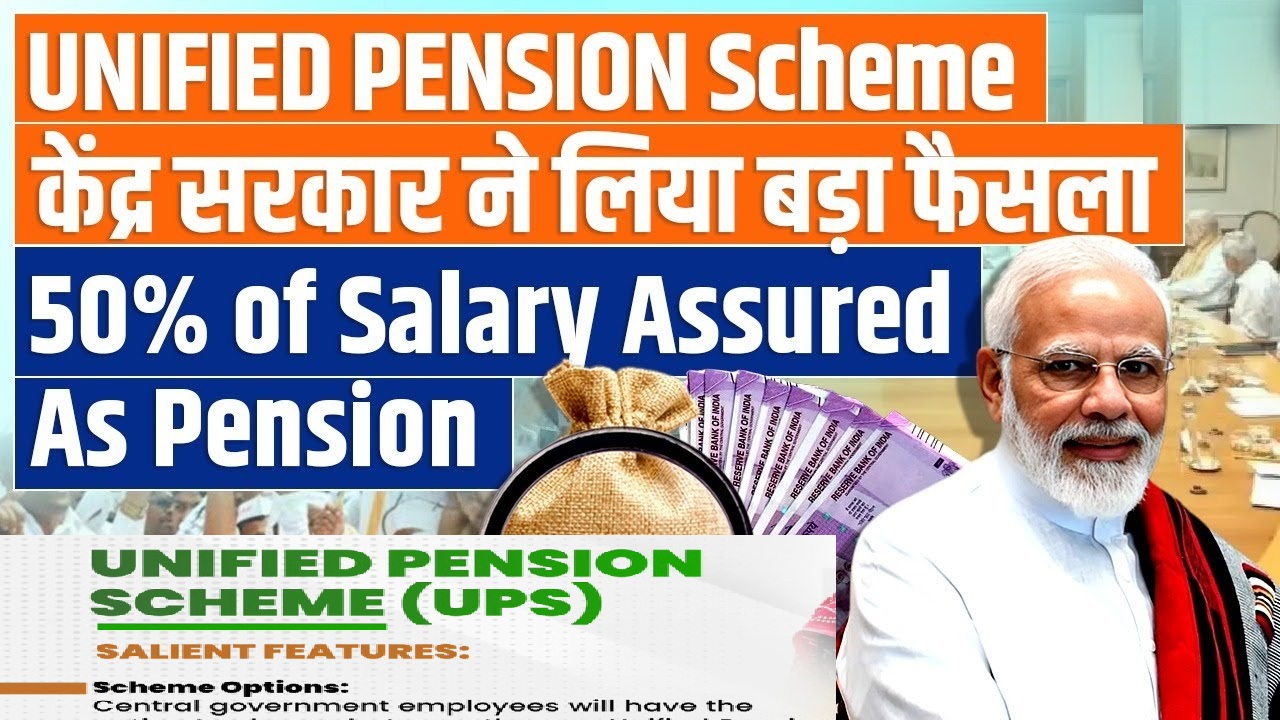
Understanding the Unified Pension Scheme (UPS) and Its Distinctions from the National Pension Scheme (NPS)
Unified Pension Scheme 2025 Explained Check Benefits, Features, Implementation, The recent introduction of the Unified Pension Scheme (UPS) marks a significant shift in the pension framework for government employees in India. Approved by the Union Cabinet, this new scheme replaces the National Pension Scheme (NPS), addressing widespread criticism and demands for a more stable retirement plan. In this article, we’ll explore the UPS, how it differs from the NPS, and its implications for government employees.
What is the Unified Pension Scheme (UPS)?
The Unified Pension Scheme (UPS) is a government-initiated retirement plan designed to provide assured post-retirement benefits to government employees. Unlike the NPS, which was heavily criticized for its market-linked returns and lack of guaranteed pension, the UPS promises a fixed pension amount based on the employee’s last drawn salary. This scheme is set to take effect from April 1, 2025, and will also benefit employees who joined after 2004 under the NPS.
Key Features of the Unified Pension Scheme (UPS)
1. Assured Pension Amount
The cornerstone of the UPS is its guarantee of a fixed pension amount. Under this scheme, retirees are assured of receiving 50% of their average basic pay from the last 12 months of service. This is a significant shift from the NPS, where pension amounts were subject to market fluctuations. To qualify for this assured pension, an employee must have a minimum of 25 years of service. For those with less than 25 years but more than 10 years of service, a proportional pension is provided.
2. Family Pension
In the unfortunate event of a retiree’s death, the immediate family members are entitled to 60% of the last drawn pension amount. This ensures financial security for the family, a feature that aligns more closely with the old pension schemes that were phased out in 2004.
3. Inflation Indexation
One of the major criticisms of the NPS was its failure to keep up with inflation. The UPS addresses this by incorporating inflation indexation, meaning that pensions will be adjusted periodically based on the All India Consumer Price Index for Industrial Workers. This mechanism ensures that the purchasing power of the pension remains intact over time.
Key Highlights of the Unified Pension Scheme
- Scheme Name: Unified Pension Scheme
- Launched By: Indian Government
- Approval Date: August 24, 2024
- Implementation Date: April 1, 2025
- Objective: To enhance security and stability for government employees
- Mode: Online
- Beneficiaries: 23 lakh central government employees
Objectives of the Unified Pension Scheme
The introduction of the Unified Pension Scheme is primarily driven by the need to address the growing concerns among younger government employees about the sufficiency of their pension benefits. By combining elements of the OPS and NPS, the UPS aims to offer a more robust and reliable retirement income. Key objectives include:
- Ensuring Pension Adequacy: The UPS is designed to provide a stable and predictable retirement income by increasing government contributions and offering a defined assured pension.
- Enhancing Family Security: The scheme includes provisions for a family pension, ensuring financial stability for the families of government employees in the event of the employee’s death.
- Promoting Economic Stability: By offering guaranteed pension benefits, the UPS helps to alleviate the economic concerns of government employees, ensuring a more secure post-retirement life.
Features of the Unified Pension Scheme 2024
The Unified Pension Scheme comes with several noteworthy features that distinguish it from previous pension plans. Some of the key features include:
- Higher Government Contribution: The government’s contribution to the pension fund has been increased from 14% to 18.5% of the basic pay, while the employee’s contribution remains at 10%. This adjustment aims to close the gap between the guaranteed 50% pension and the returns from the pension corpus.
- Guaranteed Pension Benefits: The UPS guarantees a defined assured pension, providing government employees with a predictable retirement income. Additionally, the scheme offers a minimum pension, ensuring that retirees receive at least Rs. 10,000 per month after superannuation.
- Family Pension Provision: In the event of an employee’s death, the scheme guarantees a family pension at 60% of the employee’s pension, providing financial security to the family.
- Inclusivity for All Employees: The UPS includes provisions for employees who do not meet the required service duration for a full pension, ensuring that all government workers benefit from the scheme.
Benefits of the Unified Pension Scheme 2024
The Unified Pension Scheme offers several significant benefits to government employees, making it a favorable alternative to the existing National Pension System. The primary benefits include:
- Financial Security: With the UPS, around 23 lakh government employees will benefit from increased financial security, ensuring a dignified post-retirement life.
- Guaranteed Pensions: The scheme provides a guaranteed pension that is equal to 50% of the average basic salary drawn during the 12 months preceding retirement, ensuring a stable income for retirees.
- Family Pension: In the unfortunate event of an employee’s death, the family will receive a guaranteed pension at 60% of the employee’s pension, providing a safety net for the family.
- Minimum Pension Assurance: For employees with at least 10 years of service, the scheme guarantees a minimum pension of Rs. 10,000 per month, ensuring that even those with shorter service durations receive adequate retirement benefits.
- Arrears Payment: The scheme also includes provisions to pay arrears to employees who retired after the NPS was introduced in 2004, addressing past grievances and ensuring equitable treatment.
Eligibility Criteria for the Unified Pension Scheme
To be eligible for the Unified Pension Scheme, applicants must meet the following criteria:
- Indian Residency: The applicant must be a resident of India.
- Government Employment: Only government employees are eligible for the scheme.
- Service Duration: Employees must have completed a minimum of 25 years of service to qualify for the assured pension. Those with at least 10 years of service will receive corresponding pension adjustments.
- Retirement Date: The scheme will come into effect on April 1, 2025. Employees who retire with arrears by March 31, 2025, will also be eligible.
Application Process for the Unified Pension Scheme
As of now, the government has not announced the official website for the Unified Pension Scheme. Once the official website is launched, eligible applicants will be able to apply online by filling out the required forms and submitting the necessary documentation.
The Downfall of the National Pension Scheme (NPS)
The NPS was introduced on January 1, 2004, under the government of Atal Bihari Vajpayee. It was a shift from the old pension scheme, which was considered unsustainable due to its unfunded nature. The NPS required employees to contribute a portion of their salary towards their pension fund, which would then be invested in market-linked instruments. While this was intended to reduce the financial burden on the government, it led to dissatisfaction among employees due to the uncertainty and variability of returns.
1. Lack of Guaranteed Pension
The most significant drawback of the NPS was the absence of a guaranteed pension amount. Unlike the old pension scheme, which promised a fixed percentage of the last drawn salary, the NPS linked pensions to market performance, leading to uncertainty and lower returns for retirees.
2. Employee Contributions
Another major issue was that the NPS required employees to contribute a percentage of their salary (initially 10%, later increased to 14% by the Modi government). This was perceived as a burden, particularly because the returns were not assured, leading to widespread opposition from government employees.
Transition from NPS to UPS
In response to the growing discontent with the NPS, the Modi government formed a committee in 2023, headed by Cabinet Secretary T.V. Somanathan, to explore alternatives. After extensive consultations with state governments and various organizations, the committee recommended the introduction of the UPS. This new scheme is designed to address the shortcomings of the NPS while also maintaining financial sustainability for the government.
Who Will Benefit from the UPS?
The UPS is set to benefit approximately 23 lakh central government employees. Additionally, state governments have the option to adopt the UPS for their employees, potentially expanding the coverage to over 90 lakh individuals across the country. Employees who joined after 2004 under the NPS will have the option to switch to the UPS, ensuring that they too can benefit from the fixed pension structure.
Financial Implications for the Government
Implementing the UPS will have financial implications for the government. It is estimated that transitioning from the NPS to the UPS will cost the government an additional ₹800 crore initially. Over time, this figure is expected to rise as more employees opt into the UPS, with the first year alone projected to cost an extra ₹6,500 crore. However, the government believes that this cost is justified in ensuring the long-term financial security of its employees.
Conclusion
The introduction of the Unified Pension Scheme represents a significant step towards addressing the concerns raised by government employees regarding their post-retirement financial security. By offering a guaranteed pension amount, family benefits, and inflation indexation, the UPS aims to provide a more reliable and stable retirement plan compared to the NPS. As the scheme rolls out in 2025, it will be crucial to monitor its impact on both the beneficiaries and the government’s financial health.
The UPS is a testament to the government’s willingness to adapt and respond to the needs of its workforce, ensuring that the pension system remains robust, fair, and sustainable in the long run.
When will the Unified Pension Scheme be implemented?
The scheme is scheduled for implementation on April 1, 2025.
Are private sector employees eligible for the Unified Pension Scheme?
No, the scheme is exclusively available to government employees.
What are the main benefits of the Unified Pension Scheme?
The UPS offers guaranteed pensions, family pensions, minimum pensions, and provisions for inflation indexation and dearness relief, ensuring comprehensive financial security for government employees.