The Indian Railway Finance Corporation Limited (IRFC) has been making headlines recently, but not necessarily for the right reasons. As one of India’s premier public sector undertakings (PSUs) specializing in railway infrastructure financing, IRFC has witnessed significant volatility in its stock price. This comprehensive analysis delves into the current state of IRFC, examining the factors behind its recent decline, the company’s robust business model, and what the future might hold for this critical player in India’s railway ecosystem.
Understanding IRFC: The Financial Backbone of Indian Railways
IRFC serves as the dedicated financing arm for Indian Railways, providing crucial funding support for various infrastructure projects across the country. The company’s portfolio has expanded considerably beyond traditional railway financing to encompass multiple sectors including power, multimodal logistics parks, and metro projects. This diversification has positioned IRFC as a comprehensive infrastructure financier with unique advantages in the Indian market.
As a PSU with zero Non-Performing Assets (NPAs) and limited operational expenses, IRFC maintains a distinctive position in the financial services sector. The company’s business model revolves around raising funds from domestic and international markets and lending them to Indian Railways and other eligible entities for infrastructure development.
Current Stock Performance: A Closer Look at the Numbers
Recent Price Action and Technical Indicators
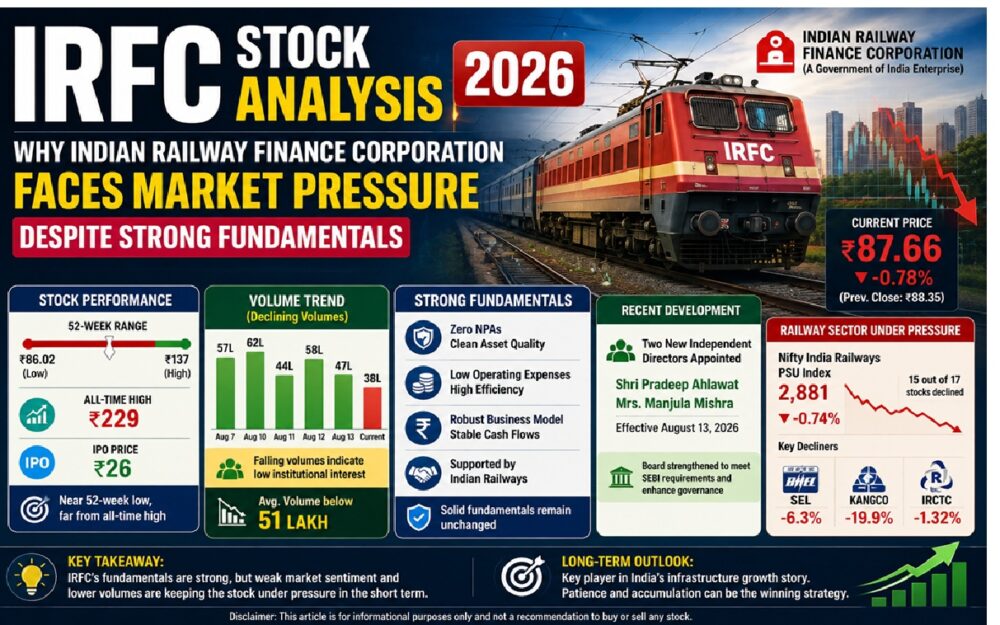
The IRFC stock has experienced considerable pressure in recent trading sessions. Closing at ₹87.66, the stock recorded a decline of 0.78% from the previous day’s closing of ₹88.35. The trading session saw the stock opening weak at ₹88.20, touching an intraday high of ₹88.50 before succumbing to broader market pressures.
The stock’s 52-week range tells an interesting story. With a low of ₹86.02 and a high of ₹137, IRFC currently trades near its yearly lows. The all-time high of ₹229 seems distant, indicating significant downside from peak levels. However, long-term investors might draw comfort from the fact that IRFC’s IPO was priced at ₹26, and despite touching ₹19 at one point, the stock had previously demonstrated remarkable recovery potential.
Volume Analysis: Institutional Participation Remains Limited
One of the most telling indicators of the current market sentiment is the declining trading volumes. The volume data reveals a concerning pattern:
- August 7: 57 lakh shares
- August 10: 62 lakh shares
- August 11: 44 lakh shares
- August 12: 58 lakh shares
- August 13: 47 lakh shares
- Current session: Only 38 lakh shares
This decline in volumes suggests that large fund houses are currently maintaining distance from the counter. The average volume has dropped below 51 lakh, indicating reduced institutional participation. Until major funds begin accumulating positions, retail investors alone may struggle to drive significant upward momentum in the stock.
Key Developments: Board Reorganization and Strategic Appointments
New Independent Directors Join IRFC Board
A significant development in the company’s governance structure is the appointment of two new part-time non-official independent directors. The Ministry of Railways and the Government of India approved the appointment of Shri Pradeep Ahlawat and Mrs. Manjula Mishra as independent directors effective August 13, 2026.
These appointments hold particular significance as they address the board composition requirements under SEBI regulations. The company had previously received observations from both stock exchanges regarding the need to fill vacant positions, which has now been accomplished. The new directors will serve a three-year term, bringing valuable expertise to the boardroom.
Corporate Governance and Compliance
The appointments demonstrate IRFC’s commitment to maintaining robust corporate governance standards. As a company falling under the jurisdiction of the President of India, IRFC follows specific appointment protocols. The new independent directors will contribute to strengthening the board’s oversight capabilities and ensuring alignment with regulatory requirements.
Railway Sector Performance: Industry-Wide Trends
Rail PSU Stocks Under Pressure
The weakness in IRFC is not an isolated phenomenon. The Nifty India Railways PSU Index, which tracks 17 railway-related stocks, declined by 0.74% to settle at 2,881 levels. Out of the 17 constituent stocks, 15 recorded losses during the trading session, highlighting the broader bearish sentiment in the railway sector.
The index, with a base date of April 1, 2021, and a base value of 1,000, has specific composition rules. It maintains a 80:20 split between core and non-core groups, with individual stock weightage capped at 20%. This index serves as a useful benchmark for tracking the performance of railway-related PSU stocks.
Sector-Wide Declines
Other railway PSU stocks also faced selling pressure:
- SEL: Down 6.3%
- Kangco: Down 19.9%
- IRCTC: Down 1.32%
These declines suggest that IRFC’s weakness is part of a broader trend affecting the entire railway PSU sector, possibly driven by profit-booking, sector rotation, or macroeconomic factors.
Fundamental Strength: The Solid Business Backdrop
Impressive Financial Performance
Despite the recent stock price weakness, IRFC’s underlying business performance remains robust. The company has demonstrated significant growth in key financial metrics:
Profit Growth: IRFC’s net profit has increased by approximately 10% to reach ₹1,927 crore, up from ₹1,746 crore in the previous year. This consistent profit growth reflects the company’s operational efficiency and strong business model.
Income Expansion: Total income has witnessed substantial growth, rising to ₹8,391 crore from approximately ₹698 crore in the previous year. This remarkable increase in income demonstrates the company’s ability to expand its lending portfolio and generate higher revenues.
Zero NPA Advantage
IRFC maintains a unique position in the financial sector with its zero NPA status. This achievement is particularly noteworthy given the challenges many financial institutions face with asset quality issues. The zero NPA status reflects:
- High-quality lending practices
- Government backing and sovereign guarantee
- Focus on railway infrastructure projects with predictable cash flows
- Robust risk management framework
Diversification Strategy
The company has successfully diversified its lending portfolio beyond traditional railway financing. Current lending activities extend to:
- Power sector projects
- Multimodal logistics parks
- Metro rail projects
- Dedicated freight corridors
- High-speed rail initiatives
This diversification reduces concentration risk and positions IRFC to benefit from multiple infrastructure development initiatives.
Government Initiatives Driving Future Growth
Union Budget 2026-27 Allocation
The government has allocated ₹2.93 trillion (approximately $32.56 billion) for railway infrastructure development in the Union Budget 2026-27. This substantial allocation signals the government’s commitment to modernizing and expanding India’s railway network. The funding will support:
- High-speed railway projects
- Network expansion initiatives
- Safety enhancement measures
- Station modernization programs
Amrit Bharat Station Scheme
Under the ambitious Amrit Bharat Station Scheme, railway stations across India are being transformed with:
- 100% electrification
- Airport-like facilities and amenities
- Modern passenger amenities
- Enhanced accessibility features
- Improved connectivity
Kavach Technology Implementation
The government is investing heavily in implementing the indigenous Kavach technology, an automatic train protection system designed to enhance railway safety. This investment reflects the focus on modernizing railway operations and improving passenger safety.
Dedicated Freight Corridors
The development of dedicated freight corridors aims to:
- Reduce logistics costs significantly
- Improve freight transportation efficiency
- Decongest existing rail routes
- Enhance mineral transportation capabilities
- Boost industrial competitiveness
Border Connectivity Projects
The government has announced plans to enhance railway connectivity along international borders with China, Pakistan, and Bangladesh. These projects will involve:
- New track laying in strategic locations
- Enhanced border infrastructure
- Improved connectivity for border areas
- Strategic transportation capabilities
Growth Prospects: Major Projects in Pipeline
Vande Bharat Sleeper Trains
The introduction of Vande Bharat sleeper trains represents a significant advancement in Indian railway transportation. These modern trains will feature:
- Enhanced passenger comfort
- Improved safety features
- Higher speed capabilities
- Modern amenities
- Superior operational efficiency
Ahmedabad Bullet Train Project
The bullet train project between Ahmedabad and Mumbai continues to progress, representing one of India’s most ambitious infrastructure projects. This high-speed rail corridor will:
- Reduce travel time significantly
- Introduce advanced railway technology
- Boost economic development along the corridor
- Enhance connectivity between major cities
PM Gati Shakti National Master Plan
Under the PM Gati Shakti initiative, various infrastructure projects are being implemented, including:
- Multimodal connectivity improvements
- Integrated infrastructure development
- Last-mile connectivity enhancements
- Reduced logistics costs
- Improved project coordination
Freight Corridor Operations
The freight corridor performance has been encouraging:
- 490.08 million tons of freight transported during Q1
- 1.46% year-on-year growth
- Iron and steel loading increased by 7.4%
- Clinker loading increased by 6.54%
- Other goods loading increased by 12.16%
Technical Analysis: Support and Resistance Levels
Key Support Levels
The stock’s immediate support is at ₹86.02, which represents the 52-week low. A breakdown below this level could trigger further selling pressure, with potential next supports at:
- ₹80.00 (psychological level)
- ₹75.00 (previous consolidation zone)
- ₹70.00 (major support level)
Resistance Levels to Watch
For any meaningful recovery, IRFC needs to clear several resistance levels:
- ₹88.50 (immediate resistance)
- ₹95.00 (short-term resistance)
- ₹100.00 (psychological and technical resistance)
- ₹115.00 (intermediate resistance)
- ₹137.00 (52-week high)
Volume Analysis for Future Direction
The declining volume pattern suggests that institutional participation remains weak. For a sustainable uptrend, IRFC needs:
- Volume expansion above the 50-lakh average
- Institutional buying interest
- Improvement in sector-wide sentiment
- Positive triggers from company-specific developments
Investment Considerations: What Should Investors Know?
Positive Factors for IRFC
- Government Support: As a PSU under the Ministry of Railways, IRFC benefits from implicit government backing
- Zero NPA Status: Clean asset quality provides a competitive advantage
- Growing Profitability: Consistent profit growth demonstrates business strength
- Diversification Benefits: Expanding lending portfolio reduces concentration risk
- Infrastructure Spending Boost: Increased government spending on railways creates business opportunities
- Dividend Potential: PSU status often translates into regular dividend payments
- Long-Term Growth Story: India’s railway infrastructure needs will continue growing
Risk Factors to Consider
- Regulatory Compliance: SEBI and exchange requirements need continuous monitoring
- Interest Rate Sensitivity: Changes in interest rates could impact business margins
- Dependence on Government Policy: Growth depends on government infrastructure spending
- Market Competition: Emergence of alternative financing sources could increase competition
- Economic Downturn: Economic slowdown could affect infrastructure development
- Retail Investor Dominance: Current reliance on retail investors may limit price stability
Investment Strategy Recommendations
For Long-Term Investors:
- Consider accumulating positions at current levels given the strong fundamentals
- Focus on the company’s business performance rather than short-term price movements
- Benefit from the potential upside as infrastructure projects materialize
For Short-Term Traders:
- Watch for volume expansion and institutional buying signals
- Monitor railway sector index movements for sector-wide trends
- Use technical levels for entry and exit decisions
Risk Management:
- Avoid over-concentration in a single PSU stock
- Consider stop-loss levels based on technical support levels
- Diversify across railway PSU stocks for sector exposure
Future Outlook: Where Is IRFC Headed?
Short-Term Outlook (1-6 Months)
The immediate outlook for IRFC remains cautious due to:
- Weak institutional participation
- Declining trading volumes
- Sector-wide selling pressure
- Technical weakness near 52-week lows
However, positive triggers such as:
- Announcement of new projects
- Q1 FY2027 results
- Improvement in market sentiment
- Institutional buying initiation
These factors could provide support and potentially reverse the downtrend.
Medium-Term Outlook (6-12 Months)
The medium-term outlook is more positive, supported by:
- Continued government spending on railways
- Implementation of major infrastructure projects
- Improving financial performance
- Board appointments strengthening governance
- Potential for dividend announcements
Long-Term Outlook (1-3 Years)
The long-term outlook remains bright due to:
- India’s growing infrastructure needs
- Railway modernization initiatives
- Diversification of lending portfolio
- Zero NPA advantage
- Government support and backing
The stock’s recovery from ₹19 to ₹29 previously demonstrates its ability to generate significant returns from lower levels. Similar recovery potential exists from current levels.
Comparison with Peers
When evaluating IRFC’s valuation, it’s helpful to consider peer comparisons:
| Metric | IRFC | Industry Average |
|---|---|---|
| P/E Ratio | Competitive | Industry Standard |
| Dividend Yield | Attractive | Market Average |
| NPA Levels | 0% | Varies by Sector |
| Growth Rate | 10%+ | Sector Average |
| Government Backing | Strong | Varies by Company |
Sector Analysis: Railway Infrastructure Financing
The railway infrastructure financing sector in India is characterized by:
- Growing demand for infrastructure investment
- Government initiatives promoting private participation
- Increasing focus on modernization and safety
- Expanding network connectivity requirements
- Rising funding needs for high-speed rail projects
IRFC’s dominant position in this sector provides:
- First-mover advantage in financing new projects
- Established relationships with railway authorities
- Deep understanding of railway infrastructure needs
- Proven track record in project financing
Conclusion: Navigating the Current Challenges
IRFC currently faces a challenging market environment with declining stock prices and reduced institutional participation. However, the company’s underlying business fundamentals remain strong, supported by:
- Consistent profit growth
- Zero NPA status
- Expanding lending portfolio
- Strong government support
- Robust infrastructure spending
The recent board appointments demonstrate commitment to governance improvements and regulatory compliance. The government’s continued focus on railway infrastructure development provides a solid growth platform for IRFC.
For investors, the current weakness may present a buying opportunity if considered within a long-term investment framework. The stock’s historical performance, including its recovery from lower levels, suggests potential for appreciation from current levels.
However, investors should conduct thorough research and consider consulting financial advisors before making investment decisions. The stock’s performance will ultimately depend on:
- Execution of government infrastructure projects
- Company’s ability to maintain asset quality
- Improvement in institutional participation
- Broader market sentiment towards PSU stocks
- Sector-specific developments
The Indian railway sector’s growth story remains intact, and IRFC, as the dedicated financing arm, is well-positioned to benefit from this growth. While short-term volatility may persist, the long-term outlook appears promising for investors with patience and a long-term investment horizon.
Disclaimer: This article is for educational purposes only and should not be considered financial advice. Investors should conduct their own research or consult with certified financial advisors before making investment decisions.