Bar Council as an Equal Partner in Justice TG CJ Alok Aradhe
Telangana High Court Chief Justice Alok Aradhe emphasized on Sunday that technology integration is essential for advancing the judicial system, which continues to evolve to meet the demands of modern society. He stressed the court’s responsibility to deliver swift and effective justice and underscored that the Bar plays a vital, equal role in the administration of justice.
Justice Aradhe shared these views at the groundbreaking ceremony for a new 10+2 courts building complex, which will house PoCSO and Family courts, within the District Court Complex in Karimnagar. The event also marked the foundation of 20 residential quarters dedicated to judicial officers in the area.
The ceremony saw attendance from notable members of the judiciary, including Telangana High Court Judge and Karimnagar District Administrative Judge K. Lakshman, along with Telangana High Court Judges T. Vinod Kumar, B. Vijaysen Reddy, N.V. Shravan Kumar, E.V. Venugopal, Pulla Karthik, J.J. Sreenivas Rao, and Principal District and Sessions Judge B. Prathima.
Embracing Technology for Efficient Justice
Justice Aradhe highlighted the pressing need to incorporate technology within the justice system. He announced plans to introduce a new “end step” initiative, which will enable the digital serving of summons in criminal cases, streamlining the process with police support to reach the accused swiftly. This digital solution is expected to reduce delays significantly, making the justice system more responsive and accessible.
The Chief Justice reiterated that the judiciary’s foundation rests on public trust and faith in its ability to deliver justice. The upcoming court complex, he noted, stands as a beacon of hope and commitment to effective, timely, and fair justice.
Upholding High Standards in Case Clearance
Telangana High Court has set itself apart as one of the few courts in the country with a case clearance rate exceeding 100%. Justice Aradhe applauded Karimnagar district court’s dedication to using alternative dispute resolution methods. Many matrimonial disputes in Karimnagar are resolved through mediation, he noted, highlighting the significance of alternative mechanisms under Section 89 of the Code of Civil Procedure to reduce court backlog and provide faster resolutions.
Celebrating Contributions to Judicial Infrastructure
The event also honored former Telangana High Court Judge Ponugoti Naveen Rao, recognized as the visionary behind the “Nyay Nirman” design for court building complexes. His architectural contributions were acknowledged as essential to modernizing judicial infrastructure.
The ceremony was attended by State Bar Council member K. Lakshman Kumar, Karimnagar District Bar Association President P.V. Rajkumar, General Secretary Bethi Mahender Reddy, and other distinguished legal professionals, reflecting the strong collaborative spirit within Telangana’s judicial community.
In conclusion, the Telangana High Court’s initiatives under Chief Justice Alok Aradhe’s leadership highlight a forward-thinking approach to justice, where technology, effective dispute resolution, and dedicated infrastructure work hand-in-hand to meet the needs of litigants. The active partnership between the court and the Bar further strengthens the administration of justice, fostering a system that is efficient, modern, and inclusive.
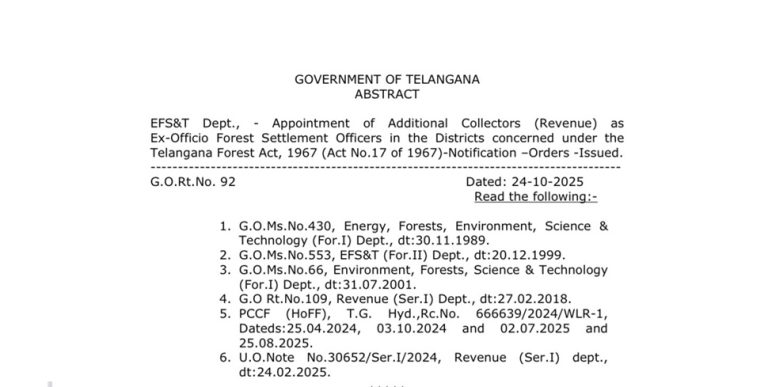
![Telangana Government Appoints Additional Collectors as Ex-Officio Forest Settlement Officers: Key Updates on G.O.Rt.No.92 Dated 24-10-2025 The Government of Telangana has issued a landmark notification through G.O.Rt.No.92, dated 24th October 2025, marking a significant shift in forest land management and settlement processes across the state. This order empowers Additional Collectors (Revenue) in all districts to serve as Ex-Officio Forest Settlement Officers, effectively replacing the outdated system of Joint Collectors. Issued under the provisions of the Telangana Forest Act, 1967 (Act No.17 of 1967), this decision aims to streamline survey, settlement, and dispute resolution mechanisms related to forest boundaries and reserved lands. This strategic administrative reform comes in response to evolving operational needs and legal interpretations under the Forest Act. The move ensures faster adjudication of claims, efficient utilization of existing revenue and forest department staff, and seamless coordination during ongoing Forest Boundary Survey and Settlement initiatives launched under Plan w.e.f. 01.03.2018. Understanding the Core Objective of G.O.Rt.No.92 The primary goal of G.O.Rt.No.92 is to enhance administrative efficiency in handling forest-related disputes and boundary demarcations. Previously, Joint Collectors held dual responsibilities, leading to delays due to workload overlap. By transitioning these powers to Additional Collectors (Revenue), the government ensures dedicated focus on forest settlement activities without compromising core revenue functions. This notification builds upon earlier directives, including G.O.Ms.No.430 (1989), G.O.Ms.No.553 (1999), and G.O.Ms.No.66 (2001), while partially modifying G.O.Rt.No.109 (2018). It reflects a progressive approach toward integrating revenue administration with environmental governance. Legal Foundation: Section 4, Sub-Section (1), Clause (C) of Telangana Forest Act, 1967 The appointment is grounded in Clause (C) of Sub-Section (1) of Section 4 of the Telangana Forest Act, 1967. This clause explicitly authorizes the state government to appoint officers—not below the rank of Revenue Divisional Officer—as Forest Settlement Officers. These officers are tasked with: Inquiring into and determining the existence, nature, and extent of any rights claimed over forest land or produce. Hearing objections against provisional declarations of reserved forests. Adjudicating disputes involving land comprised within such limits. Managing compensation, eviction, or regularization processes as per Chapter II of the Act. By designating Additional Collectors as Ex-Officio officers, the government ensures that only senior-level officials with adequate authority and experience handle these sensitive matters. Why Replace Joint Collectors with Additional Collectors? The decision to abolish the role of Joint Collectors in forest settlement roles stems from operational feedback and legal clarity provided by the Principal Chief Conservator of Forests (HoFF), Telangana, Hyderabad. In official correspondence vide T.G. Hyd.Rc.No. 666639/2024/WLR-1, the PCCF emphasized that: “As per sub-section (2) of Section 4 of the Forest Act 1967, an Officer not below the rank of Revenue Divisional Officer shall be appointed as Forest Settlement Officer…” This legal stipulation raised concerns about the appropriateness of Joint Collectors (typically above RDO rank) performing these duties. Moreover, many Joint Collectors were overburdened with multiple portfolios, causing delays in survey completion and claim verification. Thus, entrusting Additional Collectors (Revenue)—who operate at an optimal administrative level—ensures: Faster decision-making Better coordination between Revenue and Forest Departments Dedicated manpower for time-bound survey targets Uniform implementation across all 33 districts of Telangana Historical Context: Evolution of Forest Settlement Policies in Telangana To fully appreciate the importance of G.O.Rt.No.92, one must trace the evolution of forest governance in the region: YearG.O. NumberKey Directive1989G.O.Ms.No.430Initial framework for energy, forests, environment, science & technology coordination1999G.O.Ms.No.553Strengthened role of EFS&T (For.II) Dept. in policy execution2001G.O.Ms.No.66Clarified roles of Environment, Forests, Science & Technology Dept.2018G.O.Rt.No.109Introduced Joint Collectors as interim Forest Settlement Officers2024–25PCCF LettersRequested abolition of Joint Collector posts in favor of Additional Collectors2025G.O.Rt.No.92Final implementation – Additional Collectors appointed Ex-Officio This timeline reflects a gradual refinement of inter-departmental roles to align with ground realities and statutory mandates. Role and Responsibilities of Ex-Officio Forest Settlement Officers Once appointed, Additional Collectors (Revenue) assume full jurisdiction over all notified Forest Blocks within their respective districts. Their key responsibilities include: 1. Survey & Demarcation of Forest Boundaries Conduct joint surveys with District Forest Officers (DFOs) and Survey Teams Use GPS-enabled devices and DGPS technology for accurate mapping Resolve encroachments identified during field verification 2. Adjudication of Claims Receive and verify claims from individuals, communities, or institutions Conduct public hearings as mandated under the Act Issue speaking orders on eligibility for regularization or rejection 3. Coordination with Stakeholders Liaise with Tahsidars, Mandal Revenue Officers, and Village Revenue Officers Collaborate with Tribal Welfare Department for ST claims under FRA 2006 Engage Gram Sabhas for community forest rights validation 4. Compliance with Environmental Laws Ensure no diversion of forest land violates Forest Conservation Act, 1980 Prevent illegal felling, mining, or commercial activity in reserved areas Impact on Ongoing “Survey and Settlement of Forest Boundaries” Scheme Launched w.e.f. 1st March 2018, the statewide Forest Boundary Survey Scheme had faced bottlenecks due to: Vacancies in Joint Collector positions Lack of dedicated technical support Delayed claim disposal leading to prolonged litigation With G.O.Rt.No.92, the scheme receives a major boost: ParameterBefore G.O.Rt.No.92After G.O.Rt.No.92Nodal OfficerJoint CollectorAdditional Collector (Revenue)Staff UtilizationLimitedFull integration of District Revenue & Forest teamsClaim Disposal Time12–18 monthsTargeted within 6–9 monthsSurvey Progress~68% completeExpected 90% by March 2026 This accelerated timeline is critical ahead of the 2026 Forest Rights Act compliance deadline. How District Collectors and PCCF Are Directed to Act The notification mandates immediate action from key authorities: Principal Chief Conservator of Forests (HoFF), Hyderabad Issue operational guidelines to all Divisional Forest Officers Deploy Rapid Survey Teams equipped with modern tools Monitor monthly progress via e-Forest Telangana Portal Chief Commissioner of Land Administration (CCLA) Train Additional Collectors on provisions of Forest Act & FRA Update revenue records post-settlement finalization All District Collectors Convene District-Level Coordination Committee meetings bi-monthly Ensure no pending claims older than 90 days Submit compliance reports to Revenue (Ser.I) Dept. Commissioner of Printing & Stationery Publish notification in Extra-ordinary Telangana Gazette dated 31.10.2025 Supply 100 copies to EFS&T Dept. and 300 copies to PCCF (HoFF) District-Wise Implementation Strategy Each of Telangana’s 33 districts now has a designated Ex-Officio Forest Settlement Officer. A sample rollout plan includes: DistrictKey Forest BlocksTarget CompletionAdilabadKawal Tiger Reserve BufferDec 2025Bhadradri KothagudemKinnerasani Wildlife SanctuaryJan 2026Komaram Bheem AsifabadSirpur Reserve ForestNov 2025NizamabadPocharam Wildlife SanctuaryFeb 2026WarangalEturnagaram Wildlife SanctuaryMar 2026 High-encroachment zones like Mahabubabad, Khammam, and Mulugu will receive additional survey teams. Public Participation and Grievance Redressal The government encourages active public involvement: Village-level Awareness Camps organized by MROs Toll-free Helpline 1967 for filing objections Online Portal: forestsettlement.telangana.gov.in for claim status tracking 30-day Objection Window post-notification in local newspapers All hearings will follow principles of natural justice, ensuring transparency and fairness. Environmental and Social Implications This reform carries far-reaching impacts: Positive Outcomes Reduced Encroachment: Clear boundary demarcation deters future intrusions Tribal Rights Protection: Faster processing of Community Forest Rights (CFR) claims Biodiversity Conservation: Strengthened control over reserved forests Climate Resilience: Better management of carbon sinks Challenges Ahead Resistance from entrenched encroachers Need for large-scale staff training Integration of legacy data from pre-bifurcation Andhra Pradesh records Comparison: Telangana vs Other States StateForest Settlement OfficerSurvey Completion %Digital IntegrationTelanganaAdditional Collector (Revenue)68% (Oct 2025)e-Forest Portal + DGPSAndhra PradeshSpecial Deputy Collectors72%Partial GISKarnatakaDeputy Commissioners81%Full WebGISOdishaRevenue Divisional Officers55%Manual + Partial Tech Telangana’s hybrid model combining senior revenue officials with cutting-edge tech positions it for leadership in forest governance. Future Roadmap: From Settlement to Sustainable Management Post-settlement, the government plans: Geo-fencing of all reserved forests using satellite imagery Community Forest Management Committees in tribal areas Eco-tourism Zones in buffer regions Carbon Credit Certification for protected forests The Environment, Forests, Science & Technology Department will launch a “Green Telangana 2030” initiative aligned with these goals. Official Signatory and Authentication The order is issued under the signature of: AHMAD NADEEM Principal Secretary to Government (By Order and in the Name of the Governor of Telangana) Authenticated by Section Officer, forwarded to all concerned departments including: Revenue (Ser.I) Department Law (C) Department PS to Chief Secretary PS to Hon’ble Chief Minister All District Collectors & Additional Collectors (Revenue) How to Access the Official G.O.Rt.No.92 Citizens and stakeholders can download the full text from: Official Website: goir.telangana.gov.in → Search “G.O.Rt.No.92” Telangana Gazette: Extra-ordinary issue dated 31.10.2025 PCCF Office: T.G. Hyderabad For queries, contact: Email: pccf[at]forests[dot]telangana[dot]gov[dot]in Phone: +91-40-2322XXXX Conclusion: A New Era in Telangana’s Forest Governance The issuance of G.O.Rt.No.92 on 24-10-2025 marks a pivotal moment in Telangana’s journey toward sustainable forest management. By appointing Additional Collectors (Revenue) as Ex-Officio Forest Settlement Officers, the state government demonstrates decisive leadership in resolving long-pending disputes, protecting ecological assets, and upholding tribal rights. This reform is not merely administrative—it is a commitment to environmental justice, biodiversity conservation, and inclusive development. As Telangana marches toward completing its forest boundary surveys by March 2026, the foundation laid today will echo for generations.](https://www.tgnns.com/wp-content/uploads/2025/10/Abolishing-the-Joint-Collector-Position-and-Appointing-Additional-Collectors-as-Forest-Settlement-Officers-768x387.jpg)