Vodafone Idea, a prominent telecommunications giant in India, recently unveiled its financial performance for the fourth quarter of the fiscal year 2026. The announcement sent ripples across the market, primarily due to a remarkable swing from a substantial loss to a significant net profit. This shift, however, demands a meticulous examination to understand the underlying factors and their implications for the company’s future trajectory within India’s fiercely competitive telecom sector. While the headline figure of a massive profit might suggest a complete turnaround, a closer look reveals a complex interplay of operational improvements, strategic financial maneuvers, and crucial regulatory relief.
The fourth quarter of FY26 marked a pivotal period for Vodafone Idea, as it navigated both persistent operational challenges and the benefits of a one-time accounting gain. The company’s financial results provide a comprehensive snapshot of its ongoing efforts to stabilize its balance sheet, enhance its service offerings, and regain market share. This detailed analysis will dissect the key financial metrics, explore the impact of the Adjusted Gross Revenue (AGR) reassessment, evaluate the growth in Average Revenue Per User (ARPU), and shed light on the strategic initiatives, including 5G rollout plans and critical fundraising efforts, that are shaping Vodafone Idea’s path forward in the dynamic Indian telecom market.
Revenue Performance: A Steady Climb Amidst Market Dynamics
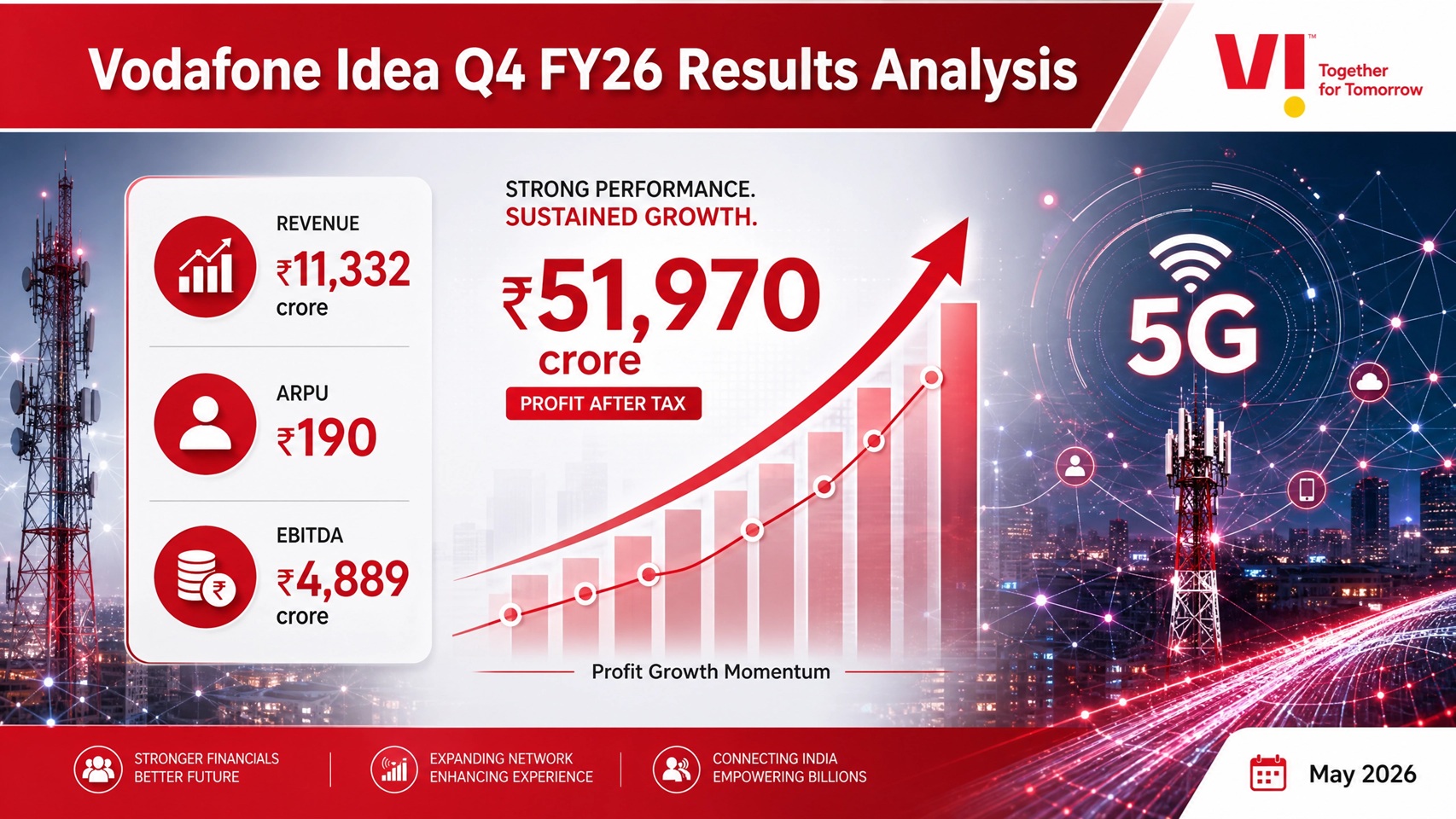
Vodafone Idea reported a revenue from operations of ₹11,332 crore for the fourth quarter of fiscal year 2026. This figure represents a modest yet significant year-on-year (YoY) growth of approximately 3% when compared to the previous year’s corresponding quarter. On a quarter-on-quarter (QoQ) basis, the revenue remained largely stable, showing a marginal increase of 0.1% from ₹11,323 crore recorded in the third quarter of FY26 . This steady revenue performance aligns closely with market expectations, which had anticipated figures around ₹11,300 crore, indicating a predictable operational environment for the company during this period.
The consistent revenue generation underscores Vodafone Idea’s ability to maintain its operational footprint and customer base in a challenging market. Despite intense competition from rival operators, the company has managed to prevent significant revenue erosion, a testament to its sustained efforts in customer retention and service delivery. The 3% YoY growth, while not explosive, signals a positive trend, suggesting that the company’s strategies are beginning to yield incremental improvements in its top-line performance. This stability is crucial for a company undergoing a significant restructuring and aiming for long-term financial health.
Cost Management: Navigating Operational Efficiencies
Effective cost management remains a critical component of Vodafone Idea’s strategy to improve its financial standing. In the fourth quarter of FY26, the company reported expenses totaling ₹16,951 crore. This figure reflects a notable reduction compared to the previous quarter’s expenses of ₹17,884 crore and a more substantial decrease from ₹18,398 crore in the same quarter last year . The observed decline in operational expenditures indicates successful initiatives aimed at enhancing efficiency and optimizing resource allocation. These efforts are vital for improving the company’s profitability margins, especially in a sector characterized by high infrastructure and operational costs.
The reduction in expenses, while contributing positively to the overall financial picture, also highlights the company’s disciplined approach to financial management. By streamlining operations and potentially renegotiating vendor contracts or optimizing network infrastructure, Vodafone Idea has demonstrated its commitment to controlling outflows. This prudent financial stewardship is essential for a company that has historically grappled with significant debt burdens and operational losses. The ability to manage costs effectively, even as revenue experiences moderate growth, positions the company more favorably for sustainable recovery and future investments.
The Profit Paradox: Unpacking the AGR Reassessment Windfall
The most striking aspect of Vodafone Idea’s Q4 FY26 results is undoubtedly the dramatic swing to a net profit of ₹51,970 crore. This figure stands in stark contrast to the substantial losses reported in previous periods—₹5,286 crore in Q3 FY26 and ₹7,167 crore in Q4 FY25 . However, this impressive profit is not a reflection of core operational profitability but rather the direct consequence of a significant one-time accounting gain. This exceptional item, amounting to ₹57,491 crore, stems from the reassessment of the company’s Adjusted Gross Revenue (AGR) liabilities .
The AGR issue has been a long-standing and contentious matter for Indian telecom operators. It refers to a fee-sharing mechanism between telecom companies and the Department of Telecommunications (DoT), based on a percentage of their revenue. The definition of ‘gross revenue’ for this calculation has been a subject of legal disputes for years, leading to massive accumulated dues for operators like Vodafone Idea. In a crucial development, the DoT provided significant relief by trimming Vodafone Idea’s AGR dues by approximately 27%, reducing the total liability to ₹64,046 crore . This regulatory intervention, coupled with an extended repayment schedule stretching until FY41, has provided much-needed breathing room for the company .
The ₹57,491 crore gain recorded in Q4 FY26 is an accounting adjustment that reflects the positive impact of this AGR reassessment. It essentially reduces the company’s past liabilities on its books, thereby converting what would have been another quarter of operational losses into a substantial net profit. While this accounting adjustment is a significant positive for the company’s balance sheet and investor sentiment, it is crucial to distinguish it from profits generated through day-to-day business operations. Without this exceptional item, Vodafone Idea’s core business would still reflect an operating loss, a point that analysts and investors are carefully scrutinizing.
Operating Performance vs. Net Profit: A Critical Distinction
To gain a clear understanding of Vodafone Idea’s true financial health, it is imperative to differentiate between its reported net profit and its underlying operating performance. While the company declared a net profit of ₹51,970 crore, its operating profit, excluding the exceptional AGR gain, tells a different story. The company’s operating performance for Q4 FY26 still indicates a loss of approximately ₹5,515 crore . This figure, though a loss, represents an improvement compared to the operating losses of ₹6,368 crore in the previous quarter and ₹7,169 crore in the same quarter last year .
This distinction is vital for investors and stakeholders. The net profit, inflated by the one-time AGR adjustment, masks the ongoing challenges in achieving sustainable profitability from core telecom services. The reduction in operating losses, however, is a positive sign, suggesting that the company’s efforts in cost optimization and revenue stabilization are having an effect. It indicates that the gap between operational revenues and expenses is narrowing, albeit slowly. The market’s reaction to these results will likely hinge on its interpretation of this dual narrative: a strong balance sheet boost from regulatory relief versus the continued, albeit shrinking, operational deficit.
The company’s Earnings Per Share (EPS) also saw a significant positive swing, reaching ₹4.80, directly attributable to the reported net profit . While this looks favorable on paper, it is essential to remember that this EPS is largely driven by the non-recurring AGR gain. For long-term sustainability, Vodafone Idea must demonstrate consistent improvement in its operating profitability, driven by subscriber growth, ARPU enhancement, and efficient service delivery, rather than relying on one-off financial adjustments.
ARPU Growth and Subscriber Trends: Indicators of Market Traction
One of the most encouraging aspects of Vodafone Idea’s Q4 FY26 results is the continued growth in its Average Revenue Per User (ARPU). The company reported an ARPU of ₹190, marking an impressive increase from ₹175 in Q4 FY25, reflecting an 8.3% year-on-year growth . This figure is particularly noteworthy as it positions Vodafone Idea’s ARPU as potentially the highest in the Indian telecom industry, surpassing market expectations that hovered around ₹173 .
ARPU is a critical metric in the telecom sector, indicating the average revenue generated from each subscriber. A rising ARPU suggests that the company is successfully upselling higher-value plans, attracting premium customers, or seeing increased data consumption among its existing user base. This growth is vital for improving the company’s financial health, as it directly contributes to revenue expansion without necessarily incurring proportional increases in operational costs. The sustained increase in ARPU demonstrates the effectiveness of Vodafone Idea’s strategies to enhance customer value and monetize its services more effectively.
Beyond ARPU, Vodafone Idea has also shown positive momentum in its subscriber base. The company reported adding subscribers for the second consecutive month, with approximately 102,899 net additions in March 2026 . This follows 21,927 net additions in February, signaling an early turnaround in subscriber trends. While the overall subscriber base remains a challenge in a market dominated by larger players, these consecutive months of net additions are a positive indicator of renewed customer confidence and successful retention efforts. The growth in both ARPU and subscriber numbers suggests that Vodafone Idea is making tangible progress in strengthening its market position and attracting new users, particularly those seeking value-added services.
Strategic Initiatives: Powering Future Growth with 5G and Fundraising
Vodafone Idea’s future growth hinges significantly on its strategic initiatives, particularly its 5G rollout and ongoing fundraising efforts. The company has ambitious plans to expand its 5G services, targeting coverage in 90 additional cities by May 2026. This expansion will bring its total 5G footprint to 133 cities across key markets . The accelerated 5G deployment is a crucial step for Vodafone Idea to remain competitive and cater to the increasing demand for high-speed data services in India. By prioritizing 5G rollouts in areas with higher penetration of 5G devices, the company aims to maximize its return on investment and attract high-value customers .
Complementing its network expansion, Vodafone Idea has also made significant strides in securing much-needed capital. The Aditya Birla Group (ABG), one of the company’s promoters, has committed an equity infusion of ₹4,730 crore (equivalent to $500 million) . This infusion is part of a broader fundraising strategy designed to stabilize the company’s balance sheet, fund its network upgrades, and support its 5G deployment. The successful securing of promoter funding signals confidence from key stakeholders and provides a critical financial boost to the company’s revival plans. This capital will be instrumental in enabling Vodafone Idea to invest in its network infrastructure, enhance customer experience, and compete more effectively in the market.
These strategic initiatives are interconnected. The fundraising provides the necessary capital for the aggressive 5G rollout, which in turn is expected to drive ARPU growth and attract new subscribers. A robust 5G network is not only a competitive necessity but also a platform for offering new services and enhancing customer engagement. The company’s focus on expanding its 4G and 5G user base, particularly among high-value data users, is central to its strategy for sustainable revenue growth and operational profitability. The successful execution of these plans will be critical in determining Vodafone Idea’s long-term viability and its ability to challenge its rivals in the Indian telecom arena.
Debt Management and Future Outlook: Navigating Financial Headwinds
Despite the positive developments in Q4 FY26, Vodafone Idea continues to grapple with a substantial debt burden. However, recent regulatory interventions have provided some relief on this front. The Department of Telecommunications (DoT) has not only reduced the company’s AGR dues but has also extended the repayment schedule until FY41 . This extended timeline, coupled with a cap on annual dues, significantly eases the immediate financial pressure on Vodafone Idea, allowing it more flexibility to manage its cash flows and invest in growth initiatives .
The new repayment schedule mandates a minimum annual payment of ₹100 crore from FY32 to FY35, with the remaining outstanding amounts to be settled thereafter . This staggered payment plan is a crucial lifeline, preventing a liquidity crunch and enabling the company to focus on operational improvements rather than being overwhelmed by immediate debt obligations. While the AGR dues are largely settled, the company still faces significant debt from other sources, including bank loans and spectrum payments. Effective management of these liabilities will be paramount for its long-term financial stability.
Looking ahead, the
future outlook for Vodafone Idea remains a mix of opportunities and challenges. The resolution of the AGR issue and the successful fundraising efforts have injected a renewed sense of optimism. However, the company must now translate these financial and regulatory reliefs into sustained operational performance. The market will closely monitor its ability to grow its subscriber base, further enhance ARPU, and effectively roll out its 5G network. The competition in the Indian telecom market is fierce, with established players continuously innovating and expanding their services. Vodafone Idea’s ability to differentiate itself through superior network quality, innovative service offerings, and competitive pricing will be crucial for its long-term success.
The Competitive Landscape: Navigating India’s Dynamic Telecom Market
India’s telecommunications sector is one of the most dynamic and competitive globally, characterized by rapid technological advancements, aggressive pricing strategies, and a vast subscriber base. Vodafone Idea operates within this challenging environment, competing primarily with two major players: Reliance Jio and Bharti Airtel. Both rivals possess significant financial muscle, extensive network infrastructure, and a strong market presence, making it imperative for Vodafone Idea to carve out its niche and execute its strategies flawlessly.
Reliance Jio, since its disruptive entry into the market, has consistently driven innovation and affordability, capturing a substantial share of the subscriber base. Its aggressive data pricing and widespread 4G and now 5G network have set high benchmarks for the industry. Bharti Airtel, on the other hand, has maintained its position as a strong contender through a focus on network quality, premium services, and a diversified portfolio that includes broadband and enterprise solutions. The ongoing 5G rollout by both these players further intensifies the competition, as they vie for early adopters and high-value customers.
In this landscape, Vodafone Idea’s strategy must be multi-faceted. Its focus on ARPU growth, driven by value-added services and potentially higher-tier plans, is a step in the right direction. However, this must be balanced with efforts to expand its subscriber base, particularly in untapped or underserved markets. The company’s accelerated 5G deployment is a critical move to bridge the technology gap with its competitors. A robust 5G network is not merely about speed; it is about enabling new applications, improving user experience, and opening avenues for enterprise solutions, which can become significant revenue streams.
Furthermore, customer retention will play a pivotal role. In a market where switching operators is relatively easy, providing excellent customer service, reliable network performance, and compelling offers can help stem churn and build loyalty. Vodafone Idea’s recent success in adding subscribers for two consecutive months, though modest, indicates that its efforts to improve service quality and address customer pain points are beginning to resonate. Sustaining this momentum will require continuous investment in network upgrades, customer support, and marketing initiatives that highlight its unique value proposition.
Regulatory Environment and Government Support: A Crucial Lifeline
The Indian government and regulatory bodies have played a significant role in shaping the trajectory of the telecom sector, particularly in the context of Vodafone Idea’s financial challenges. The relief provided through the reassessment of AGR dues and the extended repayment schedule underscores a recognition of the strategic importance of a three-player market for healthy competition and consumer choice. This support has been a crucial lifeline, preventing a potential duopoly and fostering a more balanced competitive environment.
The Department of Telecommunications (DoT)’s decision to trim AGR dues and allow staggered payments until FY41 has provided Vodafone Idea with much-needed financial flexibility. This regulatory intervention has not only eased immediate liquidity concerns but has also signaled a supportive stance towards ensuring the viability of all major telecom operators. Such measures are essential for encouraging investment in network infrastructure, particularly for advanced technologies like 5G, which require substantial capital outlay.
Beyond AGR, the government’s broader policy framework, including initiatives like the Production Linked Incentive (PLI) scheme for telecom and networking products, aims to boost domestic manufacturing and reduce reliance on imports. While not directly impacting Vodafone Idea’s immediate financial results, a thriving domestic ecosystem for telecom equipment can indirectly benefit operators by potentially reducing equipment costs and improving supply chain resilience in the long run. The ongoing dialogue between the government, regulators, and telecom operators will continue to be critical in addressing emerging challenges and fostering a conducive environment for growth and innovation.
Technology and Innovation: The Path to Differentiation
In the rapidly evolving digital landscape, technology and innovation are paramount for telecom operators to differentiate themselves. For Vodafone Idea, its 5G rollout is at the forefront of its technological strategy. The expansion to 90 new cities by May 2026, targeting a 133-city footprint, is an aggressive move to catch up with competitors and offer next-generation connectivity to a wider audience . 5G technology offers significantly higher speeds and lower latency, opening opportunities for Fixed Wireless Access (FWA), enterprise solutions for smart factories, and enhanced mobile entertainment. By prioritizing areas with high 5G device penetration, the company aims to maximize initial adoption and revenue .
Beyond 5G, Vodafone Idea must invest in Artificial Intelligence (AI) and Machine Learning (ML) for network optimization and personalized customer service. AI-driven analytics can provide insights into subscriber behavior, while partnerships with content and cloud providers can diversify revenue streams. Innovation in bundled service offerings will also be key to attracting customers in a market where basic connectivity is increasingly commoditized.
Human Capital and Organizational Resilience: The Backbone of Revival
While financial and technological factors are crucial, the human element remains the backbone of Vodafone Idea’s revival. The company’s ability to navigate significant financial headwinds speaks to its organizational resilience. Attracting and retaining top talent in engineering, technology, and marketing is essential as the company focuses on 5G and service innovation. Investing in employee training will ensure the workforce can handle the demands of next-generation technologies.
Fostering a culture of agility and customer-centricity is equally important. The recent positive developments, such as the AGR relief and fundraising, serve as a morale booster, reinforcing belief in the company’s prospects. Furthermore, robust governance and risk management are vital for rebuilding investor trust. The collective efforts of its human capital, guided by strong leadership, will ultimately determine Vodafone Idea’s success in re-establishing itself as a formidable player in the Indian telecom market.
Conclusion: A Cautious Optimism for Vodafone Idea’s Future
Vodafone Idea’s Q4 FY26 results present a nuanced picture of a company at a critical juncture. The headline net profit of ₹51,970 crore, while impressive, is primarily an accounting phenomenon driven by the one-time AGR reassessment. This regulatory relief, coupled with the significant equity infusion from the Aditya Birla Group, has provided a much-needed financial cushion and a clearer path forward for debt management. These developments have undoubtedly bolstered the company’s balance sheet and instilled a cautious optimism among stakeholders.
Operationally, the company demonstrates encouraging signs with a steady revenue performance, improved cost management, and, most notably, a significant increase in Average Revenue Per User (ARPU) to ₹190. The consistent subscriber additions for two consecutive months also hint at a potential turnaround in customer sentiment and market traction. The aggressive plans for 5G rollout, targeting 133 cities by May 2026, underscore Vodafone Idea’s commitment to technological advancement and competitive positioning.
However, the journey ahead remains challenging. The underlying operating loss, though shrinking, indicates that the core business still needs to achieve sustainable profitability. The intense competition from well-entrenched rivals necessitates continuous innovation, superior network quality, and compelling service offerings. Vodafone Idea must leverage its newfound financial flexibility to accelerate network investments, enhance customer experience, and explore new revenue streams beyond traditional voice and data services.
In essence, Vodafone Idea is undergoing a strategic metamorphosis. The Q4 FY26 results mark a significant milestone, offering a glimpse of a potential revival. The coming quarters will be crucial in demonstrating whether the company can translate regulatory and financial support into sustained operational excellence and reclaim its position as a leading force in India’s vibrant telecommunications sector. The path to full recovery is long and arduous, but with strategic execution, technological prowess, and unwavering organizational resilience, Vodafone Idea has laid the groundwork for a more promising future.