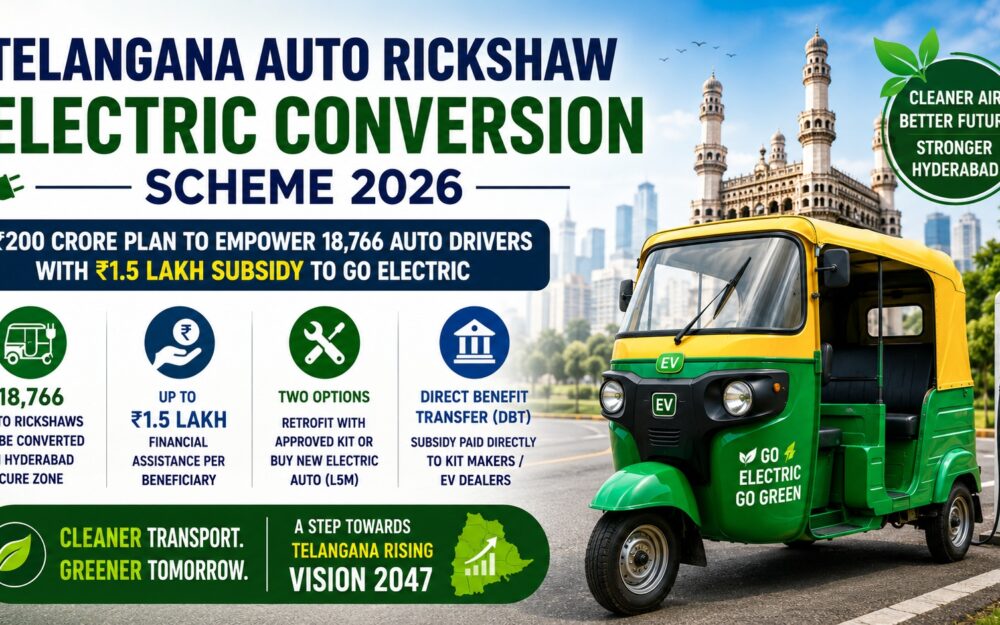
Telangana has cleared one of the most ambitious three-wheeler electrification programmes any Indian state has attempted so far. The government has approved the Telangana Auto Rickshaw Electric Conversion Scheme 2026, backing it with ₹200 crore and offering every eligible auto owner financial assistance of up to ₹1.5 lakh to move away from petrol and diesel. The Transport, Roads and Buildings (R&B) Department issued the order, and the Transport Department will run the scheme on the ground.
The target is specific rather than vague. The state has identified 18,766 permitted auto rickshaws operating inside Hyderabad’s Core Urban Region Economy (CURE) area and plans to convert every one of them to electric propulsion in phases. Of these, 11,254 run on diesel and 7,512 run on petrol.
This article breaks down exactly how the scheme works, who qualifies, how the two subsidy routes differ, how the money reaches beneficiaries, what the rollout calendar looks like, and what the switch actually means for a driver’s daily earnings.
Telangana Auto Rickshaw Electric Conversion Scheme 2026 at a Glance
| Scheme Detail | Specification |
|---|---|
| Official name | Telangana Auto Rickshaw Electric Conversion Scheme–2026 |
| Issuing department | Transport, Roads and Buildings (R&B) Department |
| Total outlay | ₹200 crore |
| Coverage area | Core Urban Region Economy (CURE), Hyderabad |
| Vehicles targeted | 18,766 permitted auto rickshaws |
| Fuel-wise split | 11,254 diesel + 7,512 petrol |
| Maximum assistance | ₹1.5 lakh per beneficiary |
| Route A | Retrofit an AIS-123 approved electric kit |
| Route B | Scrap the old auto and buy a new L5M electric auto |
| Payment mode | Direct Benefit Transfer (DBT) to kit makers or EV dealers |
| Cash to beneficiary | None. The subsidy never passes through driver hands |
| Umbrella programme | Rajiv Yuva Vikasam |
| Vision alignment | Telangana Rising Vision 2047 |
Why Hyderabad’s CURE Zone Comes First
Hyderabad’s air quality problem does not come from any single source, but old commercial three-wheelers punch far above their weight. An auto rickshaw that has run for a decade or more on diesel covers far more kilometres per day than a private car, idles constantly in traffic, and often carries an engine that has drifted well outside its original emission tolerances.
By concentrating the first phase inside the CURE boundary, the government targets the densest cluster of these vehicles instead of thinning the budget across the entire state. The CURE area carries the heaviest passenger loads, the worst congestion, and the highest human exposure to tailpipe emissions per square kilometre. Cleaning up the fleet here delivers the largest measurable air-quality return for every rupee spent.
The approach also makes charging infrastructure planning realistic. A compact geography allows the government and private operators to place charging points and battery-swap stations where converted vehicles actually operate, rather than scattering assets across districts where demand may not appear for years.
The ₹200 Crore Funding Model: One Scheme, Four Welfare Departments
The financing structure deserves attention because it solves a problem that has stalled similar schemes elsewhere. Instead of carving the money out of a single transport budget line, the government adopted a “single scheme, multiple funding streams” model.
Four welfare departments each contribute ₹50 crore from their sub-plan allocations:
- Scheduled Castes Development Department — ₹50 crore
- Tribal Welfare Development Department — ₹50 crore
- Backward Classes Welfare Department — ₹50 crore
- Minority Welfare Department — ₹50 crore
This pooling matters for two reasons. First, it produces a ₹200 crore corpus without any department shouldering the full burden. Second, and more importantly, the government explicitly ruled that the subsidy applies equally to every eligible auto owner regardless of social category. A driver does not need to belong to a particular community to claim the ₹1.5 lakh benefit. The welfare departments supply the funds, but eligibility rests on vehicle status and permit validity alone.
The scheme sits under the Rajiv Yuva Vikasam umbrella, which gives it an established administrative framework for beneficiary verification and fund release rather than requiring an entirely new machinery.
Two Ways to Claim ₹1.5 Lakh: Component A vs Component B
The government did not force a single upgrade path on drivers. It built two components into the scheme and left the choice entirely with the vehicle owner. This flexibility recognises a practical truth: a five-year-old auto in good mechanical condition and a fifteen-year-old auto held together by repeated repairs need very different solutions.
Component A — Retrofit Your Existing Auto
Under Component A, the owner keeps the original chassis and body of the vehicle. A government-approved agency removes the petrol or diesel engine and installs a certified AIS-123 compliant electric conversion kit in its place.
The financial assistance covers the actual kit cost or ₹1.5 lakh, whichever is lower. Owners who find a compliant kit priced below the ceiling receive the actual amount rather than the full cap.
Component A also lets the driver choose the battery architecture:
- Fixed battery kits charge in place, usually overnight at home or at a depot. They suit drivers with reliable parking and a power connection, and they keep daily running costs lowest.
- Swappable battery kits let the driver exchange a depleted pack for a charged one at a swap station in a couple of minutes. They suit high-mileage drivers who cannot afford to park a vehicle for hours while it charges.
Neither option is universally better. A driver who parks at home every night and runs 80 to 100 km a day will do well with a fixed pack. A driver who runs double shifts across the city will recover the swap-station convenience premium quickly.
Component B — Scrap the Old Auto, Buy a New Electric One
Component B suits owners whose vehicles have reached the end of their working life. The owner formally surrenders the old petrol or diesel auto to the government for scrapping and purchases a new L5M category electric auto rickshaw in its place.
Here the government grants a flat ₹1.5 lakh subsidy. The mechanics of payment favour the driver considerably. Empanelled dealers must deduct the subsidy amount upfront from the vehicle’s final on-road price and deliver the vehicle at the reduced figure. The driver pays only the balance and never has to arrange the full purchase price first and wait for a reimbursement that might take months.
The L5M classification matters. It covers passenger-carrying three-wheelers built to full motor vehicle safety standards, which means the new autos come with proper braking systems, structural integrity requirements, and homologation from the factory rather than improvised assembly.
Comparing the Two Routes
| Factor | Component A (Retrofit) | Component B (New Vehicle) |
|---|---|---|
| Vehicle body | Existing chassis retained | Brand new factory-built auto |
| Subsidy structure | Kit cost or ₹1.5 lakh, whichever is lower | Flat ₹1.5 lakh |
| Old vehicle | Engine scrapped, body reused | Entire vehicle surrendered and scrapped |
| Battery choice | Fixed or swappable | As offered by the manufacturer |
| Registration | Existing RC endorsed | Fresh registration |
| Best suited for | Structurally sound autos | Ageing or heavily worn autos |
No Price Cap, but Full Price Transparency
One of the smarter design decisions in this scheme concerns pricing. The government has deliberately not fixed a maximum price for an eligible new electric auto rickshaw. Capping the price would have pushed manufacturers to strip features or use cheaper cells to squeeze under an artificial ceiling.
Instead, the scheme relies on disclosure and competition. Drivers select their own preferred manufacturer, dealer and model after receiving a mandatory disclosure sheet covering:
- Ex-showroom price
- Full on-road price
- Battery capacity in kWh
- Certified driving range on a full charge
- Battery warranty terms
- Motor and controller warranty terms
Dealers must then hold their quoted prices firm for one year under the scheme. This single clause prevents the oldest trick in subsidy schemes, where dealers quietly raise prices the moment a government incentive appears and pocket the difference. With a twelve-month price lock in place, the ₹1.5 lakh reaches the driver instead of evaporating into inflated invoices.
How the Money Moves: A Fully Digital, Cashless Pipeline
The government has closed off the leakage routes that have plagued welfare disbursements in the past by making the entire process digital and cashless.
No beneficiary receives cash at any point. The subsidy travels through Direct Benefit Transfer (DBT) straight into the bank accounts of empanelled kit manufacturers or EV dealers. The driver never handles the money, which removes the possibility of diversion, informal commissions, or middlemen extracting a cut for “processing” a file.
Before the Transport Department releases any funds, the applicant must complete a verifiable chain of documentation:
- The old engine or the complete vehicle goes to an authorised scrapping facility.
- The facility issues an official scrapping certificate.
- The applicant uploads that certificate along with registration papers to the scheme portal.
- The department verifies the submission and only then releases the subsidy to the vendor.
This sequence guarantees that every rupee spent corresponds to a polluting vehicle actually removed from the road. Nobody can collect a subsidy while quietly keeping the old diesel engine in service, and no vehicle can be presented twice under different names.
Technology Backbone: VAHAN Integration and Automated Sanction
The Transport Department is building a dedicated software module to run the scheme end to end. Applications will be screened against the VAHAN national vehicle database and approved through an automated workflow.
Automation does real work here. VAHAN already holds the registration date, fuel type, permit status, ownership record and fitness details of every registered auto. Cross-checking an application against that database instantly confirms whether the vehicle genuinely qualifies, whether the permit is valid, and whether the applicant is the registered owner. Applications that satisfy the parameters clear without discretionary human intervention.
The practical effect is that a driver’s file no longer sits on a desk waiting for someone to act on it. Automated verification also produces a clean audit trail, so any subsequent review can trace exactly which vehicle received which subsidy at which point in time.
Rollout Timeline: What Happens and When
The government has published a phased implementation calendar rather than a vague launch promise.
Weeks 1 to 8 — Empanelment and rate contracts. The department completes empanelment of kit manufacturers and EV dealers and finalises rate contracts. Nothing reaches drivers during this window, but the groundwork determines whether the scheme functions properly afterwards. Rate contracts fix what the government will pay for approved kits and vehicles, which prevents price negotiation from happening case by case.
Week 8 onwards — Applications open. Once vendors are on the panel and rates are locked, the portal begins accepting applications from auto owners.
By Week 16 — Full DBT automation live. The Transport Department expects the complete Direct Benefit Transfer automation process to be operational by the sixteenth week from launch. At that point the entire pipeline, from application to verification to vendor payment, runs digitally end to end.
An eight-week gap before applications open may frustrate drivers who want to act immediately. It is, however, the right sequence. Opening applications before vendors are empanelled would have produced a backlog of approved beneficiaries with nowhere to spend their entitlement.
Three-Tier Governance Keeps the Scheme Accountable
Continuous supervision runs through a three-level committee structure, so responsibility sits with named officers at every level.
State-Level Steering Committee — Headed by the Special Chief Secretary of the Transport and R&B Department. This body sets policy direction, resolves inter-departmental issues, and monitors overall progress against targets.
Scheme Implementation Committee — Chaired by the Transport Commissioner. This committee handles operational execution, vendor empanelment, technical standards and day-to-day administration.
District Sanction Committees — Chaired by District Collectors or Municipal Commissioners. These committees sanction applications locally, verify ground-level compliance, and address grievances closest to where beneficiaries actually live and work.
Layering the structure this way means a driver facing a problem in a specific area does not need to reach the state capital for a resolution. The district committee has authority to act.
Safety and Service Standards: Empanelment Comes With Conditions
Passenger safety drove a set of strict technical conditions. The government will empanel only those companies that meet both of the following requirements:
- Spare parts availability within the CURE area. A converted auto is a commercial asset. If a controller fails and the replacement part takes three weeks to arrive, the driver loses three weeks of income.
- At least one authorised service centre in operation. Manufacturers cannot sell into the scheme and then disappear. Somebody must remain accountable for repairs, warranty claims and technical support.
The AIS-123 standard for conversion kits carries equal weight. AIS-123 is the Automotive Industry Standard governing electric propulsion retrofitment in India. It specifies requirements for the motor, controller, battery pack, wiring, insulation, mounting and overall vehicle safety after conversion. Restricting the subsidy to AIS-123 approved kits keeps uncertified workshop conversions out of the passenger-carrying fleet, which matters enormously when the vehicle carries paying passengers through dense city traffic every day.
What the Switch Means for Driver Economics
The environmental argument gets most of the headlines, but the economic argument will decide whether drivers actually adopt the scheme.
Consider the daily arithmetic. An auto driver covering 100 to 120 km a day on petrol or diesel typically spends a substantial share of gross earnings on fuel alone. Electricity costs a fraction of that per kilometre. Even after accounting for charging losses and commercial power tariffs, the per-kilometre energy cost of an electric three-wheeler generally falls well below its fossil-fuel equivalent.
Maintenance adds a second saving. An internal combustion auto needs oil changes, filter replacements, clutch work, gearbox attention and periodic engine overhauls. An electric drivetrain has dramatically fewer moving parts. No oil changes, no clutch, no exhaust system, no fuel injection system to service.
Set against these savings sit two real costs. The battery pack represents the single largest replacement expense over the vehicle’s life, typically arriving somewhere in the middle of the ownership period. And the driver must still fund the balance amount above the ₹1.5 lakh subsidy, either from savings or through a vehicle loan.
The subsidy is designed precisely to compress that gap. By removing ₹1.5 lakh from the on-road price upfront, the government reduces both the down payment and the loan principal, which lowers the monthly EMI. A driver who saves meaningfully on daily fuel while paying a smaller EMI ends up with higher net income from the first month rather than after a long payback period.
These figures are illustrative. Actual savings depend on daily distance covered, local electricity tariffs, model selection and financing terms.
The Environmental Case
Removing 18,766 petrol and diesel three-wheelers from Hyderabad’s core has a compounding effect that a raw vehicle count understates.
Commercial autos operate for far more hours per day than private vehicles and spend those hours in exactly the places where people breathe: near markets, bus stations, railway stations, hospitals, schools and residential main roads. They idle at signals, accelerate hard from stops, and often carry ageing engines producing emissions well above their original certified levels.
Electric three-wheelers eliminate tailpipe emissions entirely at the point of use. Particulate matter, nitrogen oxides and carbon monoxide simply do not enter the street-level air where pedestrians and passengers are exposed to them. Noise pollution drops as well, which is a benefit residents notice immediately even though it rarely appears in policy documents.
Scrapping the old vehicles and engines rather than reselling them makes the gain permanent. If the retired diesel autos simply moved to another district, the state would have relocated the pollution instead of eliminating it. The mandatory scrapping certificate closes that loophole.
Who Qualifies? An Eligibility Checklist
An applicant should be able to answer yes to the following:
- The auto rickshaw holds a valid permit to operate within the CURE area.
- The vehicle currently runs on petrol or diesel.
- The vehicle appears in the Transport Department’s database with correct registration details.
- The applicant is the registered owner of the vehicle.
- The applicant holds a bank account for verification purposes, though the subsidy itself pays the vendor.
Social category does not affect eligibility. Every qualifying auto owner receives the same benefit on the same terms.
How to Apply: Step by Step
- Wait for the portal to open. Applications begin from the eighth week after launch, once empanelment concludes.
- Choose your route. Decide between Component A (retrofit) and Component B (new vehicle) based on the mechanical condition of your existing auto.
- Select an empanelled vendor. Compare disclosure sheets across dealers or kit manufacturers on the approved panel. Prices stay firm for one year, so take the time to compare.
- Submit the application online. Enter registration and ownership details for automated verification against VAHAN.
- Complete the scrapping. Surrender the old engine (Component A) or the entire vehicle (Component B) to an authorised facility and collect the scrapping certificate.
- Upload documentation. Submit the scrapping certificate and registration papers to the portal.
- Take delivery. The dealer or kit installer completes the work at the subsidy-adjusted price. The Transport Department releases the subsidy directly to the vendor through DBT.
Challenges Worth Watching
No scheme of this size runs without friction, and a few pressure points deserve honest acknowledgement.
Charging infrastructure density. Converting nearly 19,000 vehicles creates immediate demand for charging and swapping points. If infrastructure lags conversions, drivers will queue for power and lose earning hours, which sours adoption faster than any other factor.
Financing the balance amount. The subsidy covers a large share but not the entire cost. Drivers still need credit for the remainder, and access to affordable finance for commercial three-wheelers has historically been uneven. Banks and NBFCs will need to lend against the reduced principal at reasonable rates for the scheme to reach its full target.
Battery replacement anxiety. Drivers know the battery represents a future cost. Clear, enforceable warranty terms and a functioning second-life or recycling market for used packs would settle much of this concern.
Vendor capacity. Empanelled manufacturers and dealers must scale to serve thousands of conversions within the phased timeline. Supply constraints on kits, motors or cells could slow delivery even when applications clear quickly.
Retrofit quality control. AIS-123 certification sets the standard, but consistent installation quality across many workshops requires ongoing inspection, not just an initial approval.
The Bigger Picture: Telangana’s Electric Mobility Trajectory
This scheme does not stand alone. It fits into a broader state push toward electric mobility that includes registration and road tax concessions for battery electric vehicles, support for charging infrastructure, and incentives aimed at manufacturers.
The auto rickshaw programme aligns with Telangana Rising Vision 2047, the state’s long-horizon development framework. Three-wheelers are a logical starting point for large-scale electrification. They cover high daily mileage, operate on predictable urban routes, return to a base each night, and carry batteries small enough to charge without industrial-scale power infrastructure. Every one of those characteristics makes the economics work sooner than they do for cars or long-distance freight.
The government has also signalled that this first phase is a beginning rather than an endpoint. The stated intention is to progressively replace petrol and diesel autos across Hyderabad and eventually across the state. The CURE cohort of 18,766 vehicles is the proving ground. If the digital pipeline, the empanelment model and the DBT mechanism hold up here, the same framework can extend outward with far less policy redesign.
Frequently Asked Questions
How much subsidy does the Telangana Auto Rickshaw Electric Conversion Scheme 2026 offer? Up to ₹1.5 lakh per eligible auto owner. Under Component A the amount equals the actual kit cost or ₹1.5 lakh, whichever is lower. Under Component B the government grants a flat ₹1.5 lakh.
How many auto rickshaws does the scheme cover? 18,766 permitted auto rickshaws inside the CURE area, comprising 11,254 diesel and 7,512 petrol vehicles.
Do I receive the subsidy as cash? No. The scheme is fully cashless. The government transfers the subsidy directly to the empanelled kit manufacturer or EV dealer through DBT.
Can I keep my existing auto and still qualify? Yes, under Component A. You retain the chassis and body, replace the engine with an AIS-123 approved electric kit, and scrap the old engine.
Does my caste or community affect eligibility? No. Although four welfare departments fund the scheme, the government has confirmed that it applies equally to all eligible auto owners irrespective of social category.
Is there a maximum price for a new electric auto under the scheme? No price ceiling exists. Drivers choose their preferred manufacturer, dealer and model after reviewing mandatory disclosures, and dealers must hold quoted prices firm for one year.
When can I apply? Applications open from the eighth week after launch, following completion of vendor empanelment and rate contracts. Full DBT automation is expected by the sixteenth week.
Can I choose between a fixed and a swappable battery? Yes, under Component A. Fixed batteries suit drivers with reliable overnight charging access, while swappable packs suit high-mileage drivers who cannot pause for long charging sessions.
The Bottom Line
The Telangana Auto Rickshaw Electric Conversion Scheme 2026 stands out because of how carefully the government has engineered the delivery mechanism rather than simply because of its ₹200 crore price tag. Plenty of subsidy schemes announce large numbers. Far fewer build in upfront price adjustment at the dealer counter, a twelve-month price lock, mandatory scrapping verification, VAHAN-based automated approval, cashless DBT to vendors, and a three-tier committee structure holding named officers accountable.
For a driver, the proposition is straightforward. Trade an ageing, fuel-hungry engine for an electric drivetrain, pay ₹1.5 lakh less than the sticker price, spend a fraction of current fuel costs each day, and skip most routine engine maintenance. For Hyderabad, the proposition is nearly 19,000 fewer polluting vehicles working the busiest streets in the city.
Execution will determine the outcome. Vendor empanelment, charging infrastructure rollout and access to affordable credit for the balance amount will decide whether the scheme reaches its full target or stalls partway. The design, however, gives it a genuine chance of succeeding where earlier attempts have not.