


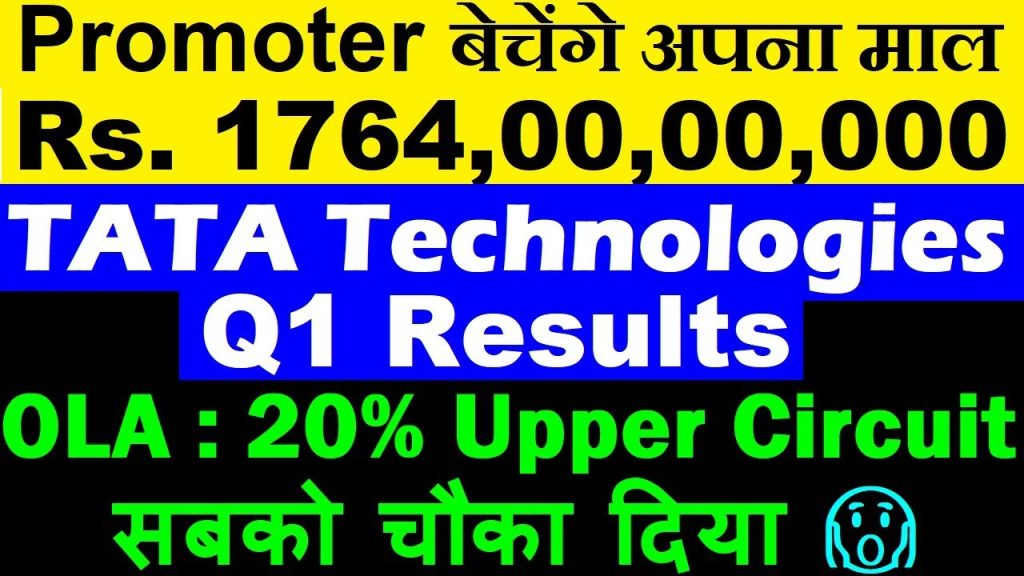
The corporate landscape is buzzing with updates from Ola Electric, Tata Technologies, and VIP Industries. These companies have released their quarterly results, sparking varied reactions in the stock market. From Ola Electric’s surprising stock surge despite significant losses to Tata Technologies’ steady yet underwhelming performance and VIP Industries’ promoter stake sale, there’s much to unpack. This article dives deep into their financial performances, management strategies, and market implications, offering insights for investors and industry enthusiasts.
Ola Electric Q1 Results: A Rollercoaster of Losses and Optimism
Ola Electric, a prominent player in India’s electric vehicle (EV) sector, reported its Q1 results for the June quarter, revealing a mix of challenges and ambitious projections. Despite a steep decline in revenue, the company’s stock soared by 20%, leaving investors both puzzled and intrigued.
Revenue Slump and Persistent Losses
Ola Electric’s financials paint a grim picture for Q1. The company recorded a revenue of ₹800 crore, a sharp 50% drop from ₹1,644 crore in the previous quarter. This decline is stark when compared to earlier quarters, where revenue consistently hit four-digit figures, such as ₹1,000–₹1,500 crore. Operating expenses remain high, staying in the four-digit range, resulting in an operating loss of ₹237 crore, down from ₹2,695 crore in prior periods. The net loss for the quarter stood at ₹428 crore, an improvement from ₹870 crore but still significant compared to ₹347 crore in earlier quarters. Negative margins continue to plague the company, signaling ongoing profitability challenges.
Management’s Bold Guidance Fuels Stock Surge
Despite these dismal numbers, Ola Electric’s stock surged by 20%, driven by the management’s optimistic outlook for Financial Year 2026 (FY26). The company’s leadership projected a robust recovery, estimating annual revenue of ₹4,200–₹4,700 crore by the end of FY26. They also forecasted selling approximately 375,000 units, with gross margins expected to reach 35–40%. A key highlight is their claim that Earnings Before Interest, Taxes, Depreciation, and Amortization (EBITDA) will turn positive starting from Q2. Additionally, Ola Electric plans to invest ₹300 crore in capital expenditure (CapEx) and eliminate debt refinancing needs by the next quarter, aiming for free cash flow positivity.
This forward-looking guidance has instilled confidence in some investors, explaining the stock’s unexpected rally. However, skepticism remains, as the market awaits tangible results in Q2 to validate these ambitious claims. Failure to deliver could lead to a sharp correction in the stock price, as markets often react harshly to unmet expectations.
What’s Driving Investor Sentiment?
The dichotomy between Ola Electric’s poor Q1 performance and its stock’s rally underscores the power of management commentary. Investors are betting on the company’s ability to execute its FY26 goals, particularly in scaling production and improving margins. However, the EV market is highly competitive, with challenges like supply chain constraints and consumer adoption rates. Ola Electric’s ability to navigate these hurdles will determine whether its stock’s momentum is sustainable.
Tata Technologies Q1 Results: Steady but Uninspiring
Tata Technologies, a global engineering and product development firm, released its Q1 results, showing a mixed performance that aligns with its recent trends. While the company beat profit expectations, revenue fell short, resulting in a lackluster market response.
Revenue and Profit Trends
Tata Technologies reported a quarterly revenue of ₹1,244 crore, slightly down from ₹1,269 crore in the previous quarter and ₹1,286 crore year-over-year. Operating profit stood at ₹200 crore, a decline from ₹231–₹233 crore in prior periods, with margins slipping to 16% from 18%. Net profit came in at ₹170 crore, surpassing the estimated ₹157 crore but lower than the ₹189 crore reported in the previous quarter. Year-over-year, net profit improved slightly from ₹162 crore.
Mixed Performance Against Expectations
The company’s ability to beat profit estimates provided some relief, but the revenue miss highlights ongoing challenges. Tata Technologies’ performance reflects a steady but uninspiring trajectory, consistent with its historical data. The decline in revenue and margins suggests operational inefficiencies or market headwinds, possibly in the global automotive and aerospace sectors, where the company derives significant business.
Market Implications and Investor Outlook
Tata Technologies’ results lack the spark to drive significant stock movement. Investors are likely to view the company as a stable but low-growth option in the short term. The firm’s focus on engineering services for electric and autonomous vehicles positions it well for long-term growth, but near-term challenges, such as global economic slowdowns, could cap its upside. For now, Tata Technologies remains a “hold” for cautious investors seeking steady returns.
VIP Industries: Promoter Stake Sale Sparks Speculation
VIP Industries, a leading luggage and travel accessories brand with a 45–46% market share in India, grabbed headlines with news of its promoters planning to sell a significant stake. This development, coupled with the company’s history of management challenges, has put it in the spotlight.
Promoter Stake Sale: What’s Happening?
The promoters, led by the Dilip Piramal family, currently hold a 51.73% stake in VIP Industries. They plan to offload approximately 32% of their stake, valued at around ₹10,764 crore. This move follows reports of a management crisis over recent years, prompting the promoters to reconsider the ownership structure. The sale is likely to attract interest from private equity (PE) firms, which see value in VIP’s strong brand and market dominance.
The decision to sell stems from the absence of a clear successor within the family, a common issue in family-run businesses. By divesting a significant portion of their stake, the promoters aim to streamline operations and potentially bring in strategic investors to drive growth.
Open Offer Implications
A critical aspect of this stake sale is the regulatory requirement for an open offer. In India, under the Securities and Exchange Board of India (SEBI) regulations, if a promoter sells more than 26% of their stake, it triggers an open offer. This allows non-promoter shareholders, including retail and institutional investors, to sell their shares at a predetermined price, typically based on a formula involving the average stock price over the past 26 weeks.
The 26% threshold is significant because it relates to SEBI’s rules on promoter control. Promoters can hold up to 75% of a company’s shares, with the remaining 25% reserved for non-promoter shareholders. A stake sale exceeding 26% reduces the promoter’s holding below 74%, stripping them of “superpower” control, which requires 75% ownership for special resolutions. These resolutions are necessary for major decisions, such as changing the company’s name, raising significant debt, or selling key assets.
For VIP Industries, the proposed 32% stake sale will trigger an open offer, giving non-promoter shareholders the option to exit at a fair price. This development has sparked speculation about the company’s future direction and potential new ownership.
Why 26%? Understanding SEBI’s Threshold
The 26% threshold is rooted in corporate governance principles. Promoters with 75% or more ownership can pass special resolutions, granting them significant control over strategic decisions. When their stake falls below this level, their ability to unilaterally influence the company diminishes. The open offer requirement ensures transparency, allowing minority shareholders to exit if they believe the change in control could impact the company’s trajectory.
This regulatory framework protects investors and maintains market stability. For VIP Industries, the open offer will be a key event to watch, as it could influence the stock’s valuation and investor sentiment.
Key Takeaways for Investors
The updates from Ola Electric, Tata Technologies, and VIP Industries offer valuable lessons for investors:
- Ola Electric: The company’s stock surge despite poor Q1 results highlights the market’s forward-looking nature. Investors are betting on management’s ambitious FY26 projections, but the risk of non-delivery looms large. Cautious optimism is warranted until Q2 results validate the guidance.
- Tata Technologies: Steady performance with a slight revenue miss suggests limited near-term upside. The company’s long-term potential in EV and autonomous vehicle engineering remains intact, but investors should temper expectations for immediate gains.
- VIP Industries: The promoter stake sale and impending open offer signal a potential shift in control. Investors should monitor the open offer price and the involvement of PE firms, which could reshape the company’s future.
Strategic Insights for the Market
These developments reflect broader trends in India’s corporate sector:
- EV Sector Challenges: Ola Electric’s struggles highlight the capital-intensive nature of the EV industry. Scaling production while managing costs remains a hurdle, but strong management guidance can sway investor sentiment.
- Engineering Services Stability: Tata Technologies’ consistent performance underscores the resilience of India’s engineering services sector, even amid global uncertainties. However, growth opportunities may be limited in the short term.
- Family Business Transitions: VIP Industries’ stake sale reflects a growing trend among family-run businesses in India, where succession planning issues prompt promoters to divest stakes to professional or institutional investors.
Conclusion: Navigating Uncertainty with Informed Decisions
Ola Electric, Tata Technologies, and VIP Industries present a diverse set of opportunities and risks for investors. Ola Electric’s bold projections require validation, Tata Technologies offers stability but lacks excitement, and VIP Industries’ stake sale introduces uncertainty but also potential for strategic realignment. By understanding these dynamics, investors can make informed decisions in a volatile market.
Stay tuned for updates as these companies navigate their respective paths. For now, the market’s reaction to their performances serves as a reminder of the interplay between financial results, management strategy, and investor sentiment.