


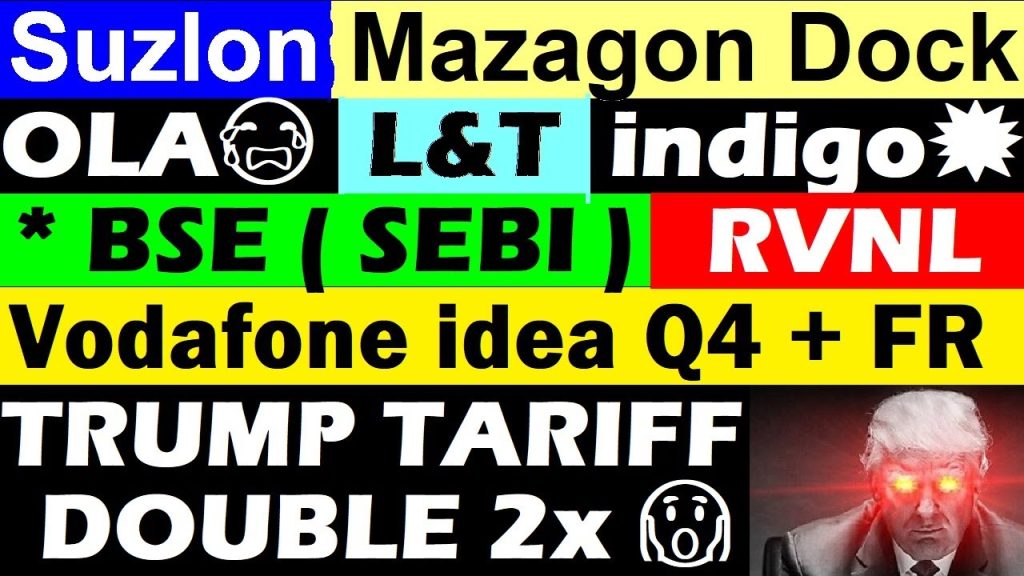
The Indian stock market is a dynamic landscape, brimming with opportunities and challenges. From infrastructure giants like Larsen & Toubro (L&T) to telecom players like Vodafone Idea, recent developments have stirred investor interest. This article delves into key updates from companies like L&T, Ola Electric, Vodafone Idea, Mazagon Dock, BSE, RVNL, Suzlon, and others, analyzing their Q4 results, market positioning, and broader economic implications. Additionally, we explore external factors like Donald Trump’s tariff policies and their potential impact on Indian markets. With a focus on actionable insights, this 3,000-word guide aims to equip investors with the knowledge to navigate these developments effectively.
Larsen & Toubro (L&T): A Breakthrough Victory in Infrastructure
Supreme Court Relief Sparks Optimism
Larsen & Toubro, a titan in India’s infrastructure sector, recently secured a significant win in the Supreme Court, paving the way for renewed opportunities. The company had been entangled in a legal battle over a ₹14,000 crore infrastructure project tendered by the Mumbai Metropolitan Region Development Authority (MMRDA). L&T argued that the tender process lacked transparency, a claim that lower courts had repeatedly dismissed. However, the Supreme Court’s decision to scrap the tender and call for a fresh bidding process has given L&T a new lease on life.
This ruling is a game-changer for L&T. As one of the lowest bidders in the original tender, the company is now well-positioned to secure the project in the upcoming round. This development not only bolsters L&T’s project pipeline but also reinforces its reputation as a leader in India’s infrastructure space. Investors can expect renewed momentum in L&T’s stock as the company capitalizes on this opportunity.
Why L&T Remains a Top Pick for Investors
L&T’s dominance in infrastructure, engineering, and construction makes it a cornerstone of India’s growth story. The company’s diverse portfolio spans roads, bridges, metro systems, and power plants, aligning with India’s ambitious infrastructure push. With the government prioritizing capital expenditure, L&T stands to benefit from increased project allocations. The Supreme Court’s decision further enhances its growth prospects, making it a compelling choice for long-term investors seeking exposure to India’s infrastructure boom.
Ola Electric: Navigating Challenges in the EV Market
Q4 Disappointments Weigh on Investor Sentiment
Ola Electric, a prominent player in India’s electric vehicle (EV) space, faced a tough Q4, with its stock witnessing a decline. The company’s financial performance fell short of expectations, with both revenue and sales underperforming. Investors, already aware of Ola Electric’s loss-making status, were particularly disappointed by the lack of progress in top-line growth. The company’s inability to capture a larger market share in the competitive EV sector has raised concerns about its long-term viability.
The Road Ahead for Ola Electric
Despite these challenges, Ola Electric operates in a high-growth sector. India’s push for sustainable transportation, coupled with government incentives for EVs, provides a favorable backdrop. However, the company must address operational inefficiencies and strengthen its market positioning to regain investor confidence. Upcoming sales data, expected around the first of the month, will shed light on Ola Electric’s market share and competitive standing. For now, cautious investors may want to monitor the company’s progress before making significant commitments.
Strategic Moves to Watch
To turn the tide, Ola Electric needs to focus on scaling production, improving product quality, and expanding its charging infrastructure. Partnerships with battery manufacturers and investments in R&D could also enhance its competitive edge. While the short-term outlook remains challenging, the long-term potential of India’s EV market makes Ola Electric a stock to watch for risk-tolerant investors.
Vodafone Idea: A Fight for Survival
Q4 Results Highlight Persistent Challenges
Vodafone Idea’s Q4 results paint a grim picture of a company grappling with financial distress. Despite generating ₹11,000 crore in sales and an operating profit of ₹4,500 crore, the company’s massive debt burden continues to erode its viability. With interest expenses nearing ₹6,500 crore, Vodafone Idea reported a significant loss before tax, underscoring the unsustainable nature of its financial structure.
The telecom giant’s struggles are well-known, but the scale of its challenges cannot be overstated. With a debt pile that dwarfs its operational profits, the company is in a race against time to stabilize its finances.
Fund-Raising Efforts: A Lifeline or a Band-Aid?
To address its precarious situation, Vodafone Idea has approved a ₹20,000 crore fund-raising plan. This move is aimed at ensuring the company’s survival, but it’s far from a complete solution. The company’s debt obligations are staggering, with an additional ₹18,000 crore in repayments due by March 31, 2026. Even with government ownership at 49%, Vodafone Idea’s ability to attract external funding remains uncertain. The company’s parent entities have shown reluctance to inject further capital, and banks are wary of extending additional loans.
Can Vodafone Idea Turn Things Around?
The telecom sector is critical to India’s digital economy, but Vodafone Idea’s shrinking market share and lack of revenue growth make its recovery uncertain. The company must prioritize network expansion, particularly in 5G, to compete with rivals like Reliance Jio and Bharti Airtel. Without significant operational improvements and successful fund-raising, Vodafone Idea risks becoming a government-owned entity or facing insolvency. Investors should approach this stock with caution, as the risks far outweigh the potential rewards at this stage.
Mazagon Dock: Navigating Volatility in Shipbuilding
Q4 Performance and Market Expectations
Mazagon Dock Shipbuilders, a key player in India’s defense and shipbuilding sector, experienced a sharp decline in its stock price following disappointing Q4 results. Both annual and quarterly profits fell significantly, with a nearly 50% drop in earnings compared to expectations. While the company outperformed slightly relative to the worst-case scenarios, its financials reflect the cyclical nature of the shipbuilding industry.
Understanding Mazagon Dock’s Business Model
Mazagon Dock’s performance is heavily tied to its project pipeline. Large-scale defense contracts, such as those for naval ships and submarines, drive its revenue and profitability. However, delays in securing new contracts can lead to prolonged periods of low activity, impacting both top-line and bottom-line growth. When projects are secured, the company can generate substantial profits, but the absence of consistent orders creates volatility.
Investment Outlook
For investors, Mazagon Dock offers exposure to India’s growing defense sector, which is benefiting from the government’s focus on self-reliance (Atmanirbhar Bharat). However, the company’s reliance on sporadic contracts makes it a higher-risk investment. Monitoring upcoming defense tenders and the company’s order book will be critical for assessing its growth potential.
BSE: Riding the Wave of Market Reforms
SEBI’s Regulatory Changes Boost Volumes
The Bombay Stock Exchange (BSE) has been a standout performer, driven by regulatory changes and market optimism. The Securities and Exchange Board of India (SEBI) recently revised its futures and options (F&O) regulations, leading to a surge in trading volumes. This has directly benefited BSE, which is seeing increased activity on its platform.
IPO Buzz and Valuation Gains
Another catalyst for BSE’s strong performance is the anticipated initial public offering (IPO) of the National Stock Exchange (NSE). When a competitor goes public, it often leads to better valuations for existing players in the sector. BSE, as a listed entity, is well-positioned to capitalize on this trend. The company’s stock has witnessed significant gains, reflecting investor confidence in its growth prospects.
Why BSE Is a Strong Contender
BSE’s ability to adapt to regulatory changes and leverage market trends makes it a compelling investment option. The exchange’s focus on innovation, including new financial products and technology upgrades, further enhances its appeal. For investors seeking exposure to India’s financial infrastructure, BSE offers a blend of stability and growth potential.
RVNL: Capitalizing on Infrastructure Momentum
New Contracts Fuel Growth
Rail Vikas Nigam Limited (RVNL) continues to benefit from India’s infrastructure push, particularly in the railway sector. The company recently signed a memorandum of understanding (MoU) and secured new contracts, boosting its order book. These developments are expected to drive top-line growth, reinforcing RVNL’s position as a key player in railway infrastructure.
Investment Appeal
RVNL’s alignment with India’s railway modernization efforts makes it an attractive option for investors. The government’s focus on expanding rail networks and upgrading existing infrastructure ensures a steady flow of projects for RVNL. With a robust order pipeline, the company is well-poised for sustained growth, making it a solid pick for infrastructure-focused portfolios.
Suzlon Energy: Powering Up with Renewable Energy
Strong Q4 Results Drive Stock Surge
Suzlon Energy, a leader in India’s renewable energy sector, delivered impressive Q4 results, fueled by strong revenue growth. Despite adjustments for deferred tax credits, the company’s performance exceeded expectations, leading to a significant rally in its stock price. Suzlon’s focus on wind energy aligns with India’s renewable energy ambitions, positioning it for long-term success.
Government Policies Boost Prospects
The government’s push for indigenous equipment in the renewable energy sector has been a game-changer for Suzlon. Policies mandating the use of domestically manufactured components have strengthened the company’s order book and market position. Brokerages like Motilal Oswal have highlighted Suzlon’s strong fundamentals, further boosting investor confidence.
Why Suzlon Is a Renewable Energy Gem
Suzlon’s leadership in wind energy, combined with favorable government policies, makes it a standout in the renewable energy space. The company’s ability to deliver consistent revenue growth and capitalize on India’s green energy transition positions it as a top pick for investors seeking exposure to sustainable investments.
Indigo and the Aviation Sector: Soaring to New Heights
Rising Demand Fuels Growth
India’s aviation sector is experiencing robust growth, driven by increasing air traffic and passenger demand. As the world’s third-largest domestic aviation market, India offers immense opportunities for airlines like Indigo. The company has consistently outperformed its peers, benefiting from strong operational performance and a dominant market share.
Promoter Activity and Institutional Interest
While Indigo has seen promoter selling, institutional investors have stepped in to absorb the stake, signaling confidence in the company’s long-term prospects. This shift in ownership, combined with Indigo’s operational strength, makes it a reliable choice for investors seeking exposure to India’s aviation boom.
Future Outlook
With rising demand for air travel and ongoing airport infrastructure development, Indigo is well-positioned to capitalize on market trends. The company’s focus on cost efficiency and fleet expansion further enhances its growth potential, making it a cornerstone of aviation-focused portfolios.
Donald Trump’s Tariff Policies: Ripple Effects on Indian Markets
Steel Tariffs and Global Implications
Former U.S. President Donald Trump’s proposal to double steel tariffs from 25% to 50% has sent shockwaves through global markets. While the policy faces legal challenges, its potential implementation could disrupt the steel industry, particularly for countries like China, which dominate global steel production. If enacted, the tariffs could lead to increased dumping of steel in other markets, including India.
Impact on Indian Steel Companies
For Indian steel companies, higher U.S. tariffs could create challenges by increasing competition from cheaper imported steel. To counter this, the Indian government may impose anti-dumping duties, as seen in previous cycles. Companies like Tata Steel and JSW Steel will need to navigate these challenges while leveraging domestic demand to maintain profitability.
Strategic Considerations for Investors
Investors in the metal and steel sectors should closely monitor developments around U.S. tariffs and India’s response. Companies with strong domestic exposure and diversified revenue streams are likely to fare better in this volatile environment.
Investment Strategies for Navigating Market Trends
Diversify Across Sectors
The developments discussed highlight the importance of diversification. While infrastructure and renewable energy stocks like L&T and Suzlon offer strong growth potential, high-risk stocks like Vodafone Idea require careful consideration. A balanced portfolio that includes exposure to infrastructure, aviation, and financial services can mitigate risks while capturing upside potential.
Focus on Long-Term Trends
India’s infrastructure, renewable energy, and aviation sectors are aligned with long-term growth trends. Companies like L&T, Suzlon, and Indigo are well-positioned to benefit from government policies and rising demand. Investors should prioritize fundamentally strong companies with robust order books and sustainable business models.
Monitor Regulatory and Global Developments
Regulatory changes, such as SEBI’s F&O reforms, and global events, like U.S. tariff policies, can significantly impact market dynamics. Staying informed about these developments will help investors make timely decisions and capitalize on emerging opportunities.
Conclusion: Seizing Opportunities in a Dynamic Market
India’s stock market is a vibrant ecosystem, offering a wealth of opportunities for informed investors. From L&T’s legal victory to Suzlon’s renewable energy surge, recent developments underscore the potential for growth in key sectors. However, challenges like Vodafone Idea’s debt crisis and global tariff uncertainties require cautious navigation. By focusing on fundamentally strong companies, diversifying across sectors, and staying attuned to market trends, investors can position themselves for success in this dynamic landscape.
For the latest updates on stock market trends and investment strategies, subscribe to our newsletter or follow our YouTube channel for expert insights. Stay informed, stay ahead, and unlock the potential of India’s booming markets.