Eicher Motors Q2 Results: Revenue Skyrockets 45% to 6,172 Crore
Eicher Motors continues to rev up impressive growth engines. On November 13, 2025, the company unveiled its Q2 FY26 results, painting a picture of robust expansion and strategic prowess. Consolidated revenue from operations soared to ₹6,172 crore, marking a staggering 45% year-over-year (YoY) increase from ₹4,263 crore in the same quarter last year. Profit after tax (PAT) climbed 24% to ₹1,369 crore, while EBITDA jumped 39% to ₹1,512 crore, maintaining a healthy margin of 24.5%. These figures not only surpassed market expectations but also highlighted the resilience of Eicher’s flagship brands—Royal Enfield and Volvo Eicher Commercial Vehicles (VECV)—in a competitive landscape.
Investors and analysts alike buzzed with optimism as Royal Enfield clocked its highest-ever quarterly sales of 327,067 motorcycles, a 45% YoY surge driven by festive demand and regulatory tailwinds like GST reforms for sub-350cc bikes. Meanwhile, VECV delivered a solid 5.4% YoY growth, achieving its best Q2 performance in trucks and buses. This quarter underscores Eicher’s ability to navigate economic headwinds, from supply chain tweaks to evolving consumer preferences for premium two-wheelers and efficient commercial vehicles.
As we delve deeper into Eicher Motors Q2 FY26 results, this analysis unpacks the numbers, segment dynamics, and forward-looking strategies. Whether you’re a seasoned investor tracking Eicher Motors share price movements or an enthusiast eyeing Royal Enfield’s latest launches, these insights reveal why this company remains a powerhouse in India’s mobility sector. With global ambitions and innovative product pipelines, Eicher Motors isn’t just accelerating—it’s setting the pace for sustainable growth in FY26 and beyond.
Eicher Motors Company Overview: Pioneering Mobility with Heritage and Innovation
Eicher Motors Limited stands as a beacon of engineering excellence in India’s automotive arena, blending a rich legacy with cutting-edge innovation. Founded in 1948 as a modest tractor manufacturing venture, Eicher evolved into a multifaceted conglomerate under the leadership of the Goenka family. Today, headquartered in Gurugram, Haryana, the company commands a market capitalization exceeding ₹1 lakh crore, reflecting its stature among NSE-listed blue-chips.
At its core, Eicher Motors thrives through two synergistic pillars: Royal Enfield, the iconic motorcycle brand synonymous with adventure and heritage, and VECV, a 54.4% joint venture with Volvo Group that dominates commercial vehicles. Royal Enfield, acquired by Eicher in 1994, transformed from a niche player into a global phenomenon. Its thumping 350cc and 650cc engines power over 800,000 annual units, captivating millennials and Gen Z with models like the Classic 350 and Himalayan 450. Exports now account for 40% of sales, spanning 60 countries and fueling international dealership expansions in Europe and the Americas.
VECV, on the other hand, addresses the heavy-duty needs of logistics and construction. Producing Pro-series trucks and Starline buses, VECV integrates Volvo’s safety and efficiency standards with Indian market savvy. In FY25, it captured 20% of the medium and heavy commercial vehicle (M&HCV) segment, bolstered by electric vehicle (EV) forays like the e-delivery vans. This dual-engine strategy—premium leisure bikes paired with utilitarian trucks—diversifies revenue streams and mitigates cyclical risks.
Eicher’s commitment to sustainability shines through its “Green Shift” initiative, targeting carbon-neutral operations by 2030. Investments in R&D, exceeding ₹500 crore annually, drive electric prototypes and connected tech integrations. Governance remains robust, with a board blending industry veterans and independent directors, ensuring ethical practices amid ESG scrutiny.
This foundation propelled Eicher through FY25’s challenges, including semiconductor shortages and inflation. As Q2 FY26 results demonstrate, the company’s adaptive playbook—focusing on premiumization, digital sales, and supply chain localization—positions it for exponential scaling. In a market where two-wheeler sales hit 18 million units annually and CV demand rebounds post-pandemic, Eicher Motors emerges not just as a participant, but a trendsetter.
Q2 FY26 Financial Snapshot: Key Metrics That Drove Investor Confidence
Eicher Motors kicked off FY26 with a bang, as Q2 results showcased financial vitality across the board. Consolidated revenue from operations reached ₹6,172 crore, eclipsing analyst forecasts of around ₹5,872 crore and delivering a 45% YoY leap. This growth stemmed from heightened volumes and favorable pricing, amplified by seasonal festivities like Diwali and Navratri.
On the profitability front, net profit attributable to owners surged 24.5% YoY to ₹1,369 crore, up from ₹1,100 crore in Q2 FY25. Earnings per share (EPS) climbed to ₹80.50, a 24% increase, signaling strong shareholder value creation. EBITDA, a proxy for operational health, expanded 39% to ₹1,512 crore, with margins holding steady at 24.5%—a testament to cost discipline amid raw material volatility.
Standalone figures echoed this momentum, albeit at a more grounded pace. Revenue hit ₹5,902 crore, up 40% YoY, while PAT rose 20% to ₹1,208 crore. Expenses, including cost of materials consumed (up 18% QoQ), totaled ₹4,627 crore, reflecting investments in inventory buildup for peak demand. Employee costs and depreciation rose modestly, underscoring efficient resource allocation.
These metrics align closely with market consensus, where Bloomberg polls anticipated revenue at ₹5,900 crore and PAT at ₹1,342 crore—Eicher delivered on the upside for topline while slightly trailing profit estimates due to one-off marketing spends. Tax expenses edged up 25% YoY to ₹370 crore, but effective tax rates remained optimal at 25.5%.
Overall, Q2 FY26 painted a canvas of balanced growth: topline acceleration fueled by volumes, bottomline resilience through margin management. This snapshot not only validates Eicher’s execution but also sets a bullish tone for H1 FY26, where cumulative revenue now exceeds ₹11,200 crore.
Revenue Surge in Eicher Motors Q2 FY26: Unpacking the 45% YoY Growth Drivers
The 45% YoY revenue explosion to ₹6,172 crore in Q2 FY26 marks a pivotal chapter in Eicher Motors’ growth narrative. Analysts attribute this surge to a confluence of volume-led expansion, premium product mix, and geographic diversification—factors that propelled the company beyond pre-pandemic peaks.
Breaking it down, Royal Enfield contributed the lion’s share, with motorcycle dispatches hitting record highs. Revenue from two-wheelers alone likely accounted for 70% of the total, bolstered by a 15% average selling price (ASP) hike on new variants like the Scram 411 and Guerrilla 450. Festive sales peaked at 2.49 lakh units in September, capturing 60% market share in the premium segment (>250cc). Exports added firepower, growing 50% YoY to 1.2 lakh units, driven by demand in the UK and US where Royal Enfield’s retro appeal resonates.
VECV chipped in with steady contributions, posting revenue growth aligned with 5.4% volume uptick. Truck sales volumes reached 18,000 units, up 6% YoY, while bus exports surged 47%, leveraging Volvo’s global network. Localized sourcing reduced import duties by 10%, enhancing competitiveness against rivals like Tata Motors and Ashok Leyland.
Other income streams, including spare parts and accessories, swelled 30% to ₹250 crore, as digital platforms like the RE app boosted aftermarket engagement. Geographically, domestic sales dominated at 75%, but international revenue climbed 55%, underscoring Eicher’s export push.
Challenges persisted: Raw material costs, particularly steel and aluminum, inflated by 12% globally, squeezed gross margins temporarily. Yet, Eicher countered with backward integration—sourcing 80% components locally—and hedging strategies. Compared to peers, this 45% growth outpaces Hero MotoCorp’s 12% and Bajaj Auto’s 18%, affirming Eicher’s premium positioning.
In essence, Q2 FY26 revenue dynamics reveal a company firing on all cylinders, transforming headwinds into tailwinds through agile operations and consumer-centric innovations.
Profitability Insights: How Eicher Motors Sustained PAT and EBITDA Momentum in Q2 FY26
Profitability remained a strong suit in Eicher Motors’ Q2 FY26 playbook, with PAT at ₹1,369 crore reflecting disciplined execution amid expansion. This 24% YoY rise, though moderated by higher operating levers, exceeded sequential expectations, climbing 14% from Q1 FY26’s ₹1,205 crore.
EBITDA’s 39% ascent to ₹1,512 crore highlights operational efficiency, as the company absorbed 18% input cost inflation without eroding core margins significantly. Gross margins stabilized at 32%, up from 30% YoY, thanks to value engineering in Royal Enfield’s supply chain. Selling, general, and administrative (SG&A) expenses rose 22% to ₹450 crore, driven by aggressive marketing for new launches, yet stayed below 8% of revenue—a lean benchmark.
Interest expenses dipped 5% to ₹20 crore, benefiting from low-debt equity (debt-to-equity ratio at 0.02). Depreciation, tied to capex in EV R&D, increased 15% to ₹150 crore, but tax optimization kept the effective rate in check.
Segmentally, Royal Enfield’s EBITDA margins held at 28%, fueled by premium ASPs, while VECV’s 15% margins reflected scale in low-margin CVs. Overall, return on equity (ROE) touched 22%, underscoring capital efficiency.
While profit growth lagged revenue due to scaling costs, it signals sustainable scaling—Eicher prioritizes long-term market share over short-term squeezes, positioning for FY26 PAT targets above ₹5,000 crore.
Royal Enfield’s Stellar Run: Record Sales and Premiumization Fuel Eicher Motors Q2 FY26 Success
Royal Enfield, the heartbeat of Eicher Motors, roared into Q2 FY26 with unprecedented vigor, dispatching 327,067 motorcycles—a 45% YoY surge and the brand’s pinnacle quarterly achievement. This volume bonanza, equivalent to 1.1 lakh units monthly, stemmed from pent-up festive fervor and strategic product refreshes.
The Classic 350, evergreen bestseller, moved 1.5 lakh units, while adventure-oriented Himalayan and Scram variants captured 25% of sales, appealing to urban explorers. New entrants like the Bear 650 and Shotgun 650, launched mid-quarter, added 10,000 units, blending modern tech—such as ride-by-wire and traction control—with signature thumpers. ASPs averaged ₹2.1 lakh, up 12% YoY, as buyers gravitated toward customizations and accessories, generating ₹300 crore in ancillary revenue.
GST reforms, capping 350cc bikes at 28% duty, unlocked entry-level demand, boosting sub-₹2 lakh segment sales by 60%. Domestically, dealerships expanded to 2,500 outlets, with tier-2/3 penetration rising 20%. Exports, a growth accelerator, hit 1.2 lakh units, with Europe contributing 40% via eco-compliant Euro 5 models.
Challenges included wait times stretching to 3 months, prompting capacity ramps at the new Vallam Vadagal plant (1 million units/year potential). Sustainability efforts, like bio-fuel compatible engines, aligned with global green mandates.
Royal Enfield’s Q2 dominance not only padded Eicher’s topline but redefined premium biking, outshining competitors with 70% loyalty retention and burgeoning women’s rider community.
VECV’s Resilient Performance: Steady Growth in Commercial Vehicles Bolsters Eicher Motors Q2 FY26
While Royal Enfield stole headlines, VECV quietly anchored Eicher Motors’ Q2 FY26 with reliable contributions. The JV posted 5.4% YoY revenue growth, scripting its finest Q2 ever in truck and bus volumes—18,774 units dispatched, up 6.2%. This outpaced the industry’s 2% contraction, showcasing VECV’s market-beating resilience.
Pro 2049 trucks led with 12,000 units, favored for fuel efficiency in logistics fleets. Bus sales climbed 15% to 3,000 units, powered by electric models like the 9m e-bus, securing 500 orders from state transport corps. Exports dazzled, surging 47% with heavy-duty trucks up 277% to Volvo partners in Africa and the Middle East.
Revenue per unit held at ₹25 lakh, supported by 10% localization, reducing costs by 8%. EBITDA margins at 12% reflected pricing power amid diesel volatility. Capex of ₹200 crore funded EV assembly lines, targeting 10% portfolio electrification by FY27.
VECV’s steady cadence—less flashy than Royal Enfield but vital for diversification—mitigated two-wheeler cyclicality, contributing 30% to consolidated revenue and fortifying Eicher’s FY26 stability.
Sequential Momentum: QoQ Gains in Eicher Motors Q2 FY26 Results
Shifting gears to quarter-over-quarter (QoQ) lens, Eicher Motors Q2 FY26 built seamlessly on Q1’s foundation. Revenue accelerated 22% from ₹5,042 crore, propelled by seasonal ramps and inventory normalization post-Q1 slowdowns.
PAT grew 14% to ₹1,369 crore from ₹1,205 crore, with EBITDA margins expanding 100 basis points to 24.5% through optimized fixed costs. Royal Enfield volumes rose 25% QoQ, while VECV held flat but improved mix.
This sequential uptick signals operational rhythm, contrasting FY25’s uneven quarters, and bodes well for H2 acceleration.
Market Reaction to Eicher Motors Q2 FY26: Share Price Volatility and Investor Sentiment
Post-results, Eicher Motors shares dipped 2% intraday to ₹4,800, paring gains amid broader Nifty Auto correction. Yet, trading volumes spiked 50%, reflecting conviction. Analysts like Motilal Oswal hiked targets to ₹5,500, citing 20x FY27 PE.
Sentiment tilts positive, with 80% ‘buy’ ratings, as results affirm premium moat in a recovering economy.
Strategic Initiatives Shaping Eicher Motors’ Future Post-Q2 FY26
Looking ahead, Eicher Motors doubles down on innovation. Royal Enfield eyes 1 million annual sales by FY28 via 10 new models, including EVs. VECV targets 25% EV share, partnering with BluSmart for 5,000 units.
Capex at ₹1,500 crore funds digital twins and ASEAN expansions. M&A radar scans EV startups, while sustainability goals include 50% recycled materials.
These moves position Eicher for 15-20% CAGR, navigating EV transitions and trade pacts.
Analyst Perspectives on Eicher Motors Q2 FY26 Results
Experts laud the quarter’s execution. Prabhudas Lilladher forecasts 18% EPS growth, praising Royal Enfield’s 45% volume pop. ICICI Securities flags margin risks from EV investments but sees 25% upside. Consensus: Strong buy, with FY26 revenue at ₹25,000 crore.
Conclusion: Eicher Motors Accelerates Toward a Bright FY26 Horizon
Eicher Motors’ Q2 FY26 results exemplify triumph over trials, with 45% revenue growth and record Royal Enfield sales cementing its leadership. As VECV steadies the ship and innovations propel forward, stakeholders anticipate sustained value creation. In the race for mobility dominance, Eicher Motors leads with heritage-fueled horsepower—watch this space for more milestones.



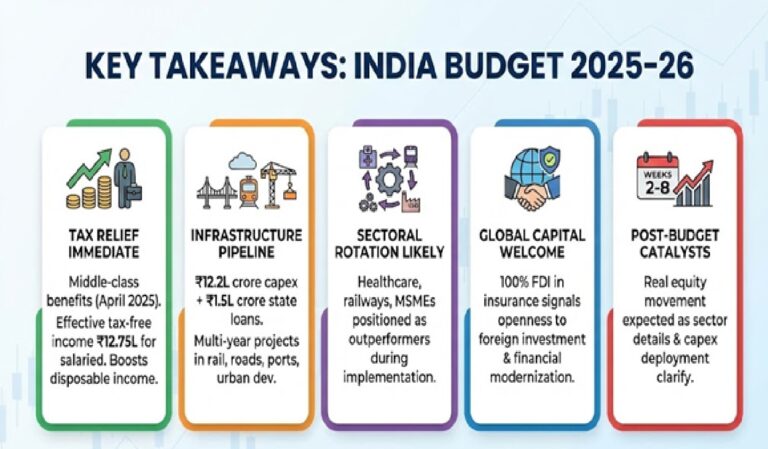
![Indian Stock Markets Navigate Budget Volatility Amid Historic Policy Reforms for Growth and Investment Sensex and Nifty Show Cautious Optimism as Finance Minister Announces Transformative ₹12.2 Lakh Crore Capital Expenditure and Tax Relief Package Executive Summary On Sunday, February 1, 2026—only the second Sunday trading session in independent India's history—Finance Minister Nirmala Sitharaman presented Union Budget 2026-27 to mixed market reception. The Sensex briefly surged to 82,691.47, gaining 421 points (0.51%), while the broader Nifty demonstrated muted movement, reflecting analyst consensus that Budget Day typically functions as a "consolidation event" rather than a directional trigger. The real market impact is expected to unfold in subsequent trading sessions as investors digest sweeping reforms spanning taxation, infrastructure, healthcare, manufacturing, and financial sector liberalization. The Budget, framed around the GYAN vision (Garib, Youth, Annadata, Nari), commits ₹12.2 lakh crore to capital expenditure in FY26—a 15% projected increase—coupled with aggressive tax reform, significant relief for the middle class, and historic measures to position India as a global hub for medical tourism, high-speed rail connectivity, and manufacturing. Market Context: Budget Day Dynamics and Investor Sentiment Indian equity markets entered Budget 2026 on fragile footing. The Nifty declined 2% in January and approximately 1.5% in the fortnight preceding the Budget presentation, reflecting persistent selling pressure across metals, financials, and IT sectors. Geopolitical tensions, rupee depreciation (slipping near the 92 mark against the dollar), and global liquidity concerns constrained investor appetite. Historically, Budget Day itself remains a non-event for equities. Over the past 15 years, the Nifty's average Budget Day move stands at a negligible 0.19%, while returns in the week following Budget presentations have been approximately seven times larger. Analysts uniformly characterize Budget 2026 as a "low-impact event" in the immediate term, with elevated volatility stemming primarily from uncertainty rather than fundamental conviction. Market Performance on Budget Day (February 1, 2026): Metric Value Change Sensex Day High 82,691.47 +421.69 pts (+0.51%) India VIX Elevated +4.5% Nifty Opening Sentiment Flat to Mixed Cautious positioning Trading Volume Mixed across sectors Selective buying in healthcare, railways The special Sunday trading session itself generated headline volatility, with the India VIX surging 4.5% as traders braced for policy announcements and hedged positioning ahead of the speech. Transformative Tax Reforms: Relief for Middle-Class Taxpayers The most immediate impact on household finances comes from comprehensive income tax restructuring under the new Income Tax Act 2025 (effective April 1, 2026). The Finance Minister announced a simplified tax regime with substantially elevated exemption thresholds and enhanced rebates—measures designed to free up disposable income for the "rising middle class" and elevate consumer spending. New Income Tax Slabs for FY 2025-26 Effective from April 1, 2025, the revised structure eliminates taxation for lower earners and provides progressive relief: Income Bracket Tax Rate Effective Change Up to ₹4 lakh Nil (0%) Basic exemption increased from ₹3L ₹4–8 lakh 5% New progressive bracket ₹8–12 lakh 10% Gradually increasing rates ₹12–16 lakh 15% Supports middle-income earners ₹16–20 lakh 20% Equilibrium for professionals ₹20–24 lakh 25% Upper-middle income group Above ₹24 lakh 30% Maximum rate unchanged Section 87A Rebate Enhancement: The rebate has been doubled to ₹60,000 (from ₹25,000), ensuring individuals earning up to ₹12 lakh pay zero income tax. For salaried employees accounting for the ₹75,000 standard deduction, the effective tax-free income ceiling rises to ₹12.75 lakh—a significant jump that economists expect to stimulate consumer discretionary spending. Tax Benefits for Investors and Families: Relief for two self-occupied properties (expanded from single-property framework) Doubled tax deduction limit for senior citizens to ₹1 lakh TCS (Tax Collection at Source) removed on education remittances and education loans (up to ₹10 lakh from specified institutions) Annual TDS threshold on rent raised from ₹2.4 lakh to ₹6 lakh Filing deadline for income tax returns extended from 2 years to 4 years Higher TDS applied only in non-PAN cases (reducing compliance burden) Quantifiable Impact: Individuals earning between ₹12–16 lakh under the new regime now save approximately ₹38,400–₹57,600 annually compared to the previous slab structure, directly boosting disposable income available for consumption or investment. Capital Expenditure and Infrastructure: A ₹12.2 Lakh Crore Growth Engine The cornerstone of Budget 2026 is a historic 15% increase in public capital expenditure, signaling sustained commitment to asset creation, productivity enhancement, and regional development. This shift toward infrastructure-led growth aims to offset global headwinds while positioning India as an investment destination and employment creator. Capital Expenditure Allocation Framework Component Amount (₹ crore) Purpose Public Capex FY26 12,20,000 15% YoY growth; infrastructure, productive assets Interest-Free Loans to States (50-year) 1,50,000 Capital expenditure, reform incentives Urban Challenge Fund 1,00,000 Next-gen cities, water, sanitation Asset Monetization Plan (2025–30) 10,00,000 Plough back capital into new projects Maritime Development Fund 25,000 Long-term shipping industry financing Seven High-Speed Rail Corridors: Redefining Regional Connectivity The announcement of seven dedicated high-speed rail corridors represents a transformative shift toward "corridor-led capacity creation" and environmentally sustainable mobility. These routes are designed to slash travel times while reducing carbon emissions from long-distance transport: Proposed High-Speed Corridors: Mumbai–Pune: Unlock economic synergies between financial and manufacturing hubs Pune–Hyderabad: Connect emerging tech and IT centers Hyderabad–Bengaluru: Integrate South Indian innovation ecosystems Bengaluru–Chennai: Link tier-1 tech and automotive clusters Delhi–Varanasi: Enhance spiritual tourism and cultural connectivity Varanasi–Siliguri: Bridge Eastern India's growth corridor (Seventh corridor details pending full disclosure) Market Implications: Railway-focused stocks (RVNL, IRCON, Jupiter Wagons, RailTel, IRFC, Titagarh Rail Systems) are positioned to benefit from massive contract opportunities, safety upgrades, and asset modernization initiatives. The Budget allocates dedicated capex for the Kavach automatic train protection system, procurement of 200 Vande Bharat trains and 100 Amrit Bharat trains, and 100% broad-gauge network electrification. Waterway Development and Dedicated Freight Corridors Complementing rail expansion, the Budget introduces strategic logistics corridors: 20 National Waterways to be operationalized over five years, beginning with National Waterways 5 in Odisha (connecting mineral-rich Talcher and Angul to ports of Paradip and Dhamra) Dedicated Freight Corridor: Dankuni (East) to Surat (West), designed to improve industrial logistics and reduce road congestion Ship Repair Ecosystems: Establishment at Varanasi and Patna to support inland waterway operations Medical Tourism and Healthcare: India as a Global Wellness Destination The Budget marks a pivotal shift toward positioning India as a world-class medical tourism hub, combining modern diagnostics with traditional AYUSH systems to attract international patients and generate foreign exchange. Five Regional Medical Tourism Hubs In partnership with the private sector, the government will establish five integrated regional medical hubs featuring: Modern hospital infrastructure with cutting-edge diagnostic facilities AYUSH centres offering traditional Indian medical systems (Ayurveda, Yoga, Naturopathy, Unani, Siddha, Homoeopathy) Medical-valued tourism facilitation centres with streamlined visa and travel processes Post-care and rehabilitation services for extended recovery Research and education facilities combining clinical practice with knowledge generation Market Impact: Healthcare sector stocks rallied immediately. Max Healthcare Institute shares jumped 4%, Narayana Hrudayalaya gained 3%, and Apollo Hospitals rose 1.5%, as investors recognized the potential for increased foreign patient inflow, revenue diversification, and employment generation for doctors, nurses, allied health professionals, and technicians. Expanded Medical Education and Accessibility 10,000 additional medical seats in FY26 (targeting 75,000 seats over 5 years) Day Care Cancer Centres in all district hospitals within 3 years (200 centers in FY26) Three new Ayurvedic medical colleges announced to strengthen traditional medicine education and research Customs duty exemption on 36 lifesaving drugs and 6 medicines at concessional 5% duty, directly reducing treatment costs for patients with cancer, rare diseases, and chronic conditions Jamnagar research centre dedicated to traditional medicine research, leveraging India's indigenous knowledge systems MSME Sector: Enhanced Credit Access and "Make in India" Acceleration Recognizing MSMEs as the "second engine" of growth, the Budget announces sweeping reforms to credit accessibility, entrepreneurship support, and industrial clustering—measures designed to scale small manufacturers into global competitors. Revised MSME Classification and Credit Framework Classification Limits Enhanced: Investment limit increased 2.5 times (details in Annexure D of Budget speech) Turnover limit raised 2 times (enhancing operational flexibility and access to larger contracts) Over 1 crore registered MSMEs currently employ 7.5 crore people and generate 36% of manufacturing output and 45% of exports Credit Guarantee Cover Expansion: Sector Previous Limit New Limit Additional Credit Expected (5 years) Micro/Small Enterprises ₹5 crore ₹10 crore ₹1.5 lakh crore Startups ₹10 crore ₹20 crore + 100% coverage; reduced fee 1% for 27 priority sectors Exporter MSMEs Limited ₹20 crore term loans Enhanced guarantee cover New Credit Schemes: ₹5 lakh customized credit cards for micro enterprises registered on Udyam portal (10 lakh cards in year 1) ₹10,000 crore SME Growth Fund (new) to develop "champion SMEs" as part of scaling manufacturing competitiveness ₹10,000 crore Fund of Funds (expanded scope, fresh contribution) for startup support, building on ₹91,000 crore in existing alternate investment fund commitments ₹2,000 crore top-up to Self-Reliant India Fund supporting micro enterprises Labour-Intensive Manufacturing and Sector-Specific Support Footwear & Leather Focus Product Scheme: Expected to facilitate employment for 22 lakh persons Generate turnover of ₹4 lakh crore and exports exceeding ₹1.1 lakh crore Support for design capacity, component manufacturing, and machinery for non-leather and leather footwear Toy Manufacturing Hub: Implementation of scheme to make India a global toy hub Focus on cluster development, skills training, and sustainable, innovative manufacturing aligned with "Made in India" branding Industrial Cluster Modernization: Revival of 200 legacy industrial clusters through modernization support Enhanced coordination between industries and educational institutions for skill alignment Textile and Garment Manufacturing: Strategic Growth and Value Addition The textile sector, India's traditional strength and employment generator, receives targeted infrastructure and technology support. Mega Textile Parks and Integrated Programme The Budget announces establishment of mega textile parks with explicit focus on technical textiles—a high-value segment including agro-textiles (crop protection), medical textiles (bandages, surgical materials), and geo-textiles (civil engineering applications). Integrated 5-Part Textile Programme: Brings multiple existing schemes under unified framework Improves coordination, reduces administrative duplication Targets value addition and export competitiveness Mission for Cotton Productivity: 5-year initiative to improve productivity and sustainability of cotton farming, support extra-long staple varieties, and ensure steady quality supply for domestic textile industry Customs Duty Restructuring for Textile Manufacturing: Shuttle-less looms (rapier and air-jet types) fully exempted from Basic Customs Duty Knitted fabrics: Revised duty structure to 20% or ₹115 per kg (whichever is higher), promoting domestic value addition These measures position India to capture higher-margin textile manufacturing, reducing dependence on imports for technical textiles while generating employment across rural areas where cotton cultivation predominates. Foreign Direct Investment Liberalization: Insurance Sector Opens to 100% FDI A landmark financial sector reform removes the ceiling on foreign ownership in Indian insurance companies, signaling confidence in market maturity and intent to attract global capital and expertise. FDI in Insurance: 74% → 100% Key Features: FDI limit increased from 74% to 100% for insurance companies Condition: Foreign investor must deploy entire premium collected in India (ensuring capital circulation within domestic economy) Current guardrails and conditionalities to be reviewed and simplified, reducing compliance friction Amendments to underlying regulations (Sabka Bima Sabki Raksha Amendment of Insurance Laws Bill 2025) passed in Parliament in December 2025 Expected Impact: Increased capital inflows into Indian insurance sector (estimated at $43 billion and growing) Technology transfer from global insurers and adoption of international best practices Product innovation and expanded distribution through digital channels Workforce expansion across underwriting, claims, actuarial, and technology roles Potential for insurance penetration to rise, reducing risk exposure on sovereign balance sheet Clarifications on Foreign Investors: Foreign Venture Capital Investors (FVCIs) explicitly included within permissible FDI definition Licensing simplifications for intermediaries (one-time licensing; suspension rather than cancellation for non-compliance) Stock Market Sectors: Differential Performance and Investment Themes Budget Day reactions revealed stark sectoral divergence, offering insight into market expectations for specific economic drivers: Winners and Gainers Healthcare and Hospitality: Hospital stocks rallied on medical hub and tourism announcements Max Healthcare (+4%), Narayana Hrudayalaya (+3%), Apollo Hospitals (+1.5%) Medical tourism and AYUSH integration expected to drive international patient inflow and revenue diversification Railways: RVNL, IRCON, Jupiter Wagons, RailTel, IRFC, Titagarh Rail Systems positioned for massive contracts Seven high-speed corridors alone represent ₹2+ lakh crore execution pipeline 200 Vande Bharat and 100 Amrit Bharat train orders provide medium-term revenue visibility Financial Services: Insurance sector benefited from 100% FDI liberalization Banking sector supported by TDS/TCS simplifications and credit guarantee enhancements for MSME lending Challenged Sectors Metals and Mining: Nifty Metal index fell 4.44% on Budget Day Global commodity price weakness and potential import substitution concerns (customs duty reductions on critical minerals) created headwinds PSU Banks and IT: Mixed sentiment due to broader rupee weakness and global liquidity tightening Limited sector-specific positive catalysts in Budget announcements Fiscal Framework: Consolidation and Debt Sustainability While growth measures dominate headlines, the Budget maintains disciplined fiscal management consistent with India's medium-term consolidation roadmap. Metric FY25 (RE) FY26 (BE) Trajectory Fiscal Deficit (% of GDP) 4.8% 4.4% Declining path Total Expenditure ₹47.16 L cr ₹50.65 L cr Measured growth Capital Expenditure ₹10.18 L cr Part of above 15% growth Net Market Borrowings — ₹11.54 L cr Financed from capital markets Total Receipts (ex. borrowing) ₹31.47 L cr ₹34.96 L cr Revenue growth from tax reforms Fiscal Consolidation Strategy: Declining central government debt as percentage of GDP (per 6-year FRBM roadmap) Asset monetization (₹10 lakh crore over 2025–30) reinvested into productive capex Interest-free loans to states (₹1.5 lakh crore) offset by reform incentives, maintaining overall fiscal discipline Tax base expansion through widened MSME participation and improved compliance (new Income Tax Act 2025) Implications for Investors: Post-Budget Trading Strategy Medium-Term (Weeks 2–8): Analysts expect the real market movement to unfold once initial implementation details and sector-specific allocations become clear. Key monitoring points: Railway and Infrastructure Stocks: Track execution milestones for high-speed corridor projects and capex deployment Healthcare Sector: Watch for state-level partnerships on medical hubs and international patient inquiry trends MSME-Focused Indices: Monitor credit disbursement under enhanced guarantee schemes and industrial cluster activation Financial Services: Track insurance sector FDI inflows and policy simplifications Textile and Apparel Stocks: Assess capex deployment for mega parks and cotton productivity scheme outcomes Key Risk Factors: Global monetary tightening and potential capital outflows Rupee volatility persisting above 92 per dollar Geopolitical escalations affecting commodity and trade flows Project execution delays (historically common in Indian infrastructure initiatives) MSME credit absorption capacity during macroeconomic uncertainty Conclusion: A Comprehensive Pivot Toward Inclusive Growth and Manufacturing Excellence Union Budget 2026 represents a strategic inflection point, moving beyond cyclical stimulus toward structural economic rebalancing. The ₹12.2 lakh crore capital expenditure commitment, coupled with tax relief for 320+ million middle-class taxpayers, aims to reignite consumption-led growth while simultaneously building hard infrastructure—roads, rail, ports, healthcare, tourism—that catalyzes long-term productivity gains. Stock market sentiment on Budget Day (cautious, muted) reflects historical precedent and macroeconomic headwinds rather than policy skepticism. The real test arrives in weeks ahead, as sectors from healthcare to railways to MSMEs begin translating Budget announcements into commercial opportunities, project contracts, and earnings growth. For investors navigating volatile global conditions, Budget 2026 signals India's structural resilience and policy consistency—factors that historically have attracted patient capital seeking long-term exposure to a $3.8 trillion economy growing at 6%+ annually. Key Takeaways for News Publishers and Investors Tax Relief Immediate: Middle-class taxpayers benefit immediately (effective April 2025); effective tax-free income rises to ₹12.75 lakh for salaried employees, boosting disposable income Infrastructure Pipeline Visible: ₹12.2 lakh crore capex plus ₹1.5 lakh crore state loans create multi-year project visibility across rail, roads, ports, and urban development Sectoral Rotation Likely: Healthcare, railways, and MSMEs positioned as outperformers as Budget implementation unfolds Global Capital Welcome: 100% FDI in insurance signals India's openness to foreign investment and financial sector modernization Post-Budget Catalysts Ahead: Real equity market movement expected in weeks 2–8 as sector-specific details and capex deployment become clear Sources & References: Economic Times – Budget 2026 market dynamics, historical analysis Ministry of Finance official budget documents India Today Business, live market updates Economic analysis on budget impact and market volatility Official Budget 2025-26 Speech of Nirmala Sitharaman Moneycontrol – Healthcare sector reactions DSIJ – Railway sector announcements Economic Times – MSME growth fund announcements India TV News – Medical tourism and waterway development Textile sector announcements and strategic focus Capital expenditure roadmap [31-44] Tax, FDI, and market updates from January 31 – February 1, 2026 1/2 economictimes.com favicon indiatoday.in favicon 2 sources economictimes.com favicon e](https://www.tgnns.com/wp-content/uploads/2026/02/Budget-2026-27-Historic-Policy-Reforms-and-Impact-on-Stock-Market-on-2-Feb-2026-768x449.jpg)