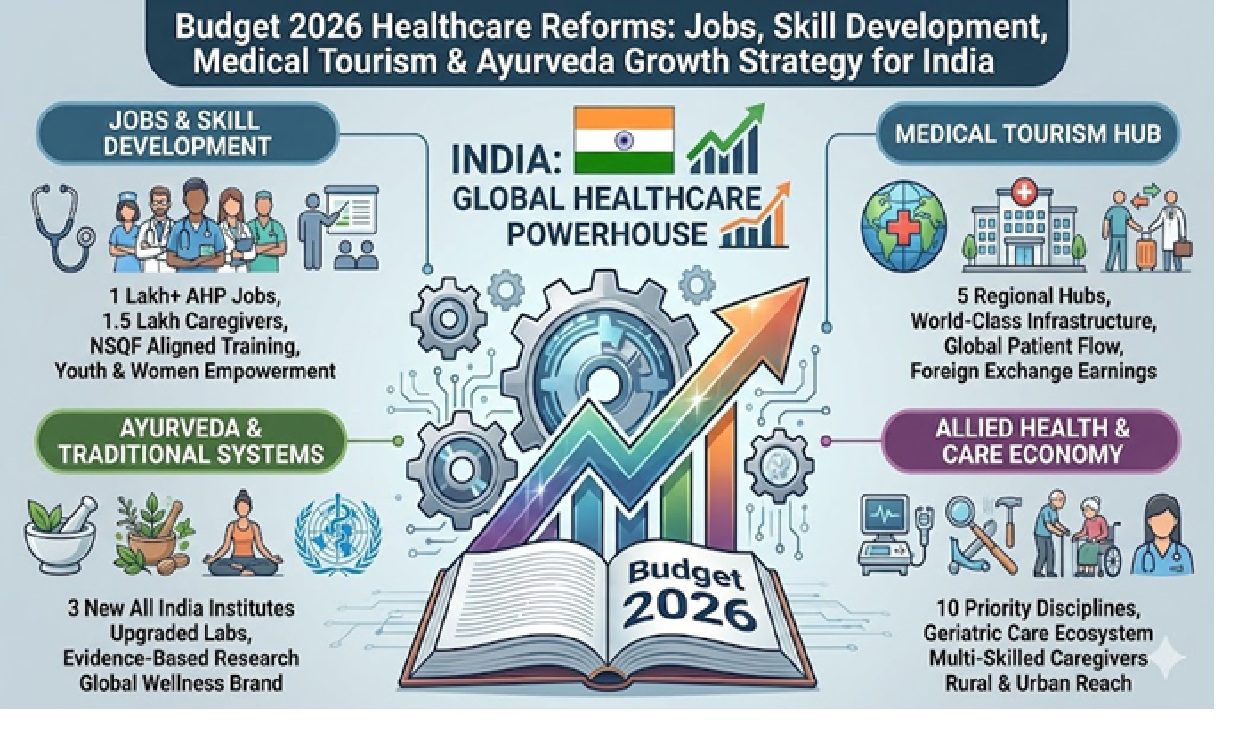
Introduction: Budget 2026 and the Strategic Reimagining of India’s Healthcare Economy
India stands at a pivotal juncture where demographics, global demand for quality healthcare, and technological transformation intersect. Budget 2026, presented by Nirmala Sitharaman, signals a decisive shift toward building a future-ready healthcare ecosystem—one that generates large-scale employment, upgrades skills aligned with global standards, and positions India as a premier destination for medical value tourism.
Rather than viewing healthcare merely as a welfare expense, the Union Budget frames it as a growth engine, capable of producing high-quality jobs, export revenues, and long-term social resilience. The announcements focus on allied health professionals (AHPs), geriatric and caregiver training, medical tourism hubs, and traditional systems of medicine such as Ayurveda and Yoga, integrating them into a modern, evidence-based, globally competitive framework.
This comprehensive healthcare push aligns with India’s broader vision of becoming a skilled, healthy, and economically robust nation, while also responding to rising global demand for affordable, high-quality medical services.
Budget 2026 Healthcare Vision: From Social Sector to Economic Powerhouse
The healthcare proposals in Budget 2026 are rooted in three strategic objectives:
- Employment Creation at Scale – Generating lakhs of skilled healthcare jobs across urban and rural India.
- Skill Standardization and Quality Enhancement – Aligning training programs with the National Skills Qualifications Framework (NSQF) and international benchmarks.
- Global Positioning of Indian Healthcare – Promoting medical value tourism, Ayurveda, and wellness as globally trusted services.
By linking education, service delivery, research, and tourism, the budget transforms healthcare into a multi-sector economic ecosystem rather than an isolated public service.
Massive Expansion of Allied Health Professionals (AHPs)
Strengthening the Backbone of Modern Healthcare
Allied Health Professionals form the backbone of any advanced healthcare system. Diagnostic accuracy, surgical efficiency, mental health support, and rehabilitation services depend heavily on skilled AHPs. Recognizing this critical gap, Budget 2026 proposes a large-scale expansion and modernization of AHP education and training.
Upgrading Existing Institutions and Creating New AHP Colleges
The budget outlines a dual approach:
- Upgradation of existing allied health institutions to meet modern infrastructure, curriculum, and accreditation standards.
- Establishment of new AHP institutions across both government and private sectors to expand training capacity.
This expansion will directly address workforce shortages and reduce dependency on overburdened doctors, improving patient outcomes and system efficiency.
Ten Priority Disciplines Identified
The government has identified 10 high-demand allied health disciplines, including:
- Optometry
- Radiology and Imaging Technology
- Anesthesia Technology
- Operation Theatre (OT) Technology
- Applied Psychology
- Behavioral Health
- Emergency and Trauma Care
- Rehabilitation Sciences
- Medical Laboratory Technology
- Critical Care Support
These disciplines align with current and future healthcare needs, ensuring employability across hospitals, diagnostic centers, research facilities, and international healthcare markets.
Employment Impact: One Lakh New AHP Jobs
Through these measures, one lakh new Allied Health Professionals will be added to India’s healthcare workforce. This expansion supports:
- Youth employment in science and healthcare streams
- Decentralized job creation beyond metro cities
- Improved healthcare access in Tier 2, Tier 3, and rural regions
This initiative alone positions healthcare as one of India’s largest organized employment sectors over the next decade.
Building a Strong Geriatric and Allied Care Ecosystem
Addressing India’s Aging Population
India’s demographic transition is accelerating. With increasing life expectancy, the demand for geriatric care and long-term support services is rising sharply. Budget 2026 directly responds to this challenge by proposing a robust, integrated care system over the next five years.
NSQF-Aligned Multi-Skilled Caregiver Training
The government plans to introduce NSQF-aligned caregiver programs that combine:
- Core patient care skills
- Allied healthcare competencies
- Wellness and preventive care practices
- Yoga and holistic health methods
- Operation and maintenance of medical assistive devices
This multi-skilling approach ensures caregivers are adaptable, productive, and globally employable.
Training 1.5 Lakh Caregivers in One Year
In a major employment push, 1.5 lakh caregivers will be trained in the coming year alone. This initiative:
- Creates immediate job opportunities
- Supports families managing elderly care
- Reduces pressure on hospitals
- Enhances home-based and community healthcare services
India’s trained caregivers will also meet growing international demand, especially in aging economies across Europe, East Asia, and the Middle East.
Medical Value Tourism: Positioning India as a Global Healthcare Hub
India’s Competitive Advantage in Medical Tourism
India already attracts international patients due to:
- High-quality doctors and surgeons
- Cost-effective treatment packages
- Advanced medical infrastructure
- Strong post-treatment recovery ecosystem
Budget 2026 aims to institutionalize and scale this advantage through targeted investments and policy support.
Five Regional Medical Value Tourism Hubs
The Finance Minister announced a landmark initiative to support states in establishing five regional medical value tourism hubs. These hubs will be developed in partnership with the private sector and designed as integrated healthcare complexes.
Key Components of Medical Tourism Hubs
Each hub will include:
- World-class hospitals and specialty centers
- Medical value tourism facilitation centers
- Diagnostics and imaging infrastructure
- Post-operative care and rehabilitation units
- Educational and training institutions
- Research and innovation facilities
This integrated model ensures seamless patient experience—from diagnosis to recovery.
Employment and Economic Impact
These hubs will generate:
- Thousands of jobs for doctors, nurses, and AHPs
- Opportunities in hospital administration and healthcare management
- Employment in hospitality, logistics, and wellness services
- Increased foreign exchange earnings
Medical tourism will evolve into a high-value export sector, strengthening India’s service economy.
Yoga and Ayurveda: India’s Soft Power in Global Healthcare
Yoga’s Global Recognition and Economic Potential
Yoga, rooted in ancient Indian tradition, gained global recognition when Narendra Modi championed its adoption at the United Nations. Today, yoga is not only a wellness practice but a global industry encompassing education, therapy, tourism, and lifestyle products.
Budget 2026 recognizes yoga as a strategic asset in preventive and holistic healthcare.
Ayurveda’s Post-COVID Global Acceptance
Post-pandemic, Ayurveda has witnessed renewed global interest due to its focus on:
- Immunity enhancement
- Preventive care
- Natural and plant-based remedies
India’s strength lies in its authentic knowledge base, biodiversity, and traditional expertise.
Strengthening Ayurveda Infrastructure and Education
Three New All India Institutes of Ayurveda
To meet rising global demand, the government proposes to establish three new All India Institutes of Ayurveda. These institutes will:
- Train skilled Ayurveda practitioners
- Promote research and clinical validation
- Support standardization and global certification
- Enhance India’s academic leadership in traditional medicine
Upgrading Aushadhis and Drug Testing Laboratories
Quality assurance is critical for global acceptance. Budget 2026 proposes:
- Upgrading Aushadhis (Ayurvedic pharmacies)
- Modernizing drug testing laboratories
- Strengthening certification and compliance frameworks
These steps will improve trust, safety, and export potential of Ayurvedic products.
Impact on Farmers and Rural Economy
Ayurveda expansion directly benefits:
- Farmers cultivating medicinal herbs
- Rural youth involved in processing and manufacturing
- MSMEs producing herbal and wellness products
This creates a sustainable rural healthcare value chain.
Global Leadership in Traditional Medicine Research
Upgrading the WHO Global Traditional Medicine Centre, Jamnagar
The budget proposes upgrading the WHO Global Traditional Medicine Centre in Jamnagar to strengthen:
- Evidence-based research
- Training and capacity building
- Global awareness of traditional medicine systems
This move reinforces India’s role as a global knowledge leader in traditional healthcare, bridging ancient wisdom with modern science.
Skill Development and Employment: A Long-Term Growth Multiplier
Healthcare as India’s Largest Skill Economy
With millions of jobs projected across allied health, caregiving, tourism, and wellness, healthcare is emerging as India’s largest organized skill economy.
Budget 2026 ensures:
- Curriculum standardization
- Public-private partnerships
- Industry-aligned training
- International mobility of healthcare workers
Empowering Youth and Women
Healthcare training programs particularly benefit:
- Women seeking stable, dignified employment
- Youth from non-metro regions
- First-generation professionals
This inclusivity strengthens social equity alongside economic growth.
India’s Global Healthcare Brand: Trust, Quality, and Compassion
The combined focus on modern medicine, allied health, wellness, and traditional systems positions India as:
- A trusted healthcare destination
- A global supplier of skilled healthcare professionals
- A leader in integrative and preventive medicine
By aligning affordability with excellence, India builds a distinctive global healthcare brand.
Long-Term Economic and Social Impact of Budget 2026 Healthcare Reforms
The healthcare initiatives announced in Budget 2026 will deliver:
- Sustainable employment generation
- Improved healthcare access nationwide
- Increased foreign exchange earnings
- Strengthened rural and urban economies
- Enhanced global influence through healthcare diplomacy
These reforms ensure healthcare contributes meaningfully to India’s GDP while improving quality of life.
Conclusion: Budget 2026 as a Healthcare Growth Blueprint
Budget 2026 marks a transformational moment in India’s healthcare journey. By investing in skills, infrastructure, medical tourism, and traditional medicine, the government has laid a foundation for inclusive, resilient, and globally competitive healthcare growth.
From creating lakhs of jobs to positioning India as a world-class medical and wellness hub, these initiatives reflect a future-focused vision—one where healthcare is not just about treatment, but about economic opportunity, global leadership, and human well-being.
As these policies unfold, India is poised to emerge not only as the pharmacy of the world, but as its healthcare skill capital and wellness destination.