Private professional and degree colleges across Telangana have commenced an unprecedented indefinite strike from September 15, 2025, coinciding with Engineers Day, which they are observing as “Black Day” to protest the state government’s failure to release pending fee reimbursement dues totaling ₹8,000 crore. The Federation of Associations of Telangana Higher Institutions (FATHI) announced this historic closure, affecting over 10 lakh students and 2,000 educational institutions across the state.
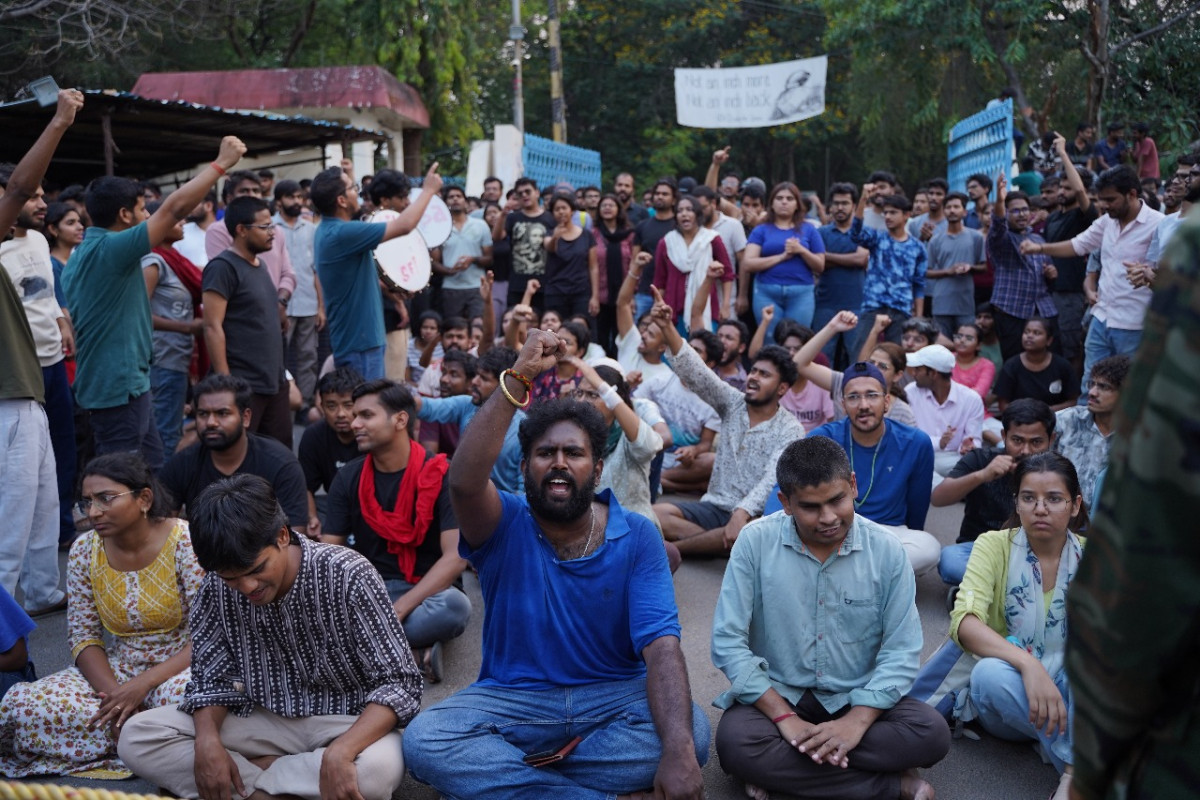
College students sitting and raising fists in protest during a strike over fee reimbursement issues in Telangana thewire
The crisis represents a fundamental breakdown in Telangana’s higher education financing system, where the Reimbursement of Tuition Fee (RTF) scheme has left private colleges struggling with unpaid dues dating back several years. Faculty and staff salaries remain unpaid for months, forcing institutions into severe financial distress while students face academic disruptions and uncertainty about their educational future.
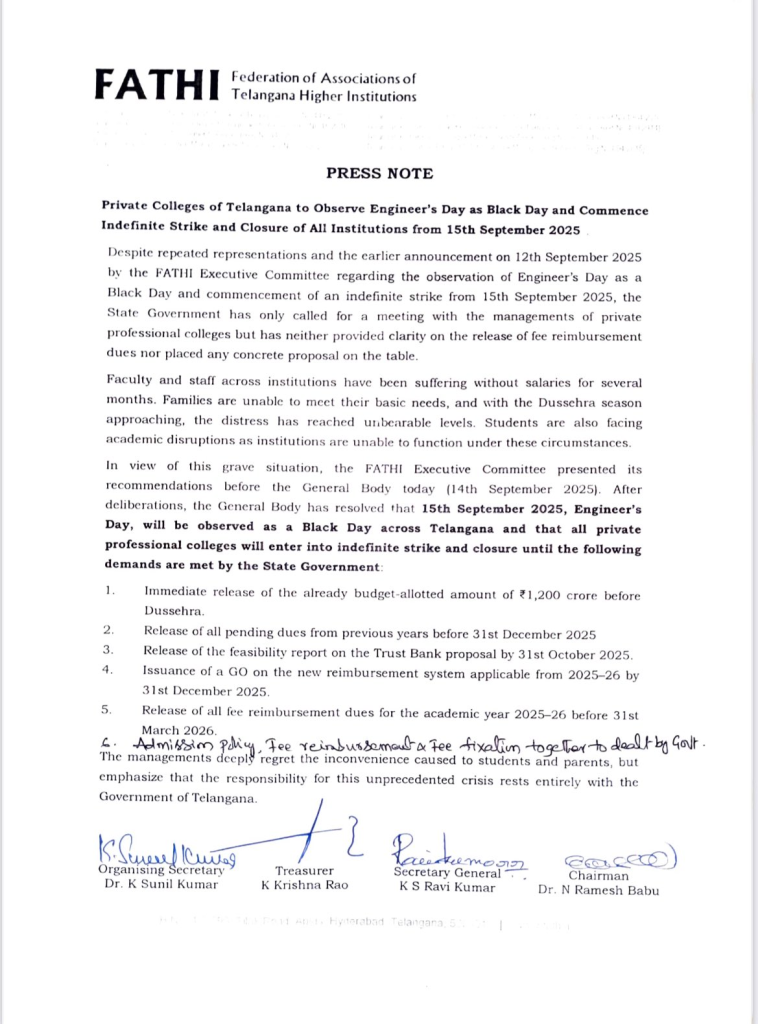
The Magnitude of Telangana’s Education Financial Crisis
The scope of the fee reimbursement crisis extends far beyond simple administrative delays. Private colleges in Telangana collectively face outstanding dues of approximately ₹8,000 crore accumulated over the past five years, with immediate demands focusing on ₹1,200 crore worth of already-generated tokens for which budgetary allocations have been made. Professional colleges, including engineering, pharmacy, MBA, MCA, and B.Ed institutions, bear the brunt of these financial pressures as they depend heavily on government reimbursements for their operational sustainability.

Financial breakdown of outstanding fee reimbursement dues in Telangana’s higher education sector
The financial breakdown reveals multiple layers of the crisis affecting different educational sectors. Degree and postgraduate colleges separately demand ₹1,800 crore in pending reimbursements, with managements seeking immediate release of at least ₹750 crore for which tokens have already been generated. These institutions emphasize their inability to continue operations without government intervention, as most technical colleges rely predominantly on RTF funds for their survival.
FATHI representatives have submitted detailed proposals to establish sustainable funding mechanisms, including a Fee Funding Bank with deposits worth ₹1 lakh crore, utilizing CSR funds and corpus contributions to generate annual interest of approximately ₹3,000 crore for clearing fee dues. However, the state government has not responded to these innovative funding proposals, forcing colleges into the unprecedented step of indefinite closure.
Engineers Day Transformed into Black Day: A Historic Protest
The decision to observe Engineers Day as Black Day carries profound symbolic significance for Telangana’s educational community. September 15, traditionally celebrated as Engineers Day to honor the birth anniversary of Bharat Ratna Sir Mokshagundam Visvesvaraya, has been transformed into a day of protest and mourning for the state of professional education.
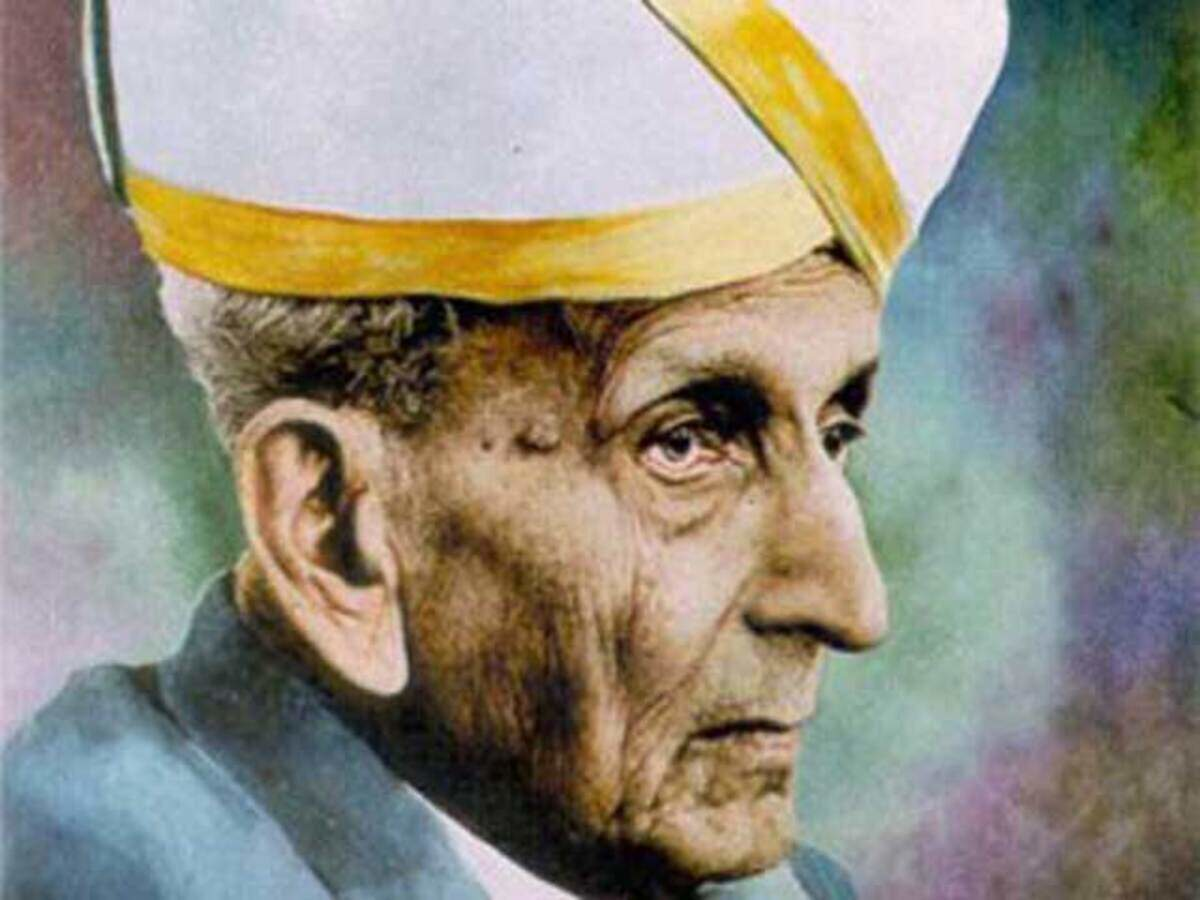
Portrait of Mokshagundam Visvesvaraya, commemorated on Engineers Day in India economictimes
Sir Mokshagundam Visvesvaraya, born on September 15, 1861, stands as one of India’s most distinguished civil engineers whose contributions to infrastructure development, irrigation systems, and educational institutions earned him the title “Father of Modern Mysore”. His pioneering work on major projects including the Krishna Raja Sagara Dam and the Khadakwasla Dam revolutionized water management and agricultural development across southern India.
FATHI officials express that if Sir Visvesvaraya were alive today, he would be deeply saddened by the current state of professional education in Telangana. The transformation of his birth anniversary into a protest day underscores the severity of the crisis affecting institutions that should ideally honor his legacy of engineering excellence and educational advancement.
The symbolic choice reflects broader frustrations within the educational community about the government’s priorities and commitment to higher education. Private college managements emphasize that observing Black Day represents not just a protest against financial neglect, but a fundamental questioning of the state’s commitment to technical education and professional development.
FATHI’s Comprehensive Demands and Government Response
The Federation of Associations of Telangana Higher Institutions has presented a structured set of demands designed to address both immediate financial pressures and long-term sustainability concerns. The primary demands include immediate release of ₹1,200 crore in already budgeted amounts before Dussehra, release of all pending dues from previous years before December 31, 2025, and establishment of a new reimbursement system applicable from the 2025-26 academic year.
FATHI’s five-point demand framework encompasses release of the feasibility report on the Trust Bank proposal by October 31, 2025, and clearance of all fee reimbursement dues for the academic year 2025-26 before March 31, 2026. These demands reflect a comprehensive approach to resolving both historical arrears and preventing future accumulation of unpaid dues.
The state government’s response has involved high-level meetings with Chief Minister A. Revanth Reddy reviewing the issue with finance and education departments regarding phased clearance of fee reimbursement arrears. Deputy Chief Minister and Finance Minister Mallu Bhatti Vikramarka has held discussions with FATHI representatives, promising to meet again to work out solutions.
However, college managements express skepticism about government assurances without concrete action. FATHI Chairman N. Ramesh Babu emphasizes that the strike will not be withdrawn based on assurances alone, demanding immediate release of at least partial arrears as proof of government commitment. The organization has set September 21 as a deadline for government response, warning of massive protests with lakhs of students on September 23-24 if issues remain unresolved.
Impact on Faculty, Staff, and Academic Operations
The fee reimbursement crisis has created a humanitarian disaster within Telangana’s private higher education sector. Faculty and staff across institutions have not received salaries for several months, forcing many educators to struggle with basic daily needs and abandon their duties. This salary crisis directly impacts academic quality and institutional operations, as experienced faculty members leave their positions due to financial pressures.
Educational institutions report severely disrupted academic activities as unpaid faculty members become unable to continue their responsibilities. The approaching Dussehra festival season intensifies the hardship for thousands of families dependent on college salaries, creating additional emotional and financial stress. College administrators describe the situation as reaching “unbearable levels” with faculty morale at “all-time lows”.
The crisis extends beyond immediate financial hardships to affect long-term institutional sustainability and academic standards. Private colleges emphasize their inability to maintain infrastructure, purchase essential equipment, or invest in educational improvements while struggling with basic operational costs. This deterioration threatens the quality of technical education that these institutions provide to students from diverse socioeconomic backgrounds.
Students face multiple challenges including academic disruptions, uncertainty about examination schedules, and delays in certificate issuance. Many students who completed their education 1-2 years ago remain unable to pursue further studies or secure employment because colleges withhold original educational certificates due to unpaid government reimbursements. This situation forces students to approach courts merely to obtain their own academic credentials.
| Date | Event | Status | Impact |
|---|---|---|---|
| June 2025 | FATHI demands ₹1,650 cr by June 30 | Past | High |
| July 2025 | CM Revanth Reddy proposes college grading system | Past | Medium |
| September 11, 2025 | FATHI announces indefinite strike from Sept 15 | Past | Critical |
| September 12, 2025 | Emergency general body meeting held | Past | Critical |
| September 13, 2025 | Government rushes to negotiate, SFI extends support | Past | Critical |
| September 14, 2025 | Final negotiations with Deputy CM Bhatti Vikramarka | Current | Critical |
| September 15, 2025 | Engineers Day observed as Black Day – Strike begins | Current | Critical |
| September 16, 2025 | Degree colleges join the strike | Future | Critical |
| September 21, 2025 | FATHI deadline for government response | Future | Critical |
| September 23-24, 2025 | Planned massive student protests if no resolution | Future | Critical |
The Fee Reimbursement Scheme: Structure and Challenges
Telangana’s Reimbursement of Tuition Fee (RTF) scheme represents a crucial welfare initiative designed to support students from SC, ST, BC, EBC, and minority communities in accessing higher education. The scheme covers non-refundable fees charged by colleges as fixed by universities and regulatory bodies, with reimbursement amounts ranging from ₹850 for intermediate courses to ₹6.90 lakh for medical courses per annum per student.
The RTF system operates through different group classifications with varying fee ranges. Group-I professional courses receive reimbursements from ₹23,000 to ₹6,90,000, while Group-II postgraduate courses range from ₹3,610 to ₹92,000. Group-III degree academic courses receive ₹1,500 to ₹20,000, and Group-IV intermediate level courses range from ₹850 to ₹16,400.
The scheme’s eligibility criteria ensure comprehensive coverage for disadvantaged communities. All SC, ST, and minority students receive full tuition fee reimbursement regardless of college and course of study. Students from other communities who studied in government colleges or achieved specific EAMCET ranks up to 10,000 also qualify for full fee reimbursement.
However, the implementation of this well-intentioned scheme has encountered significant administrative and financial challenges. The government’s delayed release of allocated funds creates a cascade effect where colleges cannot pay faculty salaries, maintain operations, or provide quality education. The token generation system, designed to streamline payments, has become a source of frustration as generated tokens worth ₹1,200 crore remain unreleased despite budgetary allocations.
Government’s Proposed Solutions and Industry Reactions
The Telangana government has proposed several measures to address the fee reimbursement crisis, including a college grading system that would prioritize fund disbursement based on institutional quality parameters. Chief Minister Revanth Reddy has directed that colleges be categorized into A, B, C, and D grades, with top-rated institutions receiving priority in fee reimbursement releases.
This grading approach considers factors such as education quality, infrastructure availability, and compliance with AICTE/UGC norms regarding staff salary payments. The government argues that this system would ensure better utilization of public funds while incentivizing institutional improvements.
However, private college managements have criticized this approach as another diversionary tactic that fails to address the fundamental issue of delayed payments. FATHI representatives argue that introducing additional bureaucratic processes will further delay much-needed financial relief while institutions continue struggling with basic operational challenges.
The government has also initiated discussions about implementing facial-recognition-based attendance systems linked to fee reimbursement schemes. College managements view this technological solution as inappropriate during a fiscal emergency, arguing that such measures only add to administrative burdens while failing to resolve the core financial crisis.
Educational institutions emphasize that these proposed solutions, while potentially valuable for long-term improvements, do not address the immediate humanitarian crisis affecting faculty livelihoods and student welfare. They demand concrete action on pending arrears before engaging in discussions about future policy modifications.
Student Organizations and Political Responses
The Students Federation of India (SFI) Telangana Committee has extended full support to private professional and degree colleges in their indefinite closure decision. SFI President S. Rajinikanth and Secretary T. Nagaraju have criticized the Congress government for failing to fulfill pre-election promises regarding fee reimbursement dues and establishment of transparent systems.
SFI highlights the additional challenges faced by students who are forced to approach courts merely to obtain their educational certificates while college managements withhold documents due to non-payment of government dues. The student organization describes the government’s silence and inaction as “nothing short of outrageous” for an administration that claims to represent people’s interests.
Political responses have emphasized the broader implications of the educational crisis for Telangana’s development and social welfare commitments. Opposition parties have criticized the Congress government’s handling of education financing, arguing that the crisis undermines the state’s commitment to accessible higher education for marginalized communities.
The crisis has also drawn attention to the sustainability of welfare schemes that depend heavily on government funding without adequate fiscal planning. Political observers note that the fee reimbursement issue reflects broader challenges in balancing welfare commitments with available financial resources.
Long-term Implications and Path Forward
The indefinite strike by Telangana’s private colleges represents more than an immediate financial dispute; it highlights fundamental questions about the sustainability of higher education financing and the state’s commitment to educational access. The crisis affects over 10 lakh students across 2,000 institutions, creating long-term consequences for human capital development and social mobility.
The situation threatens to undermine decades of progress in expanding higher education access for students from disadvantaged communities. The RTF scheme has enabled thousands of SC, ST, BC, and minority students to pursue professional education that would otherwise remain financially inaccessible. The current crisis jeopardizes this progress and may force many students to abandon their educational aspirations.
Educational institutions emphasize that resolving the current crisis requires both immediate financial relief and long-term structural reforms. FATHI’s proposal for establishing a Fee Funding Bank with corpus contributions and CSR funding represents an innovative approach to creating sustainable financing mechanisms that reduce dependence on annual government budget allocations.x
The strike’s continuation depends on the government’s willingness to provide concrete commitments rather than mere assurances. With the September 21 deadline approaching and planned massive protests on September 23-24, the situation may escalate further unless meaningful progress occurs in negotiations. The transformation of Engineers Day into Black Day serves as a powerful reminder that educational crises require urgent attention and sustainable solutions that honor the legacy of pioneers like Sir Mokshagundam Visvesvaraya.
The resolution of Telangana’s fee reimbursement crisis will ultimately determine whether the state can maintain its commitment to inclusive higher education while establishing fiscally sustainable systems for future generations. The current standoff represents a critical moment that will shape the landscape of private higher education in Telangana for years to come