The year Indian Vice Presidential Election Results 2025 witnessed something unprecedented in Indian parliamentary democracy – the first early Vice Presidential election since 1987, triggered by Jagdeep Dhankhar’s sudden resignation on health grounds. This wasn’t just another constitutional formality; it became a high-stakes political battle that tested alliances, showcased constitutional safeguards, and demonstrated the robustness of India’s democratic institutions. After following Indian elections for over a decade, I can confidently say that the Vice President election India 2025 results marked a watershed moment, combining constitutional necessity with intense political maneuvering that captivated the nation.

Indian Vice Presidential Election 2025: Complete Timeline from Notification to Results
Why an Early Election Became Constitutional Imperative
Vice President Jagdeep Dhankhar’s resignation on July 21, 2025, citing health reasons, immediately activated Article 67 of the Constitution, which allows a Vice President to step down before completing their five-year term by submitting a written resignation to the President. This resignation wasn’t just a personal decision – it triggered a constitutional cascade under Article 68(2), mandating that “an election to fill a vacancy occurring by reason of death, resignation or removal shall be held as soon as possible after the occurrence of the vacancy”.
What made this particularly significant was the historical rarity. Only three Vice Presidents in India’s history have resigned mid-term: V.V. Giri (1969), R. Venkataraman (1984), and now Dhankhar (2025). However, unlike his predecessors who quit to contest presidential polls, Dhankhar’s health-related departure created an entirely different constitutional and political dynamic.
The constitutional framework proved its resilience. Article 68 ensures there’s minimal disruption to parliamentary functioning, requiring the Election Commission to act swiftly. The last early election of this magnitude occurred in 1987, making 2025 a moment of historic significance for parliamentary democracy.
Electoral Process and Timeline: Democracy in Action
The Election Commission of India moved with constitutional precision. On August 1, 2025, the preliminary notification was issued, followed by the official election notification on August 7. The timeline was compressed but thorough:
The electoral college comprised 781 effective MPs (788 minus 7 vacant seats), including 543 elected Lok Sabha members, 233 elected Rajya Sabha members, and 12 nominated Rajya Sabha members. Unlike Presidential elections, state assemblies don’t participate, but crucially, nominated Rajya Sabha members retain voting rights.
Prime Minister Narendra Modi symbolically cast the first vote at 10 AM, maintaining the parliamentary tradition where the senior-most member initiates the process. This wasn’t merely ceremonial – it demonstrated institutional continuity and democratic decorum.

Indian Vice Presidential Election 2025: Electoral College Composition and Alliance Strength
The Candidates: Experience vs. Expertise
C.P. Radhakrishnan: The NDA’s Strategic Choice
Born in Tiruppur, Tamil Nadu, in 1957, Radhakrishnan represented the BJP’s calculated southern strategy. His journey from RSS swayamsevak to Governor of multiple states – Jharkhand, Telangana, Puducherry, and most recently Maharashtra – showcased administrative versatility.
Colleagues dubbed him the “Vajpayee of Coimbatore,” reflecting his oratorical skills and moderate political approach that resonates across party lines. His two terms as MP from Coimbatore, presidency of Tamil Nadu BJP (2004-2007), and representation of India at the UN General Assembly in 2004 demonstrated both political acumen and diplomatic capability.
B. Sudershan Reddy: The Opposition’s Judicial Icon
At 79, Justice B. Sudershan Reddy brought four decades of judicial experience, including service as Supreme Court judge (2007-2011) and Chief Justice of Gauhati High Court. Born into a farming family in Akula Mylaram, Telangana, his rise exemplified merit-based advancement in India’s constitutional framework.
His progressive judgments, including the landmark Salwa Judum case, and his appointment as Goa’s first Lokayukta (though brief) underscored his commitment to constitutional values and anti-corruption efforts. The INDIA bloc’s choice reflected their emphasis on judicial independence and constitutional propriety.
| Aspect | CP Radhakrishnan (NDA) | B. Sudershan Reddy (INDIA) |
|---|---|---|
| Full Name | Chandrapuram Ponnusamy Radhakrishnan | Buchireddy Sudershan Reddy |
| Age (as of 2025) | 68 years (born Oct 20, 1957) | 79 years (born July 8, 1946) |
| Birth Place | Tiruppur, Tamil Nadu | Akula Mylaram, Telangana (then Andhra Pradesh) |
| Educational Background | Law degree, RSS background | BA, LLB from Osmania University |
| Political Career Start | 1980s with RSS/BJP | Legal career from 1971 |
| Party/Alliance | BJP/National Democratic Alliance | INDIA Bloc (supported by Congress, regional parties) |
| Previous Key Positions | MP (2 terms), Governor (multiple states) | Supreme Court Judge (2007-2011), Chief Justice Gauhati HC |
| Recent Role | Governor of Maharashtra (until VP election) | First Lokayukta of Goa (2013, resigned same year) |
| Political Background | Lifelong RSS-BJP worker, grassroots leader | Career judiciary, non-political background |
| Regional Strength | Tamil Nadu (known as “”Vajpayee of Coimbatore””) | Telangana/Andhra Pradesh |
| Career Highlights | Gujarat High Court Advocate, UN General Assembly speaker (2004) | Salwa Judum case judgment, progressive judicial decisions |
| Symbolic Significance | BJP’s southern strategy, OBC representation | Judicial independence, constitutional values |
Results That Defied Expectations
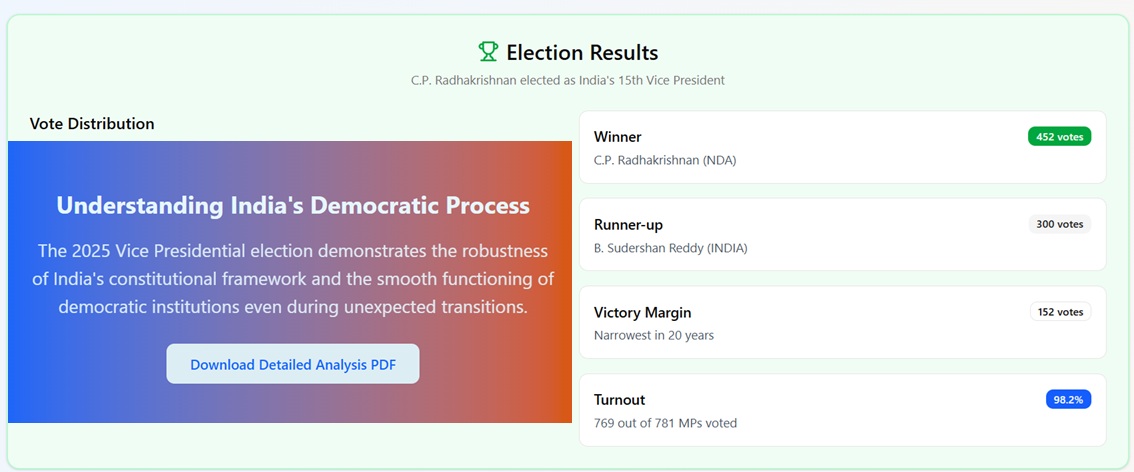
The Vice President election India 2025 results delivered both predictable outcomes and surprising margins. C.P. Radhakrishnan secured 452 votes against B. Sudershan Reddy’s 300, with a victory margin of 152 votes. However, the 98.2% turnout (767 out of 781 MPs) demonstrated unprecedented engagement.

Vice Presidential Election 2025 Results: CP Radhakrishnan Wins with 452 Votes
The numbers told multiple stories. While the NDA’s victory was expected given their 425 MPs plus YSRCP support, Reddy’s 300 votes exceeded many predictions. Several factors contributed: the secret ballot system allowed conscience voting, some NDA allies like BJD abstained, and the INDIA bloc achieved remarkable unity with nearly 100% turnout among their MPs.
The 15 invalid votes became a talking point, suggesting either genuine errors or strategic abstentions by individual MPs uncomfortable with either choice. This margin was notably tighter than the 2022 VP election where Jagdeep Dhankhar defeated Margaret Alva by 346 votes.
Political Reactions: Beyond Victory and Defeat
Prime Minister Modi’s congratulatory message emphasized Radhakrishnan’s “lifelong devotion to serving society” and his grassroots connection, subtly highlighting the contrast with elite politics. Union Home Minister Amit Shah’s statement about “bringing out the best in parliamentary democracy to serve the marginalized” signaled the NDA’s intent to position the new VP as a bridge-builder.
Congress President Mallikarjun Kharge’s response – calling it “more than an election, a battle of ideology” – revealed the opposition’s strategy of framing the contest in constitutional terms rather than purely political ones. This messaging battle continued even after results, with both sides claiming moral victories.
Bihar CM Nitish Kumar’s wishes for “fairness and cooperation in the Rajya Sabha” carried particular weight, given his recent return to the NDA fold and his understanding of coalition politics.
Constitutional Significance and Parliamentary Dynamics
The new Vice President inherits the crucial role of Rajya Sabha Chairman at a time when the Upper House often witnesses intense debates over key legislation. Radhakrishnan’s experience as Governor – presiding over state legislative councils – provides relevant preparation for managing parliamentary proceedings.
Article 67’s provision for a five-year term means Radhakrishnan will serve until 2030, potentially overlapping with the next Lok Sabha term and the 2029 general elections. His approach to managing debates, allowing dissent, and maintaining parliamentary decorum will significantly impact the legislative process.
The Vice President’s role during presidential vacancies (Article 65) adds another dimension. Should any extraordinary circumstances arise with the presidency, Radhakrishnan would temporarily assume presidential duties, making his constitutional understanding crucial.
Strategic Implications for 2029
This election served as a dry run for larger political battles ahead. The NDA’s ability to maintain discipline while accommodating allies like JDU and TDP demonstrated coalition management skills that will be tested in 2029. The INDIA bloc’s impressive unity, achieving near-perfect turnout among their MPs, suggests growing organizational capacity despite electoral defeats.
Radhakrishnan’s Tamil Nadu roots carry symbolic weight as the BJP prepares for the 2026 state assembly elections. His elevation to the second-highest constitutional office could help the party’s southern expansion strategy, particularly in a state where it has struggled historically.
The opposition’s choice of a Telugu-speaking former Supreme Court judge reflected their southern strategy too, attempting to counter the NDA’s regional appeal while emphasizing constitutional values. Though unsuccessful, this approach may influence future candidate selections.
Lessons in Democratic Resilience
The 2025 Vice Presidential election showcased several democratic strengths. The constitutional framework operated seamlessly, with Article 68 ensuring minimal disruption despite an unexpected resignation. The Election Commission’s efficient management, from notification to results declaration in just over a month, demonstrated institutional capability.
The secret ballot system allowed genuine choice, evidenced by the margin variation from predictions and the significant vote share received by the losing candidate. Cross-party respect during the process – from mock polling sessions to courteous post-result statements – reflected democratic maturity.
Perhaps most importantly, the high turnout (98.2%) showed that MPs took their constitutional duty seriously, with even imprisoned MP Engineer Rashid receiving court permission to vote. This commitment to democratic participation, regardless of political affiliations, reinforced faith in the electoral process.
Looking Ahead: Expectations and Challenges
As India’s 15th Vice President, Radhakrishnan faces several challenges. Managing the Rajya Sabha during contentious debates will test his impartiality and procedural expertise. His RSS background may draw opposition scrutiny, requiring careful balance between ideological alignment and constitutional neutrality.
The new VP must also navigate the evolving federal dynamics, with several states under non-NDA governments and regional parties playing crucial roles in the Upper House. His gubernatorial experience in diverse states – from Jharkhand to Maharashtra – could prove valuable in understanding regional perspectives.
International relations add another dimension, with the Vice President often representing India at global forums and hosting foreign dignitaries. Radhakrishnan’s UN General Assembly experience provides relevant preparation for this diplomatic role.
The Vice President election India 2025 results ultimately demonstrated that India’s constitutional democracy remains robust, adaptive, and capable of managing unexpected challenges while maintaining democratic principles. From Dhankhar’s health-related resignation to Radhakrishnan’s decisive victory, the entire process reinforced the strength of institutions that have guided the world’s largest democracy for over seven decades.
As we move toward the 2029 general elections, this Vice Presidential contest will be remembered not just for its constitutional necessity, but for how it showcased the continuing vitality of Indian parliamentary democracy in an era of global democratic challenges. The seamless transition, respectful campaign, and decisive outcome provide a template for future constitutional exercises while highlighting the enduring relevance of institutional safeguards crafted by India’s founding fathers.
Frequently Asked Questions
Why was the 2025 Vice Presidential election held early?
The early election was triggered by Vice President Jagdeep Dhankhar’s resignation on July 21, 2025, citing health reasons. Under Article 68(2) of the Constitution, when a vacancy occurs due to resignation, death, or removal, an election must be held “as soon as possible” to fill the position, ensuring continuity in parliamentary functioning.
Who were the main candidates and what was the final result?
The contest was between C.P. Radhakrishnan (NDA candidate and former Maharashtra Governor) and B. Sudershan Reddy (INDIA bloc candidate and former Supreme Court judge). Radhakrishnan won with 452 votes (60.1%) against Reddy’s 300 votes (39.9%), securing a victory margin of 152 votes out of 767 total votes cast.
What makes this Vice Presidential election historically significant?
This was the first early Vice Presidential election since 1987, making it a rare constitutional event. The high voter turnout of 98.2% among MPs, the competitive margin despite NDA’s numerical advantage, and the symbolic choice of candidates from South India (Tamil Nadu vs. Telangana) all contributed to its historical importance.