


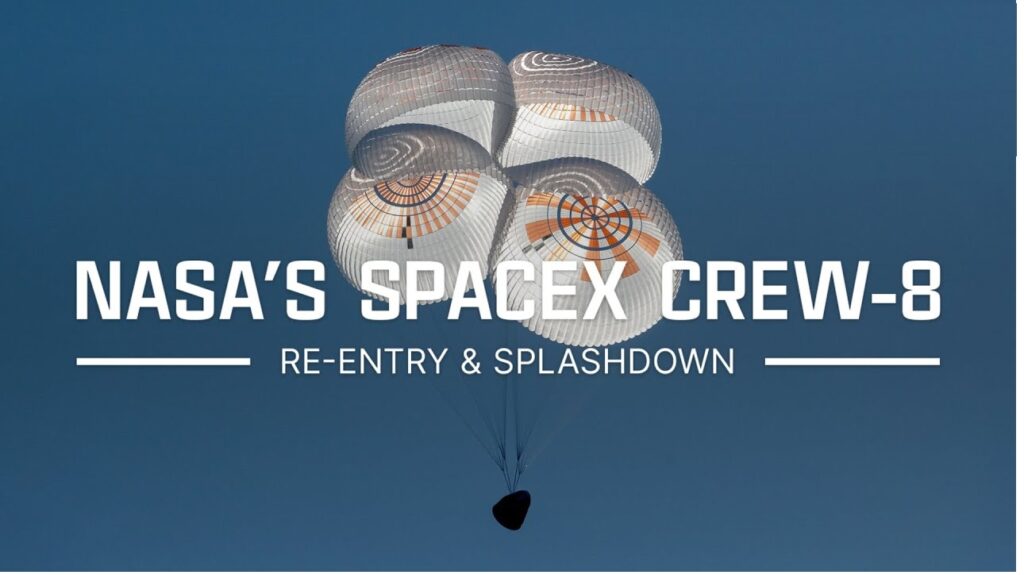
A NASA astronaut from the recent SpaceX Crew-8 mission has been hospitalized following a safe return from the International Space Station (ISS). The unidentified crew member remains stable, according to NASA, though specific medical details remain confidential to protect their privacy. Here’s a look at the journey of Crew-8, the safe splashdown, and the latest developments on the astronaut’s condition.
Crew-8’s Return Journey from the ISS
After nearly eight months aboard the ISS, Crew-8, consisting of NASA astronauts Matthew Dominick, Michael Barratt, and Jeanette Epps, along with Roscosmos cosmonaut Alexander Grebenkin, completed a successful re-entry and splashdown off the Florida coast. Their spacecraft, the SpaceX Dragon Endeavour, splashed down early Friday morning, concluding a productive mission that included essential experiments, spacewalks, and maintenance aboard the ISS.
As with all crewed returns, Crew-8 underwent routine medical evaluations onboard the recovery ship, where a medical issue prompted additional attention for one of the astronauts. The crew member was taken to Ascension Sacred Heart Pensacola hospital, where they are under observation as a precautionary measure. NASA has stated that updates will be provided as needed.
Crew Members and Their Backgrounds
Each Crew-8 astronaut brought unique expertise and backgrounds to this mission:
- Matthew Dominick: Mission Commander and Colorado native, Dominick has an extensive background in aerospace systems engineering and naval aviation, having flown combat missions and logged over 1,600 hours across 28 aircraft. His leadership and experience were integral to the mission’s success.
- Michael Barratt: A veteran astronaut and physician specializing in aerospace medicine, Barratt brought previous spaceflight experience, making him a valuable resource during the mission. Barratt has spent over 200 days in space across multiple missions and resides in Texas with his family.
- Jeanette Epps: As a mission specialist, Epps holds a doctorate in aerospace engineering. Her background in auto-collision safety systems and intelligence from her years at the CIA provided her with a strong technical perspective and analytical expertise valuable in this mission.
- Alexander Grebenkin: A first-time cosmonaut, Grebenkin contributed as the flight engineer, bringing a strong foundation in aircraft engineering and communications technology. His skillset complemented the crew’s diverse talents, enriching the mission’s technical capabilities.
SpaceX Dragon’s Technological Achievements and Safety Features
The Dragon spacecraft, developed by SpaceX, played a crucial role in the Crew-8 mission. Known for its impressive capabilities, Dragon is the only commercial spacecraft designed for human spaceflight to and from the ISS. Dragon is designed to carry up to seven astronauts and significant cargo, providing NASA with a reusable and cost-effective space transportation solution. The spacecraft is fully autonomous, though it includes manual override controls in case of emergencies.
One of the standout features of Dragon is its SuperDraco launch escape system, which is unique among space vehicles. The escape system can quickly separate the capsule from its launch vehicle, ensuring crew safety in various scenarios, from launch to orbit. Additionally, the capsule has 16 Draco thrusters for attitude control, used for adjusting orbital alignment and positioning during critical mission phases.
The spacecraft also boasts a state-of-the-art thermal control system, which maintains a comfortable internal temperature for the crew during re-entry. Its trunk, partly covered with solar panels, provides the necessary power during its stay on the ISS and on its return journey. With these design features, Dragon has set new benchmarks in commercial spaceflight safety and efficiency.
Dragon’s Journey Home: The Return Process Explained
The journey back to Earth involved a meticulous process that began with undocking maneuvers, executed by the Dragon’s onboard systems. Once it had safely distanced itself from the ISS, the crew enjoyed a rest period before donning their spacesuits and performing leak checks.
The re-entry phase started with a deorbit burn, using the Draco thrusters to lower Dragon’s altitude and prepare for atmospheric re-entry. To ensure the safety of the heat shield, Dragon detached from its trunk, an unpressurized section that provides structural support and solar power.
Once atmospheric re-entry began, Dragon relied on its heat shield to withstand the intense frictional heat. As it neared the splashdown site off the coast of Pensacola, Florida, parachutes deployed, slowing the capsule’s descent to a safe landing in the water. This phase is one of the most critical, as re-entry subjects the spacecraft to extreme temperature changes and mechanical stress.
What’s Next for Crew-8 and SpaceX’s Future Missions
Crew-8’s successful splashdown and the subsequent hospitalization of one astronaut mark another chapter in NASA’s continued collaboration with SpaceX to expand commercial space travel. Dragon Endeavour, now on its fifth mission, continues to set records for cumulative time in space and operational reusability.
NASA and SpaceX are actively working to prepare for the Crew-9 mission, aiming to build upon the knowledge gained during Crew-8. With Dragon’s capacity for frequent reusability, NASA and SpaceX are closer to achieving a sustainable low-Earth orbit presence, with plans to expand to lunar and, eventually, Mars missions.
Summary
The safe return of Crew-8 underscores the remarkable progress in commercial spaceflight technology and the commitment to astronaut safety. Despite the unexpected hospitalization of one astronaut, the team’s overall mission success and safe splashdown highlight SpaceX and NASA’s dedication to advancing human space exploration safely and effectively. With each mission, SpaceX’s Dragon capsule continues to push the boundaries of space travel, offering hope for a future where space exploration is accessible and safe.