


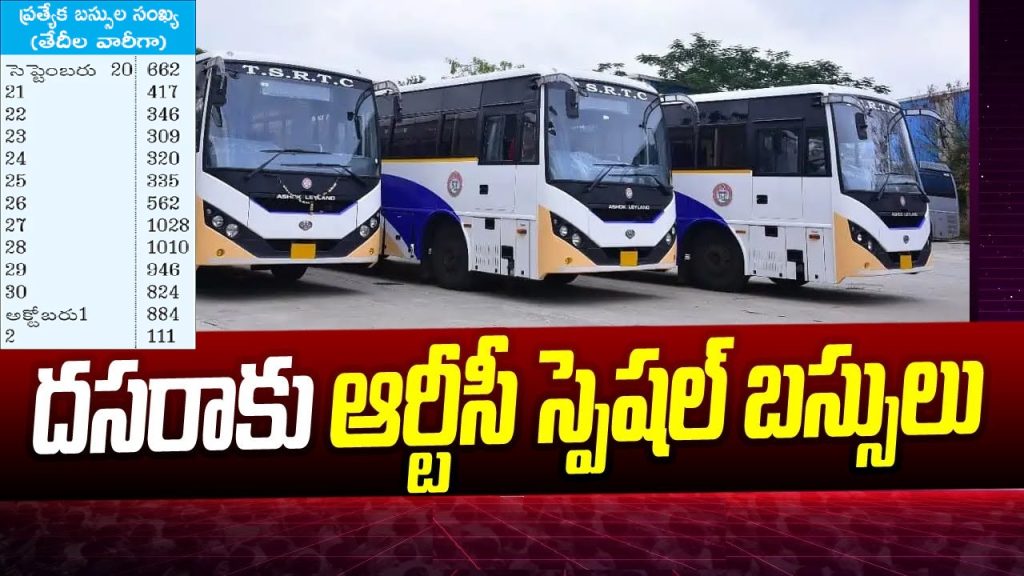
The Telangana State Road Transport Corporation (TSRTC) has announced comprehensive travel arrangements for the upcoming Bathukamma and Dasara festivals, introducing 7,754 special buses across the state while implementing a 50% additional surcharge on these festival services. The initiative aims to accommodate the massive influx of travelers during the peak festive season from September 20 to October 2, 2025.
Festival Bus Operations and Schedule
Service Period and Coverage
TSRTC will operate special bus services from September 20 to October 2, 2025, with the highest passenger traffic expected from September 27 onwards as people travel to their hometowns for Saddula Bathukamma on September 30 and Dasara on October 2. Return services will be arranged on October 5 and 6 to manage the post-festival travel surge
The daily distribution of special buses shows strategic planning, with peak deployment on September 27 (1,028 buses) and September 28 (1,010 buses), coinciding with the heaviest travel demand. The lowest allocation is on October 2 (111 buses), as most passengers would have already reached their destinations by the festival day.
Advance Booking and Reservations
Out of the 7,754 special buses, 377 services will offer advance reservation facilities. Passengers can book tickets through the official TSRTC website at www.tgsrtcbus.in or contact the call center numbers 040-69440000 and 040-23450033 for detailed information.
Detailed Schedule of Special Bus Services: Day-by-Day Breakdown
To help you plan your travel effectively, here’s a detailed day-wise schedule of the special buses focusing on the Telangana routes, as announced by TSRTC. This timetable highlights the number of additional services operating each day, ensuring you can book or board without last-minute hassles.
- September 20, 2025: 662 special buses – Expect moderate traffic as the weekend kicks off and early travelers set out.
- September 21, 2025: 417 special buses – With school and college holidays beginning, this day sees a sharp rise in family outings.
- September 22, 2025: 346 special buses – Mid-week travel picks up for those extending their holidays.
- September 23, 2025: 309 special buses – Steady demand as Navratri festivities commence.
- September 24, 2025: 320 special buses – Increasing numbers reflect building excitement for the festivals.
- September 25, 2025: 335 special buses – More services to handle the growing rush.
- September 26, 2025: 562 special buses – A notable jump as the weekend approaches.
- September 27, 2025: 1,028 special buses – Peak begins with heavy outbound traffic toward villages.
- September 28, 2025: 1,010 special buses – Continued high demand for Bathukamma preparations.
- September 29, 2025: 946 special buses – Travelers finalize their journeys home.
- September 30, 2025: 824 special buses – Saddula Bathukamma day sees focused services for last-minute trips.
- October 1, 2025: 884 special buses – Pre-Dasara rush intensifies.
- October 2, 2025: 111 special buses – Wrapping up with services for Dasara celebrations.
TSRTC expects the heaviest rush on September 20 evening and September 21, with 1,079 special buses allocated for those two days alone. From September 27 onward, the influx toward native places will surge due to the proximity of the main festival dates. This schedule allows the corporation to allocate resources efficiently, minimizing wait times and overcrowding at bus stands.
50% Fare Surcharge Implementation
Government Order No. 16 Authorization
The fare revision follows Government Order No. 16, which permits TSRTC to increase ticket prices for special buses during festivals to cover operational costs. This 20-year-old policy addresses the financial burden of buses returning empty on routes where passenger demand is primarily one-directional.
Applicable Dates for Surcharge
The 50% additional charges will be implemented on special buses operating on specific dates:
- September 20
- September 27-30
- October 1, 5, and 6
Regular bus services will continue to operate at standard fares without any price increase, ensuring affordable transportation options remain available.
Cost Justification
TSRTC Managing Director V.C. Sajjanar explained that the fare revision accounts for minimum diesel costs and maintenance expenses incurred by buses that often return empty after dropping passengers at their destinations. The corporation emphasized that this measure is essential for the financial sustainability of special festival services.
Route Network and Departure Points
Major Departure Hubs in Hyderabad
Special buses will operate from key transportation hubs including:
- Mahatma Gandhi Bus Station (MGBS)
- Jubilee Bus Station (JBS)
- Central Bus Station (CBS)
- KPHB Colony
- Uppal Cross Roads and Uppal Bus Stand
- Dilsukhnagar
- LB Nagar
- Aramghar
- Santosh Nagar
Destination Coverage
The special bus network extends beyond Telangana to cover:
- All districts within Telangana
- Andhra Pradesh
- Karnataka
- Maharashtra
This comprehensive coverage ensures connectivity to major destinations where Telangana residents have family ties and cultural connections.
Enhanced Passenger Facilities
Infrastructure Improvements
TSRTC has announced special arrangements at high-traffic boarding points including:
- Temporary seating areas with shamianas
- Drinking water facilities
- Public address systems
- Mobile toilets
These facilities will be established at congested areas including LB Nagar, Uppal, Aramghar, KPHB, and Santosh Nagar.
Traffic Management
Supervisory officers will be deployed at busy locations to monitor passenger traffic and coordinate with police, transport, and municipal officials for smooth operations. Special buses will be deployed dynamically based on real-time passenger demand.
Year-over-Year Service Enhancement
Increased Fleet Deployment
TSRTC has significantly expanded its festival operations compared to the previous year. The corporation is running 617 more special buses in 2025 compared to Dasara 2024, when 7,137 special buses were operated. This represents approximately an 8.6% increase in service capacity.
Safety and Reliability Measures
Managing Director Sajjanar emphasized the corporation’s commitment to passenger safety, urging travelers to avoid unsafe private vehicles and instead utilize TSRTC’s experienced drivers and well-maintained buses. The corporation has implemented comprehensive safety protocols to ensure incident-free festival transportation.
Historical Context and Policy Background
Long-standing Fare Policy
The Government Order No. 16 from 2003 has been in effect for over two decades, allowing fare adjustments during peak travel periods. This policy has been consistently applied during major festivals including Sankranti, Dasara, Ugadi, and Vinayaka Chavithi.
Mahalakshmi Scheme Impact
The success of the state government’s Mahalakshmi free bus travel scheme for women has contributed to increased bus ridership, with TSRTC reporting a 25% increase in congestion due to the scheme’s popularity. This has necessitated more robust planning for festival operations.
Passenger Guidelines and Recommendations
Booking Strategy
Passengers are strongly encouraged to make advance reservations through official channels to ensure guaranteed seats during the peak travel period. Early booking is particularly crucial for travel on high-demand dates like September 27-30.
Service Identification
Special buses will be clearly marked with display boards to inform passengers about the revised fare structure. TSRTC staff will also inform passengers about fare adjustments during ticket issuance.
Travel Planning
For optimal travel experience, passengers should:
- Book tickets in advance through official platforms
- Allow extra time for boarding due to increased crowds
- Carry valid identification for verification
- Plan for potential delays during peak hours
Economic and Social Impact
Revenue Generation
The special bus operations and fare adjustments are designed to make festival services financially viable while maintaining accessibility. The additional charges help offset operational costs while keeping regular services affordable for daily commuters.
Cultural Connectivity
The extensive bus network facilitates cultural participation by enabling people to travel to their ancestral homes for traditional celebrations. This transportation infrastructure plays a crucial role in maintaining cultural ties and supporting rural economies during festival seasons.
The TSRTC’s comprehensive arrangements for Bathukamma and Dasara 2025 represent a balance between operational sustainability and public service, ensuring that festival travelers have reliable transportation options while managing the financial challenges of seasonal demand fluctuations. The 50% surcharge on special services, while significant, applies only to additional festival buses, leaving regular transportation options at standard fares for budget-conscious travelers.