


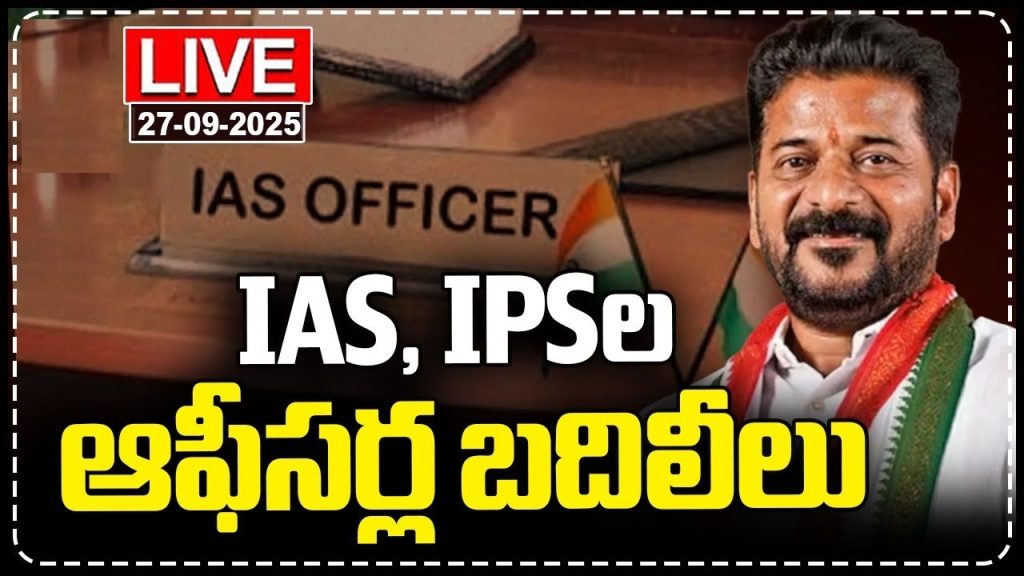
The Telangana government recently unveiled a sweeping set of transfers and postings for Indian Police Service (IPS) officers, marking a pivotal shift in the state’s law enforcement landscape. On September 26, 2025, the General Administration Department issued Government Order (G.O.) Rt. No. 1342, notifying changes for 23 senior and mid-level officers. This move aims to bolster administrative efficiency, enhance security measures, and address emerging challenges in urban policing, cyber threats, and disaster management across Hyderabad and other key regions in Telangana. As a hub for technology, commerce, and rapid urbanization, Telangana relies heavily on dynamic leadership in its police force to maintain public safety and governance standards. In this in-depth article, we explore the details of these transfers, profile the key players involved, and analyze their potential impacts on the state’s security framework.
Understanding the Significance of IPS Transfers in Telangana
Governments frequently reorganize IPS cadres to inject fresh perspectives, reward performance, and align expertise with pressing needs. In Telangana, a state formed in 2014 and known for its vibrant IT sector in Hyderabad, such reshuffles play a crucial role in tackling issues like cybercrime, traffic management, and anti-corruption drives. The September 2025 transfers come at a time when the state pushes for modernized policing amid growing urban populations and digital threats. Chief Minister A. Revanth Reddy’s administration emphasizes merit-based appointments, ensuring that experienced officers handle critical portfolios.
These changes affect multiple departments, including the Home Department, Cyber Security Bureau, Anti-Corruption Bureau (ACB), and disaster response units. By rotating officers, the government prevents stagnation and promotes cross-functional skills. For residents of Hyderabad and surrounding areas, this means potentially improved law and order, faster response to emergencies, and stronger vigilance against corruption. Keywords like “Telangana police reshuffle 2025” and “Hyderabad IPS postings” highlight the public’s interest in these developments, as they directly influence daily safety and governance.
Key Highlights from the September 26, 2025 Government Order
The order outlines precise transfers and additional charges, ensuring seamless transitions in leadership. Senior officers from the 1990s batches dominate the top-tier shifts, while younger cadres fill operational roles. The government places emphasis on filling vacancies promptly, with some officers holding full additional charges until further notices. This strategic approach minimizes disruptions in high-stakes areas like intelligence and special forces.
Notably, the reshuffle integrates roles across urban policing in Hyderabad, state-wide security, and specialized units. It reflects a balanced distribution of responsibilities, drawing from diverse experiences in law enforcement, administration, and public service. Below, we break down the transfers category-wise, starting with senior leadership changes.
Senior IPS Leadership Changes: Strengthening Core Departments
Top brass transfers often set the tone for departmental reforms. In this round, several 1990s-batch officers move to pivotal positions, bringing decades of expertise to bear.
Ravi Gupta, a 1990-batch IPS officer, now serves as the Executive Vice-Chairman and Director General of the Centre for Good Governance in Hyderabad. Previously, he led as Special Chief Secretary in the Home Department and chaired the Road Safety Authority. Gupta’s track record includes innovative governance initiatives, and his new role positions him to drive digital transformations in public administration. Under his guidance, the Centre for Good Governance could accelerate e-governance projects, benefiting Telangana’s tech-savvy populace.
C.V. Anand, from the 1991 batch, steps into the role of Special Chief Secretary to the Government in the Home Department. He vacates his position as Hyderabad City Police Commissioner, where he oversaw major operations during challenging times. Anand’s tenure as Commissioner featured enhanced community policing and traffic reforms in Hyderabad. His elevation to the Home Department allows him to influence statewide policies, potentially streamlining coordination between urban and rural forces.
Shikha Goel, a 1994-batch officer, takes charge as Director General of Vigilance and Enforcement, also serving as Ex-Officio Principal Secretary in the General Administration Department. She previously directed the Telangana Cyber Security Bureau and the Forensic Science Laboratory in Hyderabad. Goel’s expertise in cyber forensics has been instrumental in combating digital crimes, a growing concern in IT hubs like Hyderabad. She retains additional charge of the Cyber Security Bureau, ensuring continuity in this vital area until a permanent replacement arrives.
Enhancing Specialized Security and Protection Forces
Specialized units receive focused attention in this reshuffle, with officers assigned to handle elite forces and high-risk operations.
Swati Lakra, IPS (1995), assumes full additional charge as Director General of the Special Protection Force in Telangana, based in Hyderabad. She transfers from her role as Additional Director General of Police for Organization and Home Guards. Lakra’s background includes strong leadership in women’s safety initiatives, and her new posting strengthens VIP security and critical infrastructure protection across the state.
Mahesh Muralidhar Bhagwat, also from the 1995 batch, holds full additional charge as Additional Director General of Police (Personnel) in Telangana. He moves from his Law and Order role in Hyderabad. Bhagwat’s experience in personnel management will likely focus on training and welfare programs, boosting morale within the force.
Charu Sinha, a 1996-batch officer, steps up to full additional charge as Director General of the Anti-Corruption Bureau in Hyderabad. Previously with the CID, Sinha brings a reputation for integrity and investigative prowess. Her appointment signals a renewed push against graft, especially in government contracts and public services in Telangana.
Operational Shifts in Elite Units and Intelligence
Operational efficiency gets a boost with transfers in greyhounds, octopus units, and intelligence wings.
Dr. Anil Kumar, IPS (1996), now leads as Additional Director General of Police for Operations in Greyhounds and Octopus, Telangana’s elite anti-Maoist and counter-terrorism forces. He replaces M. Stephen Raveendra and comes from the Personnel division. Kumar’s strategic acumen could enhance tactical responses in sensitive border areas.
V.C. Sajjanar, another 1996-batch officer, becomes the new Commissioner of Police for Hyderabad City. He leaves his post as Managing Director of the Telangana State Road Transport Corporation, where he turned around the organization’s finances. Sajjanar gained national prominence in 2019 as Cyberabad Commissioner during the handling of a high-profile rape-murder case involving an encounter. His urban policing experience makes him ideal for managing Hyderabad’s bustling metropolis, with its mix of corporate hubs and residential zones.
Vijay Kumar, from the 1997 batch, shifts to Additional Director General of Police for Intelligence in Hyderabad. He previously headed the Anti-Corruption Bureau. Kumar’s intelligence background will fortify the state’s surveillance capabilities against emerging threats like cyber espionage.
Boosting Disaster Response and Transport Security
Disaster management and public transport security see key appointments to ensure resilience.
Y. Nagi Reddy, IPS (1997), takes over as Managing Director of the Telangana State Road Transport Corporation in Hyderabad. He transfers from Director General of Disaster Response and Fire Services. Reddy’s prior role involved modernizing fire safety protocols, and his new position could improve road safety and public transit efficiency in Telangana’s growing cities.
Devendra Singh Chauhan, also 1997 batch, moves to Additional Director General of Police for Multizone-II. He previously served as Principal Secretary in the Consumer Affairs, Food, and Civil Supplies Department, overseeing legal metrology and supplies. Chauhan’s administrative skills will aid in coordinating multi-district operations.
Vikram Singh Mann, IPS (1998), assumes the role of Director General for Telangana Disaster Response and Fire Services in Hyderabad. He comes from Additional Commissioner of Police (Law and Order) in Hyderabad City. Mann’s urban experience could integrate better emergency protocols in high-density areas like Hyderabad.
Mid-Level Command Changes: Reinforcing Urban Policing
Mid-level officers ensure ground-level execution, and this reshuffle fortifies city-specific commands.
M. Stephen Raveendra, 1999 batch, becomes Commissioner of Civil Supplies and Ex-Officio Principal Secretary in the Consumer Affairs Department. He transfers from Greyhounds and Octopus operations. Raveendra’s operational expertise might streamline supply chain security.
M. Srinivasulu, IPS (2006), shifts to Additional Commissioner of Police for Crimes in Hyderabad City. Previously IGP in CID, Srinivasulu’s investigative skills will target organized crime in the capital.
Tafseer Iqubal, 2008 batch, takes Joint Commissioner of Police (Law and Order) in Hyderabad City. He moves from Deputy Inspector General in Zone-VI and Multizone-II. Iqubal’s zonal experience enhances daily policing in Charminar and beyond.
Junior IPS Postings: Building Future Leadership
Younger officers fill critical deputy and superintendent roles, fostering growth.
S.M. Vijay Kumar, IPS (2012), becomes Commissioner of Police in Siddipet. He transfers from Deputy Commissioner (West Zone) in Hyderabad. Kumar’s urban stint prepares him for district-level command.
Sindhu Sharma, 2014 batch, joins as Joint Director in the Anti-Corruption Bureau, Hyderabad. From Superintendent of Police (Intelligence), Sharma’s move strengthens anti-graft probes.
Dr. G. Vineeth, IPS (2017), assumes Superintendent of Police in Narayanpet. He leaves Deputy Commissioner (Madhapur) in Cyberabad. Vineeth’s tech-zone experience aids rural security.
Dr. B. Anuradha, also 2017 batch, shifts to Deputy Commissioner of Police in LB Nagar Zone, Rachakonda. From Siddipet Commissioner, Anuradha’s leadership focuses on suburban safety.
Ch. Praveen Kumar, 2017 batch, becomes Joint Director in the ACB, Hyderabad. He transfers from LB Nagar Zone.
Yogesh Goutam, IPS (2018), takes Deputy Commissioner of Police in Rajendranagar, Cyberabad. From Narayanpet SP, Goutam’s rural insights benefit urban edges.
Ch. Srinivas, 2018 batch, moves to Deputy Commissioner (West Zone) in Hyderabad City. From Rajendranagar.
Ms. Ritiraj, 2018 batch, assumes Deputy Commissioner (Madhapur) in Cyberabad. From a prior ACB role.
Profiles and Achievements of Prominent Officers
Delving deeper, many officers boast illustrious careers. V.C. Sajjanar, for instance, transformed the TSRTC from losses to profits through efficient management. His 2019 handling of the Disha case underscored decisive action against heinous crimes.
C.V. Anand, a veteran, implemented smart policing in Hyderabad, including CCTV expansions and community outreach. Shikha Goel’s cyber expertise led to busting several online fraud rings, protecting Telangana’s digital economy.
Charu Sinha, the first woman to head the CRPF in Kashmir (in prior postings), brings gender-sensitive approaches to anti-corruption. Mahesh Bhagwat’s awards for communal harmony efforts highlight his inclusive style.
These profiles underscore how the reshuffle leverages proven talents for Telangana’s needs.
Impact on Hyderabad’s Law Enforcement and State Security
Hyderabad, as Telangana’s capital, stands to gain from fresh leadership. Sajjanar’s appointment as Commissioner could intensify traffic and cyber patrols in areas like HITEC City. Goel’s vigilance role might curb bureaucratic corruption, fostering investor confidence.
Statewide, enhanced intelligence under Vijay Kumar could preempt threats, while disaster units under Mann prepare for monsoons. Overall, these changes promote accountability and responsiveness.