


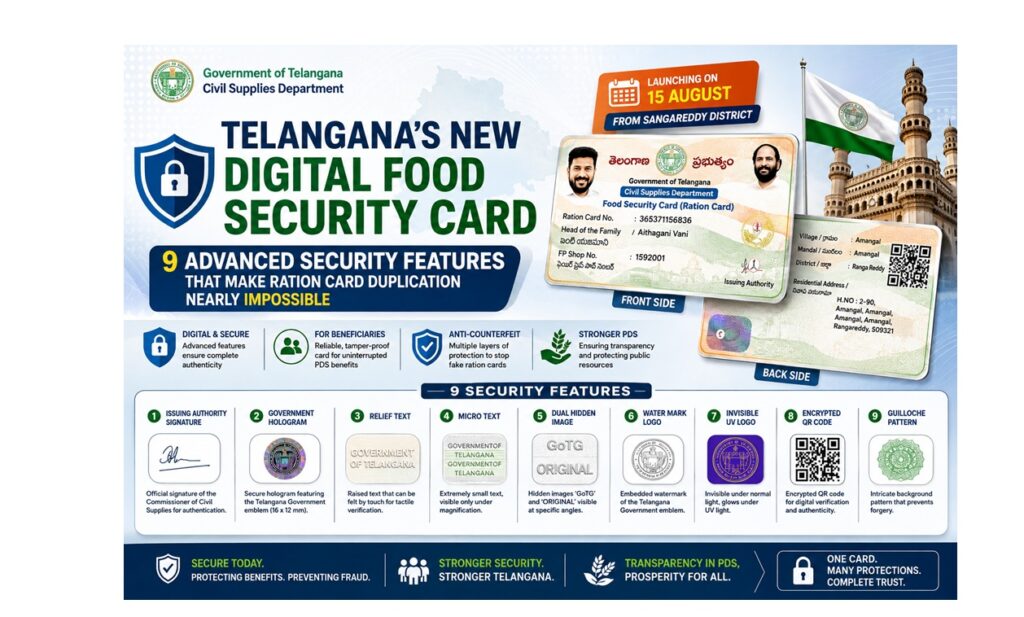
Telangana is about to hand its ration cardholders something that looks far less like a government form and far more like a banknote. The Civil Supplies Department has finalised the design of the new digital Food Security Card, and the state has packed nine separate security features into a single plastic card — from a tactile relief print you can feel with your fingertip to an ultraviolet emblem that stays completely invisible until someone shines a UV lamp on it.
The rollout begins on 15 August from Sangareddy district, and officials have already confirmed the launch schedule. What follows is a complete, plain-English breakdown of the new card: what changes for cardholders, why the government rebuilt the design from scratch, how each of the nine security features works, and how an ordinary family can check whether the card in their hand is genuine.
What Exactly Is the New Telangana Food Security Card?
The Food Security Card — most people still call it the ration card — is the document that connects a household to the Public Distribution System (PDS). It establishes who the head of the family is, which fair price shop serves that household, and how many members are entitled to subsidised rice and other essentials.
Until now, that document existed largely as a printed booklet or a basic laminated card. The new version replaces it with a durable, credit-card-sized digital identity document issued by the Civil Supplies Department, Government of Telangana. KL Hi-Tech Secure Print Limited, a specialist secure-printing company, produces the card using techniques normally reserved for currency notes, passports and share certificates.
The upgrade is not cosmetic. Every element on the card — the background pattern, the ink, the text size, the emblem, even the paper-level watermark — now does double duty as a security control.
Launch Date and Venue: Sangareddy Goes First
The government has fixed 15 August as the official launch date, with Sangareddy district serving as the venue for the statewide rollout. Distribution starts there and then expands to the rest of Telangana in phases.
Choosing a single district as the launch point gives the department a controlled environment to test issuance, verification hardware and dealer training before the card reaches crores of beneficiaries. Cardholders in other districts will receive their new Food Security Cards as the phased distribution progresses.
Why Telangana Redesigned the Ration Card
Any document that unlocks subsidised food will attract forgery. That is the blunt reality behind this redesign.
Duplicate and fake ration cards drain the PDS in three ways. First, they divert subsidised grain to households that never qualified. Second, they inflate beneficiary numbers, which distorts procurement planning and district-level allocation. Third, they make genuine cardholders wait longer and, in some cases, lose out entirely when stock runs short at the fair price shop.
Older ration cards were easy targets. A colour printer, a laminating machine and a scanned template could produce something convincing enough to pass a quick glance at a busy shop counter. Verification depended almost entirely on the dealer’s eyesight and memory.
The new design attacks that problem from a completely different angle. Instead of relying on one anti-counterfeit measure, the Civil Supplies Department layered nine of them across visible, covert, tactile and digital categories. A forger would need to defeat all nine simultaneously — using industrial secure-printing equipment, UV-reactive ink, micro-printing capability and access to the encryption behind the QR code. That combination sits well beyond the reach of a local print shop.
Card Layout: What Appears on the Front and Back
Before examining the security features individually, it helps to understand where everything sits.
Front side carries the identity and entitlement data:
- Government of Telangana emblem and the Telugu state seal
- “Civil Supplies Department” and “Food Security Card (Ration Card)” headers
- Photographs of the household members
- Ration Card Number
- Head of the Family name, printed in both English and Telugu
- Fair Price (FP) Shop Number
- Signature of the Issuing Authority
Back side carries the location and verification data:
- Village, Mandal and District fields
- Full residential address including house number and PIN code
- The encrypted QR code
Both faces sit on a printed guilloche background, and several covert features hide inside artwork that most people will never consciously notice.
The 9 Security Features of the Telangana Ration Card — Explained
Here is the complete feature list as approved by the Civil Supplies Department, followed by a detailed explanation of each.
- Issuing Authority — Commissioner of Civil Supplies signature
- Hologram — Government of Telangana emblem, 16 × 12 mm
- Relief Text — “GOVERNMENT OF TELANGANA”
- Micro Text — “GOVERNMENT OF TELANGANA”
- Dual Hidden Image — “GoTG” and “ORIGINAL”
- Watermark Logo — Government of Telangana emblem
- Invisible UV Logo — Government of Telangana emblem
- Encrypted QR Code — 20 × 20 mm
- Guilloche Pattern
1. Issuing Authority — The Commissioner’s Signature
Every genuine card carries the official signature of the Commissioner of Civil Supplies, printed in the lower right section of the front face beneath the label “Issuing Authority.”
This feature answers the most basic question a verifier can ask: who authorised this document? A card without that signature has no legal standing, regardless of how convincing the rest of it looks. The signature also creates a single, consistent reference mark. Field officers and fair price shop dealers learn one signature and can flag anything that deviates from it.
Because the signature prints as part of the secure-print run rather than being added afterwards, a forger cannot simply scan and paste it without also reproducing the surrounding print quality, colour registration and background pattern.
2. Government Hologram — 16 × 12 mm of Optical Security
A hologram measuring 16 millimetres by 12 millimetres sits on the card and displays the Telangana Government emblem. Tilt the card and the image shifts, throws different colours, and reveals depth that flat printing cannot imitate.
Holograms remain one of the most effective public-facing security devices precisely because verification requires no equipment at all. A dealer, a vigilance officer or a cardholder can confirm authenticity in under a second by angling the card toward a light source.
Manufacturing a hologram demands specialised mastering and embossing equipment, tightly controlled supply chains and considerable capital investment. Photocopiers and inkjet printers reproduce holograms as a dull grey or silver smear — an instantly recognisable failure. That single characteristic makes holographic film a strong deterrent against casual counterfeiting.
3. Relief Text — Security You Can Feel
The card carries raised, embossed lettering that spells out “GOVERNMENT OF TELANGANA.” Run a fingertip across it and you feel a distinct texture, similar to the raised numerals on a credit card or the intaglio printing on a currency note.
Relief text — also called embossed or raised text — delivers tactile verification. That matters enormously in real-world conditions. Fair price shops often operate in poor light, in crowded conditions, at the end of a long queue. A dealer does not always have time to hold a card up to a lamp. Touch works in any lighting, takes no training and requires no device.
Key benefits of relief text:
- Standard printing equipment cannot duplicate it
- Verification happens instantly through touch
- It adds a premium, tamper-resistant finish to the document
- It strengthens both security and perceived value of the card
Counterfeiters using flatbed or digital printers produce a smooth surface every time. The absence of texture becomes an immediate red flag.
4. Micro Text — Letters Too Small for Ordinary Printers
Micro text consists of extremely small printed characters that remain crisp and readable under magnification but appear as a thin line or faint band to the naked eye. On the Telangana Food Security Card, this micro printing repeats the phrase “GOVERNMENT OF TELANGANA GOVERNMENT OF TELANGANA GOVERNMENT OF TELANGANA…” in a continuous string.
The security value comes from resolution. Consumer printers and photocopiers simply lack the dot density to render characters at that size. When a counterfeiter scans and reprints the card, the micro text blurs into an unreadable smudge or disappears altogether. A verifier with a basic magnifying glass or a phone camera on maximum zoom can spot the failure in seconds.
Key benefits of micro text:
- Highly effective anti-copy feature
- Difficult to reproduce with normal printers
- Widely used in banknotes, passports and other high-security documents
Micro printing has protected currency for decades. Its inclusion here places the ration card in a genuinely different security class from its predecessor.
5. Dual Hidden Image — “GoTG” and “ORIGINAL”
The dual hidden image, sometimes called a super-imposed letter feature, embeds two separate hidden messages into the card design: “GoTG” (Government of Telangana) and “ORIGINAL.”
These characters stay invisible during normal viewing. They surface only at specific viewing angles or under magnification, when overlapping patterns align and the letters resolve out of what previously looked like plain background.
This is covert authentication — security that a counterfeiter may not even know exists. Someone copying the card without prior knowledge of the feature will reproduce the visible artwork faithfully and still fail, because the hidden layer depends on precise line placement that scanning destroys.
Key benefits of the dual hidden image:
- Functions as a hidden, covert authentication feature
- Extremely difficult to duplicate accurately
- Enables fast expert verification during audits and vigilance checks
6. Watermark Logo — The Emblem Inside the Material
A watermark is a translucent image or logo embedded into the material itself during manufacturing rather than printed onto the surface afterwards. Hold the Telangana Food Security Card up against a light source and the Government of Telangana emblem appears within the substrate.
Because the watermark forms part of the material’s structure, no amount of surface printing can recreate it convincingly. A printed imitation looks flat and sits visibly on top of the card; a true watermark changes appearance depending on whether light passes through the card or reflects off it.
Key benefits of the watermark logo:
- Provides strong authentication grounded in the material itself
- Integrated during manufacturing, not applied later
- Long established in legal and government documentation
For frontline verification, the test is refreshingly simple: raise the card toward daylight or a bulb and look for the emblem.
7. Invisible UV Logo — Hidden Until the Light Changes
The card also carries a Government of Telangana emblem printed in ultraviolet-reactive ink. Under ordinary lighting, the logo stays completely invisible. Place the card under a UV lamp and the emblem glows clearly.
UV features have become standard in banking, border control and secure identity documents because they combine strong protection with fast verification. A ration shop or a mandal-level office needs nothing more than a small handheld UV torch — inexpensive, portable and already common at bank counters across India.
Key benefits of the invisible UV logo:
- Delivers hidden, covert security that casual observers never see
- Supports both machine reading and quick manual inspection
- Counterfeiters struggle to detect the feature, let alone reproduce it
The last point deserves emphasis. A forger who examines a genuine card in daylight will never notice the UV emblem. Their copy will pass a visual check and fail the moment a UV light touches it.
8. Encrypted QR Code — 20 × 20 mm of Digital Verification
The back of the card carries a 20 mm × 20 mm encrypted QR code. This is the feature that pushes the Food Security Card from “secure document” into genuinely digital territory.
An ordinary QR code stores plain data that any scanner can read and any device can regenerate. An encrypted QR code works differently: it stores digitally protected information that only authorised software or approved scanning systems can decode and authenticate. Someone can photograph and reprint the code, but the data behind it will not validate against the department’s system.
Key benefits of the encrypted QR code:
- Enables secure digital verification at the point of distribution
- Prevents tampering with the underlying data
- Delivers instant authentication rather than manual cross-checking
- Stores serial numbers, URLs and encrypted metadata
Practically, this changes daily transactions at the fair price shop. A dealer scans the code, the system confirms the card and household details in real time, and the transaction proceeds. Cards that fail authentication get flagged immediately, and the flag creates a digital trail that supervisors can audit later.
9. Guilloche Pattern — Mathematical Artwork Against Forgery
Look closely at the background of the card and you will see an intricate lattice of curved, interwoven lines forming a rosette. That is a guilloche pattern — a geometric design generated using precise mathematical formulas, the same technique used on banknotes, share certificates, bonds and diplomas around the world.
Guilloche patterns defeat copying because of their density. The lines run so fine and interlock so tightly that scanners and photocopiers cannot resolve them. Reproduction attempts produce moiré interference — those wavy, shimmering distortions — or a muddy blur where crisp lines should appear.
Key benefits of the guilloche pattern:
- Complex structure resists replication
- Reinforces overall visual security across the whole card face
- Adds an elegant, professional design aesthetic
The pattern also serves a second purpose. It covers the entire card surface, which means any attempt to alter printed data — changing a name, a card number or an FP shop number — disrupts the background lines and leaves a visible scar.
How the Nine Features Work Together as Layered Security
Individually, each feature raises the cost of forgery. Collectively, they create something close to a wall.
The nine features fall into four distinct categories, and that spread is deliberate:
- Visible features — hologram, guilloche pattern, issuing authority signature. Anyone can check these instantly, without tools.
- Tactile features — relief text. Verification works by touch alone, in any light.
- Covert features — micro text, dual hidden image, watermark, invisible UV logo. These need magnification, backlighting or UV light, and most of them stay unknown to casual observers.
- Digital features — encrypted QR code. Machine verification that ties the physical card back to a live government database.
A counterfeiter must defeat all four layers at once. Beating the visible layer requires hologram manufacturing capability. Beating the tactile layer requires embossing equipment. Beating the covert layer requires micro-printing precision, UV-reactive ink and knowledge of features they may never discover. Beating the digital layer requires breaking the department’s encryption.
Meanwhile, detection requires only one failure. A single missing feature exposes the fake.
How Cardholders Can Verify a Genuine Food Security Card
Families receiving the new card can run their own authenticity check in under a minute. No special equipment is necessary for the first four steps.
- Tilt the card toward a light. The hologram should shift colour and reveal the Telangana emblem with visible depth.
- Run a finger over the raised text. You should feel “GOVERNMENT OF TELANGANA” as a distinct texture, not a smooth printed surface.
- Hold the card up to daylight or a bulb. The watermarked Government of Telangana emblem should appear inside the material.
- Check the issuing authority signature. The Commissioner of Civil Supplies signature must appear in the designated space on the front face.
- Zoom in on the micro text. Use a magnifying glass or a phone camera at maximum zoom. The repeated “GOVERNMENT OF TELANGANA” string should read clearly rather than blur.
- Scan the QR code at a fair price shop. Authorised systems will confirm whether the card authenticates successfully.
If any of these checks fail, the cardholder should report the card to the local Civil Supplies office or the mandal-level authority rather than attempting to use it.
What the Upgrade Means for the Public Distribution System
Telangana’s PDS network serves millions of households through thousands of fair price shops. Strengthening the card strengthens the entire chain.
Fewer ghost beneficiaries. Eliminating duplicate cards removes phantom households from the rolls, which means allocation figures start reflecting genuine demand.
Better stock planning. When district-level entitlement data becomes accurate, procurement and transport planning improves. Shops receive stock matched to real requirements.
Faster transactions at the counter. QR-based verification replaces manual register checks and reduces disputes about entitlement.
A stronger audit trail. Digital verification generates records. Records enable pattern analysis — and pattern analysis is how departments detect diversion at scale rather than one shop at a time.
Restored confidence among genuine beneficiaries. Families who qualify for subsidised food gain a document that clearly proves their status and cannot be casually imitated by someone else.
Who Prints the Card
KL Hi-Tech Secure Print Limited handles production of the Food Security Card. The company operates in the secure-printing sector, which covers documents where authenticity carries legal or financial weight — certificates, examination materials, financial instruments and government identity documents.
Secure printing differs fundamentally from commercial printing. It involves controlled facilities, accounted materials, restricted access to design files, and equipment capable of micro-printing, intaglio effects, UV-reactive inks and holographic application. Handing card production to a dedicated secure printer means the security features exist not just on paper as a specification, but in a manufacturing process built to protect them.
Frequently Asked Questions About the New Telangana Ration Card
When does the new digital Food Security Card launch? The rollout begins on 15 August, starting from Sangareddy district, with phased distribution to other districts of Telangana thereafter.
How many security features does the card contain? Nine: the issuing authority signature, government hologram, relief text, micro text, dual hidden image, watermark logo, invisible UV logo, encrypted QR code and guilloche pattern.
Do cardholders need to apply again for the new card? Existing beneficiaries receive the new card through the department’s distribution process. Cardholders should follow announcements from their local Civil Supplies office and mandal authorities regarding collection.
Can someone photocopy the new ration card? A photocopy will not function as a valid card. Photocopying destroys the hologram, flattens the relief text, blurs the micro text, removes the watermark and UV logo, and produces moiré distortion across the guilloche pattern.
What does the QR code on the back contain? It stores encrypted, digitally protected information that authorised scanning systems decode to verify the card and its beneficiary details. Ordinary QR scanners cannot read or replicate the protected data.
How large is the hologram? The government hologram measures 16 × 12 mm and displays the Telangana Government emblem.
What size is the QR code? The encrypted QR code measures 20 × 20 mm and sits on the back face of the card alongside the address details.
Which department issues the card? The Civil Supplies Department, Government of Telangana, with the Commissioner of Civil Supplies signing as the issuing authority.
What should someone do if their card looks suspicious? Report it to the nearest Civil Supplies office or mandal-level authority instead of using it at a fair price shop.
Key Takeaways
- Telangana replaces the traditional ration card with a digital Food Security Card carrying nine layered security features.
- The rollout starts 15 August from Sangareddy district, then expands statewide in phases.
- Features span four categories — visible, tactile, covert and digital — so defeating one layer still leaves a counterfeiter exposed by the others.
- The encrypted QR code links the physical card to live government verification at the fair price shop.
- KL Hi-Tech Secure Print Limited manufactures the card using banknote-grade secure printing techniques.
- Cardholders can verify authenticity themselves through simple tilt, touch and backlight checks.
Conclusion
The Telangana Food Security Card now integrates visible, covert, tactile and digital security technologies in a single document. That combination does three things at once: it establishes authenticity beyond reasonable dispute, it shuts down practical avenues for duplication, and it strengthens beneficiary verification across the Public Distribution System.
For families who depend on subsidised food, the change is straightforward and welcome. The card in their hand becomes harder to fake, faster to verify and more difficult to misuse. For the state, it means allocation data that finally reflects genuine households rather than inflated numbers.
Distribution begins on 15 August from Sangareddy. Cardholders across Telangana should watch for announcements from their local Civil Supplies office regarding collection schedules in their mandal, and should run the simple verification checks described above the moment they receive the new card.