


Introduction
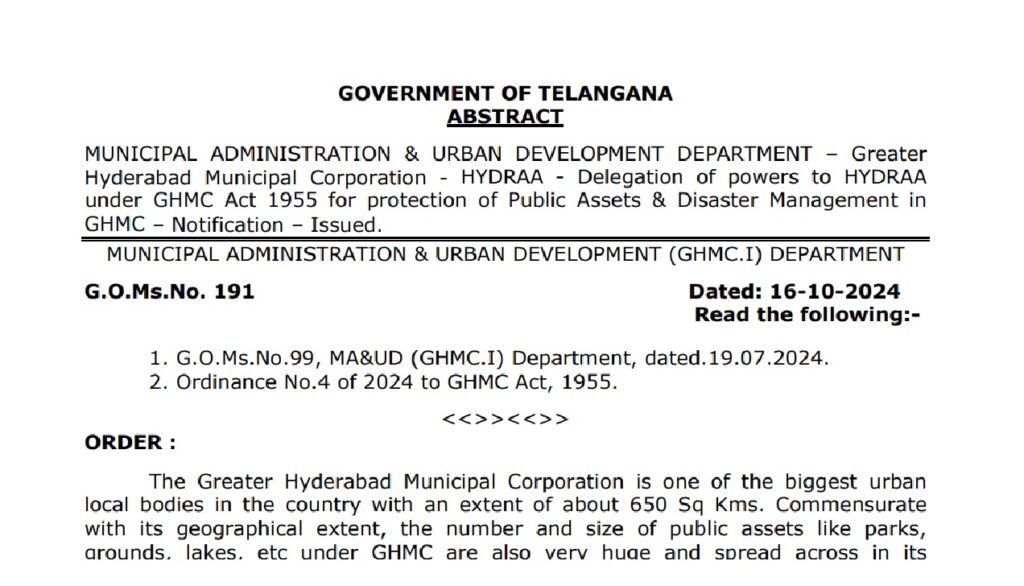
The Greater Hyderabad Municipal Corporation (GHMC) plays a critical role in safeguarding public assets and ensuring disaster management. As Hyderabad rapidly urbanizes, protecting public spaces and managing disasters has become more complex. A new directive seeks to empower the Hyderabad Disaster Response and Asset Protection Agency (HYDRAA) to streamline these responsibilities. This article explores the recent notification, its impact on urban governance, and how HYDRAA’s role will evolve in safeguarding public assets and managing disaster preparedness.
GHMC’s Expanding Role in Urban Asset Protection
Hyderabad is one of India’s largest urban agglomerations, covering over 650 square kilometers. The city’s parks, lakes, and public spaces are vital for residents, offering recreational opportunities and reducing the effects of climate change. However, rapid urbanization has led to the encroachment and degradation of these spaces, raising concerns about their future. Protecting these public assets is critical to maintaining the city’s environmental health and meeting the community’s needs.
The Emergence of HYDRAA
To address the pressing need for asset protection, the GHMC has delegated significant responsibilities to the Hyderabad Disaster Response and Asset Protection Agency (HYDRAA). Established under the GHMC Act of 1955, HYDRAA’s primary mandate is to protect critical public infrastructure. This includes roads, public parks, lakes, and water bodies. In addition to managing urban assets, HYDRAA will also be responsible for disaster management, making it a comprehensive solution for safeguarding both public property and citizen safety.
Disaster Management in Hyderabad: Why HYDRAA Is Crucial
As Telangana experiences rapid growth, particularly in and around Hyderabad, disaster management becomes even more important. With a 3.2% annual urban population growth rate, significantly higher than the national average, Hyderabad faces various urban challenges. Natural disasters such as floods and infrastructural issues like traffic jams during heavy rains are becoming more frequent. Despite GHMC’s efforts, its existing disaster management capabilities are insufficient for such a vast urban region. HYDRAA was thus formed to unify disaster management efforts across the Telangana Core Urban Region (TCUR), which includes the GHMC area and parts of Hyderabad, Rangareddy, Medchal-Malkajgiri, and Sangareddy districts.
Functions and Responsibilities of HYDRAA
HYDRAA has a broad scope of responsibilities, divided into three key wings: Asset Protection, Disaster Management, and Logistical Support. Each of these wings plays a vital role in ensuring the effective functioning of the agency.
1. Asset Protection Wing
The Asset Protection Wing focuses on preventing encroachments on public land and safeguarding parks, lakes, playgrounds, and other urban spaces. This wing coordinates with various local bodies, including the GHMC, HMDA, and local law enforcement, to protect public assets. It also has the authority to inspect private buildings for structural safety, particularly in cases where public safety is at risk.
2. Disaster Management Wing
The Disaster Management Wing is responsible for responding to emergencies such as floods, fires, and other natural disasters. This wing coordinates with state and national agencies, such as the National Disaster Response Force (NDRF), the Indian Meteorological Department (IMD), and other technical agencies to provide timely warnings and manage disaster responses effectively. HYDRAA’s disaster response force (DRF) is also tasked with relief and recovery efforts, ensuring the safety and wellbeing of residents during emergencies.
3. Logistical Support Wing
HYDRAA’s Logistical Support Wing is responsible for staffing, procurement, and operational logistics. This wing handles everything from office administration to maintaining equipment and vehicles essential for disaster response. In addition, it oversees the IT and GIS services required to monitor and manage disaster risk across the TCUR region.
Traffic and Emergency Coordination
One of HYDRAA’s notable roles is in traffic coordination, especially during disasters or emergency situations. With frequent flooding and road damage during Hyderabad’s heavy monsoon rains, traffic jams are a common problem. HYDRAA works in coordination with local traffic police to manage traffic flows, especially in waterlogged or disaster-prone areas, ensuring that relief and rescue operations are not delayed.
Governing Structure of HYDRAA
HYDRAA is structured to ensure efficiency and accountability. It functions as a separate Head of the Department (HOD) under the Municipal Administration and Urban Development (MA&UD) department. A senior All India Services (AIS) officer, not below the rank of Secretary to Government, will oversee HYDRAA as its Commissioner. The agency reports to a governing body headed by the Chief Minister of Telangana, ensuring high-level oversight and policy guidance.
Budget and Funding
HYDRAA will be funded through a combination of government allocations and internal resources generated from beneficiary agencies, such as the GHMC, HMDA, and HMWSSB. This ensures that the agency has the necessary resources to fulfill its broad mandate, from disaster preparedness to asset protection.
Future Implications of HYDRAA’s Mandate
As Hyderabad continues to grow, both geographically and in population, the importance of an agency like HYDRAA cannot be understated. Its dual focus on asset protection and disaster management positions it as a key player in urban governance. The establishment of HYDRAA is a forward-looking initiative aimed at enhancing Hyderabad’s resilience to disasters and ensuring the preservation of public spaces for future generations.
Conclusion
The delegation of powers to HYDRAA marks a significant step in the governance of Hyderabad’s urban development. By centralizing both disaster management and asset protection under one agency, the government is taking proactive steps to address the challenges of rapid urbanization. HYDRAA’s role will be crucial in protecting Hyderabad’s public assets from encroachment and in preparing the city for future disasters, ensuring a safer, more sustainable urban environment.