


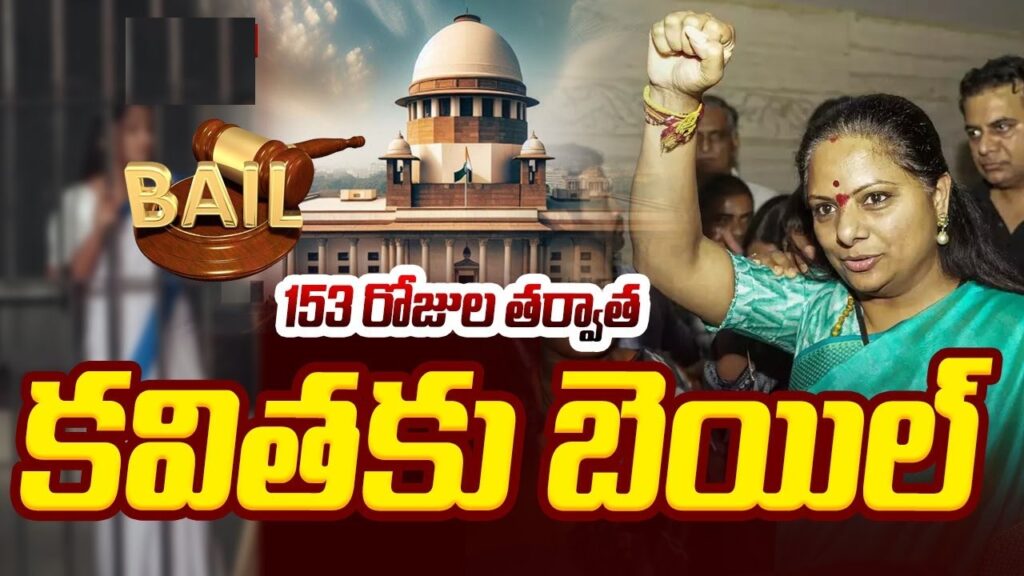
Kavitha Kalvakuntla’s release from Tihar Jail after 153 days has sent ripples through India’s political landscape. The Telangana politician and daughter of former Chief Minister K. Chandrashekar Rao found herself at the center of a high-profile case that captured national attention. Her detention and subsequent release have highlighted the complex interplay between politics and the justice system in India.

The circumstances surrounding Kavitha’s arrest and her time in custody have raised questions about the nature of political prosecutions in the country. Her release is likely to have an impact on the political dynamics in Telangana and beyond. As the dust settles, many are eager to understand the implications of this development for Kavitha’s political career and the broader political scene in the region.
Background of Kavitha Kalvakuntla’s Arrest
Kavitha Kalvakuntla, daughter of former Telangana Chief Minister K. Chandrashekar Rao, was arrested by the Enforcement Directorate (ED) on March 15, 2024, in connection with the Delhi liquor policy scam. The ED conducted a raid at her residence in Hyderabad, questioning her for hours before taking her into custody. This arrest came after Kavitha had been summoned and questioned three times in the previous year regarding the case.
The ED alleged that Kavitha was linked to a “South Group” of liquor traders who played a key role in the Delhi excise policy scam. According to the agency, this group, which included Kavitha, Sarath Reddy, and Magunta Srinivasulu Reddy, allegedly gave kickbacks of ₹100 crore to Aam Aadmi Party (AAP) leaders. The case involves accusations of irregularities in the modification of the Delhi Excise Policy, including undue favors to license holders and waiving of fees.
Details of Release from Tihar Jail
The Supreme Court granted bail to Bharat Rashtra Samithi leader K Kavitha on August 27, ending her 153-day detention in Tihar Jail. The court cited the special consideration for women under Section 45(1) of the Prevention of Money Laundering Act. Kavitha’s release came with conditions, including furnishing sureties of Rs 10 lakhs each for both cases and surrendering her passport. The court also directed her not to influence or intimidate witnesses.
Kavitha’s arrest on March 15 by the Enforcement Directorate (ED) was related to the Delhi liquor policy scam. The Central Bureau of Investigation (CBI) later arrested her while she was in ED custody. Upon her release, Kavitha maintained her innocence, calling it a “political laundering case” rather than a money laundering one. She claimed the case was fabricated and expressed confidence in clearing her name.
Ongoing Supreme Court Hearing on MLC Kavitha’s Bail Petition
The Supreme Court is currently hearing the bail petition of BRS MLC Kavitha. In a significant development, renowned senior advocate Mukul Rohatgi has been representing Kavitha, arguing that she is fully eligible for bail. Rohatgi emphasized that the case against Kavitha lacks substantial evidence and that she has been unjustly imprisoned.
The Argument for Bail: A Detailed Analysis
During the ongoing hearing before a bench comprising Justice B.R. Gavai and Justice Viswanathan, Rohatgi presented strong arguments in favor of granting bail to Kavitha. He pointed out that the investigative process in both the Enforcement Directorate (ED) and Central Bureau of Investigation (CBI) cases had already concluded. Despite this, Kavitha remains incarcerated, which Rohatgi argued is unwarranted.
Completed Investigations and Charges Filed
Rohatgi highlighted that investigations in both cases have been completed. He noted that Kavitha has been in jail for five months under the ED case and four months under the CBI case. The thorough investigation process involved questioning 493 witnesses, and the charge sheets have already been filed. Given that the evidence collection phase is over, Rohatgi argued that there is no legal ground to deny Kavitha bail.
Supreme Court’s Justification for Granting Bail
The Supreme Court noted that the investigation into the case has been completed, and a chargesheet has already been filed. The Court observed that the continued custody of Kavitha is unnecessary since she has already been behind bars for five months. Highlighting the lengthy nature of the judicial process, the Court emphasized that undertrial custody should not be punitive.
The Justices further underscored the special provisions under Section 45 of the Prevention of Money Laundering Act (PMLA), which allows for beneficial treatment of women. The Court made it clear that Kavitha is entitled to such considerations, rebuking the Delhi High Court’s previous observation that an educated, sophisticated woman is not eligible for bail under this provision.
Critique of Delhi High Court’s Observation
The Supreme Court strongly criticized the Delhi High Court’s interpretation, which suggested that educated women should be exempt from the beneficial provisions for bail under the PMLA. The Justices expressed concern that such a ruling could set a dangerous precedent, potentially barring educated women from receiving bail under similar circumstances. The Supreme Court clarified that the law should be applied uniformly, without creating artificial distinctions based on education or social status.
Arguments Presented During the Hearing
During the Supreme Court hearing, Additional Solicitor General (ASG) SV Raju argued against granting bail to Kavitha, claiming that she had tampered with evidence by formatting her phone. He asserted that this action amounted to the destruction of evidence and intimidation of witnesses. However, Senior Advocate Mukul Rohatgi, representing Kavitha, countered this argument by stating that the phone was formatted because it was given to a servant, questioning the significance of such an act.
The Court sided with Rohatgi’s argument, noting that formatting a mobile phone alone is insufficient to constitute tampering with evidence. Justice Viswanathan highlighted the personal nature of mobile phones, suggesting that partial deletion of messages is common and should not automatically be interpreted as an attempt to destroy evidence.
Discussion on the Evidentiary Value of Co-Accused Statements
A significant point of contention during the hearing was the evidentiary value of statements made by co-accused individuals. The ASG pointed out that one of the co-accused, Arun Pillai, had retracted his statement, implying Kavitha’s involvement in the alleged crimes. However, the Supreme Court questioned the reliability of such statements, especially when made under custody, and deliberated on how much weight should be given to such evidence in determining Kavitha’s culpability.
The Court concluded that more substantial evidence would be needed to prove Kavitha’s involvement, beyond the mere retraction of statements by a co-accused. The Justices emphasized that legal standards require a careful assessment of all available evidence, rather than relying solely on potentially coerced statements.
No Risk of Flight: Kavitha’s Commitment to the Legal Process
One of the critical arguments presented by Rohatgi was that there is no risk of Kavitha fleeing the country. He firmly stated that the allegations against Kavitha, involving the exchange of ₹100 crores, are unsubstantiated. Rohatgi reiterated that Kavitha has cooperated fully with the investigation agencies, including providing all requested phones. He questioned the relevance of the accusations that she switched phones, pointing out that this action is neither illegal nor indicative of guilt.
The Lack of Substantial Evidence: A Flawed Case?
Rohatgi further argued that despite the investigation agencies’ claims of a ₹100 crore transaction by the so-called “South Group,” no concrete evidence or recovery has been made to support these allegations. With 493 witnesses examined, the prosecution has yet to present any credible evidence proving Kavitha’s involvement in any illegal activities. Additionally, Rohatgi questioned why no cases were filed for alleged witness intimidation, a claim made by the prosecution but not substantiated with any legal action.
The Sisodia Precedent: A Case for Consistent Application of Law
Rohatgi drew parallels between Kavitha’s case and that of Manish Sisodia, where the court had granted bail under similar circumstances. He argued that the same legal principles should apply to Kavitha’s bail plea, as the circumstances are comparable. The prolonged investigation and the lack of fresh evidence further justify granting her bail to avoid unnecessary delays in the judicial process.
Impact on Political Landscape
Kavitha Kalvakuntla’s release has stirred up the political scene in Telangana. The Bharat Rashtra Samithi (BRS) has accused the BJP government of engaging in vendetta politics, claiming that Kavitha’s arrest was part of a broader strategy to target parties that oppose the BJP’s agenda. This has heightened tensions between the BRS and the BJP in the state.
The situation has also exposed divisions within the opposition. The Congress party’s stance on Kavitha’s arrest has been criticized as inconsistent. While the party condemned the arrest of Delhi Chief Minister Arvind Kejriwal in a similar case, Telangana Chief Minister A. Revanth Reddy and other state Congress leaders supported Kavitha’s arrest. This discrepancy has led to accusations of double standards against the Congress.
The case has had a significant impact on political alliances. Some BRS members, such as MLA Kadiyam Srihari, have switched allegiance to the Congress, citing corruption allegations against BRS leaders as a reason for the party’s declining popularity. This shift in loyalties suggests that the case may have long-lasting effects on Telangana’s political landscape.
Conclusion
Kavitha Kalvakuntla’s release from Tihar Jail after 153 days has stirred up the political scene in Telangana and beyond. Her detention and subsequent release have put a spotlight on the complex relationship between politics and the justice system in India. This high-profile case has had an impact on political alliances and exposed divisions within the opposition, potentially reshaping the political landscape in the region.
As the dust settles, many are keen to understand what this means for Kavitha’s political future and the broader political environment. The case has sparked debates about political prosecutions and has led to shifts in party loyalties. Moving forward, it will be interesting to see how these developments play out and shape the political dynamics in Telangana and at the national level.