


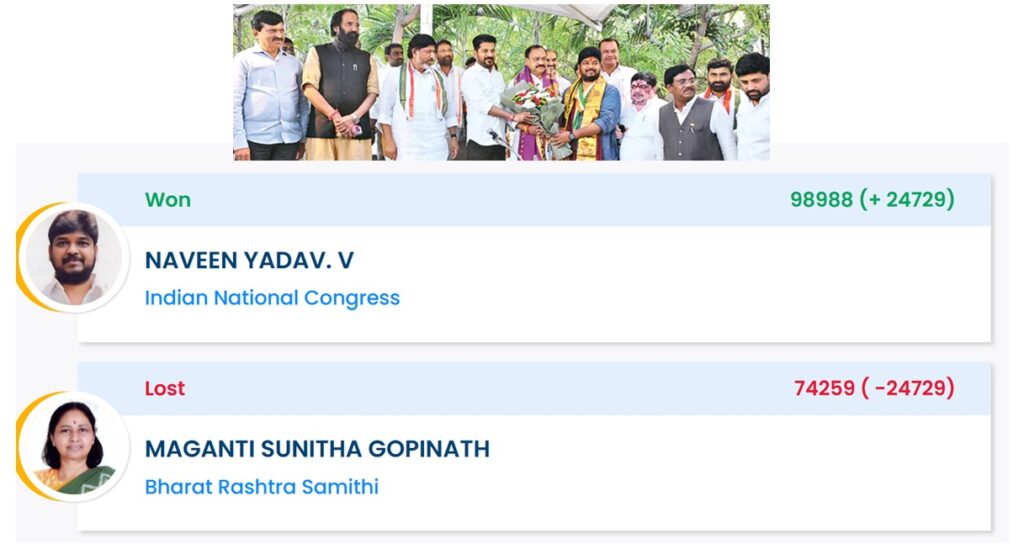
The Jubilee Hills by-election of November 2025 delivered a resounding verdict that has fundamentally reshaped Telangana’s urban political landscape. Congress candidate Naveen Yadav V secured a historic victory with 98,988 votes (50.83%), defeating Bharat Rashtra Samithi’s Maganti Sunitha Gopinath by a commanding margin of 24,729 votes.
This victory marks not just a seat gain but a significant political statement about the changing dynamics in Greater Hyderabad, where Congress has traditionally struggled to establish a foothold.
The by-election was necessitated following the untimely death of three-time BRS MLA Maganti Gopinath in June 2025 due to a heart attack. Gopinath, who had represented the constituency since 2014—first on a Telugu Desam Party ticket and later for BRS—was a formidable political figure who had defeated prominent candidates including former cricketer Mohammed Azharuddin in 2023. His passing created a vacuum that transformed into a high-stakes political battleground among Congress, BRS, and BJP, each viewing the contest as critical to their future trajectory in India’s youngest state.


Jubilee Hills By-Election 2025: Final Vote Count – Congress candidate Naveen Yadav secured a decisive victory with 98,988 votes (50.83%)
Electoral Overview and Key Results
The Final Verdict
The Election Commission of India declared results on November 14, 2025, after ten rounds of counting conducted at the Kotla Vijayabhaskar Reddy Indoor Stadium in Yousufguda. The comprehensive nature of Congress’s victory becomes evident when examining the final tally: Naveen Yadav’s 98,988 votes represented the highest vote share (50.83%) ever achieved by Congress in Jubilee Hills since Telangana’s formation in 2014.
BRS candidate Maganti Sunitha Gopinath, the widow of the late MLA, secured 74,259 votes (38.13%), while BJP’s Deepak Reddy Lankala managed only 17,061 votes (8.76%), losing his security deposit in a humiliating setback for the saffron party. The constituency recorded a voter turnout of 48.49%, with 1,94,727 votes cast out of 4,01,365 registered voters—marginally higher than the 47.58% turnout in the 2023 Assembly elections.
Congress maintained its lead from the very first round of counting, starting with a slender 47-vote advantage and progressively widening the gap through all ten rounds. By Round 7, the lead had expanded to 19,797 votes, and by the final count, Congress had secured a decisive 12.70% victory margin—the largest in the constituency’s recent electoral history.
Historical Context and Comparison
To appreciate the magnitude of this victory, one must examine Jubilee Hills’ electoral history. The constituency has witnessed a fascinating political evolution since its creation after delimitation in 2009. In the 2014 elections, Maganti Gopinath won on a TDP ticket with just 30.78% of votes, defeating AIMIM’s Naveen Yadav (the same candidate who won in 2025) by 9,242 votes. Gopinath consolidated his position in 2018 after switching to BRS (then TRS), securing 44.30% votes with a 16,004-vote margin.

Vote Share Progression (2023-2025): Congress shows consistent upward trend while BRS and BJP witness fluctuations in Jubilee Hills constituency
The 2023 Assembly elections saw Gopinath achieve a hat-trick victory with 43.94% votes, defeating Congress’s Mohammed Azharuddin by 16,337 votes. BJP’s Deepak Reddy finished third with 14.11% votes—nearly double his 2025 performance. What makes the 2025 result particularly striking is Congress’s 15.80 percentage point surge from 35.03% in 2023 to 50.83%, while BRS declined by 5.81 points and BJP plummeted by 5.35 points.
The progressive upward trajectory of Congress becomes clearer when tracking intermediate elections. In the 2024 Lok Sabha elections, Congress secured 40.10% in the Jubilee Hills segment of the Secunderabad parliamentary constituency, while BJP surged to 35.08% and BRS collapsed to 16.68%.
The 2024 Secunderabad Cantonment by-election, held after the death of BRS MLA Lasya Nanditha, saw Congress candidate Sri Ganesh win with 40.86%, with BJP at 30.80% and BRS at 26.25%. This consistent upward trend culminated in the 2025 Jubilee Hills landslide, where Congress finally breached the 50% mark.
Demographic Profile and Constituency Characteristics
A Tale of Two Worlds
Jubilee Hills presents a unique demographic mosaic that distinguishes it from typical urban constituencies. With approximately 4.01 lakh registered voters, the constituency encompasses stark contrasts—affluent gated communities and luxury apartments coexist with dense slum clusters and lower-income neighborhoods. This duality played a crucial role in shaping campaign strategies and ultimately the election outcome.
The constituency comprises approximately 33% Muslim voters, making it one of Greater Hyderabad’s constituencies with significant minority representation. This demographic factor proved decisive, as the Muslim vote consolidated overwhelmingly behind Congress, particularly among women voters who turned out in substantial numbers. The constituency also has considerable populations of Andhra settlers, predominantly from the Kamma community, IT professionals working in the nearby tech corridor, Telugu film industry personnel, and service-sector employees.
Age Demographics and Voter Behavior
According to detailed voter data, the 30-39 age group constitutes the largest voting bloc with nearly 97,000 voters—approximately one in every four voters in Jubilee Hills. This demographic, characterized by urban professionals with exposure to infrastructure and civic issues, proved highly responsive to Congress’s development-focused messaging. The 40-49 age group follows with 87,492 voters (21.9%), while those aged 20-29 comprise over 72,000 voters.
Political analysts noted distinct behavioral patterns across age segments. Voters aged 25-39 are politically active, aligning with specific parties and participating in campaigns both on-ground and through social media. Those above 40 are “legacy voters” who have tested political parties over time and understand long-standing constituency issues. The youngest voters (18-24) exhibit greater volatility, swinging based on social media content and campaigns.
Urban Apathy and Electoral Participation
Despite steady growth in registered voters—from 2.59 lakh in 2009 to 3.85 lakh in 2023 and nearly 4 lakh in 2025—Jubilee Hills has consistently recorded low voter turnout. The constituency recorded 52.76% turnout in 2009, which declined to 50.18% in 2014 and further dropped to 45.59% in 2018—the lowest among Telangana’s urban segments. The 2023 Assembly elections saw marginal improvement to 47.58%, with the 2025 by-election recording 48.49%.
This pattern reflects broader urban apathy seen in upscale and cosmopolitan constituencies, where civic amenities, traffic, and governance dominate discussions but rarely translate into active voter participation. Observers cite large floating populations, high-income demographics, weekend travel patterns, and weak mobilization as contributing factors. However, the marginal turnout increase in 2025 suggested that intensive campaigning by all parties, particularly Congress’s booth-level organization, managed to overcome some of this apathy
The Winning Candidate: Naveen Yadav’s Political Journey
From Repeated Defeats to Historic Victory
Vallala Naveen Yadav’s victory represents the culmination of a remarkable political journey marked by persistence through multiple electoral setbacks. Born on November 17, 1983, the 42-year-old architect and real estate businessman from Yousufguda has deep roots in the constituency. His father, V. Chinna Srisailam Yadav, provided the foundation for his entry into politics, and Naveen has been married to Varsha Yadav with whom he has a son, Anshi Yadav.
Naveen’s political career began in 2009 when he contested the Yousufguda division corporator post as an AIMIM candidate but lost to TDP’s Murali Goud. His most significant early performance came in 2014 when he contested Jubilee Hills Assembly constituency on an AIMIM ticket, securing 41,656 votes (25.19%) and finishing second behind Maganti Gopinath. This established him as a credible political presence in the constituency.
He faced defeat again in 2015 when contesting from Rahmathnagar division as an AIMIM candidate. In 2018, after AIMIM denied him a ticket, Naveen contested as an independent and secured 18,817 votes, finishing third. Each defeat served as a learning experience, allowing him to deepen his grassroots connections and understand constituency dynamics.
The turning point came on November 15, 2023, when Naveen joined the Congress party in the presence of then-TPCC president A. Revanth Reddy, who would soon become Telangana’s Chief Minister. This strategic move aligned him with a party on the ascendant in Telangana politics. Through his Nava Yuva Foundation, Naveen had been conducting community service initiatives, building social capital that would prove invaluable in the 2025 campaign.
The AIMIM Connection and Muslim Outreach
Naveen’s previous association with AIMIM proved to be a significant asset rather than a liability. His years of organizing and outreach in Muslim-dominated pockets of Jubilee Hills had built substantial rapport with community leaders and ordinary voters alike. When AIMIM president Asaduddin Owaisi decided to back Naveen’s Congress candidacy rather than fielding a rival candidate, it effectively consolidated the Muslim vote—which comprises over 36% of the 4.01 lakh electorate.
Owaisi’s endorsement was unequivocal and strategic. He appealed to Jubilee Hills voters who had supported BRS for the last decade to now back the “young and capable” Naveen Yadav, criticizing BRS for failing to bring development despite holding the seat continuously. This support proved decisive in tilting the contest overwhelmingly toward Congress, particularly among Muslim women voters who turned out in large numbers
Campaign Strategies and Political Dynamics
Congress’s Multi-Layered Approach
The Congress campaign in Jubilee Hills represented a masterclass in urban political mobilization, combining state resources, organizational discipline, and community-specific outreach. Chief Minister Revanth Reddy personally led the campaign with unprecedented intensity, conducting roadshows for an entire week, covering two divisions each day, and addressing multiple street-corner meetings.
Revanth Reddy’s aggressive messaging focused on portraying BRS and BJP as “Bad Brothers” blocking Hyderabad’s development. He argued that real progress in Hyderabad occurred only during Congress rule between 2004-2014, when foundations were laid for the international airport, Metro Rail, IT hubs, and pharma clusters. He blamed the BRS-BJP nexus for cancelling the Information Technology Investment Region (ITIR) project that could have elevated Telangana’s economy.
The campaign structure reflected meticulous planning. The government appointed three ministers—Ponnam Prabhakar, Tummala Nageswara Rao, and Gaddam Vivek—as constituency in-charges who submitted a comprehensive report on ground realities. Subsequently, 13 ministers were assigned as in-charges for door-to-door campaigning across all divisions, with special committees formed to engage women voters specifically.
This translated into operational terms through the slogan “Congress for Every Home,” with senior leaders, MLAs, and cadres making door-to-door visits up to four times in the final days. The campaign highlighted a comprehensive list of welfare measures with specific beneficiary numbers: 25,925 families receiving free electricity below 200 units; 19,658 families benefiting from ₹500 LPG cylinders; women saving ₹120 crore on free bus travel; 14,197 new ration cards issued; and 11,328 people drawing Aasara pensions.
BRS’s Sympathy Card and Organizational Challenges
The BRS strategy centered on leveraging sympathy for the late Maganti Gopinath by fielding his widow, Maganti Sunitha Gopinath. This approach—using family connections to retain seats after a sitting MLA’s death—has produced mixed results historically. While it succeeded in some cases, the 2024 Secunderabad Cantonment by-election saw BRS lose despite fielding Niveditha Sayanna, sister of the deceased MLA Lasya Nanditha.
BRS’s campaign faced multiple structural challenges. The party, already reeling from its 2023 Assembly defeat and complete washout in the 2024 Lok Sabha elections, struggled with organizational cohesion. Several BRS MLAs had defected to Congress, and the arrest of K. Kavitha, daughter of BRS president K. Chandrasekhar Rao, in a liquor scam had tarnished the party’s image.
BRS working president K.T. Rama Rao led community-level engagement efforts alongside senior Hyderabad-based leaders like Talasani Srinivas Yadav, emphasizing the party’s welfare-oriented governance record. However, their messaging about Congress-BRS coordination proved ineffective. The party also attempted to attack HYDRAA, the Telangana government’s ambitious drive to clear encroachments and reclaim water bodies, but this strategy backfired as urban voters appreciated the anti-encroachment drive.
Following the defeat, KTR called on party cadre to view the loss as “just a minor setback” and urged them not to rest until KCR is voted back to power. However, the result raised serious questions about BRS’s organizational strength in key city constituencies ahead of GHMC and local body elections.
BJP’s Catastrophic Collapse
The BJP’s performance represented perhaps the most shocking outcome of the by-election. Having secured 14.11% votes in 2023 and surging to over 30% in the Secunderabad parliamentary segment during the 2024 Lok Sabha elections, the party crashed to just 8.76% in 2025. Deepak Reddy Lankala, who had finished third in 2023 with 25,866 votes, managed only 17,061 votes—losing his security deposit in a humiliating setback.
Internal fissures weakened the BJP campaign despite public claims of a triangular contest. Sources indicated that key leaders operated in silos with inconsistent district-level coordination. The party entered the race knowing victory was unlikely but expected to retain its deposit and secure a competitive third position. Instead, it lost control over both narrative and ground mobilization early in the campaign.
Strategic lapses compounded organizational problems. The BJP failed to engage with Telangana TDP voters—a sizeable bloc in Jubilee Hills—neither evaluating TTDP’s residual influence nor attempting informal coordination. The party’s campaign focused primarily on Hindu-majority areas, seeking to consolidate votes through ideological mobilization and highlighting PM Modi’s initiatives. However, this narrow approach failed to resonate with the constituency’s diverse, cosmopolitan electorate.
BJP state president K. Ravi Kumar Rao attempted damage control by claiming the bypoll was “effectively won by the Majlis Party” and alleging misuse of official machinery. Union Minister Bandi Sanjay Kumar blamed minorities for voting “one-sided” and urged the majority community to “awaken”. These defensive responses failed to address the fundamental strategic failures that led to the debacle.
The AIMIM Factor: Strategic Withdrawal and Tactical Support
Owaisi’s Calculated Gambit
AIMIM’s role in the Jubilee Hills by-election proved crucial to Congress’s victory, yet it represented a complex political calculation by party president Asaduddin Owaisi. Despite fielding candidates in Bihar Assembly elections simultaneously—a move seen as harming the Mahaghatbandhan prospects—AIMIM chose to sit out the Jubilee Hills contest and tacitly support Congress.
Owaisi justified this apparent contradiction by distinguishing between state elections where governments are formed and by-elections with no impact on political circumstances. He revealed that AIMIM had written to Congress chief Mallikarjun Kharge, RJD’s Lalu Prasad, and Left party leaders seeking to join the Mahaghatbandhan and contest six Bihar seats, but received no favorable response. Therefore, AIMIM contested Bihar independently while supporting Congress in Jubilee Hills.
The AIMIM chief’s endorsement of Naveen Yadav was unambiguous. He appealed to the nearly 4 lakh voters who had supported BRS for a decade to now elect “a young Naveen to see development”. He criticized BRS for failing to bring any development despite representing the segment for ten years. Owaisi advised Naveen to take an inclusive approach, reaching out to people of all communities in the 3.98 lakh electorate.
Consolidation of Muslim Votes
The overwhelming consolidation of Muslim votes proved decisive in Congress’s victory. Political observers and community leaders confirmed that the shift began when Congress aggressively pushed the narrative that BRS had struck a covert understanding with BJP—an allegation that resonated strongly within the Muslim electorate. The minority vote, accounting for over 36% of voters, proved pivotal in a constituency where margins matter.
Chief Minister Revanth Reddy held closed-door meetings with Muslim scholars and leaders of Jamiat Ulema, Islami Jamaat, and Tableeghi Jamaat, seeking their support and promising to address their concerns. His assurance of a special support package for auto drivers affected by the free bus scheme and promises to provide land for graveyards further reassured sections of the minority community.
TPCC president B. Mahesh Kumar Goud coordinated with key Muslim leaders to fine-tune poll management and expand community mobilization efforts. Senior leaders including Mohammed Shabbir Ali and Mohammed Azharuddin held meetings with religious heads and social organizations to deepen trust and revive grassroots connections.
Though BRS attempted to make political capital from Revanth’s remark during the campaign—”If Congress exists, then only Muslims exist, without Congress, you are nothing”—it failed to undercut his rapport with the community. Far from denting the Congress campaign, the episode helped consolidate Muslim backing. By staying away from the contest, AIMIM effectively cleared the field, allowing Congress to absorb a larger share of the Muslim vote than would have been possible in a three-way contest.
Welfare Schemes and Ground-Level Impact
Targeted Development Works
The Congress government’s approval of development works worth over ₹800 crore to address persistent civic problems formed the foundation of its campaign strategy. This wasn’t mere promise-making but tangible interventions that voters could see and experience. The government acted on CM Revanth Reddy’s directives to distribute new ration cards, while free supply of fine rice (sanna biyyam) helped households save at least ₹2,000 per month.
Major infrastructure proposals included flyovers and underpasses at traffic junctions including Jubilee Hills Checkpost, KBR Park Entrance, Road No. 45, Filmnagar, and Basavatarakam with an outlay of ₹826 crore. Another ₹11 crore was allocated for transformer and feeder upgrades, while GHMC prepared ₹162 crore proposals for underground electricity cabling. Drinking water and sewerage improvements worth ₹6.43 crore were set in progress, with works worth ₹5.51 crore underway under the Special Development Fund.
Ration Card Revolution
The distribution of new ration cards emerged as a game-changing welfare intervention. The Congress government institutionalized ration card distribution as a continuous process—a stark contrast to the previous BRS regime, which had not issued new ration cards or updated existing ones for over a decade. Civil Supplies Minister N. Uttam Kumar Reddy described this as a landmark step toward fulfilling Congress’s commitment to food security.
In Jubilee Hills specifically, 14,197 new ration cards were issued, and 8,123 new members were added to existing cards. Every ration card holder received 6 kg of fine rice per person monthly, entirely free of cost. With the addition of new cards and updated family data, beneficiaries across Telangana stood at 3.1 crore individuals across 94.72 lakh families.
The ration card scheme linked beneficiaries to six major welfare schemes launched by the Congress government: Mahalakshmi Scheme, Gruha Jyothi Scheme, Yuva Vikasam Scheme, Indiramma Indlu Scheme, Cheyutha Scheme, and Rythu Bharosa Scheme. This integration created a comprehensive welfare ecosystem that touched multiple aspects of citizens’ lives, making the benefits tangible and immediate.
Other Welfare Measures
Beyond ration cards, Congress highlighted multiple welfare measures with specific beneficiary numbers. Free electricity for consumption below 200 units benefited 25,925 families, while 19,658 families benefited from ₹500 LPG cylinders. Women saved ₹120 crore on free bus travel within Jubilee Hills alone—a visible, daily benefit that resonated particularly strongly with female voters.
The Aasara pension scheme supported 11,328 people, including senior citizens, widows, disabled individuals, and dialysis patients. Indiramma Canteens serving breakfast at ₹5 supported 25,000 people daily, providing affordable nutrition to lower-income residents. This comprehensive approach ensured that Congress’s welfare messaging wasn’t abstract but grounded in specific, verifiable interventions that improved daily life for large sections of the electorate.
Implications for Greater Hyderabad and Telangana Politics
Breaking the Urban Barrier
Congress’s Jubilee Hills victory carries enormous symbolic and practical significance for the party’s position in Greater Hyderabad. In the December 2023 Assembly elections, Congress failed to win any seat within the Greater Hyderabad Municipal Corporation limits, drawing a complete blank in the capital city that sends 24 MLAs to the Assembly. This weakness in urban Hyderabad had been a persistent problem for the party.
The breakthrough came in May 2024 when Congress secured Secunderabad Cantonment in a by-election necessitated by the death of BRS MLA Lasya Nanditha. Sri Ganesh defeated BJP’s Vamsha Tilak by 13,206 votes, giving Congress its first urban Hyderabad seat. Now, with Naveen Yadav’s victory in Jubilee Hills, Congress holds two of the 24 Greater Hyderabad Assembly seats—a modest but psychologically significant foothold.
The implications extend beyond seat numbers. Congress’s emergence as a competitive force in these constituencies signals a new balance of power in Hyderabad, which was long dominated by BRS, AIMIM, and BJP networks. The result may influence future contests, especially municipal and assembly elections in the city. Political observers note that Congress is making steady inroads among Hyderabad’s urban, tech-savvy, and cosmopolitan voters—segments that once leaned toward BRS, AIMIM, and BJP.
GHMC Elections: The Next Battleground
Emboldened by favorable trends in Jubilee Hills, Congress is preparing to scale up the same formula for forthcoming GHMC elections. The party sees a chance to consolidate its urban base and reshape Hyderabad’s political map through replicating its community-focused campaign playbook. Party strategists believe the popularity of welfare schemes—such as free bus travel for women, subsidized LPG cylinders, and free electricity—positions Congress favorably for municipal contests.
In the last GHMC elections, Congress secured single-digit seats out of 150 wards, with BRS and BJP dominating the show. The party is now moving quickly to constitute a dedicated committee to replicate the Jubilee Hills model across Hyderabad. Sources indicate that exit poll projections have lifted morale among Congress workers, many of whom see Jubilee Hills as a turning point for the party’s urban revival
The victory strengthens Chief Minister Revanth Reddy’s mandate to push ahead with ambitious reforms in urban governance, policing, infrastructure, and public services. With growing voter support, he may feel more confident in taking bold decisions, and the result gives the government political stability to pursue long-term development priorities. Congress’s strong booth-level coordination and extensive door-to-door outreach—which gave it a decisive advantage in Jubilee Hills—will likely be replicated across Hyderabad constituencies.
BRS’s Existential Crisis
For BRS, the Jubilee Hills defeat represents another blow to a party already facing an existential crisis. After losing the 2023 Assembly elections and drawing a complete blank in the 2024 Lok Sabha polls, BRS has struggled to maintain organizational coherence and political relevance. The party’s vote share collapsed from 41.71% in the 2019 Lok Sabha elections to just 16.68% in 2024.
The exodus of leaders has weakened the party structure. Five of nine BRS Lok Sabha MPs and multiple MLAs have defected to Congress or BJP, with at least 10 BRS MLAs now part of the ruling party. The arrest of K. Kavitha in a liquor scam has further tarnished the party’s image and made it difficult for KCR to keep his flock together.
KCR’s tactical blunder of underplaying the BJP threat while focusing exclusively on Congress has apparently forced him to cede space to the saffron party. The Congress successfully projected KCR as “Modi’s B-team” during elections, while post-elections, BJP ensured Kavitha’s arrest to get into BRS’s space. BRS, devoid of much of its regional character after rebranding from Telangana Rashtra Samithi to Bharat Rashtra Samithi, faces declining relevance in the BJP-Congress binary of national politics.
Following the Jubilee Hills defeat, KTR called on party cadre to view it as “just a minor setback” and gear up for future elections. However, observers note that BRS’s declining urban footprint, organizational weaknesses, and inability to present a compelling alternative narrative raise serious questions about its viability as the principal opposition. The result deepens BRS’s post-electoral decline, making it harder to regain political relevance ahead of the 2028 Assembly elections.
BJP’s Urban Strategy in Question
The Jubilee Hills bypoll delivered a sobering reality check to Telangana BJP, significantly undermining the narrative of steady gains it had built through recent electoral battles. For a party that positioned itself as the rising alternative in Greater Hyderabad—buoyed by wins in Dubbak and Huzurabad and strong runner-up finishes in Secunderabad Cantonment and Munugode—the steep erosion of vote share triggered serious introspection.
The contrast between parliamentary and assembly performance is stark. In the 2024 Lok Sabha elections, BJP crossed 30% in the Jubilee Hills segment of Secunderabad constituency, helping G. Kishan Reddy win the parliamentary seat. However, the party was unable to convert this parliamentary strength into localized assembly support, dropping to just 8.76% in the by-election.
Senior BJP leaders privately admitted the party entered the race knowing victory was unlikely but still expected to retain deposit and secure a competitive third position. The fact that they lost deposit early—with counting slipping away in initial rounds—reflects fundamental strategic and organizational failures. The party’s failure to engage TTDP voters, internal fissures among leaders, and narrow focus on Hindu-majority areas without broader community outreach all contributed to the debacle.
State BJP president Ramchander Rao faces immediate challenges in preparing for local body elections and the crucial 2026 GHMC elections. The party won 46 divisions in the last GHMC elections and needs to not only retain them but significantly increase numbers to capture the civic body. However, the Jubilee Hills result suggests BJP’s urban expansion strategy in Hyderabad faces serious headwinds.
Chief Minister Revanth Reddy’s Strategic Vision
Hyderabad Development and Global Positioning
Chief Minister Revanth Reddy has articulated an ambitious vision for transforming Telangana into a trillion-dollar economy by 2034 and achieving a $3 trillion state GDP by 2047. This vision centers on making Hyderabad a truly world-class city with top amenities and highest quality of living. His pitch to global investors emphasizes Telangana’s advantages: Hyderabad’s central location, absence of major security risks, excellent weather, and world-class infrastructure.
Flagship projects include Bharat Future City spanning 30,000 acres, positioned as India’s most advanced urban ecosystem. The River Musi rejuvenation project aims to transform Hyderabad’s riverfront into a space matching the experience of London, Tokyo, Dubai, or Seoul, while adding a night economy cycle. Major infrastructure initiatives include a dry port, Hyderabad Metro Rail expansion, regional ring road, radial roads, and a manufacturing zone between the Regional Ring Road and Outer Ring Road.
In an innovative proposal, Revanth Reddy suggested naming major roads in Hyderabad after global corporations rather than political leaders—envisioning “Google, Meta, TCS, or Infosys Street”. He has invited world-class universities including Harvard, Stanford, and Oxford to set up offshore campuses in Hyderabad, arguing that students from the Global South could attend Ivy League programs with easier visa rules and lower costs.
Congress Consolidation Strategy
The Jubilee Hills victory validates Revanth Reddy’s aggressive, hands-on approach to elections. Despite criticism about why a Chief Minister would campaign intensively for a week for a single bypoll, Revanth defended his approach: “I take every election seriously. I campaigned as TPCC chief in every election, irrespective of the result. Every election is my election”. This strategy reflects his understanding that consistent engagement builds organizational strength and voter trust.
Revanth has systematically worked to consolidate Congress’s position after the narrow majority secured in 2023. Congress won 64 seats in the 119-member Assembly but has bolstered its strength by attracting 10 MLAs from BRS, along with winning by-elections in Secunderabad Cantonment and now Jubilee Hills, bringing its total to 66 MLAs. This provides greater political stability and confidence to implement ambitious reforms.
The Chief Minister has also demonstrated skill in navigating coalition politics and strategic partnerships. His ability to secure AIMIM’s support in Jubilee Hills while maintaining distance on contentious issues shows political pragmatism. Similarly, his coordination with Muslim scholars and community leaders reflects understanding that Hyderabad’s diverse demography requires inclusive rather than polarizing approaches.
Infrastructure and Welfare Balance
Revanth Reddy’s governance model attempts to balance mega infrastructure projects with grassroots welfare schemes. The Telangana Rising 2047 Vision Document guides development over the next two decades, with ₹43,000 crore worth of Metro expansion proposals already submitted to the Centre. Approvals have been secured for airports in Warangal and Adilabad, with new projects planned for Khammam and Ramagundam. The state has drawn up plans for road development at an estimated cost over ₹60,799 crore.
Simultaneously, the government has focused on delivering tangible welfare benefits: issuing new ration cards after a decade-long hiatus, providing free fine rice to over 3.1 crore beneficiaries, free electricity below 200 units, ₹500 LPG cylinders, free bus travel for women, and expanded Aasara pensions. This dual approach—mega projects for long-term transformation combined with immediate welfare relief—forms the core of Congress’s “Praja Palana” governance model
National Context and Bihar Contrast
The Jubilee Hills result stands in stark contrast to Congress’s catastrophic performance in Bihar Assembly elections held simultaneously on November 11, 2025. While Congress secured a decisive urban victory in Hyderabad, the party faced a crushing defeat in Bihar where the BJP-led NDA steamrolled the opposition. This divergence highlights regional variations in Indian politics and the importance of state-specific strategies.
In Bihar, AIMIM contested independently after seat-sharing talks with the INDIA bloc collapsed, eventually fielding 25 candidates after initially announcing plans for 100. This independent AIMIM presence was seen as potentially harming Mahaghatbandhan prospects, yet Owaisi defended the decision by arguing that Congress and allies had rejected AIMIM’s partnership offers. The contrast between AIMIM supporting Congress in Jubilee Hills while opposing them in Bihar drew criticism for ideological inconsistency.
BJP leaders attempted to use the Bihar triumph to downplay the Jubilee Hills setback. State BJP president K. Ravi Kumar Rao celebrated the NDA’s Bihar victory while claiming the Jubilee Hills bypoll was “effectively won by the Majlis Party” through alleged misuse of official machinery. However, these defensive responses failed to address the fundamental questions about BJP’s declining urban appeal in Telangana’s capital city.
Looking Ahead: Municipal Elections and 2028 Assembly Polls
The GHMC Elections Test
The forthcoming Greater Hyderabad Municipal Corporation elections represent the next major political test for all three parties. Congress is positioning the Jubilee Hills victory as a template for broader urban expansion, with party strategists working to replicate the community-focused mobilization model across all 150 GHMC wards.
In the previous GHMC elections, BRS and BJP dominated, with Congress securing only single-digit seats. However, the political landscape has shifted dramatically since then. Congress’s emergence as a credible urban force, combined with BRS’s organizational weakening and BJP’s inconsistent performance, creates an opening for Congress to significantly improve its municipal presence.
BJP faces particular pressure in GHMC elections, having won 46 divisions last time and needing to retain and expand that base to capture the civic body. New state president Ramchander Rao, who hails from Greater Hyderabad and served as a corporator in his early political career, faces the challenge of consolidating gains made in Lok Sabha constituencies while overcoming the setback in Jubilee Hills.
The 2028 Assembly Elections Horizon
While immediate focus centers on local body and GHMC elections, all parties are positioning for the 2028 Assembly elections. For Congress, the challenge is sustaining momentum and delivering on development promises while managing fiscal constraints inherited from the previous government. Chief Minister Revanth Reddy spent initial months struggling to implement pre-election guarantees due to near-empty state coffers but has gradually gained traction.
For BRS, the 2028 polls represent a do-or-die battle for political survival. KCR needs to reverse the downward trajectory, rebuild organizational strength, and present a compelling alternative narrative. The party’s fate may depend on whether it can reconnect with its Telangana statehood legacy while addressing criticisms of nepotism and sub-regional neglect that contributed to its 2023 defeat.
BJP’s trajectory remains uncertain. While the party achieved impressive 35.08% vote share in the 2024 Lok Sabha elections, its inability to convert parliamentary support into assembly-level strength raises questions. The party needs to expand beyond its traditional urban pockets and ideological base to become a genuine alternative to Congress in 2028.
Conclusion: A Watershed Moment in Telangana Politics
The Jubilee Hills by-election of November 2025 represents far more than a single seat changing hands. It marks a watershed moment in Telangana’s political evolution, signaling Congress’s successful penetration of urban Hyderabad after years of struggle. Naveen Yadav’s journey from repeated electoral defeats to a historic 50.83% victory margin embodies the possibilities of political persistence and strategic repositioning.
The result validates Chief Minister Revanth Reddy’s governance model that combines mega infrastructure projects with grassroots welfare schemes, intensive personal campaigning with sophisticated booth-level organization, and inclusive outreach with strategic political partnerships. The Congress playbook—issuing new ration cards, providing free fine rice, announcing major infrastructure works, and conducting extensive door-to-door campaigns—proved effective in mobilizing voters across economic and social strata.
For BRS, the defeat deepens an existential crisis that began with the 2023 Assembly loss and accelerated through the 2024 Lok Sabha whitewash. The party faces fundamental questions about organizational coherence, leadership credibility, and political relevance in a state where the Congress-BJP binary increasingly dominates discourse. KCR’s silence following the defeat—broken only by KTR’s call to treat it as a “minor setback”—suggests the magnitude of the challenge facing Telangana’s first ruling party.
BJP’s catastrophic vote share collapse from 14.11% to 8.76% represents perhaps the most shocking outcome, undermining the party’s narrative of steady urban gains in Hyderabad. The inability to convert Lok Sabha-level support into assembly performance, combined with internal organizational weaknesses and strategic failures, raises serious questions about the party’s expansion trajectory in Telangana.
AIMIM’s strategic decision to support Congress while contesting against them in Bihar illustrates the complex, context-dependent nature of contemporary Indian politics. Owaisi’s calculation that a by-election differs fundamentally from state elections where governments are formed proved sound, as his support helped consolidate the crucial Muslim vote that proved decisive.
As Telangana moves toward GHMC and local body elections in 2026 and Assembly elections in 2028, the Jubilee Hills result will be remembered as the moment when Congress demonstrated it could win decisively in urban Hyderabad—breaking a psychological barrier that had constrained the party for years. Whether this translates into broader electoral success across Greater Hyderabad and Telangana remains to be seen, but the template has been established and the political dynamics fundamentally altered.
The 24,729-vote victory margin in Jubilee Hills sends an unmistakable message: Telangana’s political landscape is in flux, urban voters are willing to realign based on governance performance and welfare delivery, and no party can take any constituency for granted. In this fluid environment, the party that combines visionary leadership, organizational discipline, welfare delivery, and inclusive outreach will shape Telangana’s political future for the decade ahead.