


Introduction
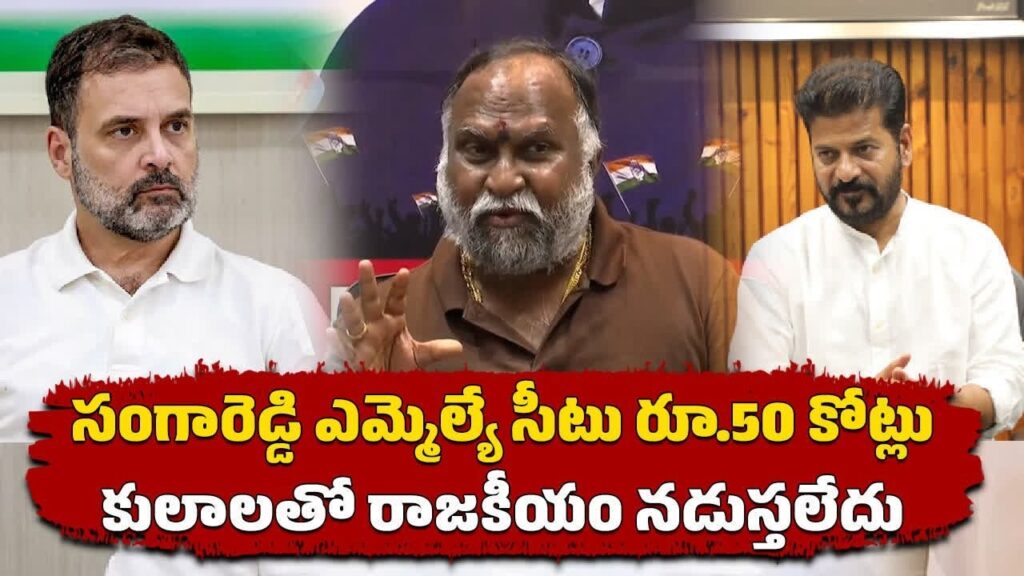
Jagga Reddy, a prominent leader from the Indian National Congress, recently made headlines with his bold and controversial statements regarding the financial landscape of politics in Telangana. According to Reddy, securing a seat as a Member of the Legislative Assembly (MLA) requires exorbitant sums of money—ranging from ₹50 crore to ₹100 crore, depending on the constituency. His remarks shed light on the increasing influence of wealth in Indian politics, raising questions about the integrity of democratic processes.

This article delves into the implications of Jagga Reddy’s comments, examines the broader issue of political funding in India, and explores how this controversy impacts public perception and the political future of the region.
Jagga Reddy’s Controversial Comments
The Statement on MLA Seat Costs
Jagga Reddy’s claim that winning an MLA seat in Telangana demands a massive financial investment shocked many but resonated with those aware of the growing cost of elections. According to his allegations, obtaining a ticket for the Sangareddy constituency, his own political turf, requires an outlay of ₹50 crore. For constituencies like Patancheru, the figure reportedly climbs to ₹100 crore.
Political Dynamics in Sangareddy
Sangareddy, an important political battleground, has long been a focal point for Congress in Telangana. Jagga Reddy’s public outburst reveals the undercurrents of financial strain politicians face while vying for power, indicating a deeper malaise within the political system that stretches beyond his individual case.
The Role of Money in Indian Politics
Political Corruption and Campaign Funding
The relationship between money and politics in India has always been a contentious issue. Campaigns increasingly rely on private donations, often leading to opaque financial practices. Jagga Reddy’s comments are a reflection of this reality—where electoral success is directly linked to one’s ability to mobilize vast sums of money. This creates a breeding ground for political corruption, as candidates often resort to unethical means to raise the necessary funds.
Historical Examples of High-Cost Elections
Historically, political funding in India has been a topic of concern. Elections in states like Tamil Nadu, Maharashtra, and Andhra Pradesh have been marred by scandals involving lavish spending. The 2014 and 2019 General Elections were among the costliest in the world, showcasing the extent of financial power in Indian politics.
Influence of Caste in Politics
Caste Politics in India
Caste has always played a pivotal role in Indian politics, especially in regions like Telangana. Traditionally, politicians have relied on caste-based support to secure votes. However, Jagga Reddy’s comments suggest a shift in focus—from caste-based politics to one driven by financial power.
Jagga Reddy’s Views on Caste and Money
In his statement, Reddy emphasized that political success is no longer driven by caste dynamics but by financial muscle. This assertion marks a significant departure from the caste-based narratives that have dominated Telangana politics for decades.
Impact on Public Perception
Public Reactions to Jagga Reddy’s Comments
The public response to Jagga Reddy’s remarks has been mixed. While some view his candidness as a much-needed exposure of the realities of modern politics, others criticize his comments as being indicative of the deeper issues plaguing Indian democracy.
Media Coverage and Its Role in Shaping Opinion
The media has played a critical role in amplifying Reddy’s comments, sparking a national conversation on the influence of money in politics. News channels and social media have been abuzz with debates on whether his statements reflect the truth or are an exaggerated depiction of political corruption.Political Repercussions for Congress
How the Controversy Affects Congress’s Image
For the Indian National Congress, already struggling to regain its foothold in Telangana, Jagga Reddy’s comments have come at a particularly sensitive time. His remarks may further alienate the party from voters, reinforcing the perception that Congress is out of touch with the realities of its constituents.
Internal Party Reactions
Within the Congress Party, Jagga Reddy’s remarks have sparked internal discussions. While some party members support his bold stance, others fear the controversy may harm their political prospects in future elections.
Expert Opinions on Political Funding
Insights from Political Analysts
Political analysts believe that Jagga Reddy’s comments, while controversial, highlight a growing concern about the role of money in elections. Experts argue that unless serious reforms are introduced, the influence of wealth will continue to undermine the democratic process.
The Broader Issue of Political Funding Reform
India’s political funding system is in dire need of reform. Experts suggest greater transparency in campaign donations and spending limits to curb the influence of money on political outcomes.
Future of Political Funding Reforms
Potential Reforms for Campaign Financing
As Jagga Reddy’s comments have reignited the debate over political funding, there are growing calls for reforms. Proposals include stricter laws on donation disclosures and public funding options for political campaigns to level the playing field.
Future Trends in Indian Politics
Looking ahead, political funding is likely to remain a contentious issue in Indian politics. With rising costs and increasing public scrutiny, parties may be forced to adopt more transparent practices, making reforms inevitable.
Conclusion
Jagga Reddy’s controversial remarks have opened up a Pandora’s box regarding the role of money in Indian politics. His allegations, though provocative, reflect a reality that many are aware of but seldom acknowledge publicly. As the political landscape in Telangana evolves, the discussion on electoral reforms and transparency will become increasingly critical for the health of India’s democracy.
In conclusion, while Jagga Reddy’s comments have caused a stir, they may also serve as a catalyst for much-needed reforms in India’s political funding system.