


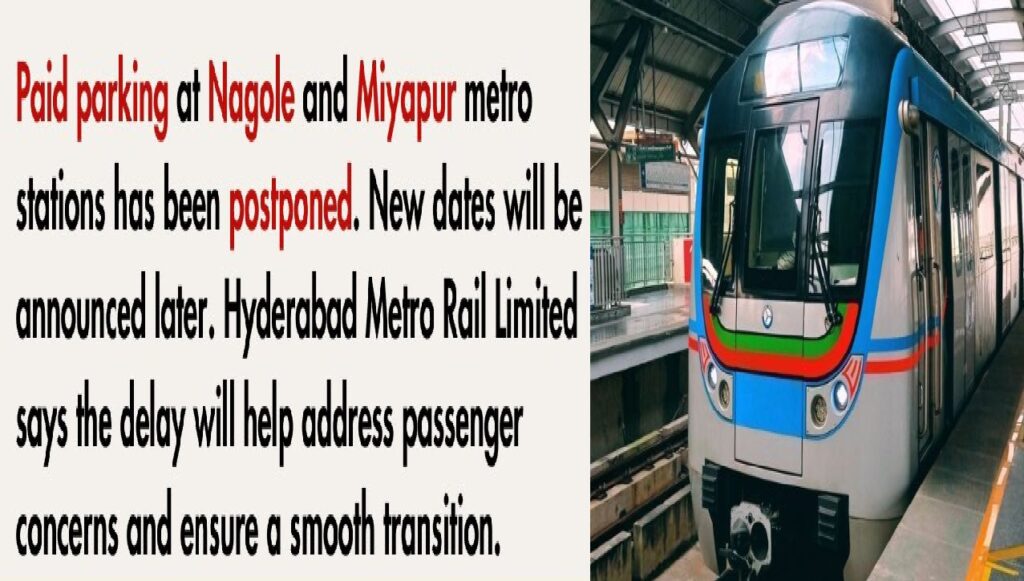
The Hyderabad Metro Rail authorities have recently made a significant decision that has captured the attention of commuters across the city. Plans to introduce paid parking at two major metro stations—Nagole and Miyapur—have been indefinitely postponed following strong opposition from the public. This article delves into the details of the withdrawn plan, the reasons behind the public’s discontent, and the potential implications for future transportation policies in Hyderabad.
Public Opposition Forces Hyderabad Metro to Reconsider Paid Parking
In an unexpected turn of events, the Hyderabad Metro Rail authorities have retracted their decision to implement paid parking at Nagole and Miyapur stations. Originally, the paid parking scheme was set to be rolled out at Nagole on August 25 and at Miyapur on September 1. However, following widespread public outrage, the authorities have decided to defer the implementation indefinitely.
The proposal to introduce paid parking was met with severe backlash from commuters who felt that the additional charge was unjustified. Many residents threatened to organize mass protests if the plan were to be implemented, arguing that it would add to the financial burden of daily commuters who already bear the cost of metro tickets.
The Reason Behind the Public Backlash
The public’s discontent primarily stems from concerns about the financial strain that paid parking would impose on regular metro users. The introduction of parking fees was seen as an additional burden on commuters who rely on the metro for their daily transportation. Many argued that the metro, which is a public service, should provide free or at least affordable parking options to encourage more people to use public transport, thereby reducing traffic congestion and pollution in the city.
Moreover, the lack of alternative parking options in the vicinity of these stations exacerbated the situation. Commuters expressed frustration over the limited parking spaces available, and the introduction of fees was perceived as an unfair move to capitalize on the already strained infrastructure.
Hyderabad Metro’s Official Statement and Future Plans
In response to the public outcry, the Hyderabad Metro Rail (HMR) issued a statement on Saturday, confirming that the paid parking plan had been deferred. The statement acknowledged the concerns raised by metro users and emphasized that the decision to postpone the implementation was made to ensure a smooth transition and to address the issues highlighted by the public.
“We are using this time to address the concerns of metro users and ensure a smooth transition,” the HMR notification stated. The authorities did not provide a new timeline for when the paid parking plan might be reconsidered, leaving the matter open-ended for now.
Implications for Future Transportation Policies
The decision to postpone the paid parking scheme has broader implications for future transportation policies in Hyderabad. The strong public response serves as a reminder to policymakers that any changes affecting daily commuters need to be carefully considered and communicated transparently.
This incident also highlights the importance of public involvement in decision-making processes, especially when it comes to policies that directly impact the lives of citizens. The authorities’ quick response to the backlash indicates a willingness to listen to the concerns of the public, which could set a positive precedent for future interactions between the government and the citizens.
What’s Next for Hyderabad Metro?
As the situation stands, paid parking at Nagole and Miyapur stations remains on hold. The Hyderabad Metro Rail authorities have not yet indicated when or if they will revisit the proposal. In the meantime, commuters can continue to park their vehicles for free at these stations.
The deferral of the paid parking plan provides an opportunity for the authorities to re-evaluate their approach. This could involve conducting public consultations, exploring alternative parking solutions, or even reconsidering the pricing structure to make it more palatable to the public.
Conclusion: A Victory for Public Opinion
The Hyderabad Metro’s decision to defer the paid parking plan is a clear victory for public opinion. It underscores the power of collective action and the importance of considering the needs and concerns of the public in policymaking. As Hyderabad continues to grow and develop, it is crucial that future transportation policies are designed with the best interests of the citizens in mind, ensuring that public services remain accessible and affordable for all.