


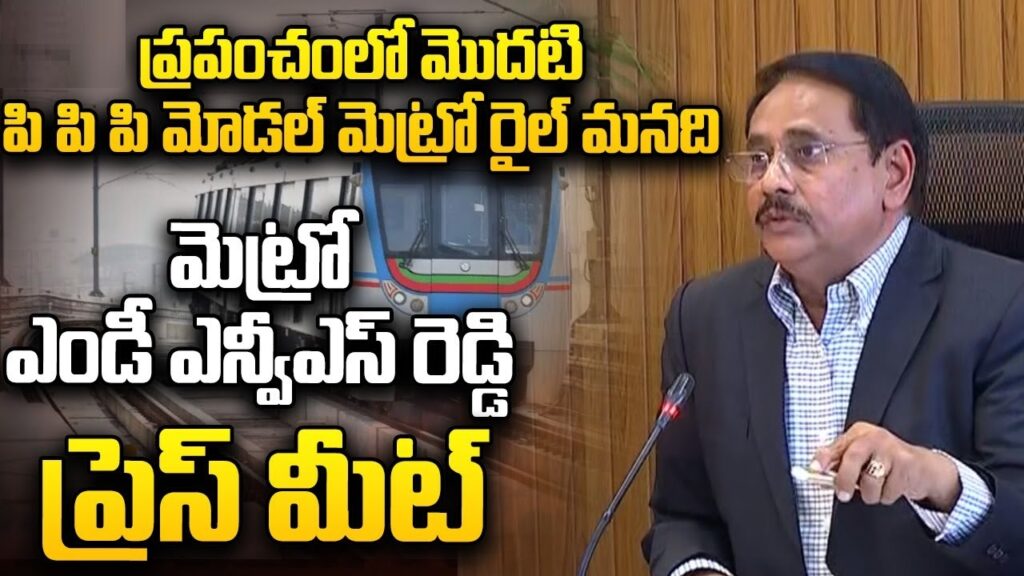
Hyderabad Metro 7 years of Success and Phase II Expansion, A Trail of Development and Further Prospects.
Hyderabad Metro Rail during the last seven years has brought a remarkable and priceless change in the urban commuting pattern as more than 63.4 crore has availed services of this system. According to Managing director of Hyderabad Metro Rail Limited (HMRL) NVS Reddy, the metro has not only eased means of transport but forged the city as well as state of Telangana into something to be proud of.
Nevertheless, in spite of all this achievement, in terms of progress the metro in Hyderabad has not expanded to the same extent as it did in the other metropolitan cities, Mumbai, Bengaluru and Chennai. Here’s an in-depth look at the current achievements and future plans for Hyderabad Metro Rail.
Looking back over the period of seven years of effectiveness, it can be regarded as a historic achievement for Hyderabad Metro.
Metro systems today have become an integral component of city fabric, and development authorities are undertaking to complete the first phase of the Hyderabad metro the mission of altering urban transportation within the country. The metro system which is executed on the principle of public private partnershiphas demonstrated to be an efficient, environmentally compatible and a convenient transport system.
NVS Reddy, who expressed his thoughts on this journey, narrated on the bureaucracy and console society which was encountered in its first stages. “During Phase I construction, they were against it but now the same people are the supporters,” he observed.
In the context of everyday life, the metro has revolutionized the way commuters transport themselves, since its establishment covering three corridors, by saving time, reducing the vehicles on the road and providing us with a safe means to travel in during the age of severe pollution.
Need for the Phase II Extension
Even though the Phase I was successful in its program, its applicability did not lead to an increase in the metro systems expansion within the City of Hyderabad over the next 10 years. This is in stark contrast with Mumbai, Bengaluru and, Chennai along with other Indian cities which are set to spend enormous amounts of money in the multicrore metro expansion plans. This has resulted in grave concerns of Hyderabad being an underperforming city in the development of mobility infrastructure.
This is where the proposed Phase II plans of Hyderabad Metro come into the picture. This includes the addition of six corridors which will be covering a distance of 116.4 kilometers with the idea of supplementing the old city with the integrated master plan of extending it towards Medchal and to other regions. It is worth mentioning that Detailed Project Reports (DPRs) for five corridors have already”.
Costing Aspects of Hyderabad Metro Rail Proj Get Best in Phase II
A remarkable feature of the Hyderabad Metro Phase II proposal is its efficacy in terms of costing. The construction cost estimates were pegged at approximately ₹318 crore over a kilometer which is significantly less competitive than other cities: Bengalu: 373 to 569 crore Channai: 619 to 756 crore Mumbsi: 543 to 1492 crore This cost reduction approach advocates smart planning and efficient use of resources and hence makes the proposal attractive to both state and central government agencies.
Faced with Continued Uncertainties on Begoining Works for Old City Metro
Metro expansion to the Old City of Hyderabad, a long sought after promise by the residents is one of the essential features of Phase II. The preliminary works are planned to commence on the 1st of January 2025 and intends starting with resettlement and utility shifting problems.
Reddy NVS pointed out that 1,100 properties in the old city may be impacted but we are working towards least disruption. It is pertinent to note that to enhance execution and planning the team is deploying higher order techniques like drone surveys and geo-technical surveys.
Reddy remarked ever with the legal and logistical challenges faced in Phase I, I suspected the second phase is bound to be trouble free because we will have already learnt from the past.
Government Aid and Review Sessions
Over the course of the past ten months, K. Chandrashekar Rao, the Chief Minister has held a set of ten review meetings to expedite the implementation of metro extension plans in the region. The priority has been to get certificates for commencement of work and starting activities as early as possible.
Taking into consideration the significance of the required action within a stipulated time horizon, the state has plans to undertake preliminary works in the Old City long before receiving actual approvals from the central government. This kind of approach indicates the level of seriousness that is associated with infrastructure expansion requirements.
A call for action: A comparison with other metros
When the hyderabad metro was launching one milestone after the other, there will be a need to examine its rate of growth relative to other cities opportunities. For instance:
Mumbai Metro: Well ambitions expansion plans are on top of the list amid massive investments.
Bengaluru Metro: Target operating a rapidly growing metro to a new scale at an increasing rate of funding.
Chennai Metro: Devised to fuse together the suburban rail and the metro rail.
It is rather disappointing to note that the rate of increase in the size of hyderabad metro has remained waning as a result, the city runs the risk of losing its competitive advantage as far as the provision of urban mobility is concerned. There is a need to hasten the Implementation of Phase II in order to restore Hyderabad to be among the best 5 cities in India with respect to the size of the metro.
Benefits and Future Scope of Work
The timely completion of the phase ii will definitely result in:
Increase the accessibility of several center points such as the Rajiv Gandhi International Airport.
Enhance the economic activities through the linkage of business centres.
Raise the realty price appreciation along the metro corridors.
Provide a permanent remedy to mounting traffic issues.
Conclusion: A Vision for Tomorrow
Hyderabad metro rail took roots as a new age public transport system in the city but the road is ahead is action oriented, well defined and government support for it is crucial. With the proposed Phase II, Hyderabad is likely to become model example of economic and extensive metro growth in the country.
As the city of Hyderabad gets expanded further, equally further the people’s intake on the metro system will also increase, otherwise the city will cease to be an advanced city, in worse being cliche, in better an obsolete.