


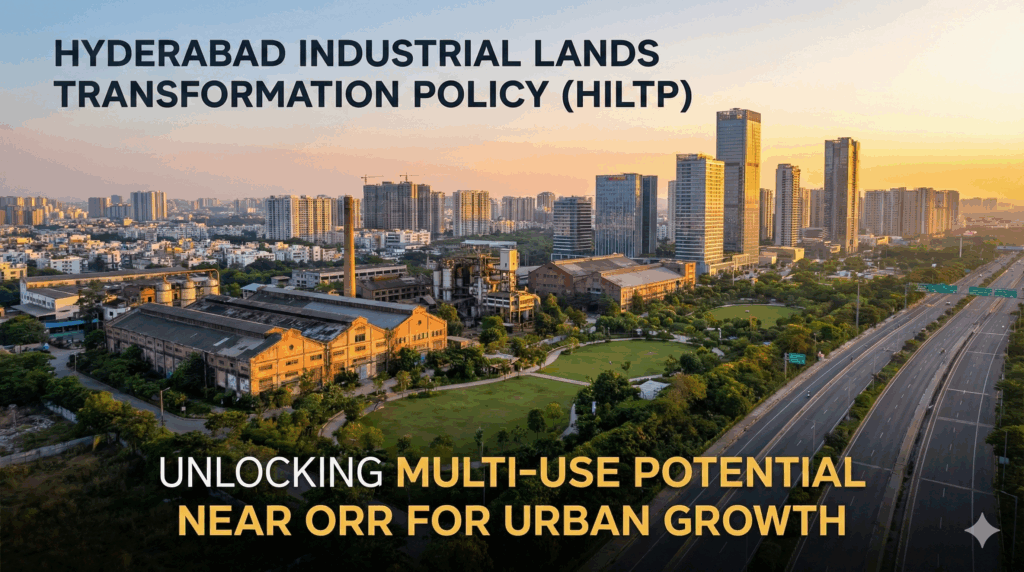
In the heart of Telangana’s booming economy, Hyderabad stands as a beacon of innovation and progress. The city’s rapid urbanization has reshaped skylines and sparked new opportunities, but it also poses challenges for legacy industrial zones. Enter the Hyderabad Industrial Lands Transformation Policy (HILTP)—a groundbreaking initiative approved by the Government of Telangana on November 22, 2025. This policy paves the way for converting approximately 9,292 acres of industrial land within and near the Outer Ring Road (ORR) into vibrant multi-use zones. With a plotted area spanning 4,740 acres, HILTP promises to blend industrial heritage with modern commercial, residential, and recreational spaces, fostering sustainable urban development.
Imagine transforming dusty factory floors into bustling tech hubs, luxury residences, and green parks—all while generating substantial revenue for infrastructure upgrades. HILTP doesn’t just rezone land; it revitalizes Hyderabad’s economic landscape. Developers, investors, and urban planners now have a clear, streamlined path to repurpose these assets. This article dives deep into the policy’s mechanics, benefits, application process, and long-term impacts, equipping you with everything you need to navigate this transformative opportunity.
Understanding the Hyderabad Industrial Lands Transformation Policy: A Catalyst for Urban Renewal
Hyderabad’s journey from a historic princely state to India’s IT powerhouse has been nothing short of spectacular. Yet, the city’s explosive growth has left behind a patchwork of industrial estates established 50-60 years ago. Areas like Balanagar, Kukatpally, and Uppal once buzzed with manufacturing activity, but evolving market demands call for adaptive reuse. The HILTP addresses this head-on, targeting industrial parks inside the ORR and select zones within 8 km of its periphery.
At its core, HILTP authorizes the shift from single-use industrial designations to multi-use zoning. This means landowners can now integrate offices, retail outlets, housing complexes, and even hospitality venues on the same plot. The policy covers 20 key industrial parks, totaling 9,292 acres, with a focus on those facing socio-economic and environmental pressures. For instance, the IDA Nacharam spans 700 acres, while the sprawling IDA Patancheru covers 1,188.82 acres—prime real estate ripe for reinvention.
What sets HILTP apart? It mandates a one-time Development Impact Fee (DIF), calculated as a percentage of the Standard Rate of Open (SRO) value. This fee ensures that transformations contribute fairly to public infrastructure, like enhanced roads and public transport. Plots facing roads narrower than 80 feet attract a 30% SRO fee, while those on wider 80-foot-plus corridors pay 50%. This tiered structure incentivizes strategic location-based planning, aligning private gains with public good.
The Telangana Industrial Infrastructure Corporation Limited (TGIIC)—formerly TGIIIC—serves as the nodal agency, streamlining approvals through the user-friendly TG-IPASS portal. This digital-first approach minimizes red tape, promising approvals in as little as 14 days. As Hyderabad eyes its place among global metropolises like Singapore and Dubai, HILTP emerges as a smart policy tool, blending economic vitality with inclusive growth.
Key Industrial Parks Targeted Under HILTP: Opportunities in ORR Proximity
The HILTP blueprint meticulously outlines 20 industrial parks eligible for conversion, each with unique potential. These zones, developed decades ago, now grapple with underutilization amid Hyderabad’s tech-driven boom. By repurposing them, the policy unlocks billions in investment and creates thousands of jobs.
Let’s spotlight a few standouts:
- IDA Nacharam: At 700 acres total (455 acres plotted), this park boasts an SRO value of ₹3,288.1 crore. Its central location near the airport makes it ideal for logistics-integrated commercial spaces. Developers could envision mixed-use towers housing co-working hubs and upscale apartments, capitalizing on the 21,000 sq.m. DIF potential.
- IP Mallapur: Covering 240 acres (156 plotted), with an SRO of ₹3,682.7 crore, Mallapur’s green buffer zones lend themselves to eco-friendly residential enclaves. The 14,700 sq.m. fee underscores its high-value transformation prospects.
- IP Cherlapally: This 762-acre behemoth (495.3 plotted) holds an SRO of ₹6,639.8 crore. Proximity to tech corridors positions it for innovation districts, blending R&D labs with vibrant retail strips.
Smaller gems like IP Kukatpally (20.47 acres) and IP Jeedimetla (980 acres) offer niche opportunities. The former, with its compact 13.31 plotted acres, suits boutique commercial revamps, while Jeedimetla’s scale supports large-scale urban villages. Collectively, these parks represent a ₹54,340 crore SRO windfall, with DIF revenues projected at ₹12,200 crore—fuel for Hyderabad’s next growth phase.
TGIIC’s data reveals plotted areas totaling 4,740 acres, emphasizing efficiency. Landowners here gain flexibility to lease or develop sub-parcels, attracting global players in real estate and F&B. As ORR encircles the city like a lifeline, these conversions will decongest inner roads and amplify connectivity via metro expansions.
The Development Impact Fee: Balancing Growth and Infrastructure Funding
Central to HILTP’s success is the Development Impact Fee—a one-time levy that captures the uplift in land value from rezoning. Unlike ad-hoc charges, this fee follows a transparent formula: 30% or 50% of SRO, depending on road frontage. Why this bifurcation? Narrower roads (under 80 feet) face less traffic strain, warranting a lighter 30% hit, while arterial 80-foot avenues justify 50% to offset heightened infrastructure demands.
Picture a 10-acre plot in Balanagar IP, SRO-valued at ₹516.2 crore. A 50% DIF translates to ₹258.1 crore—funds earmarked for road widening, stormwater drains, and green corridors. This mechanism ensures that private windfalls subsidize public upgrades, preventing the urban decay seen in other Indian cities.
Revenue streams flow strategically: Statutory portions remit to HMDA/MAUD for land conversion oversight. TGIIC retains 25% in a dedicated account for targeted infrastructure, like ORR flyovers or smart lighting. The balance bolsters state coffers, strengthening fiscal resilience. Early estimates peg total DIF collections at over ₹12,000 crore, a boon for Telangana’s Vision 2050 blueprint.
Critics might decry the fees as burdensome, but proponents highlight their equity. Smallholders benefit from phased payments—20% upfront via TG-IPASS, 80% in two 45-day installments. A one-month grace period mitigates delays, with 1% monthly penalties thereafter. Exceed that, and the application forfeits, underscoring the policy’s urgency.
In essence, the DIF isn’t a tax; it’s an investment pact. It transforms raw revenue into tangible assets, ensuring Hyderabad’s multi-use zones thrive without straining taxpayers.
Streamlined Application Process: From TG-IPASS Filing to Swift Approvals
Gone are the days of bureaucratic mazes. HILTP champions efficiency, leveraging TG-IPASS as a single-window portal for submissions. Applicants—be they industrialists or REITs—initiate conversions online, uploading plot details, environmental clearances, and layout revisions. TGIIC’s Industrial Area Layout Approvals (IALA) wing conducts initial scrutiny within seven days, flagging gaps or endorsing proceeds.
Post-scrutiny, the Vice Chairman & Managing Director (VC&MD), alongside Industries & Commerce Secretary, reviews within another seven days. Approvals cascade digitally, with demand notices auto-generated. This 14-day timeline rivals global benchmarks, slashing approval waits from months to mere weeks.
For plot-specific tweaks, TGIIC mandates revised layouts compliant with HMDA norms. Environmental nods from TSPCB fast-track via integrated checks, minimizing overlaps. Once greenlit, unit holders access the grace period for payments, securing their multi-use entitlements.
A sunset clause adds tempo: All applications must file within six months of the November 22, 2025, gazette. This deadline spurs action, preventing policy drift. TGIIC, as nodal custodian, oversees compliance, with HMDA auditing land-use shifts. Developers praise the transparency—real-time dashboards track status, fostering trust.
Success stories already emerge. A Kukatpally plot owner, filing Day 1, secured approval by Week 3, pivoting from idle warehouses to a 500-unit residential project. Such velocity positions Hyderabad as an investor magnet, outpacing rivals like Bengaluru.
Financial Implications and Revenue Revolution Under HILTP
HILTP’s fiscal blueprint is a masterstroke, channeling DIF into a triple-pronged revenue engine. First, statutory fees fortify HMDA/MAUD’s coffers for urban planning. Second, TGIIC’s 25% slice funds park-specific upgrades—think solar-powered facades in Uppal or EV charging grids in Medchal. Third, the Treasury balance amplifies state-wide initiatives, from skill academies to flood-resilient infrastructure.
Projected inflows? A staggering ₹12,200 crore from the 20 parks, with IDA Nacharam alone contributing ₹2,100 crore. This non-tax bonanza eases budget pressures, enabling debt-free expansions. Transparency reigns: Funds allocate via audited accounts, with annual reports to the legislature.
For applicants, costs are front-loaded but manageable. The 20% upfront secures slotting, while installments align with financing cycles. Penalties deter dawdlers, but the grace month offers breathing room. Post-conversion, enhanced land values—potentially doubling SROs—yield ROI within 3-5 years via rentals or sales.
Economists forecast ripple effects: 50,000 direct jobs in construction, 1 lakh in ancillary services. Multi-use zones could spike GDP by 2-3% annually, drawing FDI from Singapore’s GIC or Qatar’s sovereign funds. HILTP isn’t just policy; it’s a fiscal accelerator, propelling Telangana toward a $1 trillion economy.
Environmental and Social Safeguards: Sustainable Multi-Use Zones in ORR
Sustainability threads through HILTP’s fabric. Conversions demand green building certifications—LEED or GRIHA—ensuring 30% open spaces and rainwater harvesting. TGIIC enforces buffer zones around water bodies, mitigating pollution legacies from industrial eras.
Social equity shines too. 10% of repurposed plots reserve for affordable housing, targeting EWS segments. Skill upgradation programs, funded by DIF, retrain factory workers for service roles. Women-led enterprises gain priority in retail allocations, fostering inclusivity.
Near-ORR zones like Ramachandrapuram ALE (25.27 acres) exemplify eco-blends: Vertical farms atop offices, pedestrian-friendly streets. This holistic approach curbs sprawl, preserving Hyderabad’s lung spaces like KBR Park.
Challenges persist—eviction risks for legacy tenants—but HILTP’s phased relocations and compensation clauses soften blows. Overall, it models resilient urbanism, where growth harmonizes with nature.
Economic Boost: How HILTP Fuels Hyderabad’s Multi-Use Zone Boom
Hyderabad’s ORR corridor pulses with potential. HILTP ignites it, converting moribund parks into economic dynamos. Tech giants like Google and Amazon eye mixed-use pads for employee housing; hospitality chains scout Jeedimetla for convention centers.
Property markets surge: Pre-policy, Balanagar plots idled at ₹5 crore/acre; post-HILTP, projections hit ₹15 crore, driven by premium zoning. Retail voids fill with malls, boosting footfall by 40%. Residential influx—targeting 2 million sq.ft.—eases CBD pressures.
Job creation cascades: Construction peaks at 20,000 roles/year; operations sustain 1.5 lakh positions in ITES, F&B, and logistics. MSMEs thrive via plug-and-play spaces, with TGIIC incubators nurturing startups.
Broader impacts? Enhanced tax bases from commercial levies; tourism upticks via themed districts. As ORR integrates with NH-44, logistics efficiencies cut costs by 15%, luring manufacturers back. HILTP cements Hyderabad’s alpha-city status, rivaling Mumbai’s Bandra-Kurla Complex.
Navigating Challenges: Potential Hurdles and Mitigation Strategies
No policy is flawless. HILTP faces scrutiny over fee steepness—50% SRO could deter SMEs. Mitigation? Tiered rebates for green projects or job-pledges. Implementation lags risk bottlenecks; TGIIC counters with AI-driven queues.
Litigation looms from holdouts, but single-window dispute cells expedite resolutions. Equity gaps—urban bias over rural—prompt complementary policies like rural industrial parks.
Stakeholder buy-in proves pivotal. Town halls and webinars demystify processes, while TGIIC’s helpline (1800-XXX-XXXX) offers guidance. Early adopters, like a Gandhinagar CIE developer flipping to edutainment hubs, showcase wins, inspiring peers.
Future Outlook: HILTP’s Role in Telangana’s Urban Vision 2050
As the six-month window ticks, HILTP heralds a new era. By 2030, multi-use zones could house 500,000 residents, host 1,000 enterprises, and generate ₹50,000 crore in economic value. TGIIC’s operational guidelines, due Q1 2026, will refine mechanics, incorporating feedback.
Synergies with TS-iPASS 2.0 amplify ease, while HMDA’s master plan weaves HILTP into fabric. Globally, it mirrors Shenzhen’s SEZ evolutions, positioning Hyderabad for unicorn spawns.
Investors, act now: Scout parks via TGIIC’s GIS portal; model DIF via calculators. Policymakers, scale successes to Vizag or Warangal. For Hyderabad, HILTP isn’t reform—it’s renaissance.
In closing, the Hyderabad Industrial Lands Transformation Policy empowers visionaries to sculpt tomorrow’s cityscape. With disciplined execution, it will etch Telangana’s name in urban innovation annals. Ready to transform? The ORR awaits.