


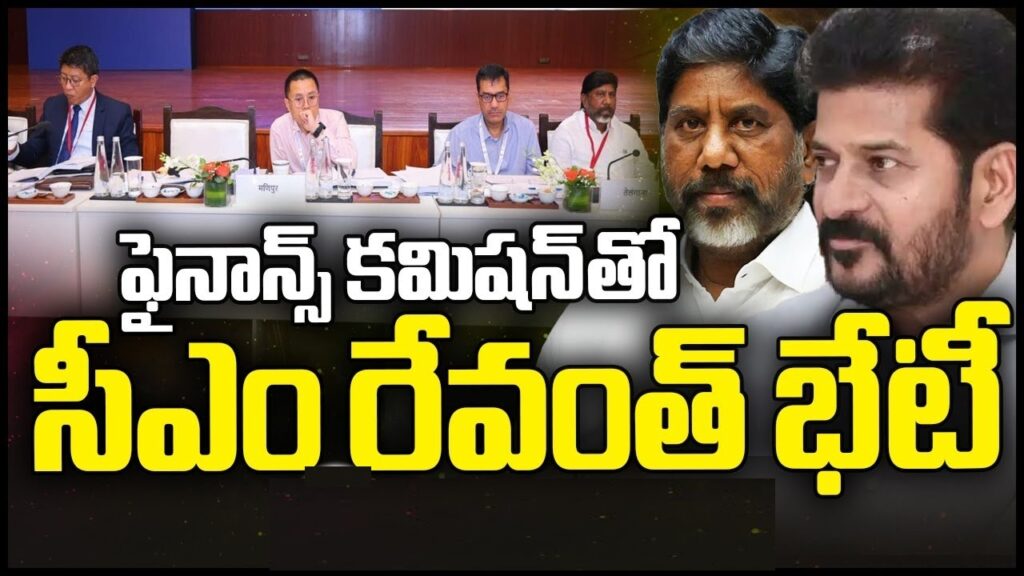
The latest Finance Commission meeting focused on the allocation of central funds to the states, particularly Telangana. The Chief Minister of Telangana, Revanth Reddy, alongside Deputy Chief Minister Bhatti Vikramarka and other senior state officials, engaged in crucial discussions with the Finance Commission team. The primary objective was to secure increased funding from the central government to support ongoing developmental activities in the state. Let’s delve into the key aspects discussed during this meeting.
1. Increased Fund Allocation from the Centre
The Telangana government has been emphasizing the need for an increase in the funds allocated by the central government. Currently, 41% of the taxes collected by the central government are distributed to the states. The Telangana government, however, has requested an increase in this share to 50%. This demand stems from the state’s growing developmental needs and the requirement for greater financial support to carry out its welfare programs.
The state officials highlighted the discrepancy in the current allocation, noting that despite the 41% allocation, Telangana has not been receiving the full share as expected. The state is pushing for a re-evaluation of this percentage to better meet its financial requirements and ensure that its developmental goals are met efficiently.
2. Focus on Developmental Programs
Telangana’s government has been pushing for the central government to allocate funds with a focus on development. Major ongoing developmental projects in the state have been impacted by the limited funds. Telangana is looking to prioritize various initiatives, such as improving infrastructure, agricultural support, and welfare schemes for the population.
In light of these pressing needs, the Chief Minister underscored that funds should not be allocated based solely on population figures. Instead, the central government should consider the specific requirements and current situation in each state, especially those facing challenges like Telangana, which recently suffered massive losses due to heavy rains. The state estimates the damages to exceed ₹5,000 crore, further stressing the urgency for financial support.
3. Tax Revenue and Changes in Fiscal Policy
Another critical discussion point revolved around changes in tax revenue allocation. Telangana has urged for reforms in the way tax revenues are distributed among the states. The current system, while functional, does not take into account the evolving economic landscape and the unique challenges faced by different states.
Chief Minister Revanth Reddy proposed reforms to the tax structure that would give states more flexibility in utilizing the funds. The state’s request included a focus on local development, urging the central government to allocate funds that align with Telangana’s economic priorities, particularly in agriculture and welfare sectors.
4. Relief for Farmers: Loan Waivers and Welfare Schemes
One of the central pillars of Telangana’s economy is agriculture, and as such, the state’s government has implemented numerous farmer welfare schemes. The most prominent is the Rythu Bandhu (Farmer’s Assurance) program, which provides financial assistance to farmers. Additionally, loan waivers have been a crucial component of the state’s farmer support policy.
During the Finance Commission meeting, Telangana requested additional funds to bolster these schemes and expand their reach. The state argued that supporting farmers is vital for maintaining the economic balance, particularly after the recent devastation caused by floods. Providing financial security to farmers is seen as essential in preventing an economic downturn in rural areas.
5. Central Government Welfare Schemes and State Priorities
The central government has its welfare programs, some of which have been successfully implemented across various states. However, Telangana raised concerns over the compatibility of these schemes with the state’s priorities and needs. Some centrally sponsored schemes may not align with the local requirements of Telangana, thus causing implementation challenges.
Telangana has called for greater autonomy in choosing which schemes to implement, advocating for a system that allows states to opt for the most relevant programs. The state also requested additional funds to adapt central schemes to better serve the specific needs of its population. This would ensure that welfare programs, whether state-run or centrally sponsored, are better tailored to the people’s needs.
6. Demand for an Equitable Share of Cess and Surcharges
A significant part of the discussion revolved around the distribution of cess and surcharge revenues collected by the central government. Currently, a large portion of these revenues is retained by the centre, with only a small fraction being shared with the states. Telangana argued for a more equitable distribution of these funds.
The state believes that a fair share of cess and surcharge revenues would provide much-needed financial relief. These funds could then be utilized for developmental programs and infrastructure projects, enabling the state to achieve its growth targets.
7. Addressing Natural Disasters and Emergency Funds
Recent natural disasters, particularly the heavy rains and subsequent flooding in Telangana, have exacerbated the state’s financial woes. The state government has estimated that the damages exceed ₹5,000 crore, and relief efforts are underway. However, the scale of the disaster has overwhelmed local resources, and the state is seeking additional support from the central government.
During the meeting, the state government highlighted the need for an emergency fund or disaster relief allocation to help states cope with such unforeseen challenges. This fund would allow for quicker and more effective disaster response and recovery efforts, preventing long-term economic damage.
8. Conclusion: The Path Forward for Telangana’s Development
The Finance Commission meeting between Telangana’s government and central officials centered on the state’s demand for a larger share of central funds, reforms in the fiscal policy, and relief for sectors like agriculture. The discussions underscored the pressing financial needs of Telangana, particularly in the wake of recent natural disasters.
Telangana’s government, led by Chief Minister Revanth Reddy, made a strong case for increased financial support from the central government, not just for the state’s current developmental projects but also to ensure long-term economic stability. The state’s push for a 50% tax share allocation and greater flexibility in utilizing central funds reflects a forward-looking approach aimed at balancing immediate needs with sustainable growth.
In the coming weeks, the decisions made during this meeting will be critical in shaping Telangana’s financial future, helping the state tackle its current challenges and achieve its ambitious developmental goals.