


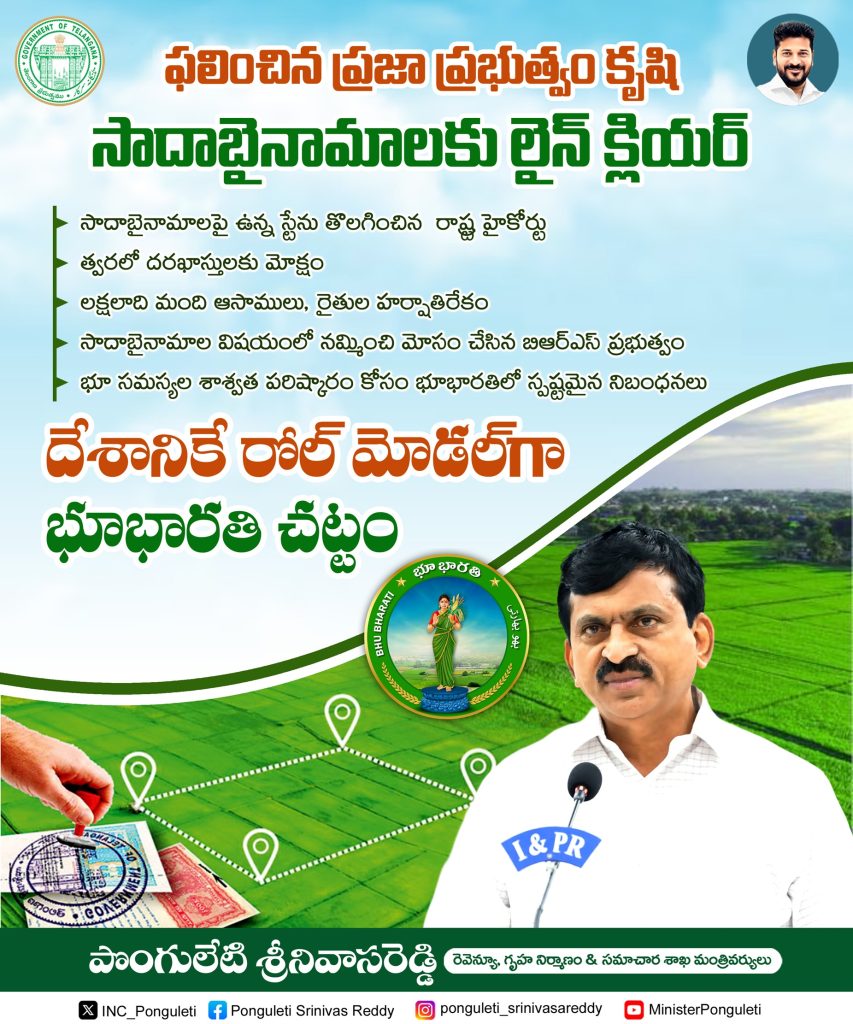
The recent notification by the Telangana government in September 2025, allowing the processing of Sadabainama land regularisation applications under the Bhu Bharati Act, represents one of the most significant land reform initiatives in the state’s history. This groundbreaking development promises to benefit nearly 10 lakh farmers who have been waiting for legal recognition of their agricultural land ownership for over five years. The notification, issued following favorable High Court orders, marks the end of a complex legal and administrative journey that began with the contentious Dharani Act of 2020 and culminated in comprehensive land rights recognition under the new legislative framework.


Timeline of Major Events in Telangana Sadabainama Land Regularisation (2014-2025)
Understanding Sadabainama: The Foundation of Rural Land Transactions
The Cultural and Economic Significance
Sadabainama, literally meaning “plain agreement” in Urdu, represents a deeply entrenched practice in rural Telangana’s agricultural economy. These transactions involve the purchase and sale of agricultural land through simple, unregistered agreements written on white paper or bond paper, often without formal registration or government documentation. This practice evolved as a practical solution to the complex and expensive formal land registration processes that many small and marginal farmers could not afford or navigate.
The prevalence of Sadabainama transactions stems from several socio-economic factors unique to Telangana’s rural landscape. First, the prohibitive costs associated with formal land registration, including stamp duty and registration fees, made such transactions financially unviable for small farmers dealing with parcels of 1-2 acres. Second, the cumbersome bureaucratic processes often required multiple visits to district headquarters, causing significant loss of income for daily wage laborers. Third, the historical informality of rural land markets, where community trust and local relationships often superseded legal documentation, made white paper agreements socially acceptable and practically effective.
Research indicates that approximately 18 lakh acres of agricultural land in Telangana involved some form of unregistered transactions, highlighting the massive scale of this informal land market. The economic implications are staggering, with estimates suggesting that over ₹50,000 crore worth of agricultural assets remained outside the formal land records system prior to regularisation efforts.
Legal Recognition Challenges
The absence of legal recognition for Sadabainama transactions created a cascade of problems for farmers. Without proper documentation in government records, farmers could not access institutional credit, crop insurance, government welfare schemes, or sell their land through formal channels. This exclusion from the formal economy perpetuated rural poverty and prevented agricultural modernization.
The situation became particularly acute with the introduction of the Rythu Bandhu scheme in 2018, which provided direct cash transfers to farmers. Only those with valid pattadar passbooks—official land ownership documents—were eligible for the scheme. This exclusion affected lakhs of farmers who, despite possessing and cultivating their land for decades, remained ineligible due to documentation gaps.


A farmer standing amidst healthy crops in a rural Telangana field, representing small and marginal farmers benefiting from agricultural welfare schemes indiafilings
The Complex Legal and Policy Evolution
The Rights in Land Act Foundation (1971)
The Telangana Rights in Land and Pattadar Passbooks Act of 1971 provided the original legal framework for land records management in the state. Section 5-A of this Act specifically addressed the regularisation of unregistered transfers and alienations, providing a mechanism through which Sadabainama transactions could be legitimized through the issuance of 13-B certificates.
Under the 1971 Act, the government successfully conducted the first phase of Sadabainama regularisation in 2016. This initiative processed 12.64 lakh applications and resulted in 6 lakh farmers receiving 13-B proceedings and pattadar passbooks. The success of this first phase demonstrated both the massive demand for regularisation and the feasibility of integrating informal land transactions into formal records.
The 1971 Act’s approach was comprehensive, requiring proof of continuous possession for at least 12 years, evidence of the original transaction, and verification through local revenue officials. The process included field verification, public notifications for objections, and final approval through Tahsildar-level authorities. This multi-layered verification ensured the authenticity of claims while providing legal protection against fraudulent applications.
The Dharani Act Disruption (2020)
The introduction of the Telangana Rights in Land and Pattadar Passbooks Act of 2020, commonly known as the Dharani Act, represented a fundamental shift in land records management. While the Act aimed to digitize land records and eliminate corruption through the Dharani portal, it inadvertently created significant challenges for Sadabainama regularisation.
The Dharani Act replaced the 1971 legislation but critically omitted provisions for regularising unregistered transactions. This oversight effectively blocked the continuation of Sadabainama regularisation efforts that had been ongoing since the first successful phase in 2016. The Act’s digital-first approach, while innovative, failed to account for the massive informal land economy that had developed over decades.
The problems compounded when the BRS government, responding to persistent farmer demands, issued Government Order (GO) 112 on October 12, 2020, inviting fresh applications for Sadabainama regularisation. The government received over 9 lakh applications between October 12 and November 10, 2020, but the lack of legal provisions in the Dharani Act to process these applications created an unprecedented administrative and legal crisis.

Key Statistics of Sadabainama Land Regularisation in Telangana (Applications and Beneficiaries)
The High Court Intervention and Legal Limbo
The legal complications reached a crescendo when Shinde Devidas of Nirmal district filed a public interest litigation challenging GO 112, arguing that the government could not accept applications under the old ROR Act after the Dharani Act had come into force. The Telangana High Court, recognizing the legal inconsistency, imposed an interim stay on November 11, 2020, effectively freezing the processing of 6.74 lakh applications that were filed after October 29, 2020.
This judicial intervention created a five-year period of uncertainty for nearly 10 lakh farmers who had applied for regularisation. The legal limbo was particularly painful because these farmers had legitimate expectations of regularisation based on government announcements, but found themselves trapped between conflicting legal frameworks.
The High Court’s stay orders revealed fundamental issues with the Dharani Act’s implementation. Revenue officials reported that approximately 18 lakh acres of agricultural land were classified under “Part B” of the new land records, indicating disputed or problematic ownership status. This classification effectively prohibited any transactions on these lands, creating additional hardships for farmers who could neither sell their property nor access government benefits.

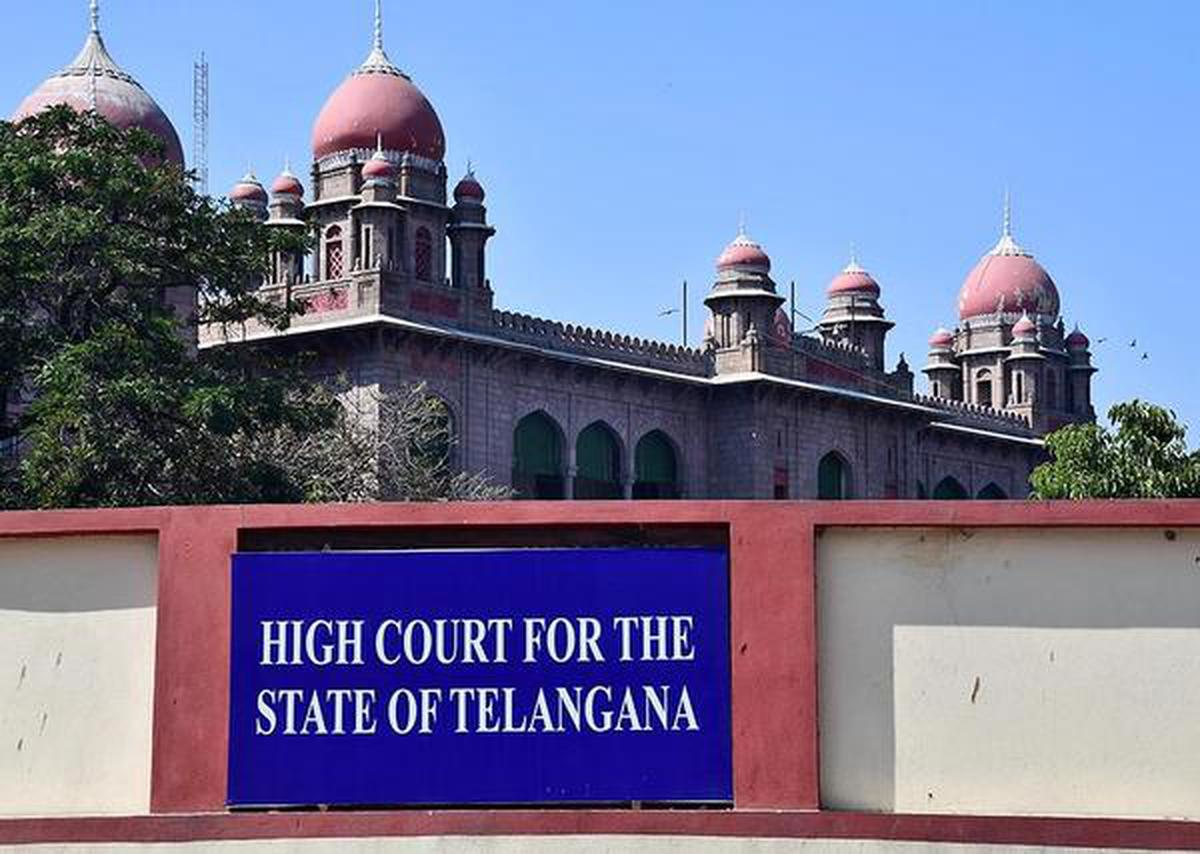
The Telangana High Court building, central to legal rulings on land regularisation in Telangana english.rtvlive
The Bhu Bharati Act: A Comprehensive Solution (2025)
Legal Framework and Provisions
The enactment of the Telangana Bhu Bharati (Record of Rights in Land) Act in January 2025 marked a turning point in addressing the Sadabainama crisis. The Act, designated as Act No. 1 of 2025, represented a careful balance between digital innovation and practical recognition of existing ground realities in rural land ownership.
Section 6 of the Bhu Bharati Act specifically provides for the regularisation of unregistered land transactions, restoring the legal pathway that had been eliminated by the Dharani Act. The provision states that the government can issue certificates validating transfers or alienations made by small or marginal farmers through unregistered documents, provided specific conditions are met.
The Act introduces several innovative features, including the Bhudhaar system—a unique land parcel identification system that provides both temporary and permanent identifiers for land parcels. This system enables better tracking and management of land records while maintaining the flexibility needed for regularisation processes.
Eligibility Criteria and Implementation Framework
The current notification establishes clear eligibility criteria that balance the need for regularisation with safeguards against fraud. Key requirements include land acquisition before June 2, 2014, continuous possession for more than 12 years, and submission of applications between October 12 and November 10, 2020.
The geographic limitations are significant, excluding HMDA (Hyderabad Metropolitan Development Authority) areas, municipal corporations, and municipalities, while making exceptions for certain notified mandals. This exclusion acknowledges the different dynamics of urban versus rural land markets and focuses regularisation efforts where they are most needed.
The financial benefits are substantial for eligible farmers. Small and marginal farmers with up to 5 acres receive complete exemption from stamp duty and registration fees, while larger landowners must pay applicable charges. This progressive fee structure ensures that the scheme primarily benefits those who need it most while generating revenue from larger transactions.
Benefits and Impact Assessment
Direct Economic Benefits for Farmers
The regularisation process delivers multiple layers of economic benefits to farmers. The most immediate advantage is legal recognition of land ownership through the issuance of pattadar passbooks, which serve as conclusive proof of ownership rights. This documentation enables farmers to access institutional credit from banks and cooperative societies, often for the first time in their lives.
Access to government welfare schemes represents another critical benefit. Farmers with regularised land become eligible for the Rythu Bandhu scheme, which provides ₹10,000 per acre annually (₹5,000 per crop season). For a farmer with 3 acres, this translates to ₹30,000 in annual direct benefit transfers, significantly improving household income and agricultural investment capacity.
The ability to participate in crop insurance schemes provides crucial risk mitigation for farmers. The Rythu Bima program, available only to farmers with proper land documentation, offers compensation for crop losses due to natural calamities, pest attacks, and other unforeseen circumstances. This insurance coverage can be life-saving for small farmers who lack the financial resilience to absorb agricultural losses.
Reduction in Land Disputes and Legal Clarity
One of the most significant long-term benefits of regularisation is the dramatic reduction in land disputes through the issuance of 13-B proceedings. These legal certificates provide conclusive evidence of ownership transfers, eliminating the ambiguity that often led to protracted legal battles between buyers, sellers, and their descendants.
The economic costs of land disputes in rural areas are enormous, often involving legal fees that exceed the value of the disputed land. Families frequently spend decades in litigation, draining resources that could otherwise be invested in agricultural productivity or education. The regularisation process effectively prevents such disputes by providing clear, government-validated ownership records.
The psychological relief for farmers cannot be understated. Many farmers who had lived with the constant fear of losing their land due to documentation issues now have legal security. This confidence encourages long-term investments in land improvement, such as soil conservation, irrigation infrastructure, and permanent crops that require multi-year commitments.
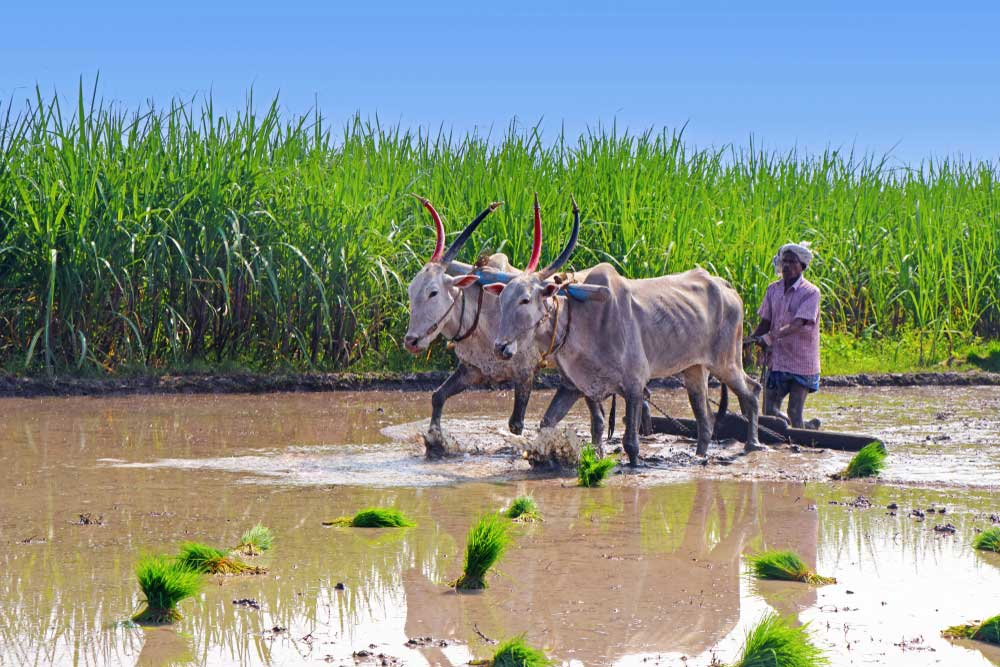
A small farmer in Telangana plows a paddy field using oxen, illustrating traditional agricultural practices in rural villages telegraphindia
Broader Economic and Social Impact
The regularisation initiative is expected to have significant macroeconomic effects on Telangana’s rural economy. By bringing nearly 11 lakh acres of agricultural land into the formal economy, the state gains better data on agricultural productivity, land use patterns, and farmer profiles. This information is crucial for evidence-based policy making and targeted intervention programs.
The formalization of land ownership facilitates agricultural modernization through improved access to credit and technology. Banks and financial institutions are more willing to provide agricultural loans against formally documented land, enabling farmers to invest in mechanization, improved seeds, fertilizers, and modern farming techniques. This technological adoption can significantly boost agricultural productivity and farmer incomes.
The social impact extends beyond immediate economic benefits. Children of regularised farmers often gain improved access to educational opportunities as families have more financial stability and can use land documents as collateral for educational loans. Women farmers, who constitute a significant portion of agricultural workers, particularly benefit as many Sadabainama transactions involved women buyers who previously lacked formal recognition.
Implementation Challenges and Mitigation Strategies
Documentation and Verification Complexities
The implementation of Sadabainama regularisation faces significant challenges in documentation and verification. Many of the original white paper agreements are decades old, with some dating back to the 1990s. The paper quality, storage conditions, and legibility of these documents vary significantly, requiring revenue officials to develop specialized expertise in document authentication.
The verification of 12-year continuous possession presents another complex challenge. Revenue officials must rely on a combination of revenue records, witness testimonies, agricultural input purchase receipts, and other circumstantial evidence to establish possession. In cases where original sellers are deceased or untraceable, the verification becomes even more complicated, requiring extensive field investigations.
The government has established multiple verification checkpoints to address these challenges. Initial document scrutiny occurs at the MeeSeva center level, followed by field verification by Village Revenue Officers (VROs) or their replacements, the Grama Paripalana Officers (GPOs). The final approval rests with Tahsildar-level officials who have the authority to evaluate evidence and make determinations on contested cases.
Preventing Fraudulent Claims and Misuse
The regularisation process must balance accessibility with fraud prevention. The massive scale of the program—potentially affecting 10 lakh farmers—creates opportunities for fraudulent claims that could undermine the entire initiative. Revenue officials have reported instances where individuals attempt to regularise land that was never actually purchased or where possession claims are fabricated.
To combat fraud, the government has implemented multi-stage verification processes. Public notifications are issued at the village level for each application, allowing community members to raise objections. GPS-based field surveys help verify the exact location and boundaries of claimed land. Cross-referencing with existing revenue records helps identify inconsistencies or overlapping claims.
The involvement of local communities in the verification process serves as an additional safeguard. Village elders, neighbors, and local agricultural workers often have intimate knowledge of land ownership patterns spanning decades. Their testimonies, when properly documented, provide valuable verification support while also ensuring community buy-in for the regularisation decisions.
Administrative Capacity and Resource Allocation
The sheer scale of processing nearly 10 lakh applications within a reasonable timeframe presents significant administrative challenges. Each application requires multiple levels of verification, field visits, documentation review, and final approval processes. With limited revenue staff at the district and mandal levels, ensuring timely processing without compromising quality is a major challenge.
The government has responded by appointing Grama Paripalana Officers (GPOs) to replace the abolished VRO system. These officers, numbering over 10,000 across the state, are specifically trained in land records management and Sadabainama regularisation procedures. Their village-level presence enables more efficient field verification and reduces the burden on higher-level officials.
Technology integration through the Bhu Bharati portal aims to streamline the application processing workflow. Digital tracking systems allow applicants to monitor their application status while providing administrators with real-time data on processing bottlenecks. However, the success of these technological solutions depends on adequate training for revenue staff and reliable internet connectivity in rural areas.
Future Implications and Policy Recommendations
Preventing Future Sadabainama Accumulation
While the current regularisation addresses historical issues, preventing the future accumulation of unregistered land transactions requires systemic reforms in land registration processes. The high costs and complex procedures that originally drove farmers to Sadabainama transactions must be addressed to ensure that future land sales occur through formal channels.
Recommendations include subsidized registration for small farmers, simplified documentation requirements, and mobile registration services that bring government offices closer to rural communities. The success of such reforms will determine whether the current regularisation represents a one-time correction or part of an ongoing cycle of informal land markets.
The integration of digital technologies in land registration offers promising solutions. Online application systems, digital document storage, and automated fee calculation can significantly reduce the time and cost associated with formal registration. However, these solutions must account for the digital literacy limitations in rural areas and ensure that technology enhances rather than complicates access to services
Broader Land Reform Implications
The Sadabainama regularisation represents part of a broader trend toward recognizing informal property rights across India. Similar issues exist in other states with significant agricultural populations, and the Telangana model may provide a template for addressing these challenges elsewhere
The success or failure of the current initiative will influence future policy approaches to land rights recognition. If implementation proceeds smoothly and delivers promised benefits to farmers, it may encourage other states to adopt similar regularisation programs. Conversely, significant implementation problems could discourage such initiatives and reinforce preferences for strict formal property systems.
The experience also provides valuable insights into the relationship between digitalization and informal property rights. The Dharani Act’s failure to account for existing informal arrangements highlights the importance of comprehensive consultation and phased implementation when introducing new technological systems in complex social environments.
Conclusion: A Historic Opportunity for Rural Transformation
The September 2025 notification allowing Sadabainama land regularisation represents more than a technical administrative process—it embodies recognition of the complex realities of rural land ownership and the state’s commitment to inclusive development. The journey from the initial Dharani Act complications through High Court challenges to the current Bhu Bharati Act solution demonstrates the importance of adaptive governance that responds to ground-level realities rather than imposing top-down technological solutions.
For the nearly 10 lakh farmers awaiting regularisation, this development offers hope for economic security, social dignity, and participation in formal development programs. The potential impact extends beyond individual families to encompass entire rural communities that will benefit from increased economic activity, reduced litigation, and improved access to credit and markets.
The success of this initiative depends critically on effective implementation, adequate administrative capacity, and continued political commitment across government changes. Farmers who have waited five years for resolution deserve efficient, transparent, and fair processing of their applications. The government’s ability to deliver on these expectations will determine whether this regularisation marks a genuine transformation in rural land rights or merely a temporary administrative adjustment.
Looking ahead, the true measure of success will be whether regularised farmers experience tangible improvements in their agricultural productivity, household incomes, and quality of life. The integration of newly documented lands into formal credit systems, insurance programs, and development schemes will provide concrete indicators of the initiative’s impact. For Telangana’s rural transformation agenda, Sadabainama regularisation represents both a correction of historical oversights and a foundation for future agricultural development.
The stakes extend beyond individual farmer welfare to encompass broader questions of rural development strategy, technology adoption in governance, and the balance between formal institutional requirements and informal social arrangements. Success in this endeavor will enhance Telangana’s reputation as a progressive state capable of innovative solutions to complex social challenges. The eyes of rural India are watching this experiment in recognizing and formalizing informal property rights, making its successful implementation crucial not just for Telangana but for the broader trajectory of land reform across the country.
Frequently Asked Questions
What is Sadabainama land and how does it differ from regular agricultural land?
Sadabainama refers to agricultural land that was purchased through unregistered sale agreements written on white paper or bond paper, without formal registration in government records. Unlike regular agricultural land that has proper title deeds and pattadar passbooks, Sadabainama land lacks official documentation despite being legally purchased and continuously cultivated by farmers. The key difference lies in documentation—while both types involve legitimate ownership, only formally registered land provides access to government schemes, bank loans, and legal protection.
Who is eligible for Sadabainama land regularisation under the Bhu Bharati Act 2025?
Eligibility is restricted to small and marginal farmers who acquired agricultural land through unregistered transactions before June 2, 2014, have maintained continuous possession for more than 12 years, and submitted applications between October 12-November 10, 2020. The scheme excludes lands in HMDA areas, municipal corporations, and municipalities, focusing on rural agricultural areas. Applicants must provide proof of possession through documents like pattadar passbooks, white paper agreements, and other evidence of continuous cultivation.
What are the main benefits farmers receive after Sadabainama regularisation?
Regularised farmers receive multiple benefits including legal ownership certificates through 13-B proceedings, pattadar passbooks that serve as title deeds, eligibility for Rythu Bandhu scheme providing ₹10,000 per acre annually, access to crop insurance under Rythu Bima, ability to obtain agricultural loans from banks, and exemption from stamp duty and registration fees for holdings up to 5 acres. Most importantly, they gain legal security and protection against future ownership disputes