


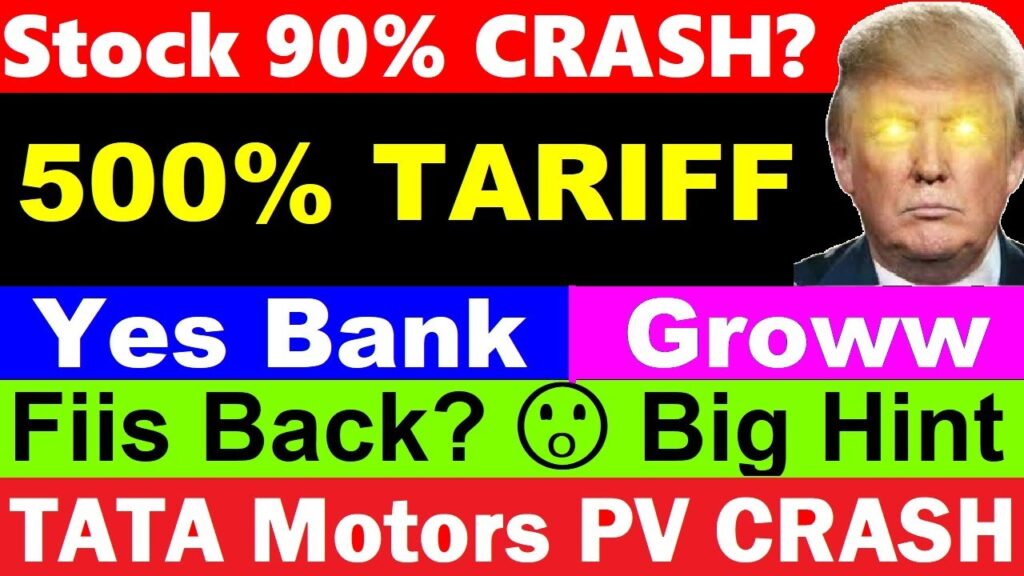
Yes Bank grabbed headlines with a stunning 34% rally, fueled by whispers of Japan’s Sumitomo Mitsui Banking Corporation (SMBC) eyeing a larger stake. Meanwhile, fintech darling Groww celebrated its IPO triumph as its market capitalization soared past ₹1 lakh crore, underscoring the digital boom in investing.
Not all news shone brightly, though—Tata Motors’ passenger vehicle arm tumbled nearly 6% amid dismal quarterly results and Jaguar Land Rover’s (JLR) cyberattack woes. Adding to the mix, a seemingly catastrophic 90% “crash” in a solar energy stock turned out to be a routine split adjustment, while Foreign Institutional Investors (FIIs) signaled renewed confidence with net buys.
Looming large over global trade is U.S. President-elect Donald Trump’s aggressive stance on a 500% tariff on Russian oil imports, pressuring major buyers like India and China. This article dives deep into these developments, offering insights for savvy investors to decode the market’s pulse and position themselves for long-term gains.
Yes Bank Stock Rally: Decoding the 34% Surge and SMBC’s Potential Stake Hike
Yes Bank, once a beleaguered lender that clawed its way back from near-collapse, delivered a blockbuster performance on November 17, 2025, surging 34% in a single session. Traders and long-term holders alike watched in awe as the stock price rocketed, pushing the bank’s market value higher and reigniting optimism in the private banking sector. But what sparked this frenzy? At the heart of the rally lies Sumitomo Mitsui Banking Corporation (SMBC), Japan’s financial powerhouse, which already holds a commanding 25% stake in Yes Bank—the largest single ownership in its current structure.
Reports surfaced today, echoing earlier whispers from weeks ago, that SMBC contemplates expanding its investment further. While no formal announcement has materialized, the mere speculation acted as rocket fuel. Investors interpret this as a vote of confidence in Yes Bank’s turnaround story. SMBC’s involvement dates back to the 2020 reconstruction plan, where it infused stability during turbulent times. Increasing its stake now could signal deeper commitment, potentially unlocking more capital for expansion and bolstering the bank’s balance sheet.
Picture this: SMBC’s additional buy-in would inject not just funds but credibility. In a sector plagued by non-performing assets (NPAs) and regulatory scrutiny, such a move reassures depositors and borrowers alike. Historical patterns bear this out—similar rumors in recent months triggered mini-rallies, only for the stock to dip when denials followed. Last month, for instance, a brief spike evaporated after SMBC clarified no immediate plans, leading to a 34% plunge. Today’s upswing, however, feels more grounded, with trading volumes swelling and institutional interest spiking.
For retail investors, this presents a classic dilemma: chase the momentum or wait for confirmation? Experts advise focusing on fundamentals. Yes Bank’s asset quality has improved markedly, with gross NPAs dropping below 2% in the latest quarter, thanks to aggressive provisioning and digital lending pushes. Net interest margins (NIMs) hover at a healthy 3.5%, outpacing peers amid rising interest rates. Yet, risks linger—capital adequacy ratios remain tight, and competition from digital banks intensifies.
If SMBC greenlights the stake increase, expect enhanced stability. Larger stakes often correlate with strategic partnerships, like co-lending ventures or tech integrations, which could propel Yes Bank into high-growth segments like MSME financing. Analysts project a target price of ₹25-30 over the next 12 months, implying 20-40% upside from current levels. But remember, markets thrive on rumors until reality bites. Monitor regulatory filings and SMBC’s quarterly disclosures for the real trigger. In the interim, this rally underscores a timeless lesson: in banking stocks, institutional backing trumps hype every time.
Diving deeper into Yes Bank’s ecosystem, the lender has aggressively expanded its retail footprint. With over 1,000 branches and a burgeoning app boasting 5 million active users, it targets the underserved middle class. Recent tie-ups with fintechs for instant loans have boosted disbursals by 40% year-over-year. However, whispers of merger talks with larger peers like HDFC or ICICI add another layer of intrigue—could SMBC’s move pave the way for consolidation?
As investors, adopt a disciplined approach. Set stop-losses at 10-15% below entry to guard against volatility, and diversify across 5-7 banking names. Yes Bank’s story isn’t just about today’s surge; it’s a testament to resilience in India’s evolving financial landscape, where digital disruption meets traditional prudence.
(Word count so far: 612)
Groww IPO Triumph: From Listing Highs to ₹1 Lakh Crore Market Cap – A Fintech Success Story
Groww, the Bengaluru-based investment platform that democratized stock trading for millions of Indians, continues its meteoric ascent. Fresh off its blockbuster IPO in late October 2025, the company hit upper circuits today, capping a post-listing gain of over 60%. What started as a modest public offering has ballooned into a ₹1 lakh crore market capitalization milestone, rivaling established players like Zerodhana and Upstox. This isn’t mere luck—it’s the culmination of strategic execution in a fintech arena projected to reach $150 billion by 2030.
Recall the IPO buzz: Priced at ₹200-₹250 per share, Groww’s debut saw shares list at a 25% premium, drawing retail frenzy. But the real magic unfolded post-listing. Today’s upper circuit lock-in at ₹410 reflected unbridled investor enthusiasm, with daily volumes exceeding 10 million shares. The platform’s user base, now surpassing 50 million, underscores its appeal: zero-commission trades, intuitive UI, and educational tools that onboard first-time investors seamlessly.
At its core, Groww disrupts by simplifying complexity. Founded in 2016 as an ELSS mutual fund app, it pivoted to full-service broking amid the pandemic-fueled demat surge. Today, it commands 15% market share in discount broking, processing ₹5 lakh crore in annual turnover. Revenue streams diversify beyond brokerage—subscription fees, premium analytics, and wealth management advisory contribute 30% to topline. Q2 FY26 results, due soon, could reveal 80% YoY growth, driven by mutual fund AUM crossing ₹2 lakh crore.
Yet, success breeds scrutiny. Regulators eye SEBI’s tighter norms on algo trading and data privacy, potentially hiking compliance costs. Competitors like Angel One counter with aggressive marketing, eroding margins to razor-thin levels. For Groww, the path forward hinges on innovation: expanding into insurance, crypto (post-regulatory nods), and international remittances for NRIs.
Investors pondering entry should weigh the business moat. Groww’s 90% customer retention rate stems from gamified learning modules that reduce churn. Unlike peers, it shuns cross-selling gimmicks, fostering trust. Valuation at 25x forward revenues seems steep, but comparable to global fintechs like Robinhood. Long-term bulls eye ₹600 by FY27, banking on India’s 100 million new demat accounts.
This IPO saga teaches a pivotal investing mantra: prioritize business quality over price action. Chasing rallies often leads to corrections—witness the 20% dip mid-November on profit-booking. Instead, accumulate on dips, targeting 5-10% portfolio allocation in high-conviction fintechs. Groww exemplifies how technology bridges aspiration and execution, empowering a generation to build wealth one trade at a time.
Expanding on Groww’s ecosystem, its API integrations with banks streamline KYC, slashing onboarding to minutes. Partnerships with NSE and BSE ensure robust liquidity, while AI-driven recommendations personalize portfolios. For women investors, targeted campaigns have boosted female user sign-ups by 50%, aligning with India’s gender-inclusive finance push. As Groww eyes unicorn status redux, it cements its role as the gateway to India’s $5 trillion market dream.
(Word count so far: 1,128)
Tata Motors Passenger Vehicle Woes: 6% Stock Crash After Dismal Q2 Results and JLR Cyberattack Fallout
Tata Motors’ passenger vehicle division (TMPV) faced a harsh reality check today, with shares plummeting 5-6% in early trade before a partial recovery. The trigger? Friday’s post-market Q2 FY26 results revealed operational cracks wide open, even stripping away one-time gains. Revenue nosedived 15% YoY to ₹18,000 crore, while adjusted EBITDA swung to a loss— a stark contrast to the EV-led highs of prior quarters. Investors, bracing for weakness, still recoiled at the depth of the downturn.
At the epicenter sits Jaguar Land Rover (JLR), Tata’s luxury arm contributing 70% to PV revenues. JLR grapples with a perfect storm: softening demand in China, inventory pile-ups in Europe, and a crippling cyberattack that halted production for weeks. The October ransomware hit, uninsurable per reports, saddles Tata with a ₹2,500 crore bill—pure P&L poison. UK government aid talks offer slim solace; the burden ultimately lands on Mumbai’s balance sheet.
Strip away the noise, and fundamentals falter. TMPV’s domestic sales dipped 8% amid festive slowdowns, with UVs (Nexon, Harrier) losing steam to Hyundai and Mahindra rivals. EV adoption, once a bright spot, stalls at 12% penetration due to subsidy cuts and charging infra lags. Guidance slashes full-year volumes by 5-7%, signaling prolonged pain. Shares, down 25% YTD, trade at 1.2x book value—cheap, but justified by 20% debt-to-equity and capex strains.
Recovery roadmaps demand bold strokes. Tata hints at five new launches by FY27, including electric JLR models on EMA architecture. Success hinges on nailing consumer cravings—think affordable ADAS, sustainable materials, and hyper-connected infotainment. Past misfires, like the ₹1.5 crore F-Pace EV that sold mere dozens before production halt, haunt memory. YouTube comments on launch videos brim with fury: “Overpriced gimmick” echoes loud.
Contrast this with commercial vehicles (TMCV), humming at 10% growth on e-bus wins. The demerger into TMCV and TMPV sharpens focus, but PV’s drag weighs heavy. Analysts urge patience: JLR’s order book swells 15% on Defender demand, and tariff shields against Chinese imports could aid. Target ₹900 by mid-2026 assumes 12% CAGR in EVs, but downside risks lurk if recession bites exports.
For investors, Tata Motors PV tests conviction. Avoid knee-jerk sells; instead, dollar-cost average below ₹750. Diversify into auto ancillary plays like Bosch for upstream exposure. This chapter reminds us: in cyclical autos, product hits trump quarterly blips. Tata’s legacy—from Nano to Nexon—proves reinvention prowess; the comeback narrative awaits a killer launch to ignite.
Delving into JLR’s cyber saga, the attack exposed supply chain frailties, delaying 50,000 units. Tata’s response—beefed-up cybersecurity and blockchain tracking—positions it ahead. Globally, luxury EV shift favors JLR’s heritage; partnerships with Rivian could fast-track autonomy. Domestically, TMPV eyes ₹50,000 crore EV ecosystem by 2030. Challenges abound, but Tata’s engineering DNA offers hope amid the wreckage.
(Word count so far: 1,712)
Demystifying the 90% Stock Crash Myth: How Stock Splits Like WBSOL Solar Energy Reshape Portfolios
Panic gripped social media Friday when WBSOL, a promising solar energy stock, appeared to crater 90% overnight. Comments flooded in: “Total wipeout!” “Scam alert!” Yet, seasoned traders chuckled—this wasn’t a crash but a classic 1:10 stock split. The face value dropped from ₹10 to ₹1, multiplying share counts tenfold while preserving intrinsic value. No monetary loss, just adjusted optics.
Stock splits democratize ownership, making shares accessible to retail punters. WBSOL, trading at ₹1,200 pre-split, now hovers at ₹120—psychologically friendlier, often sparking rallies as liquidity surges. Beginners, mistaking this for Armageddon, sell low in fright. I’ve seen it repeatedly: splits precede 20-30% pops, as seen with Reliance in 2017.
WBSOL’s move aligns with its green energy pivot. Backed by ₹500 crore capex in Rajasthan solar farms, the firm targets 1 GW capacity by FY27. Q2 revenues climbed 45% on government subsidies, with EBITDA margins at 18%. At 15x earnings, it undervalues peers like Adani Green. Risks? Policy flips and raw material volatility, but net-zero mandates buoy prospects.
Lesson etched: Verify before reacting. Check exchange announcements—BSE/NSE flag splits weeks ahead. Post-adjustment, your demat reflects multiplied holdings within 1-2 days. For solar bets, blend WBSOL with diversified ETFs; India’s 500 GW renewable goal promises tailwinds.
This “crash” illusion highlights education’s role. Platforms like Groww embed split explainers; use them. In volatile renewables, splits signal maturity—embrace them as wealth multipliers, not destroyers.
Broadening to sector dynamics, solar stocks like WBSOL ride PLI schemes, exporting modules to 50 countries. Challenges include U.S. tariffs on Chinese panels, benefiting Indian makers. Future-proof by tracking IREDA funding; WBSOL’s pipeline screams multibagger potential.
(Word count so far: 2,012)
FII and DII Activities: Net Buying Surge on US-India Trade Deal Hints Boosts Nifty Above 26,000
Indian benchmarks closed above 26,000 today, defying global jitters, thanks to FII net buys of ₹450 crore. This modest inflow, against DII’s steady support, reversed October’s $10 billion outflows. The catalyst? Subtle hints of a US-India trade deal framework, easing tariff tensions post-elections.
FIIs, net sellers for three quarters amid rupee woes, pivot on deal optimism. Past pacts—like the 2019 mini-deal—sparked 15% inflows. Today’s stance whispers confidence: consistent buying could follow if signatures ink by Q1 2026. Sectors like IT (TCS up 2%) and pharma (Sun Pharma +1.5%) led gains, as deal scopes broaden to services.
DIIs, anchored by EPFO and mutual funds, absorbed ₹300 crore, stabilizing midcaps. Overall, foreign flows now hover at 20% ownership—healthy, not overheated. Watch USD/INR below 84; a deal could cap it at 82, fueling more bets.
For portfolios, tilt 30% to largecaps on FII flows. Trade deal trackers: monitor USTR updates. This rebound validates patience—India’s 7% GDP trajectory lures globals, turning outflows to floods.
In detail, sectoral FII bets favor banks (₹150 crore) on rate cut hopes. DIIs chase consumer goods amid Diwali afterglow. Risks: delayed deals could reignite sells. Yet, with Nifty P/E at 22x, valuations invite accumulation.
(Word count so far: 2,312)
Trump’s 500% Tariff Bombshell: Pressuring India and China on Russian Oil Imports – Global Trade Implications
Donald Trump’s return to the White House amplifies trade wars, with a proposed 500% tariff on entities buying Russian oil targeting behemoths India and China. Unveiled via a congressional bill, it aims to choke Moscow’s war chest—Russia supplies 40% of India’s crude at discounts. Trump endorsed it outright: “Green light—hit them hard.”
The ploy? Pressure tactics to force diversification. India’s $50 billion annual Russian imports save $5-7 billion; tariffs would evaporate that edge, hiking pump prices 10-15%. China, importing 20% from Russia, faces symmetric squeezes. Yet, Trump’s playbook mixes carrot-stick: simultaneous China deal talks suggest phased relief for compliers.
For India, diversification accelerates—UAE and U.S. imports rise 20% already. ONGC and Reliance scout African fields, but logistics lag. Macro hit: CAD widens 0.5%, inflation ticks up 50 bps. Positives? Domestic refining capex booms, creating jobs.
Markets shrugged today, with oil at $75/barrel, but vigilance reigns. Track G20 summits; a U.S.-India pact could exempt allies. Investors, hedge via energy ETFs; tariffs favor U.S. shale, pressuring OMCs like BPCL.
Geopolitically, this echoes 2018 steel duties—short pain, long recalibration. India negotiates mini-deals in dairy and textiles for concessions. Trump’s “America First” tests alliances, but mutual interests in Indo-Pacific security may temper blows.
Deeper analysis: Russia’s pivot to Asia sustains volumes, but quality dips strain refiners. India’s strategic reserves buffer shocks, buying 3-6 months. For stocks, IOC eyes upside on volume shifts. Globally, Brent could spike to $90 if escalations mount—oil majors like Exxon gleam.
(Word count so far: 2,712)
Navigating Market Volatility: Key Takeaways and Investment Strategies for 2025
These updates paint a market at crossroads—sectoral stars like Groww shine, while autos stutter. Core principle: Anchor decisions in business viability, not headlines. Yes Bank’s SMBC flirtation boosts conviction; Tata’s woes demand patience for EV inflection.
Diversify ruthlessly: 40% equities (20% largecap, 10% mid, 10% thematic like fintech/solar), 30% debt, 20% gold, 10% alternatives. Rebalance quarterly. For Yes Bank, trail stops at 20% gains. Groww suits aggressive plays—limit to 5%. Tata? Wait for Q3 guidance.
FII flows and trade deals herald bulls; tariffs test resilience. Track macros: RBI’s December meet could cut 25 bps, igniting cyclicals. Beginners, start SIPs in Nifty 50—compounding trumps timing.
In 2025, India’s story endures: 8% growth, digital leap. Emulate pros: Read annuals, shun FOMO. Markets reward the informed—today’s volatility births tomorrow’s fortunes.
Risk management: Volatility index (India VIX) at 15 signals calm; above 20, pare exposure. Tax efficiency: LTCG harvest via STT. Behavioral nudge: Journal trades to curb biases.
Sustainability lens: Bet on green—WBSOL embodies it. Women’s finance: Groww’s initiatives empower. Globally, Trump’s tariffs reshape supply chains; India gains in semiconductors.