


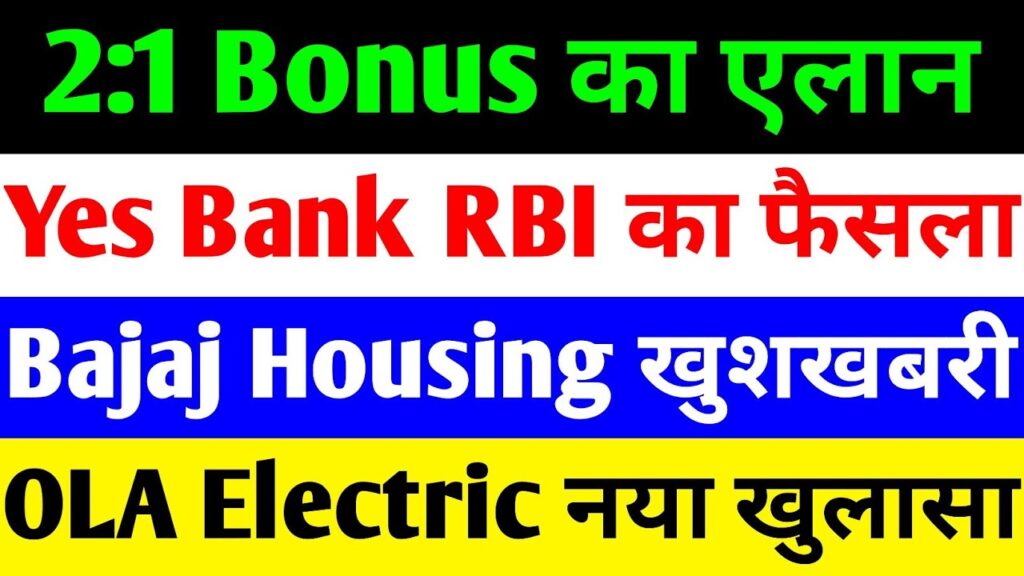
Yes Bank, Bajaj Housing Finance, Ola Electric Mobility, and Dolat Algotech. These companies represent diverse sectors—from banking and housing finance to electric vehicles and financial services—each offering unique opportunities and challenges. Whether you’re a seasoned trader in Hyderabad or a beginner exploring share market news today, this comprehensive guide dives deep into recent developments.
We’ll explore how Yes Bank’s new leadership could drive growth, why Bajaj Housing Finance remains a strong contender despite a minor profit dip, the reasons behind Ola Electric’s sales slowdown, and the exciting bonus and split announcements from Dolat Algotech. Packed with actionable insights, financial analysis, and future outlooks, this article aims to equip you with the knowledge to make informed investment decisions in India’s bustling equity landscape.
As the Nifty and Sensex fluctuate amid global economic cues, these updates highlight resilience and potential in key players. For instance, Yes Bank’s turnaround story inspires confidence, while Bajaj Housing Finance’s robust asset growth signals stability in the housing sector. Ola Electric faces headwinds in the EV market, yet institutional interest sparks hope. Meanwhile, Dolat Algotech’s shareholder-friendly moves could boost liquidity and attract more investors. Let’s break it down section by section, incorporating expert views like those from Motilal Oswal and market data to provide a holistic view.
Yes Bank Share Price Today: A New Era with Leadership Transition
Yes Bank has captured headlines once again with a significant leadership shake-up that promises to steer the institution toward even greater heights. The Reserve Bank of India (RBI) recently approved Vinay Mahendra Tons as the new Managing Director and CEO, marking a pivotal moment for the bank. This appointment comes as Prashant Kumar, who has helmed the bank since 2020, prepares to step down after an extended tenure.
Prashant Kumar took charge during Yes Bank’s darkest hour. Back in 2020, the bank teetered on the brink of collapse, prompting RBI intervention and a bailout led by the State Bank of India (SBI). Kumar, a seasoned banker from SBI, orchestrated a remarkable revival. He transformed Yes Bank from a loss-making entity into a profitable powerhouse. Under his leadership, the bank not only stabilized but also expanded its operations aggressively. Investors who followed Yes Bank stock news during this period witnessed a phoenix-like rise.
Now, Vinay Mahendra Tons steps in to continue this momentum. Tons, who retired from SBI in November 2025, brings a wealth of experience from his role as Managing Director overseeing retail operations. His background mirrors Kumar’s, ensuring continuity while injecting fresh perspectives. Tons joined Yes Bank as Deputy Managing Director in 2023, giving him intimate knowledge of the bank’s inner workings. The transition requires approvals from shareholders and lenders, which experts anticipate will come smoothly.
This change signals potential strategic shifts. Since 2020, Yes Bank has focused on rebuilding its balance sheet, enhancing risk management, and diversifying its portfolio. Revenue figures tell a compelling story: From around ₹20,146 crore in 2020, it surged to ₹37,776 crore by 2025—a staggering growth over five years. Profitability flipped dramatically too. In 2021, the bank reported a hefty loss of ₹3,489 crore, but by 2025, it posted a profit of ₹2,447 crore. Such metrics underscore the bank’s resilience and appeal to long-term investors.
What does this mean for Yes Bank share price today? Closing at ₹21.33 with a 1.02% dip amid broader market corrections (Sensex fell around 500 points), the stock remains robust. Analysts view the leadership transition positively, expecting Tons to accelerate digital initiatives, expand retail banking, and strengthen corporate lending. Partnerships like the one with Sumitomo Mitsui Banking Corporation (SMBC) further bolster confidence, providing access to international expertise and funding.
For investors in Telangana, where banking penetration is growing rapidly, Yes Bank offers local relevance. Branches in Hyderabad and surrounding areas cater to SMEs and retail customers, aligning with the state’s economic boom in IT and pharma sectors. If you’re considering Yes Bank shares, monitor upcoming quarterly results for signs of sustained growth. Experts predict the stock could rebound, targeting higher levels if macroeconomic conditions improve. However, volatility remains a factor—always consult a financial advisor before diving in.
Diving deeper, Yes Bank’s asset quality has improved significantly. Non-performing assets (NPAs) have declined, thanks to proactive provisioning and recovery efforts. The bank’s capital adequacy ratio stands strong, exceeding regulatory requirements, which positions it well for lending expansion. In the context of India’s banking sector, where digital transformation is key, Tons’ retail expertise could drive innovations like AI-driven customer service and seamless mobile banking apps.
Historically, Yes Bank’s challenges stemmed from aggressive lending practices under previous management, leading to the 2020 crisis. Kumar’s tenure emphasized conservative growth, focusing on high-quality assets. With Tons at the helm from April 2026, expect a blend of caution and ambition. Potential areas of focus include sustainable finance, given India’s push toward green energy, and fintech collaborations to capture the youth demographic.
Market sentiment around Yes Bank remains optimistic. Brokerage firms highlight its undervalued status compared to peers like HDFC Bank or ICICI Bank. The price-to-book ratio suggests room for appreciation, especially if interest rates stabilize. For day traders, short-term fluctuations offer opportunities, but long-term holders stand to benefit from dividend potential as profits grow.
In summary, Yes Bank’s new MD appointment heralds a fresh chapter. As the bank builds on its recovery, it positions itself as a key player in India’s financial ecosystem. Keep an eye on regulatory updates and earnings calls for more clarity.
Bajaj Housing Finance Share News: Q3 Performance and Bullish Outlook
Bajaj Housing Finance continues to make waves in India’s housing finance sector, with its latest Q3 results sparking discussions among investors. Despite a slight dip in profits, the company’s overall trajectory points upward, drawing praise from analysts like Motilal Oswal. This section unpacks the numbers, strategies, and future prospects for Bajaj Housing Finance shares.
The company declared its Q3 results, revealing a profit after tax of around ₹4,000 crore—a 6% decline year-on-year. This dip stems from higher provisioning and employee expenses, including ₹270 crore under labor codes. Additionally, a one-time gain of ₹1,420 crore influenced the figures. However, these are minor blips in an otherwise strong performance.
Assets under management (AUM) grew impressively by 22%, reaching ₹94,800 crore. This expansion reflects Bajaj Housing Finance’s diversified portfolio, spanning mortgages, consumer B2C loans, gold loans, secured lending, urban sales finance, commercial lending, and rural sales. The management team actively pursues growth in these areas, yielding tangible results as business scales efficiently.
Motilal Oswal’s post-results report exudes optimism. They noted a 21% year-on-year growth in profit after tax, hitting approximately ₹6.6 billion (note: figures may vary slightly due to reporting units). Net interest income (NII) rose 20% to ₹9.6 billion, aligning with expectations. Other income surged 49%, highlighting diversified revenue streams. Despite one-time provisions impacting profits, the brokerage firm emphasizes the company’s solid fundamentals.
Why the bullish stance? Bajaj Housing Finance excels in handling competition through strategic execution. Its current valuation at around 2.9x book value offers attractive medium-term potential. Motilal Oswal assigns a “Neutral” rating but remains positive, forecasting sustained growth amid India’s housing boom. With urbanization accelerating in states like Telangana, demand for affordable housing loans surges, benefiting players like Bajaj.
Share price dynamics add intrigue. Closing at ₹91.28 with a 0.61% drop, the stock trades at a discount from its post-IPO peak of ₹188. This correction presents buying opportunities for value investors. The IPO hype propelled it high, but current levels reflect market adjustments, making it appealing for accumulation.
In Telangana’s context, Bajaj Housing Finance’s presence supports local real estate growth. Hyderabad’s property market, fueled by IT corridors, sees rising home loan inquiries. The company’s competitive interest rates and quick approvals make it a go-to for first-time buyers and developers.
Looking ahead, Bajaj Housing Finance targets further AUM expansion through digital platforms and partnerships. Regulatory tailwinds, like government incentives for housing, could amplify growth. Risks include interest rate hikes affecting borrowing costs, but the company’s low NPA levels (under 1%) mitigate concerns.
Investors should analyze peer comparisons. Against rivals like LIC Housing Finance or HDFC, Bajaj stands out for its agile operations and Bajaj Group’s backing. Quarterly disbursements have risen steadily, indicating robust demand. For portfolio diversification, this stock offers stability in volatile markets.
Motilal Oswal’s analysis reinforces confidence: The firm handles provisioning prudently, ensuring long-term health. As India aims for a $5 trillion economy, housing finance plays a crucial role, positioning Bajaj for outperformance.
In essence, despite a temporary profit soften, Bajaj Housing Finance’s growth story remains intact. Savvy investors in India might find this an opportune moment to enter, betting on sector recovery.
Ola Electric Share Price Update: Navigating Sales Challenges and Institutional Interest
Ola Electric Mobility, a frontrunner in India’s electric vehicle (EV) revolution, faces scrutiny after disappointing January sales figures. Yet, amid the downturn, signs of recovery emerge through increased institutional buying. This analysis explores the hurdles, market position, and potential turnaround for Ola Electric shares.
The stock closed at ₹31.53, down 1.93%, reflecting ongoing weakness. From its IPO price of ₹76 and a high above ₹150, it has plummeted, causing significant losses for early investors. January two-wheeler sales data paints a grim picture: Ola sold just 7,751 units, slipping to fifth place. TVS Motor led with 34,288 units, followed by Bajaj Auto (25,500), Ather Energy (21,950), and Hero MotoCorp (13,273). Even Ampere outsold Ola with 5,336 units.
This slide erodes Ola’s market share from 40% to around 14%. Factors include intensified competition, supply chain issues, and subdued consumer demand amid economic slowdowns. The EV sector grapples with subsidy reductions and charging infrastructure gaps, particularly in rural areas.
Despite these woes, positive indicators shine through. Major fund houses ramp up stakes: Foreign institutional investors (FIIs) increased from 3.24% in September to 4.08% in December. Domestic institutions (DIIs) rose from 6.77% to 7.28%, mutual funds from 5.51% to 5.54%, and public holding from 53.20% to 54.05%. This buying signals confidence in Ola’s long-term vision.
Promoters trimmed holdings to repay debts, releasing pledged shares—a strategic move to strengthen the balance sheet. Ola’s innovations, like affordable scooters and expanding service networks, could regain traction. Government pushes for EVs, including FAME-III subsidies, offer tailwinds.
In Telangana, where urban mobility shifts toward sustainability, Ola’s presence grows. Hyderabad’s traffic woes make electric scooters appealing, with Ola’s app integration adding convenience. However, service complaints have dented reputation, necessitating improvements.
Future outlook hinges on sales revival. Ola aims to launch new models and enter international markets. Partnerships with battery suppliers could cut costs, enhancing competitiveness. Analysts predict a rebound if EV adoption accelerates, targeting 30% market penetration by 2030.
Risks persist: High valuations post-IPO led to corrections, and operational losses continue. Yet, institutional interest suggests undervaluation at current levels. For risk-tolerant investors, this could be a bottom-fishing opportunity.
Ola Electric’s journey mirrors India’s EV ambitions. Overcoming current dips could position it as a leader, rewarding patient shareholders.
Dolat Algotech Stock News: Bonus Issue and Split Boost Investor Appeal
Dolat Algotech, a key player in financial services, delights shareholders with a 2:1 bonus issue and stock split. These moves aim to enhance liquidity and accessibility, potentially driving share price gains. Let’s examine the details and implications.
The stock closed at ₹226, down 1.28%. The company reduces face value from ₹5 to ₹1, splitting each share into five. Additionally, it offers two bonus shares per existing one (post-split basis). Record date is February 14, with ex-bonus on the same day, allowing eligible holders to benefit from both.
This shareholder-centric strategy compensates for past underperformance. Over three months, the stock rose 13%; annually, it delivered 22% returns, outperforming Sensex by 9.03%. However, five-year investors faced 49% losses, prompting these actions to restore confidence.
Dolat Algotech specializes in algorithmic trading and wealth management, capitalizing on India’s digital finance boom. In Telangana, its services aid tech-savvy investors in Hyderabad’s financial hubs.
Outlook appears bright: Enhanced liquidity could attract retail participation, boosting volumes. Combined with market recovery, the stock might target new highs.
Investors should research thoroughly—these moves don’t alter fundamentals but improve optics.
Wrapping Up: Strategic Insights for Indian Stock Investors
Navigating stocks like Yes Bank, Bajaj Housing Finance, Ola Electric, and Dolat Algotech requires balancing risks and rewards. Leadership stability at Yes Bank, growth resilience at Bajaj, recovery signals at Ola, and value unlocks at Dolat paint a promising picture. For Telangana-based investors, these align with local economic trends. Always prioritize due diligence and professional advice. Stay tuned for more share market updates to seize opportunities in India’s vibrant economy.