


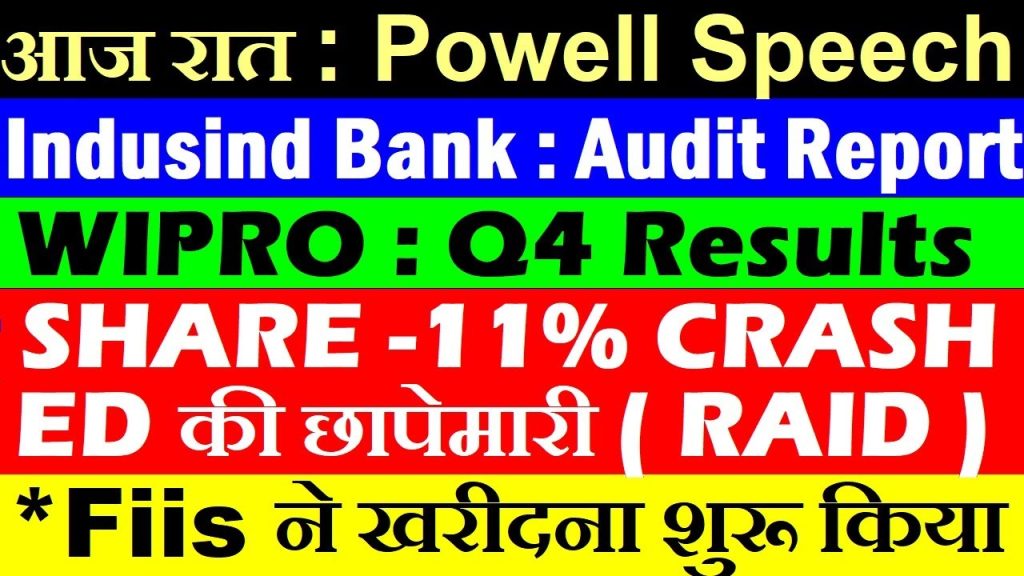
The financial markets are buzzing with significant developments, from corporate earnings to regulatory actions and global economic cues. This article explores the latest updates on Wipro’s Q4 performance, IndusInd Bank’s audit revelations, Federal Reserve Chair Jerome Powell’s anticipated speech, and the Enforcement Directorate’s (ED) raids on Easy My Trip. Additionally, we’ll analyze the role of Foreign Institutional Investors (FIIs) in driving market sentiment. Packed with insights and optimized for SEO, this comprehensive guide aims to keep you ahead in understanding these critical market events.
Wipro Q4 Results: Profit Growth Meets Cautious Outlook
Wipro, a leading player in India’s IT sector and a key component of the Nifty index, recently announced its Q4 results, sparking discussions among investors and analysts. The company reported a 6% quarter-on-quarter increase in net profit, reaching ₹3,570 crore. While this growth reflects operational resilience, the results fell short of analyst expectations, leading to mixed market reactionsKey Highlights of Wipro’s Q4 Performance
- Net Profit: ₹3,570 crore, up 6% from the previous quarter.
- Revenue Guidance: Wipro issued a cautious outlook for Q1, projecting revenue growth between 1.5% and 3.5%. This conservative forecast disappointed analysts who anticipated stronger projections.
- Dividend Announcement: The company declared an interim dividend of ₹6 per share, signaling confidence in its cash flow despite market uncertainties.
Why the Cautious Forecast?
Wipro’s CEO attributed the subdued guidance to global economic uncertainties, particularly in the U.S., which accounts for over 50% of the company’s revenue. Additional factors include:
- U.S. Policy Changes: Potential tariffs under the incoming Trump administration have created apprehension, impacting IT service demand.
- Project Delays: Large-scale projects in the U.S. and Europe (30% of Wipro’s business) are facing delays due to macroeconomic concerns.
- Market Volatility: The broader IT sector, including peers like TCS and Infosys, is grappling with similar challenges, as evidenced by a 3.5% decline in Wipro’s American Depositary Receipts (ADRs) listed in the U.S.
Investor Takeaway
While Wipro’s profit growth is a positive signal, the weak revenue forecast suggests near-term challenges. Investors should monitor the company’s performance when Indian markets open, as domestic shares may mirror the ADR’s downward trend. The dividend offers some relief, but long-term growth hinges on clarity around U.S. policies and global demand recovery.
IndusInd Bank Audit: Addressing Derivative Losses
IndusInd Bank has been under scrutiny following discrepancies in its derivative portfolio, which triggered multiple audits. The latest external audit report revealed a derivative loss of approximately ₹1,979 crore, lower than the anticipated range of ₹1,500 crore to ₹2,100 crore. This development led to a 6% surge in the bank’s share price, as the market reacted positively to the contained loss estimate.
Understanding the Audit Findings
- Derivative Losses: The audit confirmed a loss of ₹1,979 crore, which the bank will need to provision for, impacting its profitability.
- Management Shake-Up: In response, IndusInd Bank terminated three senior-level executives, signaling accountability and a commitment to addressing internal issues.
- Ongoing Audits: Multiple audits are still underway, and their outcomes will provide further clarity on the bank’s financial health.
Why the Market Reacted Positively
The market’s optimism stems from the fact that the reported loss was lower than expected. Earlier estimates speculated losses could escalate to ₹2,500 crore or ₹3,000 crore, creating uncertainty. The confirmation of a manageable figure restored investor confidence, driving the share price rally.
What’s Next for IndusInd Bank?
While the immediate market reaction is positive, investors should remain cautious. The ongoing audits could uncover additional issues, and the bank’s ability to strengthen its risk management practices will be critical. Monitoring future audit reports and management actions will provide deeper insights into the bank’s recovery trajectory.
Jerome Powell’s Speech: A Global Market Catalyst
Federal Reserve Chair Jerome Powell is set to deliver a highly anticipated speech at the Economic Club of Chicago, a platform known for influencing global markets. With no Federal Open Market Committee (FOMC) meeting scheduled, Powell’s remarks will be the focal point for investors seeking clues about U.S. monetary policy.
Why Powell’s Speech Matters
- Market Volatility: Powell’s speeches often trigger significant market movements, depending on his tone and policy hints. His comments on interest rates, inflation, and economic growth will shape investor sentiment worldwide.
- Global Uncertainty: Markets are grappling with uncertainties, including U.S. policy shifts under President Trump and geopolitical tensions. Powell’s guidance will provide direction in this volatile environment.
- Impact on India: As India’s markets are closely tied to U.S. economic developments, Powell’s speech could influence FII flows and the Indian rupee’s value against the dollar.
What to Watch For
Investors should focus on:
- Tone and Language: A hawkish stance (indicating tighter policy) could pressure equity markets, while a dovish tone (suggesting accommodation) may boost risk assets.
- Economic Outlook: Powell’s views on U.S. growth, inflation, and tariffs will impact sectors like IT and banking in India.
- Currency Movements: The Indian rupee, currently at 85.50 against the dollar, could fluctuate based on Powell’s remarks.
Powell’s speech is a pivotal event, and its ripple effects will be felt across global markets, including India’s Nifty and Sensex.
Easy My Trip ED Raid: A Blow to Investor Confidence
The Enforcement Directorate (ED) conducted raids on 15 locations linked to Easy My Trip, a prominent online travel company, as part of an investigation into money laundering allegations. The raids targeted offices and premises associated with co-founder Nishant Pitti, causing the company’s stock to plummet by 11%.
Details of the ED Investigation
- Mahadev App Connection: The raids are linked to the Mahadev betting app case, which involves allegations of illegal betting and money laundering. The ED suspects Easy My Trip’s involvement in financial irregularities tied to this case.
- Locations Raided: The ED targeted offices in Delhi, Mumbai, Chandigarh, Ahmedabad, Jaipur, Gurugram, Indore, Chennai, and Sallarpur, among others.
- Promoter Scrutiny: Nishant Pitti, a key figure in the company, is under investigation, raising concerns about governance and transparency.
Why the Stock Tanked
Easy My Trip has faced controversies in the past, including the promoter’s attempt to offload a significant stake, which was poorly received by the market. The ED raids have intensified investor concerns, as money laundering allegations could lead to:
- Regulatory Penalties: Fines or restrictions could impact the company’s operations.
- Reputational Damage: Trust in the brand may erode, affecting customer and investor confidence.
- Further Investigations: The Mahadev app case involves high-profile individuals, and additional revelations could deepen the company’s troubles.
Investor Outlook
The sharp decline in Easy My Trip’s stock reflects the market’s unease. Investors should await clarity on the ED’s findings and the company’s response. Until then, the stock remains a high-risk investment, with potential for further volatility.
FII Activity: A Silver Lining for Indian Markets
Foreign Institutional Investors (FIIs) have emerged as a key driver of market sentiment, with recent data showing significant buying activity. On the day in question, FIIs purchased stocks worth ₹3,936 crore, marking a continuation of their buying streak after a ₹6,000 crore influx the previous day.
Breaking Down FII and DII Activity
- FII Buying: The net buying of ₹3,936 crore reflects growing confidence in Indian equities, driven by attractive valuations and a weakening dollar.
- DII Selling: Domestic Institutional Investors (DIIs) sold stocks worth ₹500 crore, indicating a cautious approach amid global uncertainties.
- Market Impact: FII inflows have propelled the Nifty and Sensex into positive territory, with the market closing in the green on consecutive days.
Factors Driving FII Inflows
Several factors are contributing to FII optimism:
- Weakening Dollar: The Indian rupee strengthened to 85.50 against the dollar, down from a high of 88. A weaker dollar enhances FII returns, boosting their appetite for Indian stocks.
- Trump’s Tariff Pause: President Trump’s decision to impose a modest 10% tariff and pause further increases for 90 days has alleviated concerns about trade disruptions, particularly for India.
- China-Centric Tariffs: Trump’s focus on tariffs against China has spared India, making it an attractive investment destination.
Is This a Sustained Trend?
While the recent FII buying is encouraging, it’s premature to call it a full-fledged return. Sustained inflows would require consistent buying over multiple sessions, as seen during previous FII-driven rallies. Investors should monitor:
- Trump’s Policy Moves: Further clarity on tariffs and trade policies will influence FII decisions.
- Rupee-Dollar Dynamics: A stable or appreciating rupee will support FII confidence.
- Global Risk Sentiment: Geopolitical developments and Powell’s speech could sway FII flows.
Connecting the Dots: How These Events Shape the Market
The developments discussed—Wipro’s results, IndusInd Bank’s audit, Powell’s speech, Easy My Trip’s ED raids, and FII activity—are interconnected and collectively influence market dynamics. Here’s how:
- Corporate Earnings and Sentiment: Wipro’s cautious outlook reflects broader challenges in the IT sector, which could weigh on the Nifty IT index. Investors may shift focus to defensive sectors like FMCG or pharma.
- Banking Sector Stability: IndusInd Bank’s ability to contain derivative losses boosts confidence in the banking sector, but ongoing audits warrant vigilance.
- Global Cues: Powell’s speech and Trump’s tariff policies are external factors that could either amplify or dampen market volatility. A dovish Powell and stable U.S. policies would support FII inflows.
- Regulatory Risks: Easy My Trip’s troubles highlight the importance of governance, and similar issues in other companies could trigger broader market sell-offs.
- FII-Driven Rally: FII buying is a positive signal, but its sustainability depends on global and domestic factors aligning favorably.
Investment Strategies in the Current Environment
Navigating the current market requires a balanced approach. Here are actionable strategies for investors:
- Diversify Across Sectors: Given uncertainties in IT and banking, allocate funds to defensive sectors like healthcare and consumer goods to mitigate risk.
- Monitor Global Cues: Stay updated on Powell’s speech and U.S. policy developments, as they will influence FII flows and currency movements.
- Focus on Quality Stocks: Invest in companies with strong fundamentals and transparent governance to avoid risks associated with regulatory scrutiny.
- Track FII Activity: FII inflows are a bullish signal, but investors should wait for confirmation of a sustained trend before increasing exposure.
- Stay Informed: Follow audit outcomes for IndusInd Bank and ED developments for Easy My Trip to make informed decisions.
Conclusion: Staying Ahead in a Dynamic Market
The financial markets are at a crossroads, with corporate earnings, regulatory actions, and global economic cues shaping investor sentiment. Wipro’s Q4 results highlight challenges in the IT sector, while IndusInd Bank’s audit offers relief but demands caution. Jerome Powell’s speech looms as a potential market mover, and Easy My Trip’s ED raids underscore the importance of governance. Amid these developments, FII buying provides a glimmer of optimism, supported by a weakening dollar and favorable tariff policies.
By understanding these events and their implications, investors can make informed decisions to navigate volatility and seize opportunities. Stay vigilant, diversify your portfolio, and keep an eye on global and domestic developments to thrive in this dynamic market environment.