


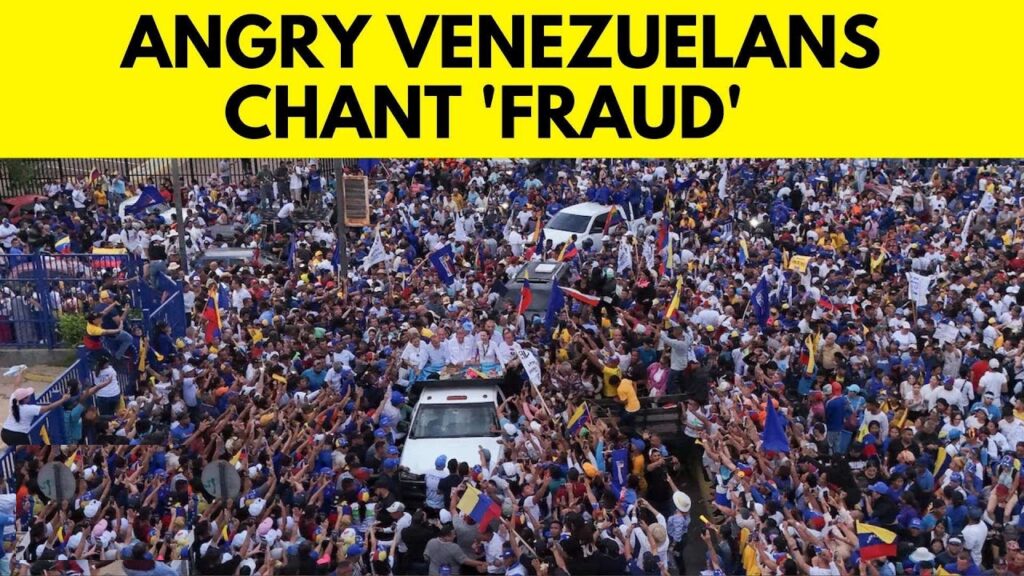
Venezuelans Demand Transparency Amid Election Dispute
Venezuelans have taken to the streets in response to the electoral authority declaring President Nicolas Maduro the winner of a contentious election. This declaration has intensified political unrest as the opposition alleges the election was fraught with fraud. Demonstrations have been widespread, with protesters even toppling a statue of Hugo Chavez, Maduro’s predecessor, in Falcon state.

Opposition Alleges Fraud in Election Process
The electoral authority’s announcement of Maduro’s victory has fueled accusations of election fraud. In Caracas, particularly in the impoverished Petare area, demonstrators voiced their dissent by shouting anti-government slogans and tearing down campaign posters. Tensions escalated as some protesters marched toward the presidential palace, Miraflores. The government deployed police and National Guard members, who used tear gas against demonstrators. Reports indicate that “colectivos,” pro-Maduro paramilitary groups, fired at protesters, further escalating the violence.
Claims of Electoral Irregularities and Lack of Transparency
Public frustration grew after the National Electoral Council (CNE) confirmed Maduro’s re-election for a new six-year term but withheld the detailed results from 30,000 polling stations. This lack of transparency has led to heightened political tensions and calls for accountability. Opposition representatives argue that their candidate, Edmundo Gonzalez, won the election. Opposition leader Maria Corina Machado, alongside Gonzalez, claimed to have secured more than 70% of the votes, contrasting the official results showing Gonzalez with 44% and Maduro with 51%.
International Reactions and Calls for Accountability
Global leaders and observers have demanded transparency in the election results. United Nations Secretary-General Antonio Guterres has urged for the publication of detailed election data and called for peaceful resolutions to disputes. The Carter Center, which monitored the election, emphasized the need for the CNE to release polling station-level results to ensure credibility and allow Venezuelans access to accurate information.
Economic Collapse and International Isolation
Under Maduro’s leadership since 2013, Venezuela has experienced severe economic decline, resulting in mass emigration. International sanctions imposed by the United States and the European Union have isolated the nation and further weakened its oil industry. Venezuelans expressed disappointment with the election outcome, hoping for change through the ballot box. Al Jazeera’s Teresa Bo reported a pervasive sense of disillusionment among citizens who anticipated a different election result.
Allegations of Cyber Attacks and Government Manipulation
Venezuela’s Attorney General, Tarek Saab, announced an investigation into alleged cyber attacks on the electoral system, which reportedly slowed the vote count. Saab accused opposition leaders, including Machado, of involvement in these attacks but provided no evidence. The government claimed it was under attack, while many Venezuelans believed massive fraud occurred.
Protests and Public Outcry Intensify
Monday morning saw widespread protests as citizens participated in a “cacerolazo,” a traditional protest involving banging pots and pans. Dalia Romero, a retiree, expressed her frustration, saying the election shattered her dream of reuniting with her daughter who emigrated three years ago. Nine Latin American countries called for an emergency meeting of the Organization of American States (OAS) due to concerns about the election results. Panama announced it would suspend diplomatic relations with Venezuela until a comprehensive review of the election process is conducted.
Venezuela at a Standstill Amid Conflicting Claims
Both Maduro and the opposition coalition claimed victory, leading to a political standstill. While Maduro considered the election results conclusive, opposition candidate Gonzalez asserted he had evidence proving his victory. Gonzalez and Machado presented tally sheets indicating their lead over Maduro. However, the CNE, loyal to Maduro, maintained that he received 51% of the vote compared to Gonzalez’s 44%.
Challenges with the Electoral Process
Venezuelans voted using electronic machines that provide a paper receipt for voters to verify their choice. The ruling party’s control over the electoral system, including the CNE, has led to restricted access for opposition representatives at voting centers. This has raised concerns about the fairness of the electoral process. Despite widespread belief in Gonzalez’s victory, the electoral council has not released detailed tallies, prompting demands for transparency.
International Calls for Fair Elections
International observers, including a U.N.-backed panel, reported increased government repression of critics leading up to the election. The opposition urged voters to remain calm and avoid violence but did not specify steps to prove their claim of victory. Gonzalez and Machado continue to insist they have the evidence to demonstrate their win.
Protests Erupt in Response to Alleged Election Fraud
Thousands of Venezuelans have taken to the streets to protest the election results, tearing down Maduro’s posters and demanding change. The opposition, predicted to win by a landslide, claimed to have secured two-thirds of the votes in a country suffering from economic ruin. Protests began spontaneously, with demonstrators expressing their discontent through pot-banging from windows and balconies.
Economic Hardships Fuel Public Anger
Venezuelans are frustrated by years of economic hardship, food shortages, and an authoritarian government. Many citizens live on minimal incomes and rely on government handouts for basic necessities. Opposition supporters argue that the election was rigged in favor of Maduro and demand change.
Conclusion: Venezuela’s Path Forward
As Venezuela grapples with political unrest, the future remains uncertain. The opposition and international observers continue to call for transparency and accountability in the electoral process. The situation underscores the urgent need for political reform and economic recovery to address the deep-seated challenges facing the nation. The path forward for Venezuela hinges on resolving electoral disputes and fostering an environment where citizens’ voices are heard and respected.