


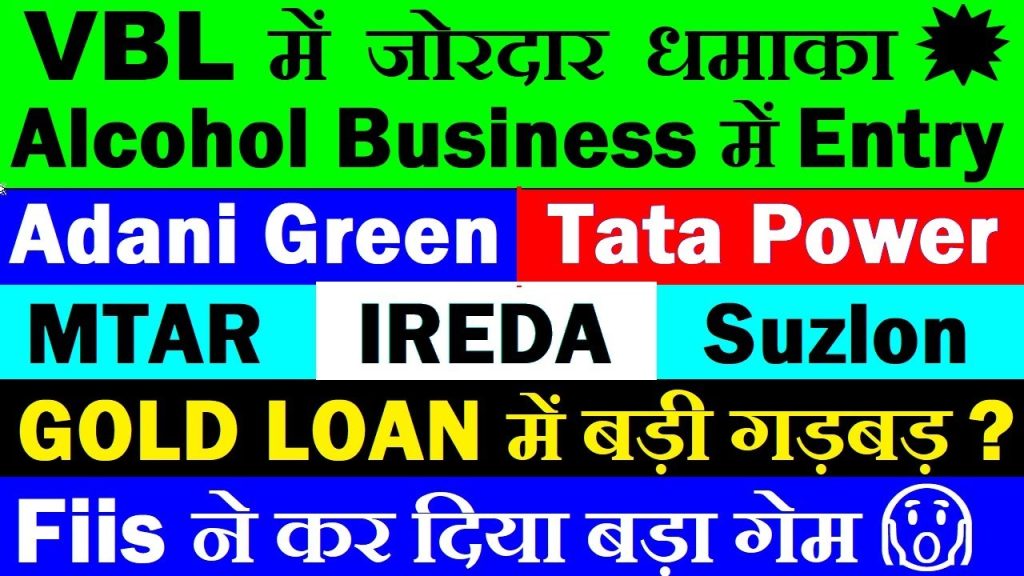
On October 29, 2025, Foreign Institutional Investors (FIIs) triggered widespread volatility with a net selling spree of approximately ₹500 crore, casting shadows over recent gains. This move comes hot on the heels of an abnormal ₹10,000 crore buying binge the previous day, highlighting the unpredictable nature of global capital flows. Amid this turbulence, standout stories emerge: Varun Beverages (VBL) rockets into the alcohol sector through a strategic Carlsberg partnership in Africa, Adani Green Energy posts impressive Q2 FY26 earnings, and gold loan providers tighten Loan-to-Value (LTV) ratios as precious metal prices fluctuate wildly. Meanwhile, renewable energy and power finance stocks like Tata Power, Suzlon Energy, IREDA, REC, and PFC rally on surging demand, while MTAR Technologies maintains steady momentum in the defense and aerospace space. This comprehensive analysis dives deep into these developments, offering insights for savvy investors eyeing long-term growth in India’s booming economy.
Gold Price Volatility in October 2025: Navigating Fluctuations and Their Market Impact
Gold, the timeless safe-haven asset, has captivated investors throughout 2025 with its relentless upward trajectory. As of late October, spot gold prices hover around ₹78,000 per 10 grams in India, marking a staggering 28% year-to-date gain—the strongest annual performance since 1979. Central banks’ aggressive buying, geopolitical tensions in the Middle East and Ukraine, and persistent inflation fears propel this surge. Yet, this rally isn’t without its tremors. Weekly fluctuations of 2-3% have become the norm, driven by U.S. Federal Reserve signals on interest rates and a strengthening dollar index above 108.
For Indian investors, these gold price swings carry profound implications beyond mere speculation. The metal’s role as collateral in loans amplifies its market influence. Historical data reveals that gold’s volatility index spiked to 15% in October 2025, up from 8% in September, as traders digest mixed economic cues from China and the U.S. This instability prompts a reevaluation of portfolios, with many shifting toward gold ETFs or sovereign gold bonds for stability. Experts predict that if the Fed delays rate cuts into 2026, gold could test ₹82,000 by year-end, but a surprise dovish pivot might trigger a 5-7% correction.
What fuels this volatility? Global demand-supply dynamics play a starring role. India’s imports hit 1,200 tonnes in the first nine months of 2025, outpacing global mine production by 20%. Jewelers stockpile ahead of Diwali, while industrial applications in electronics and dentistry add steady pressure. Currency fluctuations exacerbate the issue: a weakening rupee at ₹84.50 per dollar boosts import costs, indirectly lifting domestic prices. Investors should monitor the U.S. non-farm payrolls report due November 1, as it could sway Fed expectations and, consequently, gold’s trajectory.
In this environment, diversification emerges as a key strategy. Pairing physical gold with mining stocks like those on the MCX or international plays such as Barrick Gold offers balanced exposure. Data from the World Gold Council underscores India’s dominance, with household holdings exceeding 25,000 tonnes—enough to cover 15 years of global supply. As volatility persists, astute investors view these dips as buying opportunities, positioning for gold’s enduring role in hedging against economic uncertainty.
Gold Loan LTV Ratio Adjustments: How Lenders Respond to Price Swings and Protect Borrowers
Gold loans remain a lifeline for millions in India, offering quick liquidity against family heirlooms. Valued at over $157 billion in 2025, this market thrives on trust and accessibility, but recent gold price volatility has forced lenders to recalibrate. The Reserve Bank of India (RBI) mandates a maximum Loan-to-Value (LTV) ratio of 75%, ensuring banks and NBFCs like Muthoot Finance and Manappuram maintain buffers against downturns. In October 2025, however, many institutions proactively slashed LTVs to 60-65% for high-value pledges, a defensive move amid 3% intra-week price drops.
Why this shift? Lenders calculate LTV based on the pledged gold’s appraised value, factoring in purity (typically 22-24 karat) and current market rates. A ₹100,000 gold piece at 75% LTV yields ₹75,000, but volatility erodes this margin if prices plummet post-disbursal. To mitigate, providers now average prices over 90 days instead of 30, smoothing out spikes from the recent rally. This adjustment, evident in reports from major players, prevents overexposure—recall the 2020 crash when gold dipped 15%, triggering widespread margin calls.
Borrowers feel the pinch too. Top-up facilities, which allow additional funds as gold appreciates, face temporary halts. Imagine pledging gold worth ₹100,000 for ₹75,000; if prices surge to ₹120,000, a top-up could unlock ₹15,000 more. But with swings from ₹78,000 to ₹76,000 per 10 grams in a week, lenders pause these to avoid reversals. Interest rates, averaging 9-12% annually, remain stable, but processing fees might tick up for riskier profiles.
Navigating this landscape demands vigilance. Prospective borrowers should compare LTV policies across platforms—digital lenders like Rupeek offer 75% with doorstep service, while traditional banks emphasize documentation. RBI’s 2025 guidelines cap tenure at 12 months, urging timely repayments to reclaim collateral intact. Success stories abound: A Bengaluru entrepreneur secured ₹5 lakh against heirloom jewelry at 70% LTV, fueling his startup amid market jitters.
Long-term, these adjustments bolster sector resilience. As gold stabilizes post-Diwali, expect LTVs to ease back to 70-75%. Investors in gold loan NBFCs could see 15-20% returns, given the market’s 12% CAGR projection through 2031. By understanding LTV dynamics, borrowers transform volatility into an ally, securing funds without undue risk.
VBL Alcohol Business Entry: Strategic Carlsberg Partnership in Africa Fuels 10% Stock Surge
Varun Beverages (VBL), PepsiCo’s flagship bottler in India, shattered expectations on October 29, 2025, with a seismic pivot into alcoholic beverages. Shares skyrocketed 10% to ₹501 on the NSE, capping a week of frenzied trading. The catalyst? An exclusive distribution pact with Carlsberg Breweries A/S, targeting beer test-markets in VBL’s African subsidiaries. This marks VBL’s audacious foray beyond carbonated drinks, tapping a $500 billion global alcobev sector ripe for expansion.
VBL’s Q2 FY26 results, released alongside the announcement, painted a robust picture despite seasonal headwinds. Consolidated net profit climbed 19% year-on-year to ₹745 crore, from ₹629 crore, on revenue of ₹4,897 crore—up marginally from ₹4,805 crore. Year-on-year comparisons reveal strength: EBITDA held flat at ₹1,156 crore, but EPS rose to ₹2.19, signaling efficient operations. Quarterly dips, from Q1’s peak ₹6,500 crore revenue, stem from VBL’s seasonal rhythm—June quarters dominate with summer thirst, while September lags. Investors dismissing this as weakness overlook the 20% volume growth in international markets, led by Morocco’s Cheetos launch and Zimbabwe’s resilient ops.
The Carlsberg tie-up unfolds in Africa, where VBL’s footprint spans Zimbabwe (since 2007) and Morocco. Subsidiaries will distribute Carlsberg beer initially, mirroring VBL’s Pepsi model: no brewing, just masterful supply chain orchestration. This low-capex entry tests waters in ready-to-drink (RTD) and premium lagers, segments exploding at 8% CAGR. Chairman Ravi Jaipuria hailed the move as a “natural evolution,” amending the Memorandum of Association to embrace beer, wine, spirits—even potential Indian ventures. With Africa’s young demographics and urbanization driving 15% annual beer consumption growth, VBL eyes ₹1,000 crore incremental revenue by FY28.
Risks linger: Regulatory hurdles in alcohol-prone markets and currency volatility in Africa could snag execution. Yet, VBL’s track record—scaling Pepsi to 25% market share—instills confidence. Brokerages like Motilal Oswal slap a ‘Buy’ with ₹550 targets, citing diversification as a buffer against India’s monsoon-hit Q3 volumes (flat at 2.4% growth). For shareholders, this isn’t mere speculation; it’s VBL architecting a dual-engine growth story, blending soda fizz with spirited ambition.
Adani Green Energy Q2 FY26 Earnings: 25% Profit Jump Powers 11% Stock Rally
Adani Green Energy (AGEL) electrified the market on October 29, 2025, unveiling Q2 FY26 results that propelled shares 11% higher to new peaks. Net profit soared 25% year-on-year to ₹644 crore, eclipsing ₹515 crore from Q2 FY25, while EBITDA swelled 9% to ₹2,844 crore on 87.5% margins. Revenue dipped 4% to ₹3,249 crore, but energy sales rocketed 39% to 19.6 billion units—enough to power Croatia for a year.
This performance underscores AGEL’s green revolution. Operational capacity hit 16.7 GW by September-end, a 49% leap, with 2,437 MW greenfield additions in H1 FY26 alone—74% of FY25’s total. The crown jewel: Khavda’s 30 GW renewable mega-plant in Gujarat, advancing steadily toward India’s 500 GW non-fossil target by 2030. CEO Ashish Khanna spotlighted innovations like digitalized efficiency and safety protocols, slashing costs amid rising module prices.
Market reaction was electric: Adani group stocks, including Total Gas, surged in tandem. Brokerages applaud AGEL’s execution, with Jefferies eyeing ₹1,200 targets on 20% CAGR projections. Challenges persist—debt at 6x EBITDA and execution delays from monsoons—but policy tailwinds like RBI’s infrastructure easing buoy spirits. As India’s largest renewable operator, AGEL doesn’t just generate power; it fuels a sustainable future, rewarding patient investors with exponential returns.
Tata Power Stock Rally: Brokerage Boost and Power Sector Momentum in October 2025
Tata Power’s resurgence captivates as October 2025 unfolds. Shares climbed 1.5% to ₹404.75 on the NSE, buoyed by a broader power sector upswing amid 15% demand surge from EVs and industrials. Brokerage heavyweights like Motilal Oswal reinforce the optimism, issuing ‘Buy’ calls with ₹450 targets, citing robust Q2 previews: 12% revenue growth to ₹18,000 crore and 10% PAT at ₹1,200 crore.
The company’s 14 GW portfolio—spanning hydro, solar, and thermal—positions it as India’s integrated power titan. Recent wins include 1 GW solar EPC contracts, aligning with net-zero pledges. Dividend yield at 0.56% pales against peers like Torrent Power’s 1.49%, but ROE of 11.6% signals steady value creation. FII holdings at 9% reflect caution, yet DII inflows neutralize sells.
Volatility from FII outflows tests resolve, but Tata Power’s EV charging network (aiming 1 lakh stations by 2025) and Odisha discom turnaround promise 18% EPS growth. Investors, take note: In a electrifying market, Tata Power charges ahead, blending reliability with renewable zeal.
Suzlon Energy Updates: New CFO Rahul Jain and Q2 Results Set for November 4
Suzlon Energy buzzes with transformation as October 2025 closes. Shares jumped 4.5% to ₹58.78 on the appointment of Rahul Jain as CFO, effective December 15. The SRF veteran, with 20 years in finance, replaces Himanshu Mody, vowing to “drive profitability and resilience” in Suzlon’s wind odyssey.
Adding intrigue, Q2 FY26 results loom on November 4, following a stellar order book: 838 MW from Tata Power and 1,544 MW from NTPC. Capacity stands at 2.5 GW annually, with 80% execution visibility. Jefferies’ ‘Buy’ at ₹70 (28% upside) highlights debt reduction to ₹500 crore.
Suzlon’s pivot to hybrid turbines amid 20% wind sector growth cements its 30% market share. Investors anticipate 25% revenue jump; Jain’s stewardship could unlock ₹10,000 crore valuations. As India targets 500 GW renewables, Suzlon spins a compelling revival tale.
IREDA, REC, PFC Power Finance Rally: Surging Demand Drives 5% Gains
Power finance PSUs ignite in October 2025, with IREDA, REC, and PFC rallying 4-5% post-RBI’s infrastructure norms easing. IREDA leads at ₹155, up 4.45%, on 30% loan book growth to ₹25,000 crore, funding solar and wind. REC and PFC hit ₹390 and ₹426, respectively, as risk weights drop, slashing costs by 50 bps.
RBI’s Project Finance Directions, effective October 1, harmonize lending, boosting NBFC pipelines. Sector AUM nears ₹5 lakh crore, with 15% CAGR from EV and grid upgrades. Dividend yields shine: PFC’s 3.77% tops peers. Amid FII jitters, these yield plays offer stability, projecting 20% returns as India’s power capex hits ₹10 lakh crore by 2030.
MTAR Technologies Steady Climb: Aerospace and Defense Fuel October Performance
MTAR Technologies holds firm in October 2025, shares at ₹2,280 amid 47% YTD gains. Q1 FY26 sales rose 22% to ₹157 crore, PAT at ₹11 crore, driven by Isro and Boeing orders. Market cap: ₹7,078 crore, trading at 9.66x book value.
With 31% promoter holding and CRISIL’s ‘A’ rating, MTAR eyes ₹1,000 crore revenue by FY27. Defense exports up 40%, aerospace 25%. Intrinsic value: ₹1,271 per models. As ‘Make in India’ soars, MTAR engineers enduring gains.
FII Activity in Indian Stocks: ₹500 Crore Sell-Off Amid US Trade Deal Uncertainty
FIIs flipped the script on October 29, 2025, dumping ₹500 crore after ₹10,000 crore buys—a stark reminder of sentiment’s fragility. YTD outflows hit ₹3,363 crore, fueled by US yields at 4.5% and Trump tariff threats. India-US trade talks stall over agriculture, inflating uncertainty.
DIIs absorb the blow, buying ₹4,000 crore monthly. Nifty dips 3% from July highs, but sectors like renewables buck the trend. A deal by November could reverse flows; absent it, volatility reigns. Investors, hedge wisely—opportunities lurk in dips.
In wrapping this October 2025 saga, India’s markets pulse with resilience. From VBL’s spirited leap to Adani’s green charge, volatility births victors. Stay informed, diversify boldly—fortune favors the prepared.