


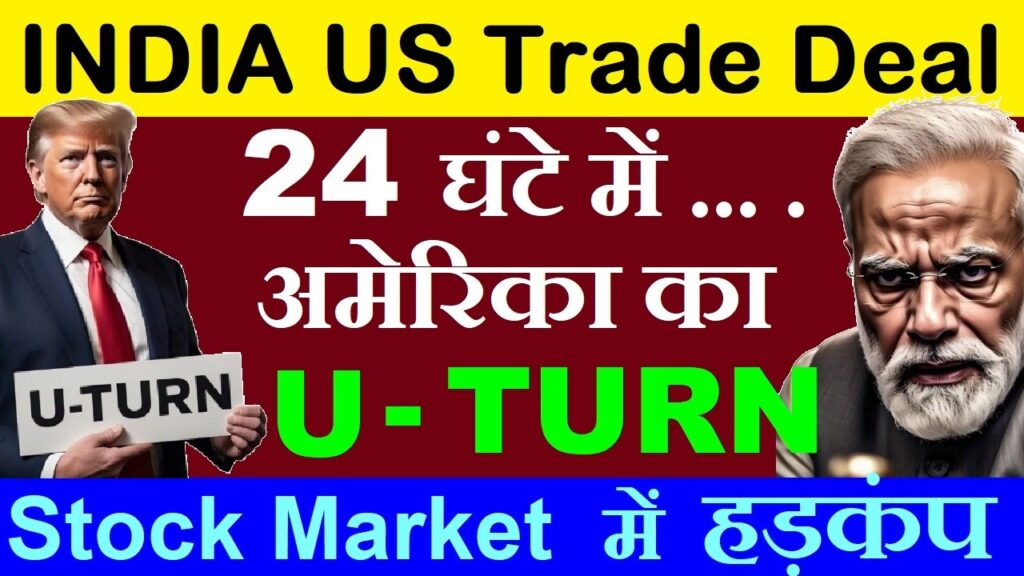
The corridors of international trade rarely witness drama as high-voltage as the events of the last 24 hours. In a move that sent shockwaves through the global financial markets and triggered intense volatility on the National Stock Exchange (NSE), the United States government executed a significant strategic retreat regarding the highly anticipated India-US Trade Deal. This sudden “U-turn” by Washington has left investors, policymakers, and the Indian agricultural community grappling with the implications of what many are calling a “ghost” fact sheet.
While the headline indices showed a deceptively calm performance—with the Nifty gaining a mere 18 points—the underlying market breath told a different story. Intense intraday swings saw the market oscillating between green and red as news trickled in about the White House quietly revising its official stance on key trade components. This article provides a comprehensive deep dive into the mechanics of the trade summary, the specific points of contention, and the geopolitical maneuvering that forced the world’s largest economy to blink.
The Anatomy of a Fact Sheet: How a Summary Ignited a Firestorm
To understand the chaos, one must understand the role of a “Fact Sheet” in international diplomacy. When two nations announce a framework as massive as the India-US Trade Deal, the legal documents span thousands of pages. A fact sheet serves as an executive summary, highlighting the major concessions and benefits for each side.
However, the fact sheet released by the US administration early yesterday contained several “phantom clauses”—provisions that the Indian government claims were never part of the negotiated agreement. These inclusions acted as a spark in a tinderbox, particularly for the Indian farming sector, which was already wary of the trade pact’s impact on domestic livelihoods.
The Three Controversial Pillars: Where the US Backtracked
The outrage in India centered on three specific areas where the US appeared to have “over-claimed” its victories. Within 24 hours, the White House revised the document, effectively removing these claims in a historic diplomatic reversal.
1. The Pulses Controversy: Protecting the Indian Heartland
In its original summary, the US claimed it had secured market access for “certain pulses” (lentils and beans). This was an immediate red flag for Indian farmers. India is one of the world’s largest producers and consumers of pulses, and any duty-free entry of American legumes would devastate local prices.
- The Reality: The actual agreement focused on niche items like tree nuts, soybean oil, and specific animal feeds.
- The U-Turn: After massive pushback and the announcement of a “Bharat Bandh” (national strike) by farmer unions, the White House dropped the reference to pulses entirely from the revised version.
2. The Digital Tax Deadlock: Sovereignty Over Silicon Valley
The second point of contention involved India’s “Equalization Levy” or digital services tax. The US fact sheet initially claimed that India had agreed to dismantle these taxes on American tech giants like Google, Amazon, and Meta.
- The Reality: India has consistently maintained that digital taxes are a sovereign right until a global minimum tax framework is fully operational.
- The U-Turn: Realizing that no such agreement existed in the current framework, the US “quietly revised” the document to remove the claim that India would scrap these taxes.
3. The $500 Billion Purchase Clause: Guarantee vs. Intent
Perhaps the most significant revision involved the much-touted $500 billion purchase commitment. The initial US draft portrayed this as a binding guarantee—that India would purchase half a trillion dollars worth of American goods over the next five years.
- The Reality: Such a massive, binding commitment would be nearly impossible for any developing nation to guarantee.
- The U-Turn: The revised fact sheet changed the language from a “guaranteed purchase” to an “intent to purchase.” This shift from a binding contract to a statement of intent is a massive victory for Indian negotiators, as it removes the threat of legal consequences if the target is not met.
Market Volatility and the “Trump Strategy” of Disturbance
Why did the US include these false points in the first place? Market analysts suggest this is a classic negotiation tactic often associated with modern American trade policy: the “Strategy of Disturbance.” By claiming more than what was agreed upon, the US creates a high-pressure environment, hoping the other side will eventually concede some ground just to keep the peace.
However, this strategy backfired. The uncertainty created a “doubtful situation” for institutional investors. In the stock market, uncertainty is a greater enemy than bad news. The fluctuating reports caused heavy selling in sectors sensitive to trade, such as agriculture-linked stocks and IT services (due to the digital tax news).
Conclusion: Looking Ahead to the Final Signing
While the US has taken a U-turn on these three critical points, the drama is far from over. The trade deal is currently in the “Framework” stage; the actual, binding treaty is expected to be signed between March and April 2026. Until that ink is dry, investors should expect more “plus and minus” headlines.
The lesson for the Indian market is clear: American trade summaries should be taken with a grain of salt. As the “Bharat Bandh” scheduled for February 12 looms, the domestic political pressure on the Indian government to maintain a tough stance remains high. For the savvy investor, this period of volatility provides both a warning and an opportunity—the warning to stay wary of unconfirmed reports, and the opportunity to capitalize on the market’s overreaction to diplomatic maneuvering.