Site icon Telangana NavaNirmana Sena

The Rise of Perplexity AI: Business Case Study on Google’s Emerging Competitor

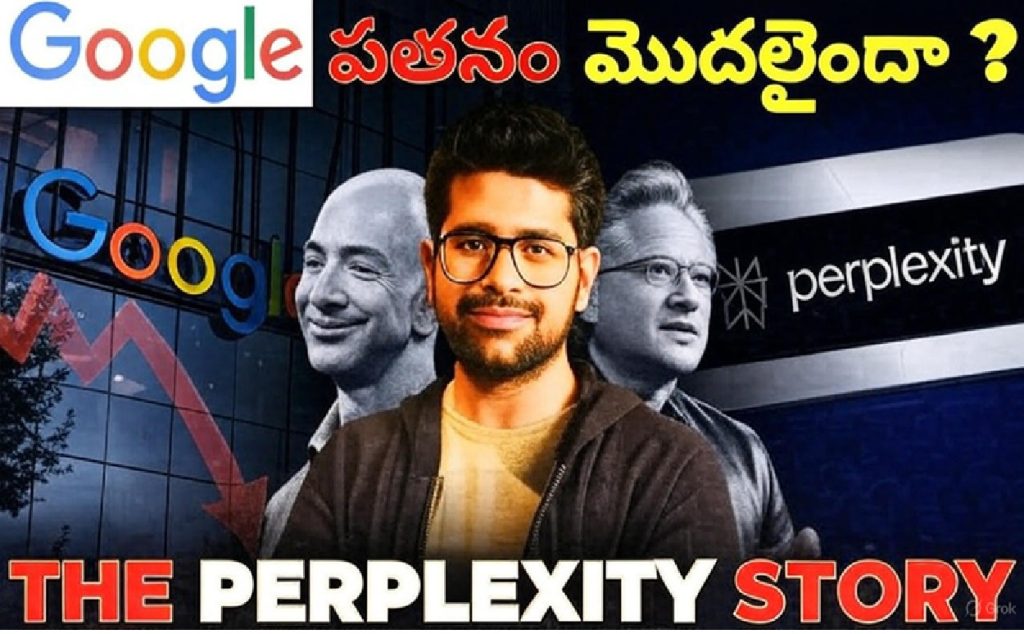
In the ever-evolving landscape of artificial intelligence and internet search, one name has been making waves globally: Perplexity AI. Founded by an ambitious Indian entrepreneur, this startup isn't just another AI tool; it's positioning itself as a formidable rival to tech giants like Google. With a staggering valuation of over $18 billion in just three years, Perplexity AI offers direct, source-backed answers without the clutter of ads or outdated information. This article dives deep into the rise of Perplexity AI, exploring its founder's journey, the flaws it addresses in traditional search engines, its innovative business model, and its bold moves that have shaken the tech world. Whether you're a tech enthusiast, business analyst, or curious user searching for "Perplexity AI vs Google," this case study uncovers the secrets behind its explosive growth. Aravind Srinivas: The Visionary Founder Behind Perplexity AI's Success Aravind Srinivas, the CEO and co-founder of Perplexity AI, embodies the classic tale of an underdog rising to prominence through sheer determination and foresight. Born and raised in Chennai, India, Srinivas grew up without grand ambitions of his own. However, his mother harbored a dream: to see her son excel at the prestigious Indian Institute of Technology (IIT) Madras and secure a bright future. Motivated by her aspirations, Srinivas studied rigorously and earned a spot at IIT Madras. He initially aimed for computer science, a field that fascinated him with its potential in machine learning and artificial intelligence. Yet, due to a lower entrance exam score, he settled for electrical engineering. Undeterred, Srinivas pursued his passion on the side. During his free time, he delved into computer science topics, building a strong foundation in AI and ML through self-study. This proactive approach paid off when he graduated in 2017 and pursued a PhD in computer science at the University of California, Berkeley. Back in 2017, AI wasn't the buzzing trend it is today. Few professors specialized in it, and the field lacked the hype surrounding it now. Srinivas's early immersion in AI, however, gave him a significant edge. His academic pursuits equipped him with the knowledge to foresee AI's transformative power, setting the stage for his entrepreneurial venture. After completing his PhD, Srinivas sought practical experience. He interned at OpenAI, the company that would later revolutionize the world with ChatGPT. In 2019, OpenAI was relatively unknown, but Srinivas gained invaluable insights into developing AI tools, chatbots, and generative models. Following this, he spent five months at DeepMind, Google's AI subsidiary, honing his skills in advanced AI applications. He then joined Google as a researcher for a year, where he learned to scale AI solutions for large audiences. These experiences at top-tier companies—OpenAI and Google—exposed Srinivas to the inner workings of the AI and search industries. He observed firsthand the limitations of existing tools, which inspired him to create something better. By combining his Indian roots with American innovation, Srinivas launched Perplexity AI in 2022 alongside three friends. This move marked the beginning of a startup that would challenge the status quo in internet search. Uncovering the Flaws in Google Search: Why Traditional Engines Fall Short Google has dominated the internet search market for over two decades, commanding a near-monopoly with its efficient algorithms and vast data resources. Competitors like Yahoo, Microsoft Bing, and AltaVista tried to dethrone it but failed spectacularly. Google's search engine processes billions of queries daily, yet Srinivas identified critical shortcomings that frustrate users and hinder genuine information discovery. First, Google rarely provides direct answers. Instead, it bombards users with a list of website links. Users must manually click through each one, sifting through content to find relevant information. This process wastes time and often leads to incomplete understanding. Moreover, not all links are created equal. Google's results prioritize paid promotions over organic content. Companies that pay for ads appear at the top, regardless of quality. This advertising-driven model turns search into a marketplace where promotional sites overshadow authentic resources. Unsuspecting users frequently end up on sponsored pages, wasting time and money on subpar products or information. Another major issue involves data privacy and targeted advertising. Google tracks every search query, using this data to display personalized ads across platforms like YouTube and Facebook. For instance, searching for a smartphone on Google might flood your social media feeds with ads for that exact model. This retargeting technique manipulates users into purchases, eroding trust and privacy. These problems stem from Google's revenue model, which relies heavily on ads—generating billions annually. While effective for business, it compromises user experience. Srinivas, having worked at Google, recognized these flaws as opportunities. He envisioned a search tool that delivers straightforward, unbiased answers without the ad clutter. ChatGPT's Limitations: Insights from Srinivas's Time at OpenAI During his internship at OpenAI, Srinivas gained intimate knowledge of ChatGPT's development. Launched in 2022, ChatGPT quickly became a go-to tool for queries, offering conversational responses that felt human-like. However, Srinivas spotted inherent weaknesses that limited its reliability. One primary concern is the lack of transparency in data sources. ChatGPT provides direct answers but doesn't cite where the information comes from. Users have no way to verify accuracy, leading to potential misinformation. Early versions of ChatGPT exacerbated this by hallucinating facts—generating plausible but incorrect responses. Additionally, ChatGPT's knowledge is static, based on training data up to a specific cutoff date. For example, the initial release used data only through September 2021, rendering it useless for current events or recent developments. Asking about a 2023 election or a 2024 tech breakthrough yields outdated or no information. Srinivas noted these issues while at OpenAI, realizing that users crave not just answers but verifiable, up-to-date ones. ChatGPT excels in creativity and conversation but falls short in factual, real-time research. This gap inspired Perplexity AI to bridge the divide between search engines and AI chatbots. How Perplexity AI Revolutionizes Search: Direct Answers with Sources and No Ads Perplexity AI emerges as a hybrid solution, combining the best of Google and ChatGPT while eliminating their drawbacks. At its core, it's an AI-powered answer engine that responds to queries with concise, accurate explanations backed by credible sources. Users pose questions, and Perplexity delivers straightforward replies. For complex topics, it breaks down information step by step, citing links to original sources alongside each point. This transparency allows users to fact-check instantly, saving time for researchers, students, and professionals. Take a historical query like "Who won the 1947 India-Pakistan war?" Perplexity states India won and provides context on why Pakistan-occupied Kashmir (PoK) remains disputed. Unlike Google, which lists links requiring manual navigation, or ChatGPT, which offers unsourced narratives, Perplexity includes hyperlinks to reputable sites like historical archives or news outlets. Another standout feature is its ad-free environment. Perplexity doesn't track user data for targeted ads, prioritizing privacy. It stays current by integrating real-time web data, ensuring answers reflect the latest developments—crucial in fast-paced fields like technology and politics. Perplexity's engine leverages advanced AI models, including those from OpenAI and proprietary tech, to synthesize information intelligently. It doesn't just regurgitate data; it understands context, offering nuanced responses. This innovation has attracted millions, positioning Perplexity as a "Google killer" in AI search. Perplexity AI's Business Model: Subscription-Driven Revenue for Sustainable Growth Unlike Google's ad-heavy approach, Perplexity adopts a subscription model that aligns with user interests. The basic version is free, allowing unlimited queries with sources. For advanced features—like faster responses, unlimited AI model access, and file analysis—users pay $20 monthly for Perplexity Pro. This direct revenue stream funds development without compromising experience. By charging users upfront, Perplexity avoids data exploitation, fostering loyalty. Subscribers enjoy ad-free, private searches, appealing to privacy-conscious individuals. The model mirrors successful SaaS companies, where value drives payments. Perplexity's focus on quality over quantity differentiates it, generating revenue through user satisfaction rather than ads. As of 2025, this strategy has propelled its valuation to $18 billion, with projections for further growth. Explosive Growth: From Startup to $18 Billion Valuation in Three Years Launched in 2022, Perplexity AI grew rapidly, amassing 25 million users by 2025. Its viral appeal stems from word-of-mouth and strategic partnerships. High-profile investors like Amazon founder Jeff Bezos, Nvidia, and SoftBank poured billions, recognizing its potential to disrupt search. Perplexity's app and web platform offer seamless access, with features like voice search and integrations enhancing usability. Collaborations, such as with India's Airtel, provide free one-year subscriptions to millions, mirroring Jio's free-data strategy to build habits. This user-acquisition tactic converts free users to paid ones, expanding globally. In regions like the US and India, Perplexity targets tech-savvy audiences, leveraging SEO keywords like "best AI search engine" to boost visibility. Bold Moves: Offering to Buy Google Chrome and Challenging Elon Musk Perplexity made headlines with its $34.5 billion offer to acquire Google Chrome, despite its $18 billion valuation. This audacious bid was a publicity masterstroke amid US antitrust scrutiny. The Department of Justice accused Google of monopolistic practices, suggesting it divest assets like Chrome to reduce dominance. Srinivas capitalized on this, drawing global attention. Though Google declined, the move highlighted Perplexity's ambitions and boosted its brand. Srinivas also challenged Elon Musk, daring him to block a $500 million investment from a US agency. This banter underscored Perplexity's confidence, positioning it as a disruptor in AI. Perplexity AI's Global Impact and Future Prospects Though founded by an Indian, Perplexity operates from the US, earning revenue worldwide without direct ties to Indian taxes. Its success inspires entrepreneurs, proving innovation trumps origins. Looking ahead, Perplexity eyes expansions in AI-driven research tools, potentially integrating with browsers or devices. Challenges include scaling infrastructure and competing with evolving rivals like Google's AI Overviews. Yet, with its user-centric approach, Perplexity could redefine search. As AI advances, it stands poised to capture more market share, offering a glimpse into a ad-free, transparent internet future. In conclusion, Perplexity AI's rise showcases how identifying market gaps and executing boldly can challenge giants. Founded on principles of accuracy and privacy, it's not just a tool—it's a movement reshaping how we access knowledge.

In the ever-evolving landscape of artificial intelligence and internet search, one name has been making waves globally: Perplexity AI. Founded by an ambitious Indian entrepreneur, this startup isn’t just another AI tool; it’s positioning itself as a formidable rival to tech giants like Google. With a staggering valuation of over $18 billion in just three years, Perplexity AI offers direct, source-backed answers without the clutter of ads or outdated information. This article dives deep into the rise of Perplexity AI, exploring its founder’s journey, the flaws it addresses in traditional search engines, its innovative business model, and its bold moves that have shaken the tech world. Whether you’re a tech enthusiast, business analyst, or curious user searching for “Perplexity AI vs Google,” this case study uncovers the secrets behind its explosive growth.

Aravind Srinivas: The Visionary Founder Behind Perplexity AI’s Success

Aravind Srinivas, the CEO and co-founder of Perplexity AI, embodies the classic tale of an underdog rising to prominence through sheer determination and foresight. Born and raised in Chennai, India, Srinivas grew up without grand ambitions of his own. However, his mother harbored a dream: to see her son excel at the prestigious Indian Institute of Technology (IIT) Madras and secure a bright future. Motivated by her aspirations, Srinivas studied rigorously and earned a spot at IIT Madras.

He initially aimed for computer science, a field that fascinated him with its potential in machine learning and artificial intelligence. Yet, due to a lower entrance exam score, he settled for electrical engineering. Undeterred, Srinivas pursued his passion on the side. During his free time, he delved into computer science topics, building a strong foundation in AI and ML through self-study. This proactive approach paid off when he graduated in 2017 and pursued a PhD in computer science at the University of California, Berkeley.

Back in 2017, AI wasn’t the buzzing trend it is today. Few professors specialized in it, and the field lacked the hype surrounding it now. Srinivas’s early immersion in AI, however, gave him a significant edge. His academic pursuits equipped him with the knowledge to foresee AI’s transformative power, setting the stage for his entrepreneurial venture.

After completing his PhD, Srinivas sought practical experience. He interned at OpenAI, the company that would later revolutionize the world with ChatGPT. In 2019, OpenAI was relatively unknown, but Srinivas gained invaluable insights into developing AI tools, chatbots, and generative models. Following this, he spent five months at DeepMind, Google’s AI subsidiary, honing his skills in advanced AI applications. He then joined Google as a researcher for a year, where he learned to scale AI solutions for large audiences.

These experiences at top-tier companies—OpenAI and Google—exposed Srinivas to the inner workings of the AI and search industries. He observed firsthand the limitations of existing tools, which inspired him to create something better. By combining his Indian roots with American innovation, Srinivas launched Perplexity AI in 2022 alongside three friends. This move marked the beginning of a startup that would challenge the status quo in internet search.

Uncovering the Flaws in Google Search: Why Traditional Engines Fall Short

Google has dominated the internet search market for over two decades, commanding a near-monopoly with its efficient algorithms and vast data resources. Competitors like Yahoo, Microsoft Bing, and AltaVista tried to dethrone it but failed spectacularly. Google’s search engine processes billions of queries daily, yet Srinivas identified critical shortcomings that frustrate users and hinder genuine information discovery.

First, Google rarely provides direct answers. Instead, it bombards users with a list of website links. Users must manually click through each one, sifting through content to find relevant information. This process wastes time and often leads to incomplete understanding.

Moreover, not all links are created equal. Google’s results prioritize paid promotions over organic content. Companies that pay for ads appear at the top, regardless of quality. This advertising-driven model turns search into a marketplace where promotional sites overshadow authentic resources. Unsuspecting users frequently end up on sponsored pages, wasting time and money on subpar products or information.

Another major issue involves data privacy and targeted advertising. Google tracks every search query, using this data to display personalized ads across platforms like YouTube and Facebook. For instance, searching for a smartphone on Google might flood your social media feeds with ads for that exact model. This retargeting technique manipulates users into purchases, eroding trust and privacy.

These problems stem from Google’s revenue model, which relies heavily on ads—generating billions annually. While effective for business, it compromises user experience. Srinivas, having worked at Google, recognized these flaws as opportunities. He envisioned a search tool that delivers straightforward, unbiased answers without the ad clutter.

ChatGPT’s Limitations: Insights from Srinivas’s Time at OpenAI

During his internship at OpenAI, Srinivas gained intimate knowledge of ChatGPT’s development. Launched in 2022, ChatGPT quickly became a go-to tool for queries, offering conversational responses that felt human-like. However, Srinivas spotted inherent weaknesses that limited its reliability.

One primary concern is the lack of transparency in data sources. ChatGPT provides direct answers but doesn’t cite where the information comes from. Users have no way to verify accuracy, leading to potential misinformation. Early versions of ChatGPT exacerbated this by hallucinating facts—generating plausible but incorrect responses.

Additionally, ChatGPT’s knowledge is static, based on training data up to a specific cutoff date. For example, the initial release used data only through September 2021, rendering it useless for current events or recent developments. Asking about a 2023 election or a 2024 tech breakthrough yields outdated or no information.

Srinivas noted these issues while at OpenAI, realizing that users crave not just answers but verifiable, up-to-date ones. ChatGPT excels in creativity and conversation but falls short in factual, real-time research. This gap inspired Perplexity AI to bridge the divide between search engines and AI chatbots.

How Perplexity AI Revolutionizes Search: Direct Answers with Sources and No Ads

Perplexity AI emerges as a hybrid solution, combining the best of Google and ChatGPT while eliminating their drawbacks. At its core, it’s an AI-powered answer engine that responds to queries with concise, accurate explanations backed by credible sources.

Users pose questions, and Perplexity delivers straightforward replies. For complex topics, it breaks down information step by step, citing links to original sources alongside each point. This transparency allows users to fact-check instantly, saving time for researchers, students, and professionals.

Take a historical query like “Who won the 1947 India-Pakistan war?” Perplexity states India won and provides context on why Pakistan-occupied Kashmir (PoK) remains disputed. Unlike Google, which lists links requiring manual navigation, or ChatGPT, which offers unsourced narratives, Perplexity includes hyperlinks to reputable sites like historical archives or news outlets.

Another standout feature is its ad-free environment. Perplexity doesn’t track user data for targeted ads, prioritizing privacy. It stays current by integrating real-time web data, ensuring answers reflect the latest developments—crucial in fast-paced fields like technology and politics.

Perplexity’s engine leverages advanced AI models, including those from OpenAI and proprietary tech, to synthesize information intelligently. It doesn’t just regurgitate data; it understands context, offering nuanced responses. This innovation has attracted millions, positioning Perplexity as a “Google killer” in AI search.

Perplexity AI’s Business Model: Subscription-Driven Revenue for Sustainable Growth

Unlike Google’s ad-heavy approach, Perplexity adopts a subscription model that aligns with user interests. The basic version is free, allowing unlimited queries with sources. For advanced features—like faster responses, unlimited AI model access, and file analysis—users pay $20 monthly for Perplexity Pro.

This direct revenue stream funds development without compromising experience. By charging users upfront, Perplexity avoids data exploitation, fostering loyalty. Subscribers enjoy ad-free, private searches, appealing to privacy-conscious individuals.

The model mirrors successful SaaS companies, where value drives payments. Perplexity’s focus on quality over quantity differentiates it, generating revenue through user satisfaction rather than ads. As of 2025, this strategy has propelled its valuation to $18 billion, with projections for further growth.

Explosive Growth: From Startup to $18 Billion Valuation in Three Years

Launched in 2022, Perplexity AI grew rapidly, amassing 25 million users by 2025. Its viral appeal stems from word-of-mouth and strategic partnerships. High-profile investors like Amazon founder Jeff Bezos, Nvidia, and SoftBank poured billions, recognizing its potential to disrupt search.

Perplexity’s app and web platform offer seamless access, with features like voice search and integrations enhancing usability. Collaborations, such as with India’s Airtel, provide free one-year subscriptions to millions, mirroring Jio’s free-data strategy to build habits.

This user-acquisition tactic converts free users to paid ones, expanding globally. In regions like the US and India, Perplexity targets tech-savvy audiences, leveraging SEO keywords like “best AI search engine” to boost visibility.

Bold Moves: Offering to Buy Google Chrome and Challenging Elon Musk

Perplexity made headlines with its $34.5 billion offer to acquire Google Chrome, despite its $18 billion valuation. This audacious bid was a publicity masterstroke amid US antitrust scrutiny. The Department of Justice accused Google of monopolistic practices, suggesting it divest assets like Chrome to reduce dominance.

Srinivas capitalized on this, drawing global attention. Though Google declined, the move highlighted Perplexity’s ambitions and boosted its brand.

Srinivas also challenged Elon Musk, daring him to block a $500 million investment from a US agency. This banter underscored Perplexity’s confidence, positioning it as a disruptor in AI.

Perplexity AI’s Global Impact and Future Prospects

Though founded by an Indian, Perplexity operates from the US, earning revenue worldwide without direct ties to Indian taxes. Its success inspires entrepreneurs, proving innovation trumps origins.

Looking ahead, Perplexity eyes expansions in AI-driven research tools, potentially integrating with browsers or devices. Challenges include scaling infrastructure and competing with evolving rivals like Google’s AI Overviews.

Yet, with its user-centric approach, Perplexity could redefine search. As AI advances, it stands poised to capture more market share, offering a glimpse into a ad-free, transparent internet future.

In conclusion, Perplexity AI’s rise showcases how identifying market gaps and executing boldly can challenge giants. Founded on principles of accuracy and privacy, it’s not just a tool—it’s a movement reshaping how we access knowledge.

Exit mobile version