


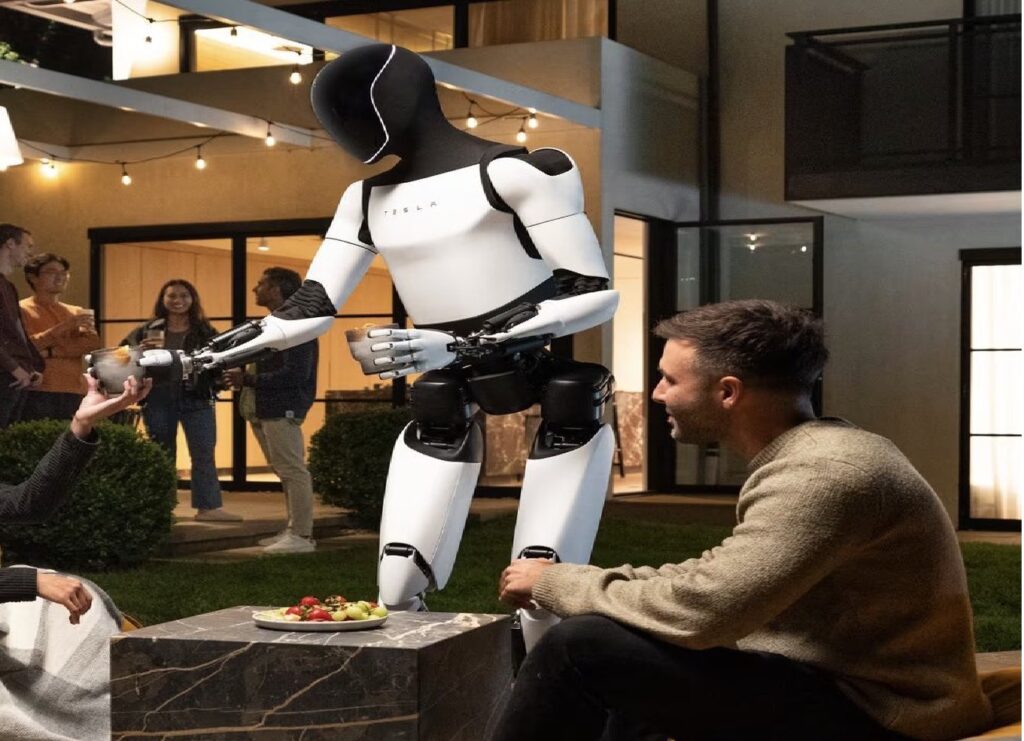
Tesla’s latest event, dubbed the “We, Robot” showcase, gave the world a fascinating glimpse into the company’s bold future of autonomous vehicles and humanoid robots. The event was packed with new revelations, from driverless taxis to sophisticated robots, all signaling Tesla’s intent to revolutionize both transportation and robotics industries. Below, we break down the key takeaways from the event and what this means for consumers and society.

Fully Autonomous Tesla Taxis: Cyber Cab and Beyond
Tesla continues to push the envelope in autonomous vehicle technology, with the introduction of the Cyber Cab. The audience was treated to the sight of fully autonomous, driverless taxis in action. Tesla showcased a fleet of 50 Model Y cars and Cyber Cabs, all operating without human drivers, steering wheels, or pedals. This leap in technology promises a future where transportation is cheaper and more efficient.
Elon Musk, the visionary behind Tesla, pointed out the substantial cost savings autonomous vehicles could offer. He explained that while the average cost per mile for a bus in a city is around a dollar, Tesla’s Cyber Cab could reduce that to just 20 cents per mile, with taxes and fees bringing it up to about 30 to 40 cents per mile. This price reduction could revolutionize urban transportation, making it more accessible and affordable for the average commuter.
The Cost-Effective Promise of Autonomous Cars
The affordability of Tesla’s autonomous vehicles doesn’t stop at transportation services. Musk revealed that consumers would be able to purchase fully autonomous vehicles at a price below $30,000. He mentioned that production is set to start in Texas and California, with unsupervised Full Self-Driving (FSD) technology rolling out for the Model 3 and Model Y in the near future. Moreover, production for the Cyber Cab, optimized for U.S. transportation needs, is expected to begin by 2026.
This new phase of autonomous vehicles could make transportation as easy as getting into a car with no steering wheel or controls, relying entirely on the car’s self-driving technology. It’s a futuristic vision that Tesla is actively turning into reality.
Inductive Charging: The Future of Electric Vehicle Efficiency
Another exciting innovation revealed at the event was inductive charging for Tesla vehicles. The Cyber Cab will feature a plug-free charging system, allowing the vehicle to automatically charge when it parks over an inductive charger. This technology represents another step towards simplifying electric vehicle use and making autonomous fleets more viable. With the convenience of inductive charging, electric vehicles can run continuously, with minimal human intervention.
Introducing the Roven: Tesla’s Autonomous People and Goods Transporter
Tesla didn’t stop at passenger vehicles. The company also unveiled the Roven (also dubbed the Robo Van by some), an autonomous vehicle capable of transporting up to 20 people or large quantities of goods. This vehicle is set to address the needs of high-density transport, whether for sports teams, large groups, or logistics companies looking for efficient urban transportation solutions.
The Roven could reduce transportation costs to as little as 5 to 10 cents per mile, making it a game-changer for businesses and consumers alike. With its large capacity and low operating costs, this vehicle is poised to become a staple in both the people-moving and goods-transport industries.
The Optimus Humanoid Robot: Tesla’s Next Frontier
Perhaps the most exciting revelation of the night was Tesla’s progress with the Optimus humanoid robot. Elon Musk shared the company’s advances in robotics, showing how far they’ve come from the early days of human actors in robot suits. The Optimus robot, equipped with the same power electronics, batteries, software, and AI as Tesla’s cars, represents a massive leap in robotic technology.
The Optimus robot will have arms and legs instead of wheels, and Musk boldly claimed that it could do virtually anything a human might need. Whether it’s walking the dog, mowing the lawn, fetching groceries, or even babysitting children, the possibilities for Optimus seem endless. In the long term, Musk envisions these robots costing between $20,000 and $30,000, making them affordable for everyday consumers.
A Personal Robot for Everyone?
Musk confidently predicted that Optimus will eventually become a common household item, similar to cars today. At scale, the robot could cost less than a car and serve as a personal assistant capable of fulfilling a wide range of tasks. From serving drinks to simply providing companionship, the Optimus robot could transform how people live, interact, and manage daily chores.
Tesla is positioning Optimus as its most significant product to date. Given the rapid advancements in both autonomous vehicles and robotics, it’s not hard to imagine a future where owning a humanoid robot is as common as owning a smartphone.

Conclusion: Tesla’s Bold Vision for the Future
Tesla’s “We, Robot” event underscored the company’s relentless drive toward innovation in both the automotive and robotics fields. The fully autonomous Cyber Cab, Roven, and Optimus humanoid robot are more than just futuristic concepts—they are tangible products that Tesla plans to bring to market within the next few years.
These innovations promise to revolutionize not only transportation but also everyday life, potentially changing how we move, work, and interact with technology. As Tesla continues to push boundaries, one thing is clear: the future is autonomous, electric, and robotic, and it’s arriving sooner than we might think.